5 B2B Agencies That Help CRM Providers Generate Leads
Compare five CRM lead generation agencies, their services, software experience, strengths, and key factors to consider before choosing an outbound partner.
 Lene Tabucanon
I'm a journalism graduate and content writer at Callbox. My work covers topics related to B2B marketing, lead generation, and sales, with a focus on creating content that's informative, practical, and easy to understand.
View full bio of Lene Tabucanon
A practical comparison of outsourced lead generation partners, their service models, software-sector experience, and the questions CRM vendors should ask before choosing an agency.
Why CRM Providers Outsource Lead Generation
Choosing among lead generation agencies for CRM providers requires more than comparing appointment volumes. Selling customer relationship management software is not simply a matter of collecting contact details and sending product emails. CRM providers often need to reach several stakeholders in the same organization, explain how a platform fits existing sales and marketing processes, and show why changing or adding software is worth the effort. This complexity is reflected in a Clutch survey of 451 employees, which found that four or more people were involved in researching software purchases in 41% of organizations.
Struggling to sell your CRM in the market?
Lead Generation Agencies vs. Lead Generation Software
A lead generation agency provides people and services to plan or execute activities such as prospect research, outbound calling, email outreach, lead qualification, and appointment setting. Depending on the engagement, it may also support account-based marketing, campaign strategy, or sales development representative (SDR) management.
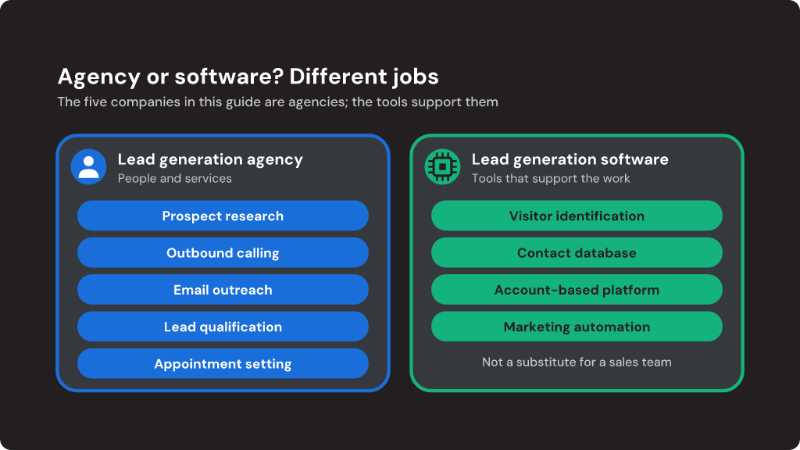
Lead generation software serves a different role. A visitor-identification platform can reveal organizations visiting a website. A contact database can help a sales team find business contacts. An account-based platform can help prioritize target accounts, while marketing automation software can manage email journeys and lead nurturing. These tools can support an agency or an in-house team, but they are not substitutes for an outsourced sales team.
This distinction matters when comparing providers. The five companies below are service providers. Software products that can complement an agency-led program are discussed separately later in this guide.
How We Selected These CRM Lead Generation Agencies
This is a non-ranked shortlist, not a claim that one provider is best for every CRM company. The selection focuses on firms that offer B2B lead generation, appointment setting, or outsourced sales development. We also considered publicly available evidence of work with CRM, SaaS, software, or technology businesses and the availability of independent client-review profiles.
Callbox publishes this guide and is included as one of the providers evaluated. Its profile is presented alongside the other agencies using the same broad criteria.
Official service pages explain what a provider says it offers. Vendor-published case studies describe examples selected by the provider and should be read as company-reported results. Independent review platforms such as Clutch and G2 provide a separate source of client feedback, although individual experiences and review listings can change. Readers should inspect recent reviews and confirm project scope directly with each agency.
The providers are listed alphabetically. This is an editorial ordering, not a score or ranking.
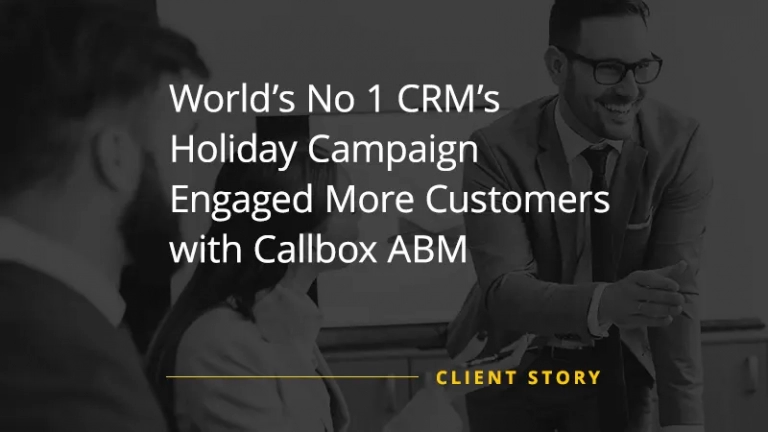
World’s No 1 CRM’s Holiday Campaign Engaged More Customers with Callbox ABM
Callbox ran the campaign, which produced a total of 108 Sales Qualified Leads, 164 Marketing Qualified Leads, and 793 Potential Leads.
View Case Study5 Lead Generation Agencies for CRM Providers
Callbox
Callbox provides managed B2B lead generation and sales support, including prospect research, coordinated outreach, lead qualification, and appointment setting. Its published materials describe a multichannel approach that can include phone, email, LinkedIn, and other campaign touchpoints. The exact channel mix depends on the agreed campaign.
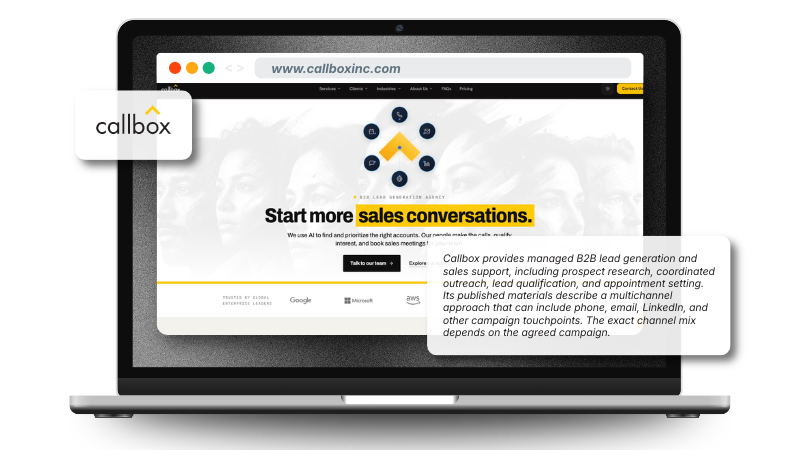
Callbox has a dedicated CRM lead generation service page describing outreach to sales, IT, and operations decision-makers, with messaging tailored to CRM product value propositions.
Its published CRM example concerns a global CRM provider’s APAC holiday campaign. The public summary describes a five-seat lead tele-nurturing program designed to keep existing customer contacts engaged through research reports and other collateral while also generating new leads. The target markets were Singapore, Indonesia, and Thailand. Callbox reports 108 sales appointments, 164 marketing-qualified leads (MQLs), and 793 potential leads. The full campaign breakdown is gated, and the client is not named in the public summary.
Read Callbox’s CRM holiday campaign case study for the company’s description and reported outcomes.
For independent client feedback, review Callbox on Clutch.
Best fit: CRM providers seeking full-service, multichannel lead generation, appointment setting, and support for campaigns across multiple markets.
Consideration: The CRM case study is vendor-published and does not identify the client; its results should be understood in the context of a nurture-led campaign that also generated new leads. Ask for relevant references, sample lead-handoff reports, and clear definitions of MQLs, sales-qualified leads (SQLs), and qualified meetings.
memoryBlue
memoryBlue provides outsourced sales development services for B2B technology companies. Its SDR model assigns dedicated representatives to a client account and supports prospect research, phone and email outreach, LinkedIn engagement, qualification, and meeting booking. The company says its teams can work in a client’s existing technology stack, including Salesforce and HubSpot.
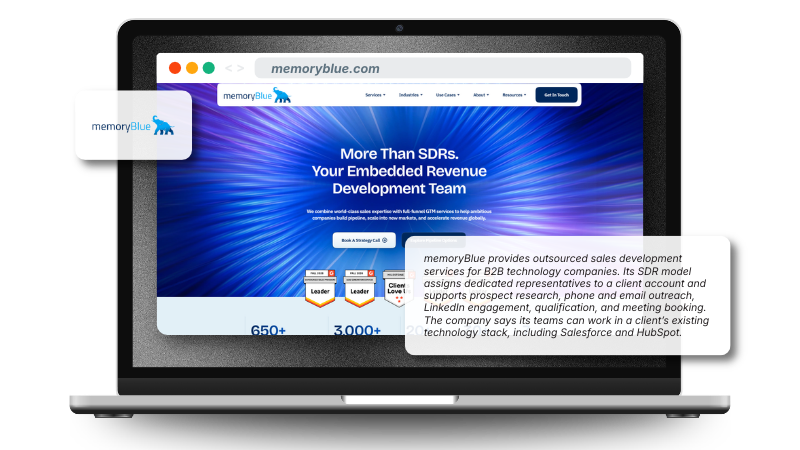
Explore memoryBlue’s outsourced SDR services for details about its team structure, outreach process, qualification, and reporting.
Its current materials describe support for technology markets such as SaaS, cybersecurity, AI, cloud, and fintech. memoryBlue acquired Operatix in 2023; current company materials say Operatix now operates under the memoryBlue brand.
Best fit: B2B CRM and technology vendors that need dedicated SDR capacity, structured outbound execution, and potential coverage across North America, EMEA, and APAC.
Consideration: A dedicated SDR model requires close alignment on messaging, account selection, qualification, and management. Confirm who supervises the team and how success is measured beyond activity volume.
EBQ
EBQ is an Austin, Texas outsourced sales and marketing company that pairs B2B appointment setting and lead generation with CRM consulting. Its Clutch profile lists Salesforce and HubSpot consulting and implementation alongside sales outsourcing.
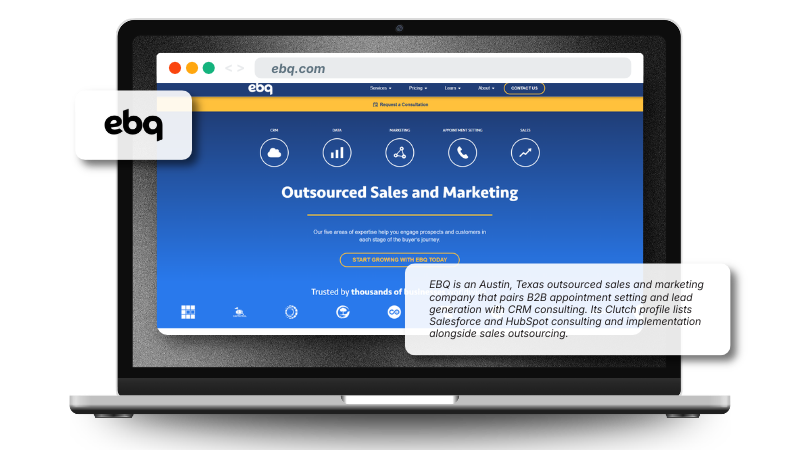
A notable point of differentiation is that EBQ often works inside the client’s own CRM. One verified Clutch review describes its team tracking activity in Salesforce for K12 Insight, an education software company, while calling and emailing 1,250 target contacts and booking seven meetings. A review from Ocra, a parking-software company, describes EBQ calling hotel general managers, booking meetings, and updating lead records in HubSpot. The Ocra reviewer also noted that four different reps were assigned over six months and said more feedback on messaging performance would have helped.
Best fit: CRM and SaaS vendors that want phone-first outreach run inside their own Salesforce or HubSpot instance, with optional CRM consulting.
Leadium
Leadium is a Las Vegas-based outsourced sales development agency that runs outbound appointment setting, lead research, and multichannel outreach for B2B companies. Its Clutch profile describes a founder-led model, senior US-based SDRs, month-to-month engagements, and CRM logging to Salesforce or HubSpot. The exact scope depends on the agreed program.
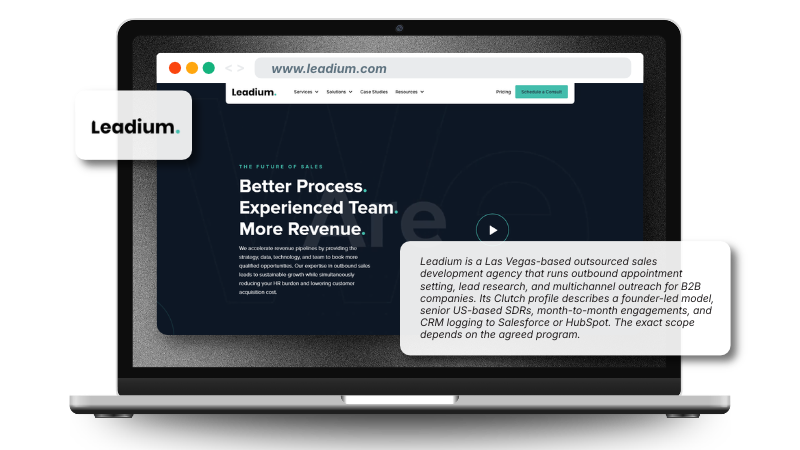
Best fit: CRM and technology vendors that want a founder-led, US-based SDR team on flexible month-to-month terms.
SalesAR
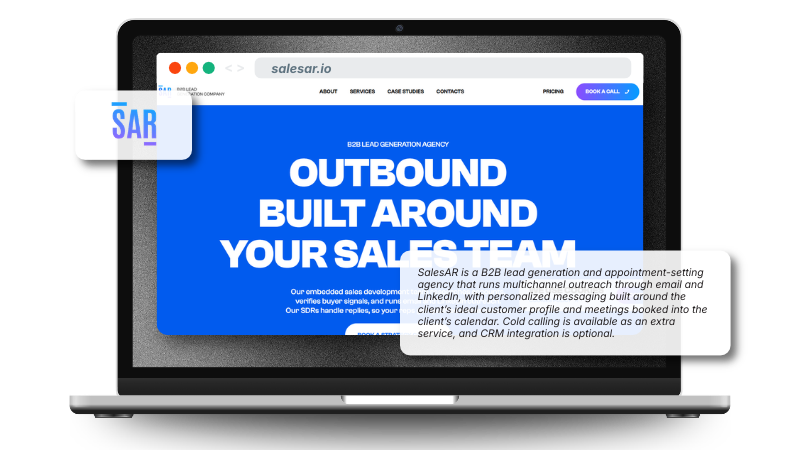
SalesAR is a B2B lead generation and appointment-setting agency that runs multichannel outreach through email and LinkedIn, with personalized messaging built around the client’s ideal customer profile and meetings booked into the client’s calendar. Cold calling is available as an extra service, and CRM integration is optional.
Best fit: CRM and B2B software providers whose buyers respond to email and LinkedIn outreach and that want a research-led, digital-first program.
Comparing the Five CRM Lead Generation Agencies
The table summarizes differences in service model and likely fit. It is intended as a starting point for evaluation, not a performance ranking.
Agency | Core service model | Potential best fit | Service-model distinction |
Callbox | Managed multichannel lead generation and appointment setting | CRM providers targeting multiple markets and buyer groups | Managed multichannel campaign programs |
memoryBlue | Dedicated outsourced SDR teams | Technology vendors needing additional SDR capacity and regional reach | Dedicated SDRs with day-to-day management |
EBQ | Appointment setting with CRM consulting | CRM/SaaS vendors that want outreach run inside their own Salesforce or HubSpot | Phone-first outreach inside the client’s CRM, with Salesforce and HubSpot consulting |
Leadium | Founder-led outsourced SDR teams | Technology vendors that want US-based SDRs on flexible terms | Senior US-based SDRs on month-to-month engagements |
SalesAR | Email and LinkedIn-led lead generation and appointment setting | Software vendors whose buyers respond to digital outreach | Research-led email and LinkedIn campaigns, with optional calling |
Tools That Complement an Agency-Led Lead Generation Program
A CRM provider may use software alongside an agency to improve targeting, identify buying signals, or manage follow-up. These products are not lead generation agencies; they are tools that can support an internal team or an outsourced campaign.
Leadfeeder — Website Visitor Identification
Leadfeeder is B2B website visitor-identification software that helps reveal which organizations visit a website and which pages they view. Its account-level insights and CRM syncing can help an agency or internal team prioritize inbound interest, but it does not replace prospect qualification or sales conversations. See its visitor-identification features.
UpLead — B2B Contact Data
UpLead is a B2B contact-data and sales-intelligence platform for building prospect lists using company, role, industry, location, and technology filters. Its product pages describe real-time email verification, data enrichment, and CRM integrations; it supplies data for prospecting rather than outsourced appointment setting. Explore UpLead’s features.
Demandbase — Account-Based GTM Software
Demandbase positions Demandbase One as an account-based go-to-market platform for sales and marketing teams. Its capabilities support account data, scoring, prioritization, advertising, engagement, orchestration, and measurement; it is software for coordinating account-based programs, not an agency that independently runs every prospecting activity. Review Demandbase’s platform overview.
Act-On — Marketing Automation
Act-On is a marketing-automation platform for managing email campaigns, landing pages, lead scoring, and marketing workflows. It can support nurture and follow-up alongside an agency-led program; confirm current CRM integrations and plan availability directly with the vendor. See Act-On’s current pricing and feature information.
Cognism — Sales Intelligence and B2B Data
Cognism is a B2B sales-intelligence and contact-data platform that supports company and contact research, firmographic and technographic filters, and contextual or intent signals. Its CRM enrichment and integrations can support prospecting workflows, but Cognism is a data provider rather than an outsourced lead generation agency. Review Cognism’s product and CRM integration information.
Related: 4 Must-Have CRM Tools for Sales Success
How to Choose a CRM Lead Generation Agency
The right agency should understand the CRM product, the people who influence its purchase, and the sales process required to move an account from first contact to a qualified opportunity. Before signing an agreement, evaluate the following areas:
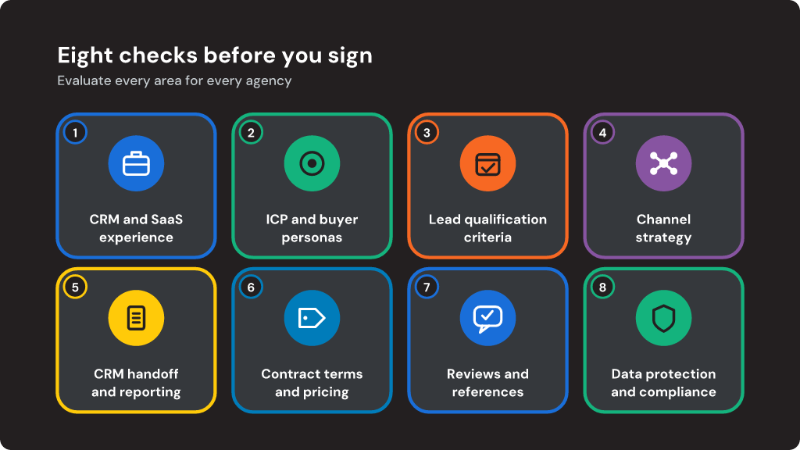
- CRM and SaaS experience. Ask for examples involving software vendors with similar buyers, deal sizes, sales cycles, and implementation complexity. Experience selling a different type of technology is useful context, but it is not the same as direct CRM experience.
- Ideal customer profile and buyer personas. Confirm how the agency will define target company size, industry, geography, installed technology, business needs, and decision-making roles. Ask how it will reach multiple stakeholders within an account.
- Lead qualification criteria. Agree on what counts as a lead, MQL, SQL, qualified meeting, and sales opportunity. Put required fields and disqualifying conditions in writing so both teams measure the same outcome.
- Channel strategy. Ask why the proposed mix of phone, email, LinkedIn, events, or account-based outreach fits the audience. A channel should be selected because it reaches the buyer effectively, not simply because the agency offers it.
- CRM handoff and reporting. Confirm whether the agency will work inside your CRM, use its own platform, or synchronize records. Define ownership, required fields, activity notes, meeting outcomes, reporting frequency, and data-transfer procedures.
- Contract terms and pricing model. Clarify setup fees, retainer structure, dedicated-team costs, minimum term, cancellation terms, and what happens if the target market or messaging needs to change. Compare the total program scope rather than price per lead alone.
- Independent reviews and references. Read recent reviews in context. Look for detailed descriptions of the client’s industry, project scope, communication, and outcomes. Ask the agency for references that resemble your business.
- Data protection and compliance. Confirm how prospect data is sourced, stored, processed, and deleted, and which party is responsible for compliance with applicable privacy and marketing rules in each target market.
Check out how to generate CRM leads.
How Much Do CRM Lead Generation Agencies Cost?
There is no single standard price for outsourced CRM lead generation. Costs depend on the number of target markets, the size and seniority of the sales team, the amount of research required, the outreach channels, the level of campaign management, and the length of the engagement.
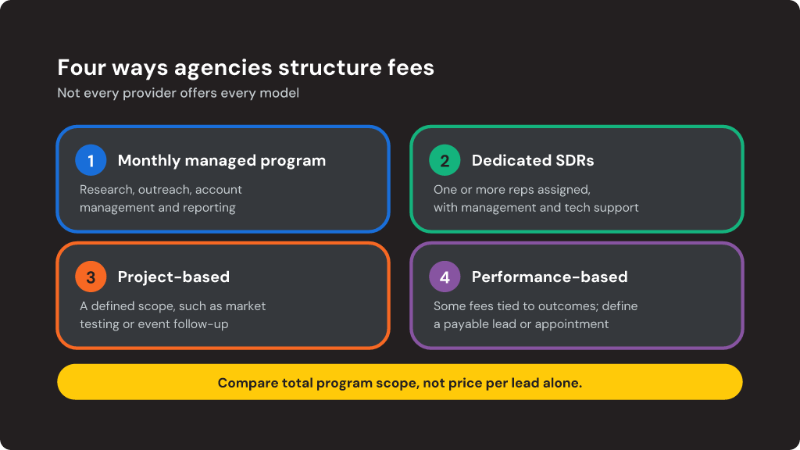
Agency proposals may use different commercial structures, and not every provider offers every model:
- Monthly managed-program fees may cover research, outreach, account management, and reporting.
- Dedicated SDR arrangements assign one or more representatives to the client’s program with defined management and technology support.
- Project-based engagements cover a defined scope, such as market testing, account research, event follow-up, or a limited outreach initiative.
- Performance-based or appointment-based arrangements tie some fees to agreed outcomes. Review these carefully so the definition of a payable lead or appointment is explicit.
Ask each agency for a written scope that explains what is included, what is billed separately, how meetings are qualified, and how performance is reviewed. Avoid relying on generic online price ranges: they may describe different staffing models, geographies, service levels, and contract terms. Directory project-size figures and third-party pricing estimates are not guaranteed quotes.
Final Takeaway
The right lead generation partner for a CRM provider depends on its product, target market, sales capacity, and preferred outreach model. Belkins combines appointment setting with HubSpot consulting; Callbox offers managed multichannel programs and dedicated CRM positioning; Martal Group brings B2B technology and enterprise software experience, including a verified review from a real-estate CRM client; memoryBlue offers dedicated outsourced SDR teams; and SalesRoads is a phone-led option with reviewed software-client engagements.
Use this list as a starting point, not a substitute for due diligence. Compare each agency’s recent client work, qualification process, CRM handoff, reporting, and contract terms. A clear agreement on what counts as a qualified opportunity will make it easier to assess whether an outsourced program is contributing to the CRM provider’s pipeline.
If your team is looking for support with CRM lead generation, speak with Callbox about your target market, buyer personas, and campaign objectives.
Frequently Asked Questions
What is the difference between a lead generation agency and a lead database?
A lead database provides contact or company information that a sales team can use for prospecting. A lead generation agency provides people and services to plan and execute activities such as outreach, qualification, and appointment setting. Some campaigns use both.
How long does it take to see results?
Timelines depend on the complexity of the target market, data quality, messaging, channel mix, and sales cycle. Early indicators such as contact rates and positive replies may appear before qualified pipeline or closed revenue. Agree on milestone metrics with the agency and avoid treating early activity as proof of revenue impact.
Can an agency work directly inside our CRM?
Some agencies can work within a client’s CRM or synchronize campaign activity with it, while others use their own systems. Confirm the supported platform, access permissions, data ownership, required fields, reporting, and security arrangements before the campaign begins.
How should CRM vendors measure lead generation success?
Measure more than the number of contacts or meetings booked. Useful metrics can include target-account coverage, contact and conversation rates, qualified meetings held, sales acceptance, opportunities created, pipeline value, conversion by channel, and eventual revenue. Agree on definitions and attribution rules before launch.