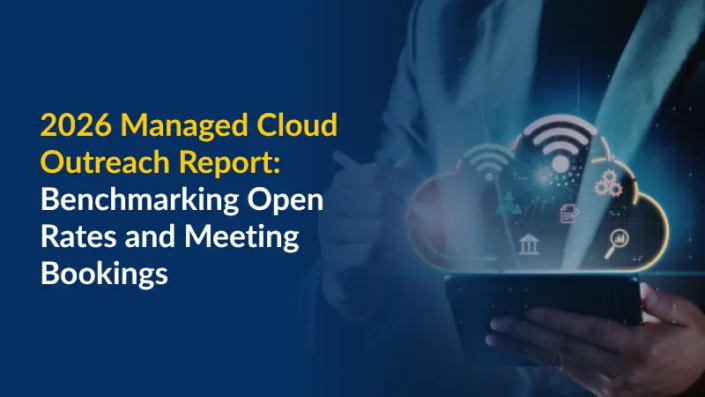






As we move through 2026, the managed cloud email outreach landscape has decoupled from the volume-heavy tactics of the early 2020s. The core challenge for cloud providers today isn’t getting into the inbox—it’s staying there.
With the 2026 enforcement of ultra-strict sender reputation protocols by Google and Microsoft, the “Managed Cloud” vertical has seen a consolidation of strategy. Success is no longer measured by how many thousands of emails you send, but by the Managed Cloud outreach benchmark of “Relevance Density.”
Are your outreach campaigns hitting a wall? In the hyper-competitive world of B2B IT sales, the latest 2026 managed cloud outreach report indicates a massive shift in how you should measure success. Many firms are currently optimized for the wrong side of the inbox, fixating on vanity metrics while their pipeline stagnates. If you want to scale your B2B revenue, it is time to pivot from volume-based blasting to a precision-led, signal-based approach.
Definition: What is Managed Cloud Outreach?
Managed cloud outreach is a targeted communication strategy used by IT service providers to engage prospects through personalized, multi-channel sequences. It leverages technical deliverability and signal-based intelligence to convert cold leads into qualified discovery meetings.
Are you still struggling to secure meetings with managed cloud buyers?
The New Reality: Shifting from Vanity to Value
The current cloud outreach benchmark for open rates ranges between 26% and 28.5% for standard promotional sequences. However, elite performers now prioritize a meeting booking rate of 1.2% to 2.5% over open rates. By leveraging intent-based triggers rather than high-volume blasts, top-tier cloud providers are achieving significantly higher conversion rates, proving that quality and timing far outweigh sheer frequency.
Managed Cloud Outreach Benchmarks (2026 Data)
The following data represents the current performance thresholds for the technology and cloud infrastructure sectors, based on aggregated 2025–2026 campaign data.
Core Metric Breakdown
| Metric | Industry Average (Cloud/SaaS) | Elite Performance (Top 10%) | 2024 Baseline (Comparison) |
| Email Open Rate | 27.7% | 45.2% | 36.1% |
| Reply Rate | 3.43% | 12.1% | 5.1% |
| Click-through Rate (CTR) | 2.1% | 6.5% | 3.2% |
| Meeting Booked Rate | 0.4% | 1.8% | 0.8% |
| Spam Complaint Rate | < 0.08% | < 0.02% | < 0.1% |
The “Open Rate” Paradox
The email open rate for cloud services has seen a technical decline from ~36% in 2024 to 27.7% in 2026. This is not necessarily a sign of failing content, but a result of two major factors:
- AI Filtering: Modern corporate inboxes use AI “gatekeepers” that pre-screen and often suppress tracking pixels.
- Bot Scrubbing: Security filters in the managed cloud space (like Proofpoint or Mimecast) now “consume” opens before the recipient ever sees the email, making raw open data less reliable than ever.
Advanced Managed Cloud Email Outreach Strategies
To exceed the managed cloud outreach benchmark, providers are moving toward “Intent-Led Sequences.”
Signal-Based Prospecting
In 2026, high-performing outreach is triggered by specific “Cloud Signals” rather than static list building.
- Infrastructure Spikes: Identifying companies with sudden increases in cloud egress or storage needs.
- Compliance Deadlines: Outreach timed specifically to regional regulatory shifts (e.g., EU-US Data Privacy Framework updates).
- Technographic Shifts: Targeting firms that have recently moved away from a competitor or integrated a specific stack (e.g., Snowflake, Kubernetes).
Content Length and Sentiment
Data shows that the “sweet spot” for managed cloud email outreach has compressed.
- Word Count: Emails between 50–125 words achieve a 50% higher reply rate than those over 200 words.
- The “Question” Factor: 69% of IT decision-makers are more likely to open an email if the subject line includes a specific, non-alarmist question (e.g., “Optimizing [Company]’s AWS Egress?”).
Having hard time in reaching your target managed cloud buyer?
Deliverability & The 2026 “Green Zone”
Maintaining a high email open rate requires a relentless focus on technical infrastructure. In 2026, if your technical records are missing, your delivery rate drops by an average of 80%.
The Technical Holy Trinity
- DMARC (p=reject): By 2026, “p=none” is no longer sufficient for enterprise delivery. Inboxes treat anything less than “reject” as a potential spoofing risk.
- BIMI Adoption: High-growth managed cloud providers are using BIMI (Brand Indicators for Message Identification) to display their logo in the inbox, which has shown to boost opens by 12–15% by increasing trust.
- MTA-STS: Encrypted transmission is now a baseline expectation for technical audiences.
Reputation Management
The managed cloud email outreach sector is prone to higher-than-average spam reporting because the “pitch” is often perceived as high-noise.
The 0.3% Rule: Crossing the 0.3% spam complaint threshold in 2026 results in immediate “Grey-listing” across Microsoft 365 domains, the primary workspace for cloud buyers.
Comparative Email Marketing Benchmarks
How does managed cloud compare to other high-stakes B2B verticals? Understanding email marketing benchmarks globally helps contextualize your performance.
Comparison by Vertical (2026 Data)
| Industry | Open Rate | Reply Rate | CTR |
| Managed Cloud/MSP | 27.7% | 3.43% | 2.1% |
| Cybersecurity | 22.1% | 2.05% | 1.8% |
| FinTech | 31.4% | 4.12% | 2.9% |
| Professional Services | 38.2% | 6.20% | 4.5% |
Managed cloud typically sees lower open rates than general professional services because the target audience (CTOs, VPs of Engineering) are the most “guarded” demographic in the B2B world.
Establishing an Effective Outreach Cadence
In the cloud sector, patience and persistence are your greatest assets. Data shows that booking a first meeting requires an average of 8 touchpoints, with top performers often hitting that mark in 5. However, rushing your sequence is a recipe for being flagged as spam.
For managed cloud prospects, a structured, multi-channel sales cadence over 21 days is the industry gold standard:
- Days 1–3 (Initial Awareness): Send a cold email (introduction, no pitch) and view their LinkedIn profile.
- Days 4–7 (Value Add): Send a follow-up email with a relevant case study or technical framework. Send a connection request on LinkedIn with a non-sales note.
- Days 8–14 (Multi-Channel Engagement): If connected, send a short LinkedIn message. Follow up with a phone call to cut through the digital noise.
- Days 15–21 (Social Proof & Closing): Share a success story from a similar company. If no response, execute a “breakup email” to signal that you are moving on.
Expert Tip: Front-load your first week with 40-50% of your total touchpoints. Space out subsequent actions progressively to match the prospect’s likely pace of decision-making.
The Role of AI in 2026 Outreach
AI has moved from “copywriting assistant” to “orchestration engine.”
- Predictive Send-Times: 2026 tools now analyze when specific prospects (e.g., a DevOps Lead in London) typically clear their inbox, ensuring the message sits at the top of the pile.
- Dynamic Value Propositions: AI can now pull a company’s public cloud spend data or recent outages to customize the “Why Now” section of an email in real-time.
- Summarization Protection: Since many executives now use AI to summarize their inboxes, outreach must be “Summary-Friendly”—clearly stating the Ask and the Value in the first two sentences.
Related: 10 Managed Cloud Trends for 2026
Best Practices for Improving Your Managed Cloud Benchmarks
If your managed cloud email outreach is underperforming, follow this 2026 optimization roadmap:
- Zero-Party Data Integration: Stop buying lists. Use webinars, whitepapers, and cloud-cost calculators to gather direct intent data.
- The “Low Friction” CTA: Instead of “Book a 30-minute demo,” use “Should I send over our 2-page cloud security checklist?” Low-friction CTAs see a 3x higher reply rate.
- Mobile-First Design: Over 80% of business professionals now read their first-pass emails on mobile. Ensure your formatting is minimalist and your “Preview Text” is optimized.
- Omnichannel Synergy: Outreach that combines email with a LinkedIn touchpoint and a targeted ad-impression sees a 287% lift in conversion compared to email-only campaigns.
The Signal-to-Meeting Gap
Data from industry leaders confirms that the Signal-to-Meeting gap is widening. While general email engagement might appear to be rising, IT executives are becoming increasingly adept at filtering out noise.
For 2026, you must stop treating open rates as a primary measure of human interest. Automated mail privacy protection filters often trigger false opens, inflating your data (Salesforce State of Marketing 2026). Instead, treat these metrics as an indicator of technical deliverability. If your open rate is below 26%, it is likely a sign of poor list hygiene or inadequate domain authentication rather than a poor subject line.
Industry Insight: Braze research indicates that using a "Person at Company" sender format increases unique opens by 14% compared to generic corporate names. Your goal is to bypass the mental filters busy IT decision-makers use to ignore bulk marketing.
Mastering the Signal-to-Meeting Framework
To transition from mere open rates to actual booked meetings, you must adopt Signal-Based Prospecting. This model triggers outreach based on verifiable business events such as leadership changes, funding rounds, or surges in cloud egress rather than arbitrary calendar schedules.
According to industry reports, signal-based outreach produces a 73% increase in click-to-open rates (Emarsys Benchmark Trends 2026). When your outreach arrives exactly when a prospect is facing a specific infrastructure challenge, your message transforms from a solicitation into a solution.
How to Optimize Your CTA for Higher Conversion
- Avoid High-Friction Requests: Asking for a 30-minute discovery call in the first email is often too aggressive.
- Offer Low-Friction Value: Ask for permission to send a relevant resource, a one-page technical report, or a case study.
- Keep it Brief: Use “micro-emails” under 80 words. Busy cloud architects are more likely to reply to a concise question from their mobile devices (HubSpot State of Marketing 2026).
Are you struggling to hit your booking targets despite high open rates? Connect with our specialists at Callboxto audit your strategy and unlock your pipeline’s true potential.
Strategic Multi-Channel Integration
Multi-channel integration significantly boosts cloud outreach benchmarks by creating a cohesive brand presence across the prospect’s digital ecosystem. Sequences that combine LinkedIn and email see a 2x higher response rate than email-only campaigns. This happens because “social proximity,” the trust built through shared connections or professional engagement, warms the prospect before you ever send a direct pitch.
Many top providers looking at top cloud software companies are now moving toward specialized managed cloud lead generation services to ensure this multi-channel approach is executed at scale.
Expert Tip: Start your sequence with a "soft" LinkedIn interaction, such as commenting on a recent post, before sending an email. This reduces the coldness of your outreach and protects your domain reputation.
Conclusion: The Path to Elite Performance
In 2026, the elite benchmark for managed cloud outreach is a 99% delivery rate and a 2.5% meeting booking rate. Achieving this requires a balanced diet of technical discipline and humanized, signal-based messaging.
If you are ready to modernize your appointment setting and lead generation efforts, it starts with shifting your focus from volume to relevance. Success in the cloud sector is no longer about who shouts the loudest; it is about who provides the most value at the exact moment the prospect needs it.