The State of HR Software Adoption in the US
Curious about what’s next in HR tech? Explore the 2025 HR software trends in the US that smart companies are already acting on.

HR Tech at Inflection Point
HR departments across the US are under pressure. Teams are understaffed, compliance demands are rising, and employee expectations have never been higher. At the same time, the HR software landscape is undergoing rapid transformation.
What was once a support function is now at the heart of strategic business growth. Human resource software is evolving into a core business enabler, streamlining operations, enhancing data-driven decision-making, and improving employee experiences.
From AI-powered automation to integrated payroll and finance systems, companies are rethinking what their HR software should do—and how it should scale. But with hundreds of tools and features available, navigating this space in 2025 is anything but simple.
In this blog, we break down the key HR software trends shaping adoption in the US, supported by fresh market data and usage statistics. Whether you’re building software or marketing it, these insights will help you align with what modern HR teams truly need.
Is your HR software declining its sales pipeline?
HR Software Adoption in the US: Trends to Watch in 2025
- AI and Automation
- Employee Experience (EX)
- Predictive Insights
- Cloud-First HR Systems
- Seamless System Integration
- Convergence of HR and Finance Functions
- Embedded Payroll Solutions
- Modular Software in the Mid-Market
1. AI and Automation
Automation is transforming HR operations—from recruitment to payroll. 57% of HR teams report being understaffed, making automation essential. HR automation has already reduced onboarding time by up to 80%, freeing teams to focus on high-impact tasks, such as engagement and retention.
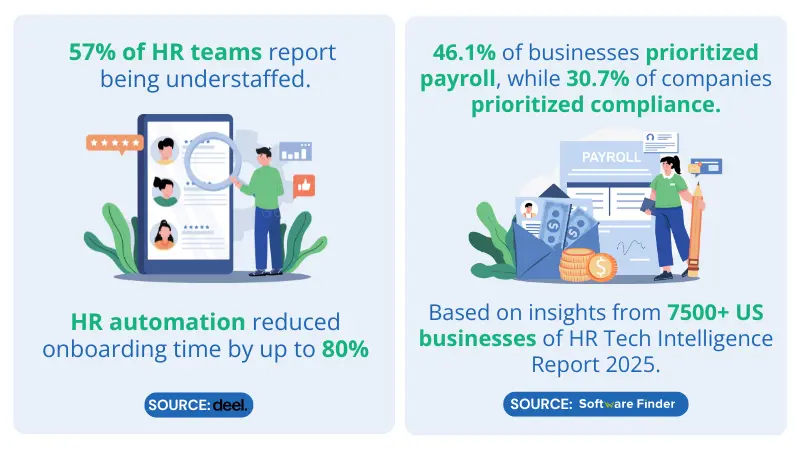
Payroll automation is the top demand among HR buyers in the US, cited by 46.1% of respondents. Compliance comes in second at 30.7%, highlighting the drive to eliminate manual errors and ensure legal accuracy.
For solution providers and marketers, this signals a clear message: Position automation as a lever for both compliance and scale. See how to implement AI for a lead generation campaign.
2. Employee Experience
Today’s employees expect intuitive, responsive HR platforms. Yet the investment in employee experience (EX) tools varies dramatically across industries.
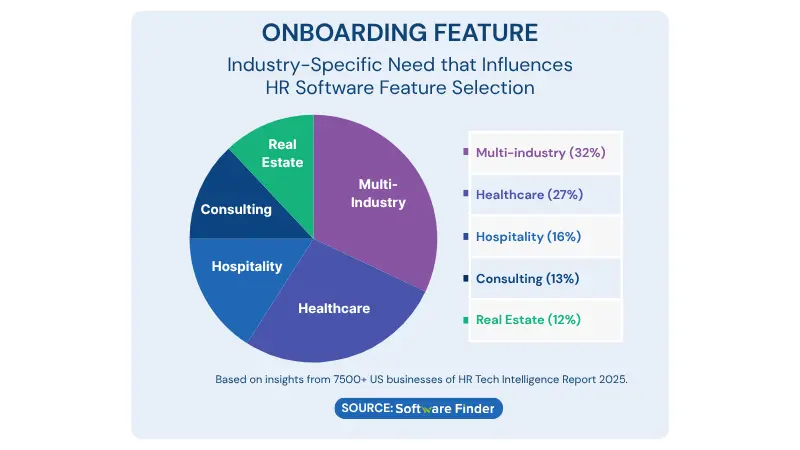
While only 4.2% of companies cite onboarding as their top feature, demand for onboarding rises to 32% in the multi-industry sector, 27% in healthcare, 16% in hospitality, 13% in consulting, and 12% in real estate. This contrast highlights how EX-related priorities vary based on sector-specific challenges—and why flexible solutions are gaining momentum.
This disparity highlights a market shift in which tailored experiences, specific to each vertical, are more important than generalized features. To resonate with buyers, marketers must tie product value to outcomes such as faster ramp-up, stronger retention, and DEI engagement—all core to HR software trends in 2025.
Ready to generate more quality HR Software leads?
3. Data-Driven HR: From Reporting to Predictive Insights
Another defining trend is the evolution from basic reporting to predictive analytics. Businesses are no longer content with seeing what happened—they want to forecast turnover, evaluate DEI metrics, and optimize workforce costs in real-time.
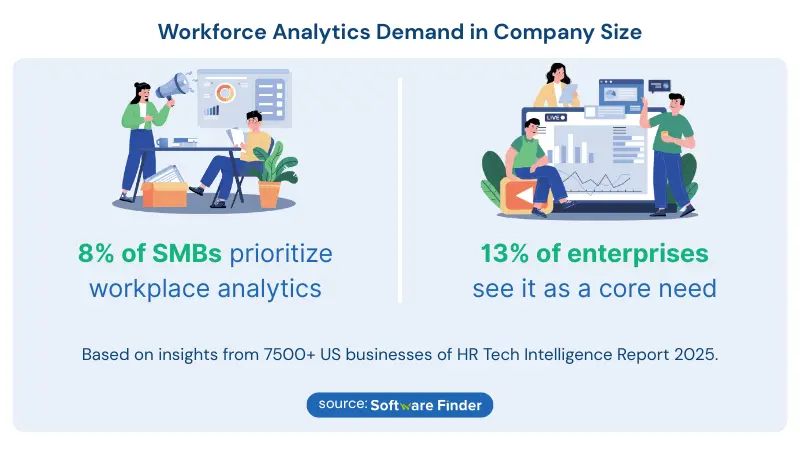
Among SMBs, workforce analytics ranked 8% in feature demand; for enterprises, it jumps to 13%. This reflects growing appetite for solutions that can translate HR data into strategic actions, especially at scale.
This signals a growing demand for HR software with embedded analytics, especially in larger firms that balance multiple systems. Tools that integrate HR and financial forecasting, such as compensation analysis, are leading the next wave of innovation in the HR software market.
Discover how Callbox lead generation campaigns boosted the SaaS HR firm’s sales pipeline by 2.5 times.
4. The Move to Cloud-First HR Systems
Cloud-based HR systems have become the de facto standard, particularly since the pandemic. Flexibility, security, and remote accessibility have made cloud platforms indispensable.
What’s changing in 2025 isn’t the adoption of cloud, but the expectation of interoperability across systems. As more companies adopt cloud-first solutions, integration challenges become deal-breakers, not afterthoughts.
5. Seamless System Integration
With more tools in play, integration is one of the most significant sticking points in HR tech adoption in the US. This is particularly true in mid-sized and enterprise businesses. Companies are prioritizing plug-and-play interoperability during the evaluation stage between HRIS, payroll, performance tools, and even CRM systems.
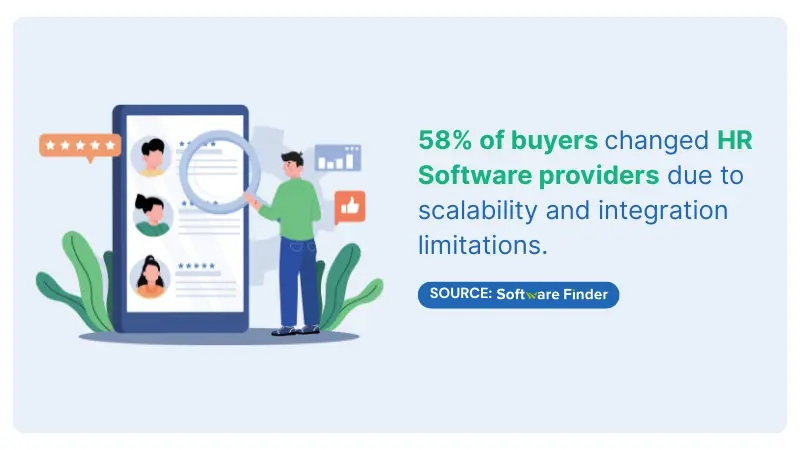
In 2024, 58% of HR software buyers cited switching vendors due to scalability and integration limitations. Without powerful integration frameworks, even the best UI or automation engine risks becoming siloed. If your platform can’t integrate easily and is unable to support business growth, it’s off the shortlist—no matter how robust the features are.
6. The Convergence of HR and Finance Functions
A rising trend among enterprise buyers is the convergence of workforce planning with financial forecasting. This is reshaping HR software into strategic infrastructure—not just administrative systems. Companies are increasingly using unified platforms for workforce planning, budgeting, and compensation forecasting.
OutSail’s 2025 HR trend report notes that buyers want shared dashboards and tighter integration between people data and financial KPIs.
For vendors, this means your HR software solutions need to convey both HR and finance—and for marketers, it means building personas and campaigns for CHROs and CFOs alike.
7. The Rise of Embedded Payroll Solutions
Embedded payroll, where payroll functionality is integrated into broader systems such as time tracking or HRIS, is gaining traction. It reduces data handoffs, limits compliance risk, and streamlines employee self-service.
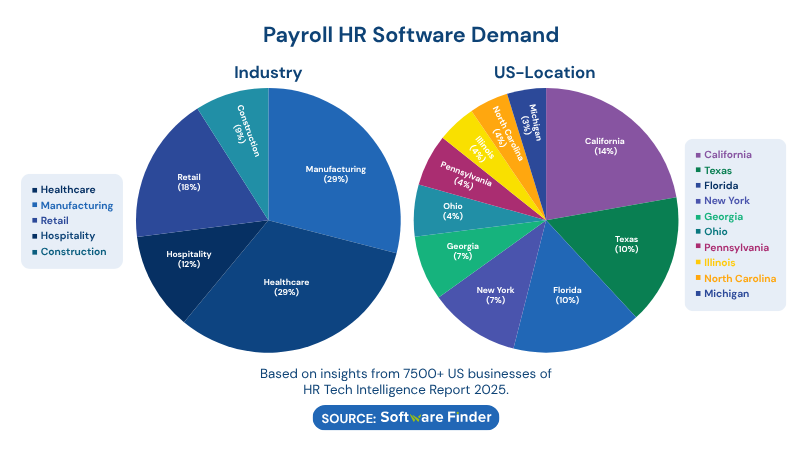
It’s especially critical in compliance-heavy sectors like:
- Healthcare (32%)
- Manufacturing (29%)
- Retail (18%)
State-wise, California (14%), Texas (10%), and Florida (10%) top payroll feature demand. B2B marketers targeting these states should prioritize messages centered on accuracy, compliance, and error-free processing, especially since 10.8% of companies cite payroll errors as a top reason for churn.
Related: Top Lead Generation Companies in California
8. Modular Software in the Mid-Market
Another emerging trend is the decoupling of services and software. In particular, mid-market companies are shifting away from bundled HR suites toward modular platforms.
Why? Flexibility. Buyers want to plug in only what they need—be it onboarding, compliance, or analytics—without paying for unnecessary features.
This reflects a more mature HR software market, where customization, API access, and transparent pricing matter more than brand recognition alone.
HR Software Adoption by the Numbers
Based on insights from 7,500+ U.S. businesses, these statistics reveal what’s driving HR software adoption—why companies switch vendors, what features matter most, and how priorities differ across industries.
HR Software Adoption by Size
- Small (1–50 employees): 80%
- Medium (51–200): 13%
- Enterprise (500+): 5%
- Large (201–500): 2%
Top Features by Demand
- Payroll: 46.1%
- Compliance: 30.7%
- Time Tracking: 5.3%
Top 5 States for HR Software Adoption
- California: 14%
- Texas: 11%
- Florida: 10%
- New York: 6%
- Georgia: 5%
Why Buyers Switch Vendors
- 58%: Scalability & integration gaps
- 23.5%: Pricing issues
- 10.8%: Payroll processing errors
- 5.9%: Compliance challenges
Strategic Marketing Implications for B2B Vendors
The 2025 HR buyer is more data-driven, risk-aware, and integration-conscious than ever before. For B2B software marketing teams, that means a shift in how you position and promote human resource solutions:
- Utilize segmented messaging tailored to buyer industry, size, and region.
- Adopt ABM strategies to address complex buying committees.
- Leverage statistics in sales enablement content and webinars.
- Promote interoperability and modularity—not just product breadth.
Aligning with the new buyer mindset is essential to stay relevant in a rapidly evolving HR software market.
Conclusion: Where the HR Software Market is Headed
As these HR software trends in 2025 show, the US market is moving fast—and the stakes are high. HR platforms are no longer passive tools; they are active drivers of business growth, workforce well-being, and operational resilience.
To compete, vendors and marketers must deliver not only on features but also on flexibility, integration, and long-term scalability. Because in this new HR era, it’s not about the software alone—it’s about how it fits into the bigger picture of work.