Sales Targets and Lead Generation: A 2026 Pipeline Guide
Missed B2B sales targets usually start upstream. See why pipeline quality fails, how to diagnose it, and how lead generation support closes the gap.
 RV Anthony Salvalosa

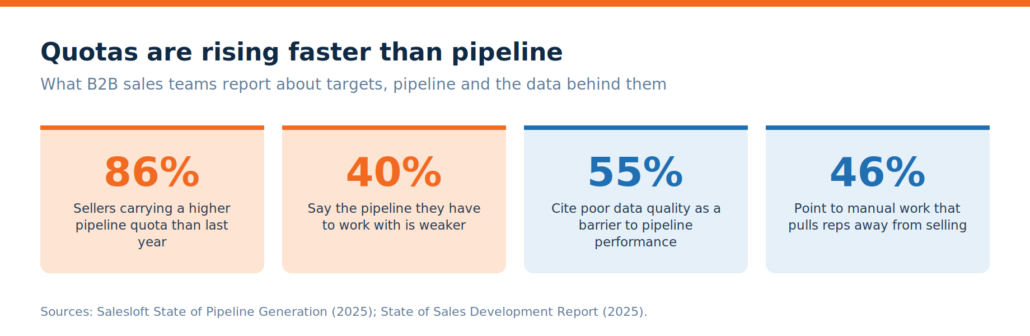
B2B sales teams across technology, SaaS, and professional services are missing their targets at historic rates. According to a 2025 Salesloft survey, 86% of sellers report pipeline quotas higher than the previous year, while nearly 40% say their current pipeline is weaker. The gap between what sales teams are expected to close and the pipeline they have to work with keeps widening. Lead generation support is no longer optional for B2B organizations that want to hit their revenue numbers.
This guide explains why sales targets slip when lead generation is absent or misaligned, identifies the root causes of weak pipeline quality, and walks through practical models for building a qualified sales pipeline that supports consistent performance. If your team has been missing quota and the usual fixes have not moved the number, the problem likely starts upstream.
Key Takeaways: Sales Targets and Lead Generation
- Missed B2B sales targets are more often a pipeline quality problem than a sales execution problem.
- Lead generation support gives sales teams a steady flow of qualified prospects who match your ideal customer profile.
- Callbox helps B2B teams build qualified pipelines through multichannel outreach and human-verified data.
- Aligning lead generation with sales goals shortens sales cycles and improves forecast accuracy across the quarter.
- Structured qualification processes filter out low-fit prospects before they consume rep time and erode confidence.
Why Do B2B Sales Teams Miss Their Targets?
Missed targets rarely start with the sales conversation. They start earlier, in the pipeline itself. When the opportunities entering the funnel are poorly qualified, every downstream metric suffers: close rates drop, sales cycles stretch, and forecasts become unreliable.
The 2025 State of Sales Development Report found that 55% of sales organizations cite poor data quality as a primary barrier to pipeline performance. Another 46% point to excessive manual work that pulls reps away from selling. These are structural issues, not effort issues.
Three conditions create the pattern of missed targets in most B2B organizations. First, lead volume that looks sufficient on paper but lacks fit and intent signals. Second, a handoff between marketing and sales that passes contacts rather than qualified opportunities. Third, reps spending their limited selling hours on accounts that were never going to close.
What Is the Connection Between Lead Generation and Sales Performance?
Lead generation is the mechanism that fills your pipeline with prospects who have a real reason to evaluate your offer. Without it, sales teams are left prospecting on their own, dividing their time between sourcing new conversations and advancing existing deals. That split erodes both activities.
When lead generation support is structured properly, it does three things for sales performance. It increases the volume of qualified conversations your team has each week. It improves the average quality of those conversations by filtering on firmographic fit, buying signals, and decision-maker access. And it creates a predictable cadence of new opportunities entering the pipeline, which stabilizes forecasting.
From over a decade’s worth of experience, Callbox has observed a consistent pattern: B2B teams that invest in dedicated pipeline generation programs outperform those that rely solely on internal prospecting. The difference is not effort. The difference is structure.
What Are the Root Causes of Weak Pipeline Quality?
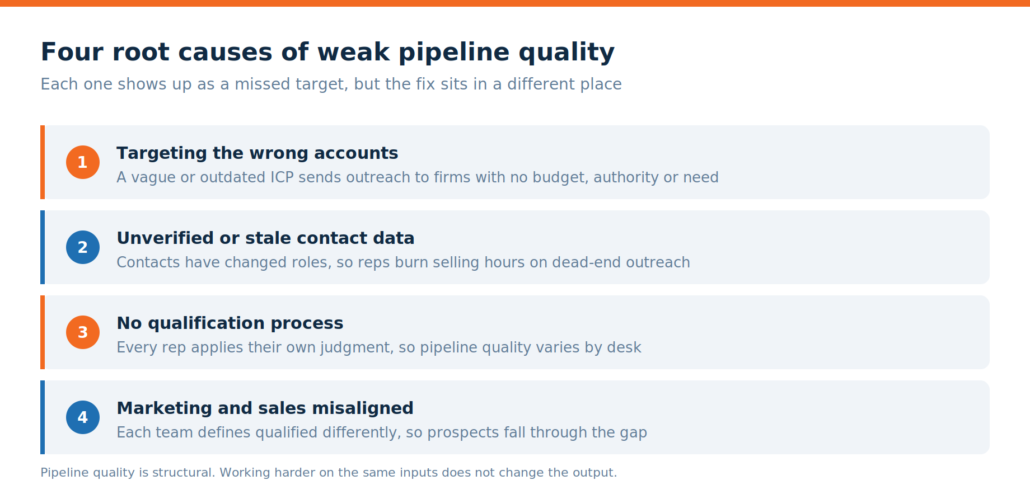
Weak pipeline quality has identifiable causes. Recognizing them is the first step toward building a system that delivers qualified opportunities consistently.
Targeting the Wrong Accounts
When the ideal customer profile is vague or outdated, outreach spreads too wide. Reps end up in conversations with companies that lack the budget, authority, or need to buy. Those conversations feel productive in the moment but stall before they reach a proposal stage.
Tighter targeting starts with firmographic data: company size, industry, revenue range, technology stack, and geographic presence. Layering intent signals on top of those criteria identifies which accounts are actively researching solutions in your category right now.
Unverified or Stale Contact Data
B2B contact data decays rapidly as professionals change roles, companies restructure, and phone numbers go inactive. Reps working from stale data waste hours on dead-end outreach, and their confidence erodes with each failed attempt. Callbox addresses this through dedicated research teams that continuously gather, verify, and enrich prospect data, ensuring campaigns target the right decision-makers with human-verified contact information.
No Systematic Lead Qualification Process
Without a consistent qualification framework, every rep applies their own judgment about which leads deserve attention. The result is inconsistent pipeline quality and unpredictable outcomes. Some deals advance too far before fit issues surface. Others get abandoned prematurely because the rep did not have enough information to assess them.
A structured lead qualification process establishes clear criteria for moving prospects from one pipeline stage to the next. It also creates a shared language between marketing and sales about what “qualified” actually means.
Misalignment Between Marketing and Sales
According to Forrester’s SiriusDecisions research, organizations with aligned sales, marketing, and product functions achieve faster revenue growth and higher profitability than those with misaligned teams. The gap typically traces back to different definitions of what constitutes a qualified lead.
Marketing may qualify on engagement metrics like content downloads and webinar attendance. Sales qualifies on buying intent, budget authority, and active need. Without shared criteria, marketing sends leads that sales considers premature, and the prospect falls through the gap.
How Does a Qualified Pipeline-Building Program Work?
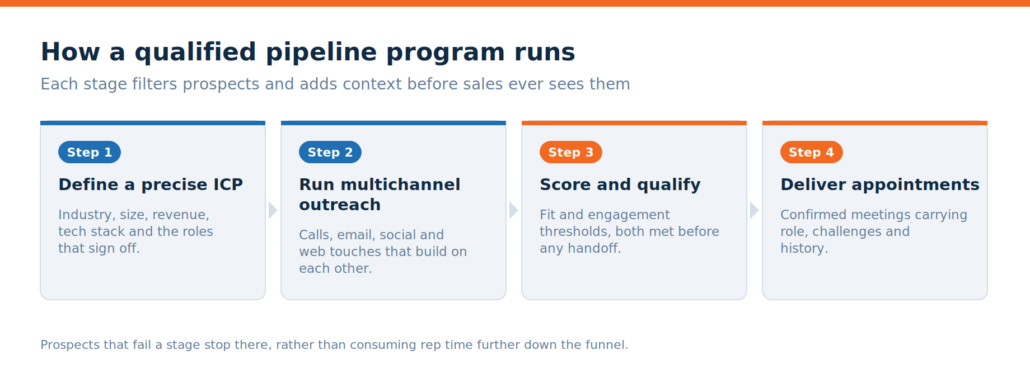
A qualified pipeline-building program moves through four stages, each designed to filter prospects and add context before they reach your sales team.
Step 1: Define a Precise Ideal Customer Profile
Start with the attributes of your best existing customers. Look at industry, company size, revenue range, technology environment, and the job functions that participate in buying decisions. Combine firmographic fit with behavioral indicators such as recent hiring patterns, published strategic initiatives, or research activity in your product category.
Callbox builds targeted prospect lists using these criteria, combining AI-driven insights with human-verified data to ensure each account meets the defined profile before any outreach begins.
Step 2: Execute Multichannel Outreach
Single-channel approaches limit your reach. Decision-makers respond to different channels at different stages of their evaluation. A multichannel outreach program combines calls, email, social media, and web-based engagement to create multiple touchpoints with each prospect.
The value of multichannel is not just coverage. It is persistence with context. Each touchpoint builds on the last, and the combined effect creates familiarity and credibility before the first sales conversation happens.
Step 3: Score and Qualify Before Handoff
Before a prospect reaches your sales team, they should be scored against both fit criteria and engagement signals. Fit scoring evaluates whether the company matches your ICP. Engagement scoring tracks actions like email responses, content interactions, and direct requests for information.
Only prospects that meet both thresholds advance to sales as qualified opportunities. This discipline protects rep time and ensures that the conversations sales has are with people who have a genuine reason to evaluate.
Step 4: Deliver Qualified Appointments to Sales
The final stage is appointment setting: booking confirmed meetings between qualified prospects and your sales team. Each appointment should arrive with full context, including the prospect’s role, company profile, stated challenges, and the engagement history that led to the meeting.
When sales teams receive appointments with this level of detail, their preparation time drops and their conversion rates improve. They enter conversations as informed partners, not cold callers.
What Role Does Data Quality Play in Pipeline Performance?
Data quality is the foundation that every other pipeline activity rests on. When contact records are inaccurate, outreach fails at the first step. When firmographic data is incomplete, targeting becomes guesswork. When intent signals are stale, timing suffers.
The practical impact is measurable. A 2026 demandDrive analysis described how many sales leaders rely on pipeline coverage ratios as a safety net, only to discover that their “3x coverage” consists largely of stalled or poorly qualified deals. The data looked healthy on the surface. The underlying quality told a different story.
Callbox’s dedicated research teams address this by maintaining continuously refreshed prospect databases. Human verification confirms that contacts are current, job titles are accurate, and direct communication channels are active. That verification step is what separates productive outreach from wasted effort.
How Can Sales Leaders Diagnose Pipeline Problems?
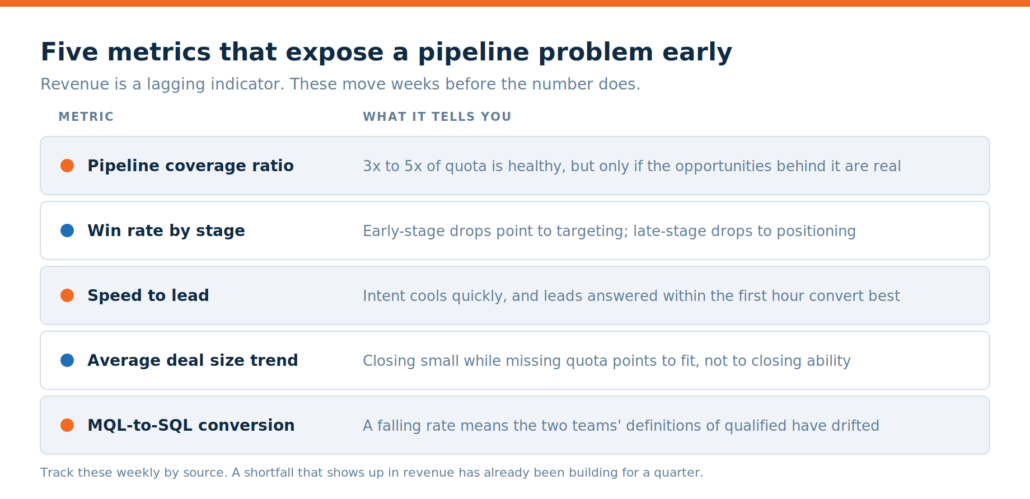
Effective diagnosis starts with the right metrics. Revenue is a lagging indicator. By the time it shows a shortfall, the pipeline problem has been compounding for weeks or months.
Leading Indicators to Track
Pipeline coverage ratio measures total pipeline value against quota. A healthy B2B pipeline typically requires 3x to 5x coverage, but only when the quality of those opportunities is high. Coverage inflated by stalled or poorly qualified deals creates a false sense of security.
Win rate by stage shows where deals are falling out. If early-stage opportunities convert well but later stages collapse, the issue is likely in value communication or competitive positioning. If conversion drops at the first stage, qualification or targeting is the more likely culprit.
Operational Metrics That Reveal Hidden Problems
Speed to lead measures how quickly new prospects receive a response. Research consistently shows that leads contacted within the first hour are significantly more likely to convert than those reached later. If your response times lag, warm intent cools before a rep ever picks up the phone.
Average deal size trends can also reveal pipeline health. If the team is closing deals but still missing quota, they may be winning small, low-fit opportunities while losing the larger ones. That pattern points to targeting or qualification issues, not closing ability.
What Is the Difference Between Lead Volume and Lead Quality?
Volume measures how many leads enter the funnel. Quality measures how many of those leads have a realistic path to becoming paying customers. The distinction matters because high volume with low quality creates more work, not more revenue.
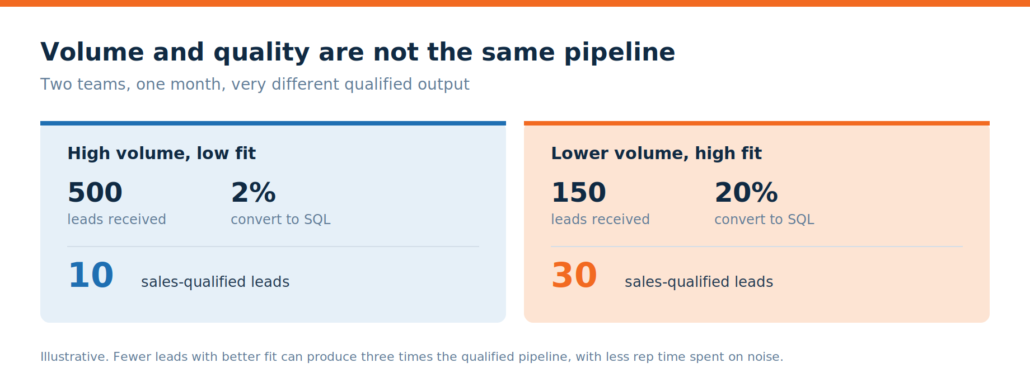
A team receiving 500 leads per month with a 2% conversion rate to SQL is underperforming compared to a team receiving 150 leads with a 20% conversion rate. The second team generates more qualified pipeline with less noise, and their reps spend time on conversations that advance.
Quality-focused lead generation support prioritizes fit, timing, and decision-maker access over raw contact volume. It treats lead generation as a precision activity rather than a numbers game. That shift changes how sales teams experience their pipeline.
How Should B2B Teams Align Sales and Marketing for Stronger Pipelines?
Alignment starts with shared definitions and shared accountability. Both teams need to agree on what qualifies a marketing-qualified lead and a sales-qualified lead before any campaign launches.
Document the criteria in a service-level agreement. Specify the firmographic attributes, engagement thresholds, and behavioral signals that must be present before a lead moves from marketing to sales. Include response time commitments so that qualified leads receive prompt follow-up.
Schedule regular pipeline review sessions where both teams examine the same data. Track MQL-to-SQL conversion rates, lead acceptance rates, and the eventual revenue contribution of marketing-sourced leads. When both teams see the same outcomes, the feedback loop tightens and quality improves over time.
What Practical Steps Can You Take to Improve Sales Target Achievement?
Improving target achievement does not require a full organizational overhaul. It requires focused changes to the systems that feed your pipeline.
Audit Your Current Pipeline Health
Review every active deal. Check pipeline coverage, stage conversion rates, average deal size, and the age of each opportunity. Identify which deals have genuine momentum and which are sitting idle. Remove stalled opportunities to get a realistic picture of your current position.
Invest in Lead Generation Support That Matches Your ICP
Choose a lead generation program that builds prospect lists based on your specific ideal customer profile, not generic industry categories. The program should combine data enrichment, multichannel outreach, and qualification before delivering leads to your sales team. Callbox structures its programs around these elements, using a combination of AI-driven targeting and human-guided outreach to deliver sales-ready appointments.
Establish a Qualification Framework
Define the minimum criteria a prospect must meet before entering your pipeline. Common qualification dimensions include budget confirmation, authority to make or influence a purchase decision, a documented need, and a realistic timeline for evaluation. Apply these criteria consistently across every lead source.
Reduce Manual Work for Your Reps
Sales reps in many organizations spend a significant portion of their week on administrative tasks: CRM data entry, manual research, proposal formatting, and internal reporting. Every hour spent on admin is an hour not spent on customer conversations.
Look for ways to automate or outsource the activities that pull reps away from selling. Outsourced lead generation is one of the most effective levers because it removes the entire prospecting burden from your closers, allowing them to focus exclusively on qualified conversations.
Build a Feedback Loop Between Sales and Lead Generation
After each quarter, review which leads converted, which stalled, and why. Feed those insights back into your targeting and qualification criteria. The teams that improve fastest are the ones that treat lead generation as an iterative process, not a one-time setup.
Why Do Underperforming Teams Stay Stuck Without External Lead Generation?
Internal prospecting has limits. Your sales team has a fixed number of hours in each day, and asking them to both source and close deals divides their focus. When pipeline runs thin, reps shift more time toward prospecting, which means fewer hours advancing the deals they already have. The pipeline shrinks further. The cycle reinforces itself.
External lead generation support breaks that cycle. Dedicated programs run parallel to your sales team’s closing activity, continuously feeding qualified opportunities into the pipeline without pulling reps away from revenue-generating conversations.
Callbox operates as an extension of your sales team, providing dedicated campaign specialists, data researchers, and SDRs who handle the front-end work of pipeline building. Your closers stay focused on closing. Your pipeline stays full.
How Do You Measure the Success of a Lead Generation Program?
Measuring lead generation is straightforward when you track the right metrics at each stage.
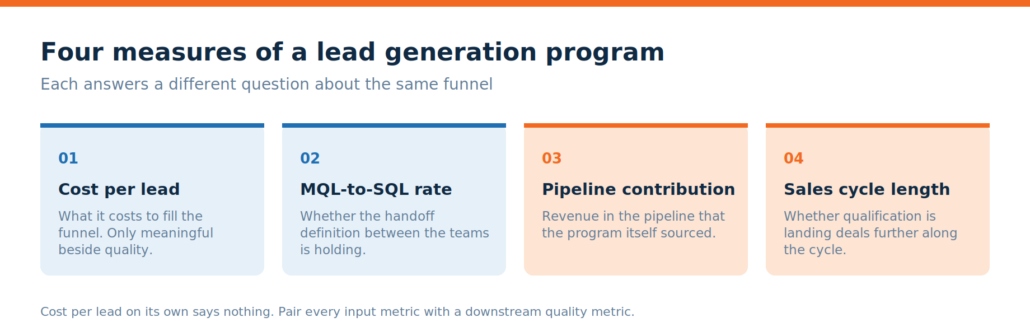
Cost per lead tells you what you are paying to fill the funnel, but it is only useful when paired with quality indicators downstream. A low CPL means little if those leads never convert to qualified opportunities.
MQL-to-SQL conversion rate measures the quality of the handoff between marketing and sales. A declining rate signals misalignment in qualification criteria or targeting. Track it monthly and by source to identify which channels produce leads that sales accepts and pursues.
Pipeline contribution measures the revenue in your pipeline that originated from lead generation activities. This is the metric that connects marketing spend to business outcomes and gives leadership a clear view of return on investment.
Sales cycle length for generated leads versus internally sourced leads is also revealing. Shorter cycles for generated leads typically indicate that the qualification process is working: reps are entering conversations at a later, more productive stage.
In Conclusion: Building a Pipeline That Supports Consistent Sales Performance
Missed sales targets are rarely solved by asking reps to work harder. The root cause is almost always upstream, in the quality and structure of the pipeline that feeds their activity. When lead generation support is absent, weak, or misaligned with your ideal customer profile, every downstream metric suffers.
Building a qualified pipeline requires precision: targeted prospecting, verified data, structured qualification, and a coordinated handoff between lead generation and sales. The teams that invest in these foundations hit their numbers more consistently and spend less time chasing opportunities that were never going to close.
If your team is ready to build a pipeline that supports consistent quota attainment, talk to Callbox about a lead generation program structured around your specific sales targets, market, and ideal customer profile.
FAQs About Sales Targets and Lead Generation
What is lead generation support in B2B sales?
Lead generation support is a structured program that identifies, qualifies, and delivers prospective buyers to your sales team. Callbox provides this through multichannel outreach, human-verified contact data, and appointment setting that connects your reps with decision-makers who match your ideal customer profile.
Why do sales teams miss targets even with enough leads?
Volume alone does not drive quota attainment. When leads lack firmographic fit or buying intent, reps spend time on conversations that never progress. A qualified pipeline filters for both fit and readiness, which is what separates productive activity from wasted effort.
How does multichannel outreach improve sales pipeline quality?
Multichannel outreach combines calls, email, social media, and web engagement to reach prospects through multiple touchpoints. Callbox uses this integrated approach to build familiarity and credibility with prospects before the sales conversation, which improves both response rates and meeting quality.
How long does it take to see results from a lead generation program?
Most B2B lead generation programs begin producing qualified meetings within the first 30 to 60 days. Full pipeline impact typically becomes visible within 90 days as qualified opportunities progress through the sales cycle and contribute to forecasted revenue.
What should you look for in a B2B lead generation partner?
Prioritize partners that build campaigns around your specific ideal customer profile, use verified contact data, offer multichannel execution, and deliver qualified appointments with full prospect context. Callbox provides all of these through dedicated campaign teams that function as an extension of your sales organization.
Can lead generation support help shorten B2B sales cycles?
Yes. When prospects arrive pre-qualified with confirmed interest and full context, your sales team enters conversations at a later stage. That reduces the discovery and qualification work that typically extends sales cycles, allowing reps to focus on advancing deals toward close.