No Show Appointments in B2B: What Your Vendor Owes You
Understand how vendors should handle B2B no-show appointments, enforce meeting standards, and protect your investment in qualified sales opportunities.
 Yza Belle Tinampay
 is an SEO/AEO Content Writer at Callbox with 9 years of experience in content creation and strategy. She specializes in writing search-optimized blog content that improves online visibility, strengthens topical authority, and helps businesses reach their target audiences through strategic, reader-focused content.
View full bio of Yza Belle Tinampay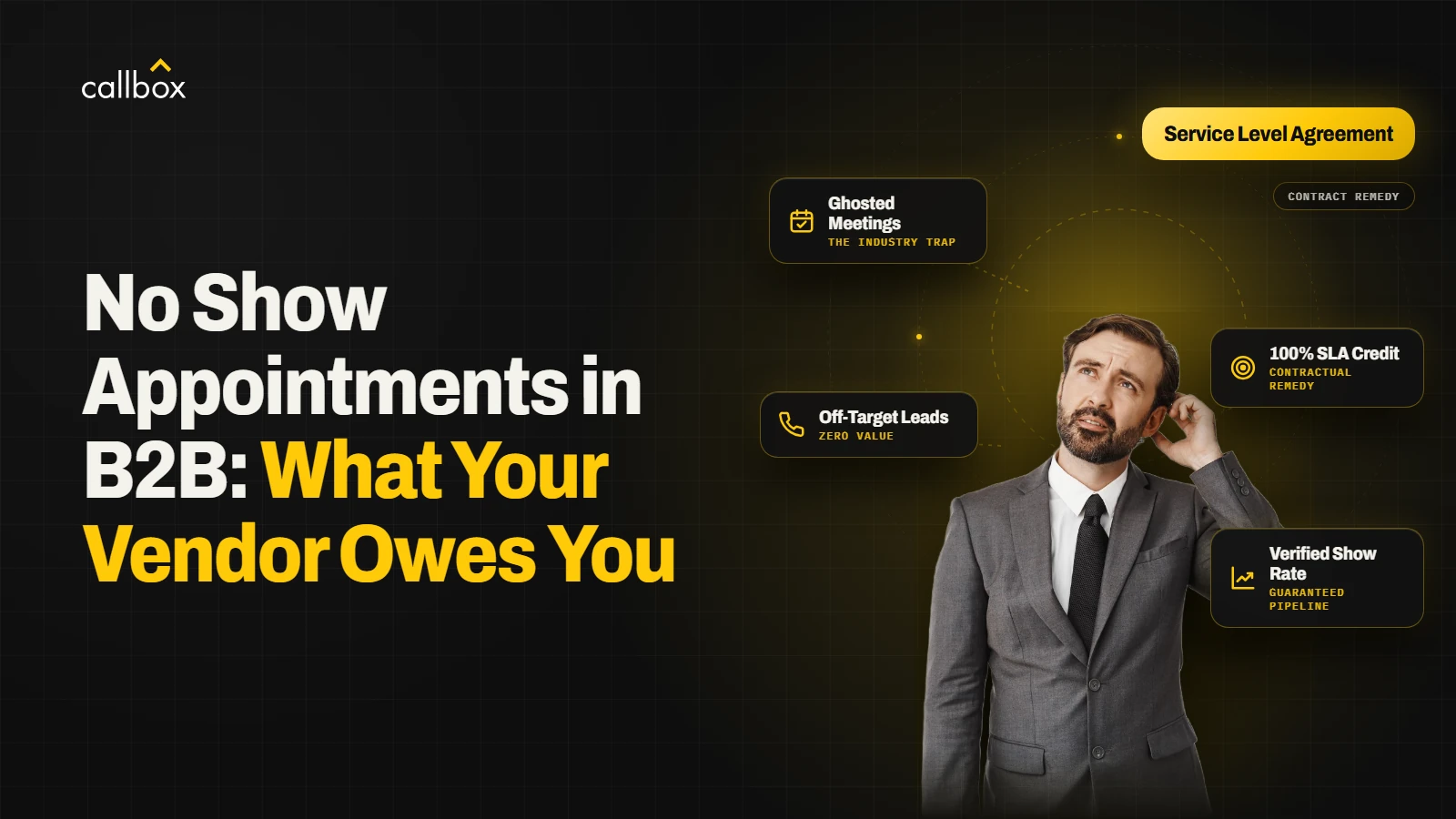
 Quick Answer
What happens when a booked B2B meeting no-shows or turns out to be off-target? With an accountable appointment setting vendor, the meeting is re-engaged and rebooked within a defined window, and if it cannot be recovered it is replaced at no extra cost and does not count toward your contracted volume. No-shows are a normal cost of outbound at scale, so the signal to evaluate is not whether a vendor has them, but whether their replacement terms, qualification criteria and dispute process are written down before you sign.
There is no shortage of content about what B2B appointment setting services cost or why you might outsource them. There is almost nothing about what happens when a meeting you paid for fails. That gap matters, because no show appointments are the single most common complaint buyers raise about appointment setting companies, and the thing vendors are least likely to address on their own websites.
Most of what ranks for this topic is written for salons, clinics and consumer booking software. The advice there, send an SMS reminder, take a deposit, blacklist repeat offenders, does not survive contact with a buying committee of eleven people and a six-month sales cycle. This guide answers the B2B version of the question. To do that honestly, we need to define what a qualified meeting is first.
Struggling to set appointment with your target decision makers?
What Makes a Meeting Qualified in B2B Appointment Setting?
A qualified meeting is one that meets criteria you and your vendor agreed in writing before the campaign launched. In practice those criteria almost always cover four things:
- Account fit. The company sits inside the agreed industry, geography, revenue band and headcount range, which is your ICP written as a filter rather than a description.
- Contact fit. The person holds a role with budget authority, direct influence over the purchase, or clear ownership of the problem you solve.
- Stated interest. The prospect knowingly agreed to a conversation about your category. They were not booked under a vague pretext and they know who they are meeting.
- Timing or need signal. There is an identified problem, an evaluation underway, or a timeline that falls inside the window you agreed to accept.
Vendors differ on how strictly they apply these, and some add a formal framework such as BANT on top. What should never differ is that the definition exists on paper before outreach starts. Anything that falls outside it is an off-target meeting, which raises the obvious question of how a professional team books one at all.

Logistics Leader Achieves Marketing and Pipeline Success with Callbox
Callbox helped the Client establish meaningful connections with key decision-makers, enhancing their sales pipeline and marketing impact..
View Case StudyWhy Do Off-Target Meetings Happen at Scale?
Off-target meetings are a structural feature of volume outbound, not a sign that a vendor is careless. Three causes account for most of them.
1. Contact data decays faster than campaigns run
B2B contact records go stale continuously. The most defensible published figure puts decay at roughly 2.1% per month, which compounds to about 22.5% a year, a MarketingSherpa measurement that HubSpot’s database decay simulation popularized. Whole-database estimates run nearer 30%. In a campaign that runs for two quarters, a meaningful share of the list you approved at kickoff is already wrong by the time it is dialed.
2. Buyer roles shift mid-campaign
The person who owned the problem in March may have been promoted, reorganized, or moved to a competitor by June. Research on B2B buying groups commonly puts the committee at around eleven stakeholders per deal, so with normal job mobility the odds that at least one of them changes during a long cycle are high. A meeting booked with a contact whose remit shifted last month is off-target through no fault of the caller.
3. Account lists go out of date
Mergers, acquisitions, funding events and restructures redraw org charts overnight. A target account that fit your ICP at list build can fall outside it, or get absorbed into a parent you already sell to, without anyone involved in the campaign being told.
Industry Insight
Be skeptical of the widely circulated claim that B2B data decays 70.3% a year ``according to Gartner.`` That figure traces back to a 2015 Biznology post about list rental, and recent attempts to source it to Gartner have come up empty. A vendor quoting it at you is repeating a chain of blog citations rather than reading research. The 22.5% annual figure is lower, better sourced, and still high enough to explain most off-target meetings.
None of this is an excuse. It is the reason a replacement policy exists. The same logic applies to no-shows, which deserve the same unsentimental read. Appointment setting companies in the USA establish clear processes for managing missed meetings and maintaining sales pipeline consistency.
Are No-Shows Normal in B2B Outbound?
Yes, and at rates that surprise buyers who have never measured their own. The complication is that published benchmarks disagree wildly, because they quietly measure different populations.
69.6% of cold-call-booked B2B meetings actually took place Growth Cab, 1,380 meetings | 14.6% no-show rate in that same dataset, with 11.0% rescheduled Growth Cab, 1,380 meetings | 23.0% no-show rate when booked 8+ days out, against 6.9% same-day Reply.io, 2,900 demos | 13.5% median no-show rate across high-volume B2B SaaS teams; top decile 5.5% RevenueHero |
Published B2B no-show rates range from roughly 6.5% to 28%, and you cannot average them. One source counts every meeting booked in a single week. Another counts inbound demos only. Another counts cold outbound, which is the only population that tells you anything about appointment setting. Before you benchmark a vendor, confirm which denominator their number uses.
The most useful pattern in the public data is not a headline rate at all. It is the lead-time curve. Across 2,900 booked demos, Reply.io found no-shows rising from 6.9% on same-day meetings to 9.6% next-day and 23.0% once the meeting sat eight or more days out. Growth Cab’s cold-call study found the same shape, with meetings held within two days taking place 85% of the time versus 59% beyond thirty days. That gives you a concrete diligence question rather than a vague one.
Expert Tip
Do not ask a vendor "what is your no-show rate." Ask for their median booking-to-meeting lead time and their show rate split by that lead time. A vendor booking meetings three weeks out is structurally buying itself a higher no-show rate, and a blended average hides it. Lead time is the lever, and it is one a competent partner actively manages.
What separates good appointment setting companies from bad ones, then, is not whether no-shows happen. It is what the contract says happens next.
How Do Accountable Appointment Setting Services Structure Replacement and SLAs?
Appointment setting outsourcing is usually sold on a subscription or retainer, with a target volume of qualified meetings per period. The commercial detail that actually determines your cost per meeting is what the vendor does when one of them fails. Four terms carry most of the weight.
The replacement guarantee
A meeting that fails the agreed qualification criteria should be replaced at no additional cost and should not count against contracted volume. Confirm whether replacement is unlimited or capped, and whether a replaced meeting extends the campaign timeline.
The re-qualification window
You need a defined period, commonly five to ten business days, in which you can flag a meeting as off-target. Outside that window it is deemed accepted. Short windows protect the vendor, long ones protect you, and the point of negotiating is to land somewhere both sides can actually operate.
The no-show recovery process
A no-show is not automatically a failed meeting. Most accountable vendors run a recovery attempt within hours, then count the meeting as held if it rebooks inside an agreed window and as replaceable if it does not. Make sure you know which of those two the contract assumes by default.
Who decides, and on what evidence
Disputes are resolved against written criteria plus a call recording or qualification note, or they are resolved by whoever argues harder. Insist on the former.
Contract element | Weak terms | Market standard | What accountable looks like | Ask the vendor |
Qualification criteria | Described in the proposal, not the contract | Listed in an appendix at kickoff | Signed criteria doc, versioned, changes require both parties | “Can I see the criteria exactly as they will appear in the agreement?” |
Replacement guarantee | Case by case, at vendor discretion | Offered for clearly off-target meetings | Automatic, uncapped, does not count toward volume | “Is replacement capped, and does a replaced meeting extend the term?” |
Re-qualification window | Undefined or 48 hours | 5 business days from meeting date | 5 to 10 business days from when the meeting was due to occur | “When does the clock start, and what evidence do you need from me?” |
No-show handling | Counted as delivered on booking | One rebooking attempt, then counted as delivered | Defined recovery attempt, rebook window, then replacement if unrecovered | “At what point does a no-show become a replaceable meeting?” |
Reporting | Meetings booked only | Booked and held | Booked, held, no-show, rescheduled, rejected, with lead time attached | “Can I see a sample report before signing?” |
Knowing what good looks like is not the same as getting it. Vendors answer the questions they are asked, so the diligence conversation has to be deliberate.
Vendor Evaluation Checklist: Questions to Ask Before You Sign
These are the questions B2B buyers raise most often during evaluation, grouped by what they actually reveal. Send them in writing and compare the answers side by side.
Qualification and off-target meetings
- How do you define a qualified meeting, and will that definition appear in the contract rather than the proposal?
- What is your process when we reject a meeting as off-target, and how long do we have to raise it?
- Who makes the final call on a disputed meeting, and what evidence is the decision based on?
- Is a replacement meeting free, and does it count against our contracted volume?
No-shows specifically
- What is your median booking-to-meeting lead time, and what is your show rate at each lead-time band?
- What confirmation cadence runs between booking and the meeting, and on which channels?
- What happens in the first hour after a prospect fails to appear?
- At what point does an unrecovered no-show become a replaceable meeting?
Setup, data and commercials
- How long is the setup period before live outreach begins, and is it billed?
- Where does the contact data come from, how often is it refreshed, and who owns it when we leave?
- Is pricing per meeting, per seat, or a subscription, and what happens if volume lands under target?
- What is the notice period, and are there penalties for ending the engagement early?
Proof
- Can we see a redacted sample of your weekly reporting, including rejected and no-show meetings?
- Can we speak to a current client in our industry and region, not just read a case study?
- Can we hear a call recording from a meeting that was booked and one that was rejected?
Expert Tip
The last question in that list is the highest-signal one in the whole process. A vendor that can produce a recording of a meeting it booked and then voluntarily rejected is showing you its QA process works. A vendor that has never rejected one of its own meetings either has flawless targeting or no quality bar, and only one of those is likely.
Related: How to Choose an Appointment Setting Company
What a No-Show Actually Costs You
Most teams negotiate replacement terms without knowing what a failed meeting is worth, which makes it hard to tell a fair clause from a generous-sounding one. Run this before the vendor conversation.
- Establish your true cost per booked meeting. Divide total program cost for the period, fees plus internal time plus data and tooling, by meetings booked. Not meetings held. Booked.
- Establish your cost per held meeting. Divide the same total by meetings that actually happened. The gap between step one and step two is what no-shows are already costing you, in money you have spent.
- Add the rep time. Multiply no-shows by the prepared-and-waiting time per meeting, typically 30 to 45 minutes including prep and context switching, then by a loaded hourly rate for whoever took the call.
- Apply your historical conversion rate. Multiply held meetings by your meeting-to-opportunity rate and average deal size to get pipeline per held meeting. That number is what each unrecovered no-show removes from the forecast.
- Price the replacement clause. Multiply your expected no-show and off-target volume by cost per held meeting. That is the annual value of an automatic replacement guarantee, and the number to hold in your head during negotiation.
Teams that run this almost always find the same thing: the contract term that looked like a procurement detail is worth more than the discount they were negotiating instead.
Related: B2B Appointment Setting Cost
How we selected the Benchmarks in this Article
We included only published B2B figures that disclose both a sample size and what population they measure, and we name the source and sample next to each number. We excluded consumer and healthcare no-show studies, which dominate search results for this topic but measure a fundamentally different behavior, and we excluded the widely repeated “70.3% per Gartner” data decay figure because we could not trace it to a Gartner source. Consumer-sector guides such as Easy!Appointments and Reservio are useful on reminder mechanics for scheduled services, and we have linked them for that reason, but their remedies of deposits, loyalty programs and client blacklists do not transfer to B2B outbound.
Frequently Asked Questions
How fast do appointment setting services produce qualified meetings?
Expect a setup period of roughly two to four weeks for ICP definition, data build, messaging and compliance review before any outreach goes live. First meetings usually land in the first month of live outreach. Stable, predictable volume typically takes a full quarter, because cadences need several cycles of real response data before they can be tuned. Ask any appointment setting company to separate setup from live outreach in writing, so the ramp is not quietly billed as performance.
What counts as an off-target meeting?
An off-target meeting is one that falls outside the qualification criteria agreed before launch. The usual examples are wrong seniority, a company outside the agreed revenue or headcount band, no authority or influence over the purchase, a timeline well outside the agreed window, or a prospect who did not knowingly agree to a sales conversation. Because it is a definition question rather than an opinion, the criteria have to be written down first. Without that, every rejection becomes a negotiation.
Is a replacement meeting free?
With most accountable vendors, yes. A meeting that fails the agreed criteria, or one that no-shows and cannot be rebooked inside the agreed window, is normally replaced at no extra cost and does not count against contracted volume. What varies is the dispute window, who decides, and whether a rescheduled meeting counts as replaced or as held. Get all three in the contract rather than the proposal deck.