Lead Generation for Hospitality: How Hotels and Venues Win Corporate Clients
Discover how hospitality companies can attract corporate clients through targeted lead generation strategies that drive bookings and long-term business.
 Mitos Aguadera
 is VP of Sales and Marketing at Callbox, leading go-to-market strategy and demand generation for B2B clients across tech and SaaS.
View full bio of Mitos Aguadera
 Quick answer: Lead generation for hospitality is the process of finding B2B buyers (corporate travel managers, event planners, travel agencies, and procurement teams) and turning them into contracted room nights, group bookings, and venue partnerships. For hotels, resorts, and event venues, the most dependable approach pairs a clear ideal customer profile with multichannel outreach by phone, email, and LinkedIn, direct-booking incentives that reduce OTA commissions, and lead qualification before sales handoff.
The hospitality industry is one of the most competitive markets, with hotels, resorts, and event venues competing for corporate clients, travel agencies, and event planners. Corporate demand is still growing: the Global Business Travel Association projects global business travel spending will reach a record $1.57 trillion in 2025, up from $1.47 trillion in 2024 (GBTA Business Travel Index Outlook 2025). Winning a share of that spend requires a strategic, data-driven approach to hospitality lead generation services and sales.
Beyond competition, hospitality businesses also face unique challenges: fluctuating demand due to seasonality, dependence on Online Travel Agencies (OTAs), changing corporate booking trends, and rising expectations for personalized experiences. Without the right hospitality B2B marketing strategies, these hurdles make lead generation costly and inefficient.
Need a steady pipeline of corporate clients?
Callbox connects hotels, resorts, and venues with travel and event decision-makers through phone, email, and LinkedIn outreach.
So how can hospitality companies attract, nurture, and convert B2B leads into long-term partnerships and direct bookings? This guide covers:
- Who your ideal B2B hospitality leads are, and how to prioritize them.
- The challenges that stall hospitality sales, from seasonality to OTA dependence.
- How to manage hotel leads from first inquiry to signed contract.
- The strategies that work, compared side by side.
Understanding Lead Generation for Hospitality
Who are your ideal B2B hospitality leads?
To reach the right hospitality buyers, you first need to identify your ideal clients. In the B2B sector, your leads could include:
- Corporate clients: Companies looking for business travel accommodations, negotiated rates, or event hosting. Those with recurring travel to your area are the most valuable.
- Event planners: Professionals searching for venues for conferences, meetings, incentive trips, and corporate retreats.
- Travel agencies and tour operators: Businesses that can drive consistent bookings through partnerships and allotments.
- Destination management companies and partners: Organizations whose own clients need accommodation or event space, and who can refer business to you.
Prioritize accounts by expected booking value and how often they travel or host events in your market. A company that books 200 room nights a year deserves a different approach than a one-off retreat inquiry.
Overcoming Common Hospitality Lead Generation Challenges
High competition
The hospitality industry is highly competitive, with numerous hotels, resorts, and event venues vying for corporate partnerships. Businesses often struggle to differentiate themselves from competitors, particularly those with strong brand recognition or loyalty programs.
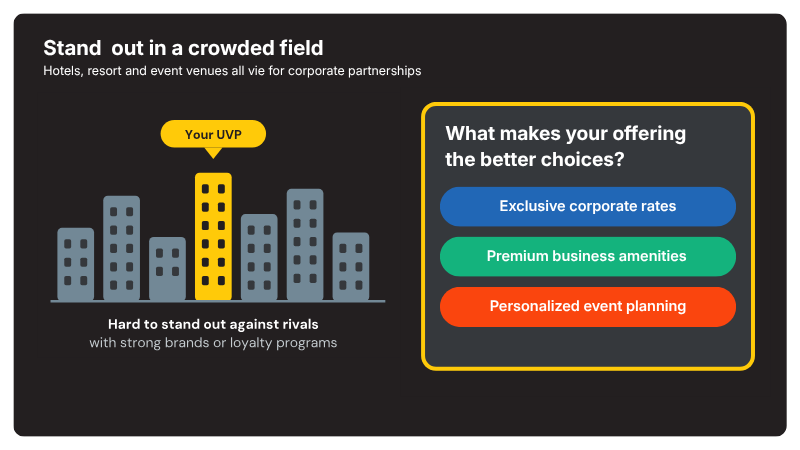
To stand out, hospitality companies must develop a unique value proposition (UVP) that shows what makes your offering the better choice, whether it’s exclusive corporate rates, premium business amenities, or personalized event planning services.

How a Bay Area POS Software Firm Generated 41 SQLs in 90 Days
Callbox successfully executed a 3-month lead generation program for a POS software provider entering independent retail.
Read The Full StorySeasonality issues
Demand in the hospitality industry fluctuates significantly throughout the year, and peak and off-peak periods vary by market, property type, and segment. Slower months make lead generation harder precisely when you need bookings most.
To counteract this, hotels and venues should create seasonal marketing campaigns with incentives like discounted long-term corporate stays or bundled event packages for off-peak periods. Start outreach well before the slow season, because corporate buyers commit to venues during their own planning cycle, not yours.
Changing corporate booking behavior
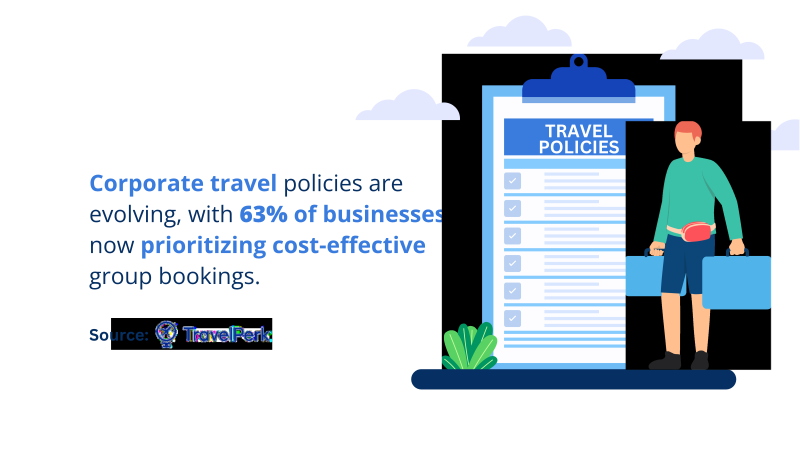
Corporate travel policies have evolved, with many companies prioritizing cost-effective group bookings and flexible travel options. More businesses are opting for extended stays, alternative accommodations, and hybrid events instead of traditional in-person meetings.
Hospitality companies need to adjust by offering customized business travel solutions, bulk booking discounts, and hybrid event spaces equipped with reliable technology.
Dependence on OTAs
Many hotels rely on Online Travel Agencies (OTAs) like Expedia, Booking.com, and corporate travel platforms to secure bookings. However, OTAs charge commission fees commonly ranging from 15 to 30%, cutting into profitability and limiting direct customer relationships.
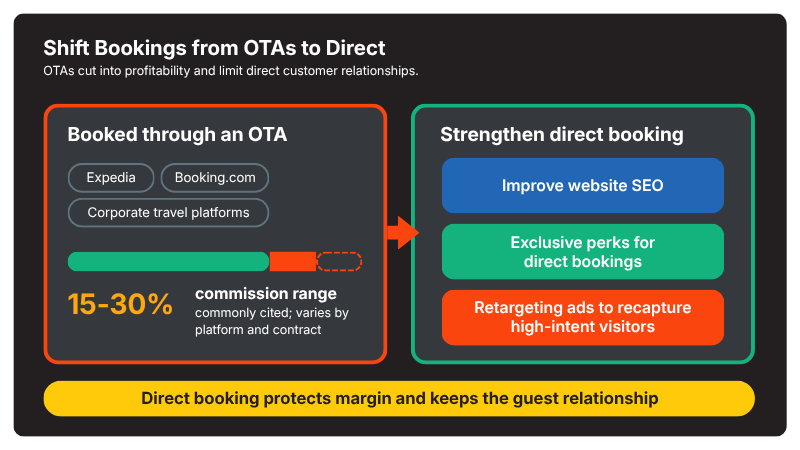
To reduce reliance on OTAs, hospitality businesses should strengthen their direct booking strategy: improve website SEO, offer exclusive perks for direct bookings, and use retargeting ads to recapture high-intent visitors.
Ineffective digital marketing
A significant number of hospitality businesses still operate with outdated websites, weak SEO, and minimal social media engagement. Many also lack modern hospitality cybersecurity measures, leaving client data vulnerable, which is a growing concern for corporate travel managers and event planners who vet suppliers before signing.
Corporate buyers research venues online before they ever contact a sales team, so a weak digital presence means you’re filtered out before the conversation starts. Focus on strengthening your SEO, LinkedIn presence, and paid advertising to capture and nurture B2B leads.
Lead qualification and conversion issues
Not all leads convert. Generating leads is just the first step; converting them into bookings is another challenge. Hospitality businesses often struggle with unqualified leads who express interest but never commit. Lead scoring, automated email follow-ups, and personalized LinkedIn outreach help identify high-quality leads and focus sales time where it pays off.
Related: Mastering Lead Qualification Can Be a Game Changer
Building long-term B2B relationships
Unlike individual travelers, B2B clients require long-term relationship-building and strategic partnerships. Securing corporate contracts involves networking, consistent communication, and demonstrating long-term value. Invest in tools like LinkedIn Sales Navigator, structured outbound outreach, and corporate loyalty programs to strengthen partnerships and increase repeat business.
Ready to fill your off-peak calendar with corporate business?
Hotel Lead Management: From Inquiry to Signed Contract
Generating a lead is only half the work. Hotels lose B2B business when RFPs, event inquiries, and corporate-rate requests sit unanswered or bounce between teams. A workable hospitality lead management process has four parts:
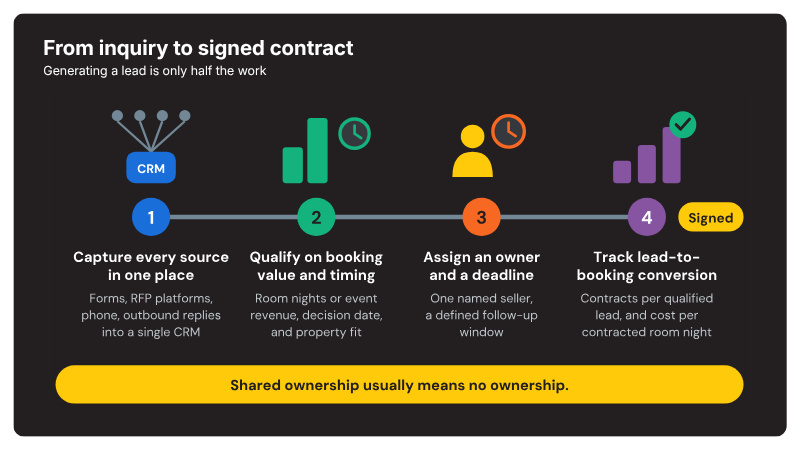
- Capture every source in one place. Route website forms, RFP platforms, phone inquiries, and outbound replies into a single CRM or sales-and-catering system, so nothing lives only in someone’s inbox.
- Qualify on booking value and timing. Score each lead on estimated room nights or event revenue, decision date, and fit with your property. A 300-person conference next spring and a 10-room block next week need different handling.
- Assign an owner and a response deadline. Each qualified lead goes to one named seller with a defined follow-up window. Shared ownership usually means no ownership. If your team is stretched, outsourced SDR services can handle first-touch qualification.
- Track lead-to-booking conversion. Measure how many qualified leads become contracts, and the cost per contracted room night by channel, so you know where to invest.
Expert tip: Speed matters most on inbound RFPs. Event planners often send the same request to several venues at once, so the first complete, tailored response sets the frame for every proposal that follows. Keep a ready-to-edit proposal template for your most common event types.
Winning Strategies for Lead Generation for Hospitality
No single channel fills a hospitality sales pipeline. Here’s how the main options compare:
Channel | Best for reaching | Strength | Trade-off |
Phone outreach | Travel managers, event planners | Fast two-way qualification | Needs trained callers and accurate data |
Email sequences | Segmented corporate and agency lists | Scales; easy to personalize offers | Deliverability and reply rates vary |
Corporate decision-makers, associations | Visible credibility; warm introductions | Slower; manual personalization | |
Paid search and retargeting | Buyers already searching for venues | Captures existing intent | Ongoing spend; competitive keywords |
Partnerships and referrals | Agencies, DMCs, associations | High trust | Takes time to build |
SEO and content marketing for hospitality B2B marketing
Search engine optimization (SEO) and content marketing are vital for attracting corporate clients. Optimizing your website for high-intent keywords like “corporate event venues” or “business travel accommodations” helps you appear when buyers are actively looking.
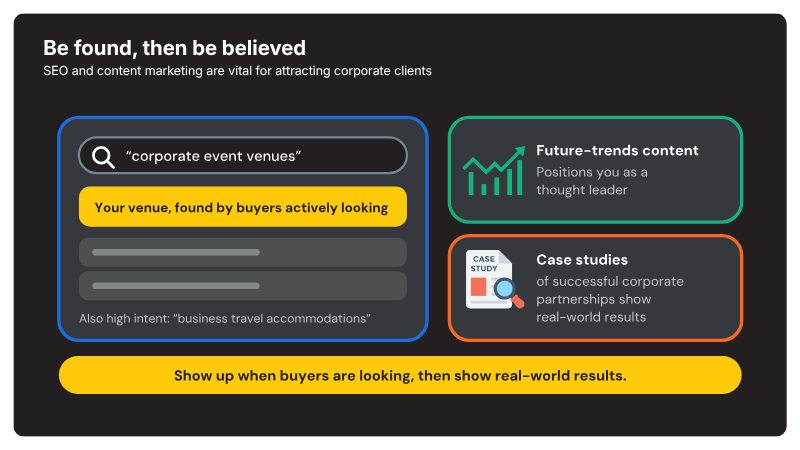
Publishing content on future trends in the hospitality industry can position your business as a thought leader, while case studies of successful corporate partnerships show real-world results.
Targeted cold calling and appointment booking
Targeted cold calling is a direct and effective way to reach decision-makers. Identifying the right contacts, such as travel managers, event planners, and procurement leads, is crucial for securing B2B partnerships.
Instead of a generic sales pitch, take a personalized approach. Focus your calls on the buyer’s real pain points: finding reliable venues for recurring meetings, controlling travel costs, or simplifying group bookings.
Cold calling works best when you offer immediate value. Position yourself as a problem solver by offering case studies, tailored packages, or a quick planning session. A well-crafted script that is empathetic, engaging, and data-driven builds trust and opens the door to long-term corporate partnerships.
Proof in practice: The corporate travel management arm of a leading online travel agency wanted more small and mid-sized business accounts, but its whitepaper promotion through SEO and social media was producing few downloads. Callbox added outbound phone and email outreach to the campaign, reaching 386 target contacts and generating 180 marketing-qualified leads and 189 ebook downloads. Read the business travel platform case study.
Related: Sample Cold Calling Scripts
LinkedIn outreach and social selling
LinkedIn is one of the most effective platforms for B2B networking in hospitality sales. Engaging with corporate clients, event planners, and travel agencies through industry insights, discussions, and direct messages builds relationships before a pitch is ever made. LinkedIn Ads targeting decision-makers in corporate travel and event planning add brand visibility.
Targeted email campaigns for corporate clients
Email marketing is a cost-effective way to nurture hospitality leads. Segmented lists for corporate clients, event planners, and travel agencies let you send personalized proposals with corporate travel rates or event hosting packages. Automated drip campaigns keep leads engaged throughout the booking decision.
Direct booking incentives for B2B clients
Encouraging direct bookings reduces OTA dependency and protects margins. Discounted corporate rates and perks for long-term partnerships attract B2B clients, and loyalty programs built for frequent business travelers encourage repeat bookings. Remarketing ads re-engage decision-makers who visited your website but didn’t convert.
Industry insight: GBTA's 2025 outlook expects global business travel spending to pass $2 trillion by 2029 (GBTA). For hotels, that makes negotiated corporate accounts a long-term revenue base worth building now, not just a way to fill the next quarter.
Paid advertising and retargeting for B2B clients
Paid advertising reaches targeted corporate audiences quickly. Google Ads focused on corporate travel and event searches put you in front of buyers with active intent, and LinkedIn retargeting reconnects with prospects who previously engaged with your content.
Account-based marketing (ABM) for B2B hospitality sales
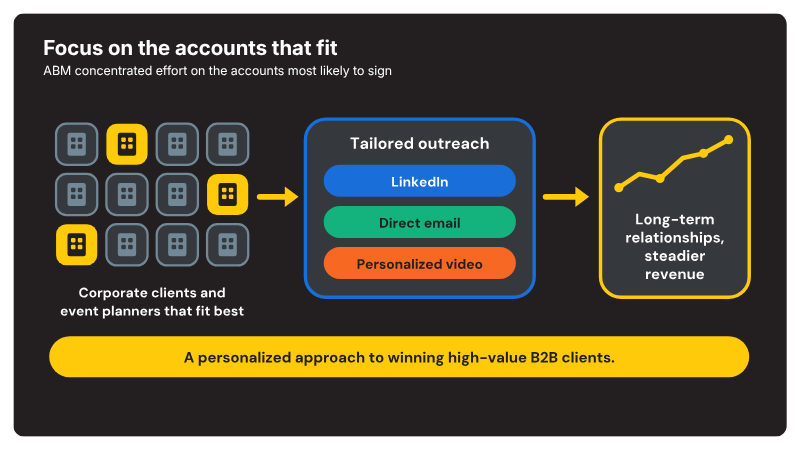
Account-based marketing services take a personalized approach to winning high-value B2B clients. By identifying the corporate clients and event planners who fit best, hospitality businesses can tailor outreach through LinkedIn, direct email, and even personalized video messages. ABM concentrates effort on the accounts most likely to sign, which builds long-term relationships and steadier revenue.
Partnerships and referral programs
Partnerships and referral programs extend your reach. Collaborations with corporate travel managers, event organizers, and business associations create a steady flow of referred leads, and event marketing puts you in front of planners where they gather.
Referral programs that reward corporate clients for introducing new business turn satisfied accounts into a word-of-mouth channel. Working with B2B travel influencers and business networking groups adds reach and credibility.
Reputation and online review management
Reputation and review management are crucial for credibility in hospitality. Monitor and respond to corporate client feedback on LinkedIn, Google, and industry forums, and encourage satisfied clients to share testimonials about their experience. Reviews are often a buyer’s first impression of your property, long before they talk to your sales team.
Learn different ways to build brand reputation.
Future-Proofing Your Hospitality Lead Generation Strategy
With rising competition, shifting corporate travel habits, and new future hospitality trends, lead generation for hospitality needs a multi-channel, data-driven approach.
To generate high-quality hospitality leads, focus on SEO, LinkedIn networking, content marketing, and targeted outreach. A strong direct corporate booking strategy reduces reliance on OTAs, a disciplined lead management process keeps good inquiries from slipping away, and AI-driven personalization and automation improve the client experience. Strategic partnerships and ABM build the long-term accounts that carry you through slow seasons.
Frequently Asked Questions About Hospitality Lead Generation
What is lead generation for hospitality?
It’s the work of finding and qualifying business buyers for hotels, resorts, and event venues, such as corporate travel managers, event planners, and travel agencies. The goal is contracted business: corporate rates, group blocks, and recurring events, rather than one-off leisure stays.
Who are the best B2B leads for hotels and venues?
Companies with recurring travel or event needs, corporate travel managers, meeting and event planners, travel agencies and tour operators, and destination management companies. Prioritize accounts by expected booking value and how often they travel or host events in your area.
How can hotels reduce reliance on OTAs for corporate business?
Build direct relationships that OTAs can’t replicate: negotiated corporate rates, group and long-stay packages, loyalty benefits for frequent business travelers, and a simple booking path on your own website. Outbound outreach to travel managers brings these offers to buyers who would otherwise book through an intermediary.
When should hotels contact corporate event planners?
Well ahead of the event, because planners shortlist venues during their own planning cycle, not during your slow season. Map when your target accounts plan offsites, conferences, and annual meetings, and start outreach before those decisions are made.
How do you measure hospitality lead generation ROI?
Track lead-to-booking ratio and cost per contracted room night, not clicks or form fills alone. Compare acquisition cost with the total value of the contracts each channel produces, including repeat bookings over the life of the account.
Should a hotel outsource lead generation or keep it in-house?
In-house teams know the property best but are often stretched across operations. Outsourcing can add trained callers, data, and multichannel campaigns without new hires. Many properties combine both: an outsourced team generates and qualifies leads, and the hotel’s sales team closes. See Callbox’s hospitality lead generation services or review pricing.