What Buyer Data Reveals About Holiday Outreach & Q1 Pipeline
Most B2B teams go quiet at Thanksgiving—costing them Q1 pipeline. Explore 2026 B2B buyer behavior data and how top revenue teams win the holiday lull.
 Yza Belle Tinampay
 is an SEO/AEO Content Writer at Callbox with 9 years of experience in content creation and strategy. She specializes in writing search-optimized blog content that improves online visibility, strengthens topical authority, and helps businesses reach their target audiences through strategic, reader-focused content.
View full bio of Yza Belle Tinampay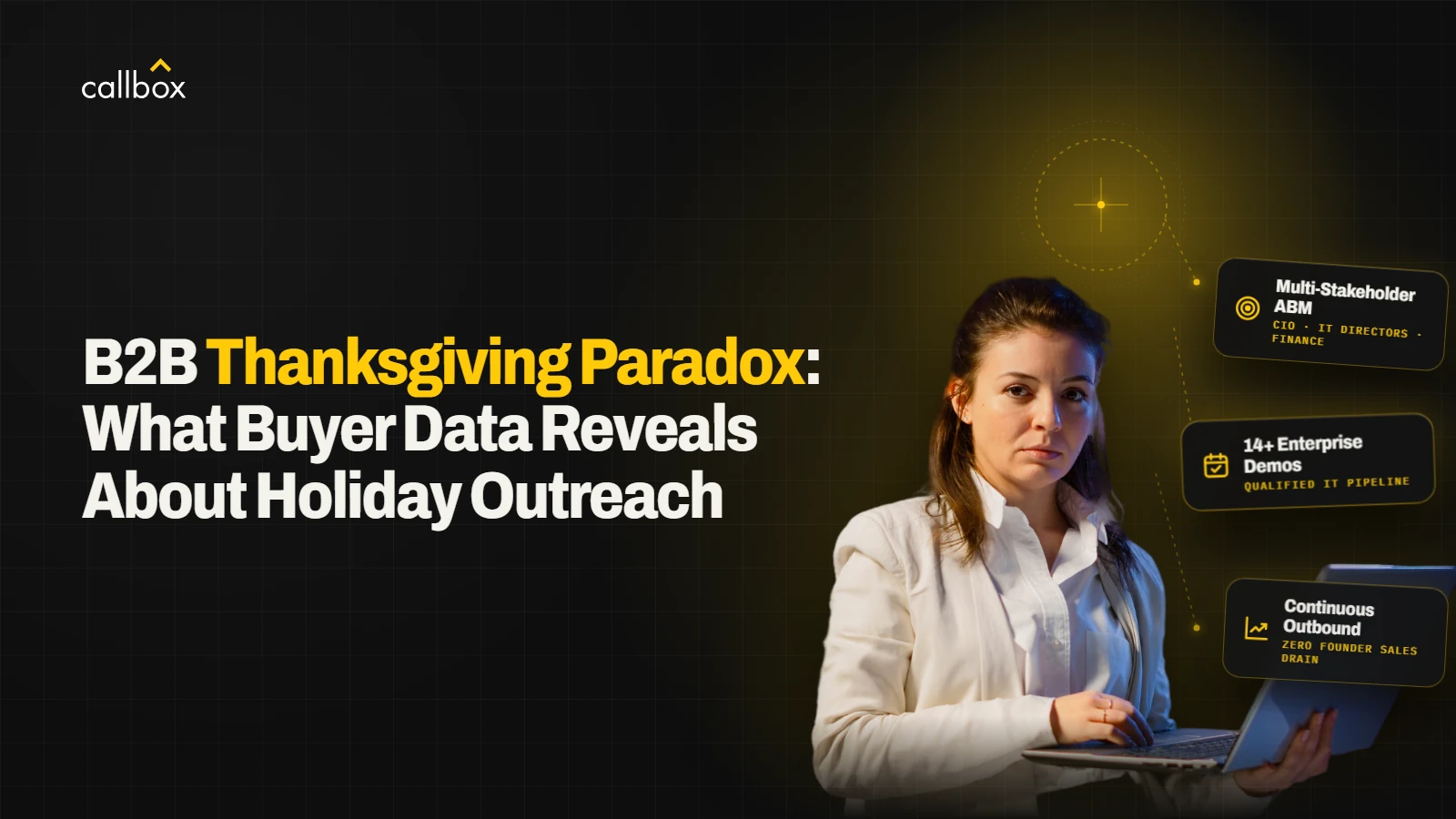
Every November, a predictable ritual plays out across B2B marketing and sales organizations. Right around the week of Thanksgiving, outbound sequences get paused, content calendars throttle down, and pipeline generation goes into hibernation until the second week of January. The prevailing assumption is simple: decision-makers are checked out, budgets are frozen, and trying to compete with Black Friday and Cyber Monday retail noise is a losing battle.
Yet when you look closely at B2B holiday marketing trends and modern buyer telemetry, a striking contradiction emerges.
While outbound seller noise drops sharply between Thanksgiving and New Year’s, buyer research, off-hours evaluation, and vendor shortlisting quietly continue. In fact, stepping away from daily operational firefighting gives executives something they rarely have in Q2 or Q3: uninterrupted bandwidth to reflect on what isn’t working and research who can help them fix it in the new year.
This is the B2B Thanksgiving Paradox. Brands that treat late November through December as a dead zone cede critical early mindshare—and pre-contact shortlist slots—to competitors who stay visible with low-friction, value-first engagement.
Want to Turn Thanksgiving Momentum Into Q1 Sales Opportunities?
Trend 1: The Q4 Content & Outreach Vacuum Creates an Unfair Share of Voice
B2B marketers often fall victim to the “B2C noise fallacy.” Because consumer channels are flooded with holiday flash sales, B2B teams assume their target accounts have tuned out altogether. As a result, publishing frequency drops, LinkedIn feeds go quiet, and SDR cadences grind to a halt.
Why Competitors Go Silent (And Why That’s Your Opening)
In reality, B2B buyers do not consume LinkedIn posts, industry benchmarks, or peer recommendations the same way they browse retail promo codes. When half your competitors pause their demand generation programs for six weeks, the noise floor in your specific vertical drops dramatically. The B2B brands that maintain a steady, helpful presence during this lull suddenly enjoy an outsized share of voice in front of the exact executives who are still scanning their feeds between holiday travel and year-end wrap-ups.
Earning Pre-Contact Mindshare While Others Pause
Waiting until January to re-engage target accounts means showing up after the race has already been decided. According to the 6sense 2026 B2B Buyer Experience Report, 91.4% of buying groups rank their shortlist before first seller contact, and the pre-contact favorite wins the deal 82% of the time. Even more telling, more than 90% of buyers report keeping current on relevant solutions between active evaluation cycles.
Staying visible over the Thanksgiving window isn’t about forcing a signature before December 31. It is about earning a spot on your prospect’s Day One shortlist so that when Q1 budgets unlock, your brand is already the benchmark against which everyone else is measured. Maintain visibility during the holidays with outsourced SDR services that keep prospects engaged and build early-stage pipeline opportunities.
World’s No 1 CRM’s Holiday Campaign Engaged More Customers with Callbox ABM
The 5-week, 5-seat Lead Tele-nurturing campaign engaged a large holiday contact database, generating 108 SQLs, 164 MQLs, and 793 Potential Leads.
View Case StudyTrend 2: How B2B Decision-Makers Actually Behave Over the Thanksgiving Window
Understanding B2B buyer behavior in Q4 requires looking at how modern enterprise purchasing actually unfolds when buyers aren’t trapped in back-to-back status meetings.
Decision Fatigue and the Need for Strategic Clarity
By late November, B2B leaders are navigating acute decision fatigue. Months of micro-decisions, shifting targets, and vendor pitches deplete cognitive bandwidth, which is why high-friction, “can we hop on a 30-minute discovery call?” emails get archived on sight. Research compiled by Corporate Visions highlights how severe this friction has become: 74% of buyers say their last major purchase involved too many competing options to choose from, and 86% of B2B buying processes stall or delay.
During the Thanksgiving break, stepping out of the daily operational grind gives executives rare breathing room for strategic clarity. They aren’t looking for another aggressive sales pitch—they are looking for clear frameworks that simplify complex problems and bridge the gap between this year’s bottlenecks and next year’s goals.
The Rise of Self-Directed, AI-Assisted Evaluation
When decision-makers do use holiday downtime to explore solutions, they do so on their own terms. A March 2026 Gartner sales survey found that 67% of B2B buyers prefer a rep-free buying experience, increasingly turning to digital content, peer networks, and generative AI tools to compare vendors and summarize capabilities before ever filling out a form.
However, self-directed research does not eliminate the need for human trust—it raises the bar for it. Buyers want proof that what they read online holds up in practice. If your brand has no visible thought leadership, no third-party validation, and zero human follow-through during Q4, AI-assisted buyers will quietly filter you out long before your SDRs return in January.
Strengthen your digital presence with B2B lead generation strategies that help attract and engage qualified decision-makers.
Trend 3: Inbox Overload vs. Multi-Channel Precision
Even if you recognize the opportunity in late Q4, executing a traditional single-channel cold email blast during Thanksgiving week is a recipe for dismal engagement.
Why Single-Channel Email Blasts Get Buried
Between Thanksgiving, Black Friday, and Cyber Monday, shared executive inboxes are inundated with promotional clutter. Busy decision-makers process email in rapid morning triage sweeps, deleting anything that feels automated, templated, or self-serving. Relying solely on cold email during this window puts your message in direct competition with retail noise—and hurts your domain’s sender reputation when engagement dips.
Orchestrating LinkedIn, Voice, and Personalized Touches
Modern buying committees are simply too large and too distributed to crack through a single channel. Winning B2B lead generation during holidays requires coordinating multiple touchpoints that reinforce one another without overwhelming the prospect:
- Social & Content Visibility: Sharing high-value industry insights, concise carousels, or executive commentary on LinkedIn where leaders browse passively during slower workdays.
- Precision Email: Sending short, plain-text notes tailored to a specific role’s year-end priority rather than a generic company pitch.
- Human-Led Voice Outreach: A well-timed, consultative phone touch—backed by accurate account intelligence—often stands out more during quieter holiday weeks because gatekeepers are less overwhelmed and decision-makers have slightly looser calendars.
When executed through a coordinated multi-channel outreach cadence, each touch builds familiarity so that your brand feels like a trusted advisor rather than another interruption.
Dimension | The Traditional Q4 Pause | The Multi-Touch Holiday Approach |
Outreach Cadence | Paused from late November until mid-January | Adjusted to low-friction, value-first touches |
Primary Channel | Single-channel cold email blasts | Orchestrated mix of LinkedIn, email, and voice |
Core Message | Aggressive demo requests or generic holiday cards | Vertical benchmarks, ROI proof, and executive insights |
Buying Committee Focus | Single point of contact | Multi-threaded across champions and finance influencers |
Q1 Pipeline Impact | Cold start in January; competing for crowded inboxes | Warm shortlist positioning and pre-booked January meetings |
Trend 4: The “Gratitude-to-Pipeline” Shift Under CFO Scrutiny
Thanksgiving naturally inspires B2B teams to send “thank you” campaigns to prospects and customers. Unfortunately, most of those messages are generic, logo-heavy HTML cards that get deleted in half a second.
What Finance and Executive Buyers Actually Value at Year-End
If you want gratitude to translate into pipeline, align it with the reality sitting on your buyer’s desk every November and December: intense financial scrutiny. According to B2B buying data aggregated by Corporate Visions and Digital Commerce 360, 79% of B2B purchases require CFO approval, and 57% of global B2B buyers expect measurable ROI within three months. Furthermore, the 6sense 2026 B2B Buyer Experience Report reveals that for failed buying journeys, finance stakeholders report justifying the category investment is 74% harder than selecting a specific vendor.
Your internal champion doesn’t need another holiday greeting card. They need ammunition to defend budget allocation to their CFO.
Replacing Generic Holiday Greetings with Value-First Gratitude
A stronger Thanksgiving B2B marketing strategy turns appreciation into practical enablement. Instead of sending a hollow seasonal template, equip your target accounts with something genuinely useful:
- A concise year-end benchmark snapshot showing how peers in their industry are solving a costly operational bottleneck.
- A customized ROI summary or business case template they can bring directly into Q1 budget defense meetings.
- A brief, personal note from an executive or account lead thanking them for earlier conversations—with zero strings attached.
This kind of intentional, account-level relevance sits at the heart of modern Account-Based Marketing (ABM), where deepening trust across every stakeholder in the buying committee matters far more than short-term click volume.
The Q4 Holiday Playbook: 3 High-Impact Plays to Run Before Mid-December
You don’t need an aggressive hard-sell blitz to win the holiday window. Run these three disciplined plays between Thanksgiving and mid-December to build unstoppable momentum heading into the new year.
To turn these early conversations into measurable pipeline opportunities, businesses can implement a structured B2B appointment setting program that identifies qualified prospects, coordinates outreach, and schedules meetings with decision-makers ahead of Q1.
Play 1: Launch a “No-Pitch” Industry Benchmark Drop
Create a tight, 1-page industry trend brief or executive takeaway tailored to your Ideal Customer Profile (ICP). Distribute it via LinkedIn and plain-text email with an explicit no-pitch framing: “Thought your team might find these Q4 benchmarks helpful as you finalize next year’s roadmap—no reply needed.” By removing the ask, you dramatically increase read rates and position your brand as a generous category authority.
Play 2: Run Account-Based Gratitude Touches for Late-Stage & Dormant Deals
Audit your open opportunities and stalled Q3/Q4 deals. Have your SDRs and account executives send personalized, human-written notes—not only to your primary champion, but also to secondary technical and finance influencers. Pair the note with a relevant case study or peer validation piece that directly addresses their top implementation or ROI concern.
Play 3: Plant Seeds for January Discovery Calls
Respect your buyer’s holiday calendar while still securing early Q1 real estate. Swap December meeting demands for low-pressure forward scheduling: “I know calendars are packed through the holidays—would it make sense to pencil in 15 minutes during the second week of January to compare notes on your Q1 pipeline targets?” Locking in confirmed meetings before year-end ensures your sales team starts January with active conversations rather than cold prospecting.
Turning Holiday Quiet Into Q1 Momentum
The B2B Thanksgiving Paradox comes down to a simple choice: treat the holiday lull as an excuse to slow down, or use it as a strategic filter that separates transactional vendors from trusted partners. While competitors go silent and wait for January to scramble for attention, consistent, human-centric engagement keeps your brand front and center during the exact weeks executives are quietly shaping their next-year shortlists.
If you want to keep your outbound engine running smoothly without burning out your internal team over the holidays, explore how Callbox’s B2B appointment setting and lead generation programs combine AI-backed account intelligence with multi-channel, human-led outreach to build a predictable Q1 pipeline while the rest of your market is asleep.