AI SDR Tools: How AI Sales Agents Generate B2B Leads in 2026
Discover how AI SDR tools for B2B lead generation help sales teams find prospects, personalize outreach, and create qualified opportunities.
 Rebecca Matias
Rebecca Matias is Callbox's COO with 18 years of experience scaling B2B pipeline through data-driven outbound marketing, lead generation, and sales development.
View full bio of Rebecca Matias
AI SDR tools generate more qualified B2B leads by automating the repetitive front half of prospecting: researching accounts, drafting personalized outreach, running follow-up sequences, and flagging buying signals, so your team spends its time on conversations that actually close. The data backs this up.
According to HubSpot’s 2025 Sales Trends Report, 64% of sales professionals say AI-driven task automation saves them one to five hours a week. That reclaimed time only becomes pipeline if the tool has a defined audience and a human reviewing its output. Left unsupervised, the same automation just sends more noise, faster. AI SDR tools generate more qualified B2B leads. For teams that need human-led qualification and meeting conversion, appointment setting services can complement AI-driven prospecting.
This guide covers what AI SDR tools do, what HubSpot’s research says about their impact, how to calculate real ROI, a step-by-step selection methodology, and where they still fall short. A reliable lead generation agency can help turn automated prospecting into qualified opportunities. This approach can also be strengthened with a broader Generative AI Lead Generation strategy.
Quick Answer: What Is an AI SDR Tool?
An AI SDR tool is software that automates some or all of the work of a human sales development representative: researching accounts, drafting personalized outreach, sequencing follow-ups, and booking meetings. It ranges from an AI copilot that drafts messages for a human to review, to a fully autonomous agent that researches, sends, and books meetings without one. Neither type replaces a rep’s judgment; it changes where that judgment gets applied.
AI adoption in B2B sales has moved fast enough that it is worth grounding this guide in named, verifiable numbers before going further, starting with HubSpot’s research on AI in B2B sales.
 Industry Insight, Adoption: AI adoption in sales is now the default, not the exception. Only 8% of sellers reported using no AI in their role as of 2025, and adoption among sales teams grew to 43% by 2024, roughly double the prior year's rate.
How Do AI SDR Tools Actually Generate Leads?
AI SDR tools generate leads through five core mechanics, and most platforms combine several of them.
- Research at scale: pulls firmographic, technographic, and intent data on a target account faster than a person could, then surfaces the details worth mentioning in an email. Learn how to use ChatGPT for lead generation.
- Personalization at volume: drafts variations that reference a prospect’s role, recent company news, or a shared connection, instead of one generic template.
- Multi-channel sequencing: email, LinkedIn, and sometimes phone or SMS touches fire on a schedule, adjusting based on whether a prospect opened, clicked, or replied.
- Reply triage: positive replies route to a human or trigger a booking flow, while objections and out-of-office replies get handled automatically.
- Signal-based timing: stronger platforms watch for signals, such as a funding round or leadership change, and prioritize outreach to accounts showing them.
Industry Insight, Time Savings: The time savings behind all five mechanics are real but modest, not miraculous. 64% of sales professionals surveyed by HubSpot said AI-driven manual task automation saved them one to five hours per week, meaningful capacity, not a headcount replacement on its own.
None of this works without clean, current data behind it. A well-built sequence running against a stale contact list will underperform a mediocre sequence running against verified data. These tactics can be combined into a broader generative AI lead generation strategy.
How Should You Calculate ROI on an AI SDR Tool?
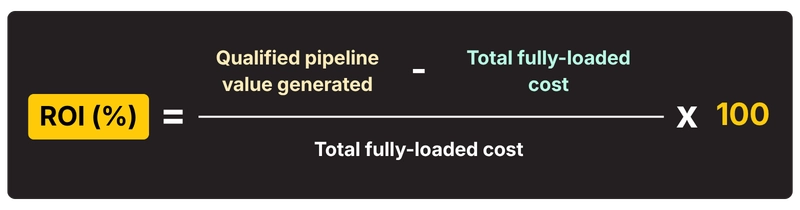
Most AI SDR ROI conversations stop at “it’s cheaper than a full-time SDR,” which is the wrong comparison. The right comparison is cost per qualified opportunity, fully loaded.
Industry Insight, Quota Attainment: Quota attainment improves when AI augments a rep rather than replacing one. Sellers who effectively partner with AI tools are 3.7 times more likely to hit quota than those who do not, per Gartner survey research, which is the underlying reason the ROI math below favors a hybrid model.
Total fully-loaded cost includes more than the subscription line item:
- Platform or contract fee: autonomous agents commonly run $9,000 to $60,000 a year at enterprise scale; augmentation and SMB tools start closer to $700 to $1,000 a month
- Data and enrichment costs, if not already bundled
- Human oversight hours: prompt tuning, reply triage, and quality review
- Ramp and implementation time before full output
Value of qualified pipeline is qualified meetings booked, multiplied by opportunity conversion rate, average deal size, and close rate.
Two benchmarks help sanity-check the output. Cost per qualified opportunity fell from $487 with human-only SDR pods to $224 with hybrid AI-plus-human pods, per Bridge Group’s 2026 SDR Metrics research. Ramp time averaged 24 days to first meeting for a new AI SDR seat, versus 142 days for a newly hired human SDR, per the same research.
Those numbers argue for a hybrid model over a pure replacement. A 54% cost drop is real and worth chasing, but it is well short of the “AI replaces your SDR team for free” framing some vendors use, and it depends on a human staying in the loop to keep reply rates from collapsing under the added volume.
How Do You Choose the Right AI SDR Tool?
There is no universal best AI SDR tool. There is a best fit for your motion, your data, and your team’s bandwidth. Here is a transparent, repeatable methodology. Before choosing full automation, compare AI SDR vs. outsourced SDR models to determine which fits your sales motion.
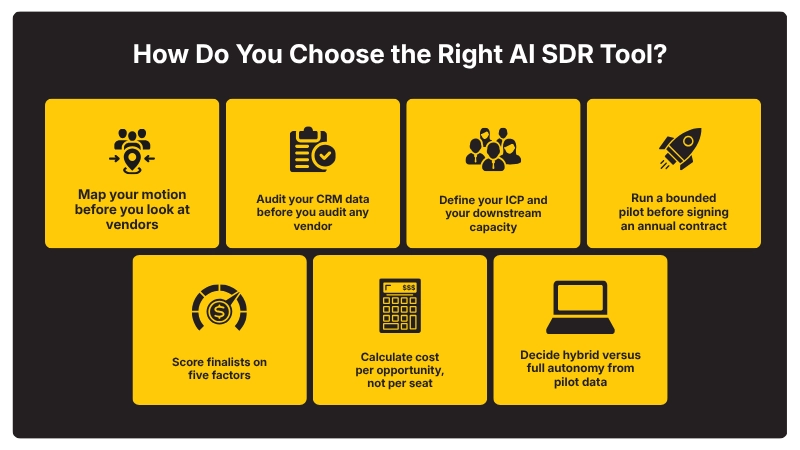
1. Map your motion before you look at vendors
Are you maximizing outbound volume, converting inbound traffic faster, or giving reps a productivity lift? Autonomous agents such as 11x, Artisan, and AiSDR fit outbound volume. Inbound tools such as Qualified fit website traffic. Augmentation tools such as Regie.ai fit reps you already trust.
2. Audit your CRM data before you audit any vendor
A brilliant AI SDR running on a stale, unverified contact list will underperform a mediocre one running on clean data. Fix the data foundation first.
3. Define your ICP and your downstream capacity
Outbound volume has risen roughly sixfold industry-wide since AI SDRs launched. If your team cannot handle a proportional increase in qualified replies, added volume will bury you rather than help you.
4. Run a bounded pilot before signing an annual contract
Four to six weeks, on one narrow segment, tracking response rate, meeting-to-opportunity conversion, and cost per qualified opportunity against your current baseline.
5. Score finalists on five factors
Autonomy level, deliverability and data ownership, CRM integration depth, pricing transparency, and how easily a human can review output before it sends.
6. Calculate cost per opportunity, not per seat
Compare it to your fully-loaded human SDR benchmark before you scale the contract.
7. Decide hybrid versus full autonomy from pilot data
Use your pilot’s actual numbers, not the vendor’s demo.
If step two turns up more data problems than you expected, that’s common. It’s also exactly what our outsourced SDR program is built to fix before any AI layer gets added on top.
AI Risk Tech Firm Builds Fintech and Ecommerce Pipeline with Callbox
See how this played out for an AI fraud detection client, where a structured six-month outbound program produced 59 sales-qualified leads and 827 marketing-qualified leads across fintech and ecommerce accounts.
View Case StudyWhich AI SDR Tools Lead the Market in 2026?
The AI SDR market has moved fast. Fewer than 10 dedicated platforms existed in 2020; more than 60 were active by 2024, according to G2’s Sales Automation Market Report. The table below profiles seven of the most established platforms as of 2026, spanning fully autonomous agents, augmentation copilots, and inbound-focused tools.
| Company | HQ | Best For | Core Strength | Global Reach |
| 11x (Alice / Julian) | San Francisco, CA | Enterprise autonomous outbound plus inbound voice qualification | Full-stack autonomous digital workers covering research, outreach, reply handling, and phone qualification | Deployed at global enterprise accounts including Merck, PwC, and Xerox; English-first with expanding voice language support |
| Artisan (Ava) | San Francisco, CA | Teams replacing an entire outbound stack with one vendor | Bundled 300M plus contact data graph with owned deliverability infrastructure and dedicated IPs | Worldwide contact coverage; outreach primarily built for English-language markets |
| AiSDR | San Francisco, CA | SMB and mid-market teams on a transparent budget | Publicly listed quarterly pricing starting near $900 a month with fast setup | Serves SMB and mid-market customers across North America and Europe |
| Regie.ai | San Francisco, CA | Teams keeping reps inside Outreach or Salesloft | Content and sequence copilot that upgrades an existing workflow instead of replacing it | North America-centric enterprise customer base |
| Qualified (Piper) | San Francisco, CA | Converting inbound website traffic in real time | Salesforce-native digital SDR that engages and books meetings from site visitors | Serves Salesforce customers worldwide; enterprise-weighted |
| Apollo.io | San Francisco, CA | Budget-conscious teams wanting data and AI in one platform | 275M plus contact database paired with per-seat AI assistant pricing | 600,000 plus companies across virtually every region and industry |
| Clay | New York, NY | Technical GTM teams building custom enrichment workflows | Access to 100 plus data providers orchestrated through a no-code workflow builder | 10,000 plus customers including global enterprises; offices in New York, San Francisco, and London |
Pricing and feature sets change quickly in this category. Confirm current terms directly with each vendor before budgeting.
Which AI Tools Help B2B Companies Generate Quality Leads?
An AI SDR is only one piece of the stack. Most B2B teams pair it with intent data, enrichment, and inbound-conversion tools to generate quality leads end to end. The table below profiles eight tools spanning intent data, enrichment, conversational AI, and deliverability infrastructure.
| Tool | Category | What It Does | Best For |
| 6sense | Account Intent Data & ABM | Predicts which accounts are already in-market using third-party intent signals and de-anonymized web traffic | Enterprise ABM teams prioritizing high-intent accounts |
| Bombora | B2B Intent Data | Tracks content-consumption signals across a co-op data network to flag active buyer research | Layering intent signals onto an existing outbound program |
| Clay | Data Enrichment & Workflow Orchestration | Pulls from 100+ data providers to enrich, score, and route leads automatically | Technical GTM teams building custom scoring workflows |
| Apollo.io | Prospecting Database + AI Assistant | Combines a 275M+ contact database with an AI assistant for research and outreach | Budget-conscious teams wanting data and AI in one platform |
| Qualified (Piper) | Conversational AI for Inbound | Engages website visitors in real time and books meetings automatically | Converting inbound website traffic into qualified pipeline |
| Drift (by Salesloft) | Website Chat & Conversational Marketing | Uses AI chat agents to qualify site visitors and route hot conversations to reps | Real-time, on-site lead capture, now integrated into Salesloft |
| HubSpot Breeze | AI-Powered CRM & Lead Scoring | Enriches records from 200M+ buyer and company profiles and applies predictive lead scoring inside the CRM | Teams already running their pipeline on HubSpot |
| Instantly | Email Deliverability Infrastructure | Manages inbox rotation, warmup, and multi-inbox sending to protect sender reputation at volume | Teams scaling outbound email without hurting deliverability |
Most teams combine two or three of these categories (for example, intent data plus an AI SDR plus deliverability infrastructure) rather than relying on a single tool.
Where Do AI SDR Tools Fall Short?
AI SDR tools are not the right fit for every team, and being upfront about that is part of evaluating them honestly.
Complex, multi-stakeholder enterprise deals still need a human. AI SDRs win decisively on volume and consistency, while human SDRs win on nuance and navigating buying committees, according to Forrester’s B2B Sales Automation Landscape report for Q1 2026. The two are complementary, not interchangeable.
Full autonomy without review tends to trade relevance for volume, a direct result of AI sending more messages without a proportional lift in personalization quality.
Industry Insight, Volume vs. Reply Rate: Outreach volume and reply rates are moving in opposite directions industry-wide. Per-rep monthly outbound volume has risen roughly sixfold since AI SDRs entered the market, while raw reply rates have fallen by about a third over the same period, per 2026 benchmark data compiled from Apollo and ZoomInfo outbound reporting. More volume is not automatically more pipeline.
Data quality is the real bottleneck, more than the underlying model: a tool with excellent language generation running against a contact list that is even 30% stale will still underperform.
Disqualifiers: an AI SDR tool is probably the wrong next step if you do not yet have a defined ICP, a CRM with verified and current contact data, or the internal bandwidth to review AI-drafted outreach before it sends. Fix those gaps first, either internally or with a partner, before adding automation on top of a foundation that isn’t ready for it.
That foundation-first approach is exactly how our 14-month ABM campaign for a managed services provider generated 700 sales appointments: AI-powered targeting, layered on a verified account list a human team built and maintained.
Conclusion
AI SDR tools generate more B2B leads when they take on the mechanical work of prospecting, research, personalization, and follow-up, while a human stays in the loop to protect relevance and reply rates. HubSpot’s own data shows the pattern clearly: adoption is now the default, time savings are real but modest, and the teams getting the strongest ROI pair AI’s volume with human review rather than replacing reps outright. Use the ROI formula and the seven-step selection methodology above to judge any vendor on cost per qualified opportunity, not on a demo. Whichever tool you choose from the comparison tables, the foundation, a defined ICP and clean CRM data, matters more than the platform sitting on top of it.
Frequently Asked Questions
How does an AI SDR tool actually work?
Most AI SDR tools pull account and contact data from a database or CRM, use a language model to draft personalized messages, sequence multi-channel outreach, and route qualified replies to a human rep or an automated booking flow.
Can an AI SDR fully replace a human SDR?
Not reliably for complex B2B sales. AI SDRs handle volume and consistency well, but human SDRs still outperform on nuanced, multi-stakeholder conversations, which is why hybrid AI-plus-human models produce the strongest cost-per-opportunity results.
What are the benefits of using an AI SDR?
Faster account research, higher outreach volume without added headcount, and freed-up rep time. HubSpot survey data shows 64% of sales professionals save one to five hours a week from AI-driven task automation.
How do you calculate ROI on an AI SDR deployment?
Weigh the fully-loaded cost (platform fee, data costs, human oversight hours) against the value of qualified pipeline generated (meetings booked times conversion rate, deal size, and close rate), then compare cost per qualified opportunity to your human SDR benchmark.
Which AI SDR tool has the best features?
There is no single best tool. Autonomous agents like 11x and Artisan fit high-volume outbound, inbound tools like Qualified fit website conversion, and augmentation tools like Regie.ai keep reps in control of every send.