How to Generate B2B Leads in LATAM: A Practical Guide to Outsourced SDR Support
Learn how to generate leads in LATAM with outsourced SDR support. Explore regional targeting, sales outreach, and strategies for qualified B2B opportunities.
 Yza Belle Tinampay
 is an SEO/AEO Content Writer at Callbox with 9 years of experience in content creation and strategy. She specializes in writing search-optimized blog content that improves online visibility, strengthens topical authority, and helps businesses reach their target audiences through strategic, reader-focused content.
View full bio of Yza Belle Tinampay
 Quick answer: To generate B2B leads in LATAM, start with one or two markets (usually Mexico, Brazil or Colombia), localize language and channels for each, and comply with each country's data protection law. An outsourced SDR team gets you live in weeks instead of the months it takes to hire, train and ramp a local team.
Most B2B teams that stall in Latin America don’t fail on product. They fail because they copy a US outbound playbook: one language, one cadence, email-first, and a single list for a region of 20+ countries with different laws, buying habits and channels. Whether you’re a US company planning to expand to Latin America or a LATAM company growing across borders, the fix is the same: pick markets deliberately, localize the motion, and decide early whether to hire SDRs or bring in an outsourced SDR team.
Having Trouble Reaching Decision-Makers Across LATAM?
Why build B2B pipeline in Latin America?
Latin America is worth the effort because decision-makers are reachable at scale, in your time zone, in markets most competitors still treat as an afterthought.
- The buyers are online. LinkedIn now has 100 million members in Brazil, its third-largest market after the US and India, and about 27 million in Mexico.
- The hours work. Mexico City, Bogotá and Lima sit within one to two hours of US Central and Eastern time, so SDRs, account executives and buyers share a working day.
- Growth is modest, so precision wins. The IMF expects regional GDP to grow about 2.3% in 2026. In a market that isn’t booming, the companies that win are the ones targeting the right accounts, not the ones sending the most emails.
Callbox has run more than 1,000 campaigns across 10+ Latin American markets from its regional hub in Medellín, Colombia. The pattern we see most: teams that treat LATAM as one market burn their first quarter. Teams that pick one or two countries and localize properly book meetings within weeks.
Which LATAM countries should you target first?
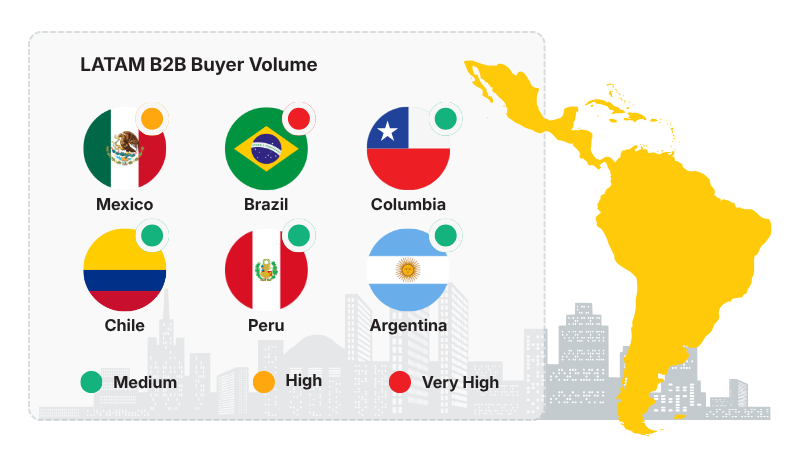
For most B2B companies, start with Mexico or Colombia if you sell from the US, and Brazil if you have Portuguese capacity and a longer runway. Score each market on five things before you commit: buyer volume in your ICP, language fit, time-zone overlap, regulatory effort and how mature your category is locally.
Country | Language | Time zone vs. US Eastern | B2B buyer volume | Regulatory effort | Best first move for |
Mexico | Spanish | 1 hour behind (2 during US daylight time) | High | Medium | US companies, manufacturing, logistics, SaaS |
Brazil | Portuguese | 1 to 2 hours ahead | Very high | High | Companies with Portuguese-speaking SDRs and a 6+ month view |
Colombia | Spanish | Same as Eastern (1 hour behind during US daylight time) | Medium | Medium | Tech, BPO, fintech; a strong regional test market |
Chile | Spanish | 0 to 2 hours ahead (both countries shift clocks) | Medium | Rising (new law in force) | Enterprise, mining, energy, financial services |
Peru | Spanish | Same as Colombia | Medium | Medium | Mining, infrastructure, financial services |
Argentina | Spanish | 1 to 2 hours ahead | Medium | Medium | Software and tech services; watch currency volatility |
Scores are Callbox’s working assessment from LATAM campaign experience, not a formal index.
Common mistake: launching five countries at once with one Spanish script. You split budget, can’t tell what’s working and never reach statistical confidence anywhere. Start with one or two, prove a meeting rate, then expand.
Explore the leading lead generation agencies in LATAM and discover which partners can strengthen your regional campaigns, reach qualified prospects, and drive sustainable pipeline growth.
How does B2B prospecting differ in LATAM, and how do you localize it?
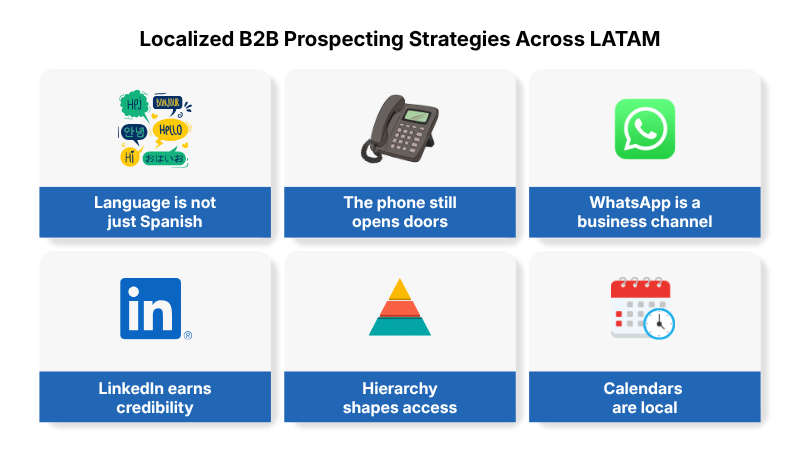
LATAM prospecting runs on relationships, the phone and messaging apps more than on cold email alone. Expect more touches, more live conversations and a longer path from first reply to qualified meeting than in the US.
- Language is not just Spanish. Brazil needs native Portuguese. Spanish also shifts by country: usted vs. tú, vocabulary and tone differ between Mexico, Colombia and Argentina.
- The phone still opens doors. Decision-makers in many LATAM markets expect a conversation before a meeting. A cold call that references the prospect’s company and market lands better than a fourth email.
- WhatsApp is a business channel. Once a prospect has engaged, WhatsApp is often where follow-up, scheduling and confirmations happen. Get consent before moving a conversation there.
- LinkedIn earns credibility. Senior buyers check who is calling. A complete, local-language profile for every SDR matters as much as the message.
- Hierarchy shapes access. In family-owned and traditional enterprises, the economic buyer is often senior and protected. Plan multi-threaded outreach to influencers and assistants, not a single contact.
- Calendars are local. Avoid Semana Santa, late December through mid-January and Brazil’s Carnival when planning launch dates.
Common mistake: measuring LATAM email reply rates against US benchmarks and killing the program early. Compare channels by qualified meetings, not replies.
Ready to expand into LATAM? Before entering the market, discover how to build a strategic go-to-market plan that drives successful expansion.
In-house vs. outsourced SDR: which is better for LATAM?
An outsourced SDR team is usually the better first move in LATAM: it’s faster to launch, cheaper to test and doesn’t require a local legal entity. Hire in-house once a market has proven its meeting rate and you’re ready to commit long term.
Factor | In-house SDR team | Outsourced SDR team |
Time to first meetings | Typically 4 to 6 months (entity, hiring, training, ramp) | Typically 4 to 8 weeks |
Local entity and payroll | Required, or an employer-of-record | Not required |
Language coverage | One hire per language and market | Spanish and Portuguese speakers from day one |
Data, tools and dialers | You buy and integrate them | Included in the program |
Compliance | You build the processes | Partner runs consent, opt-out and do-not-call checks |
Flexibility | Hard to scale down or switch countries | Add or pause markets by quarter |
Control and product depth | Highest | Shared; needs strong onboarding and feedback loops |
Best for | Proven markets, long-term presence | Market entry, testing, fast expansion |
Timelines are typical ranges from Callbox program experience, not industry benchmarks.
For LATAM-based companies growing across the region, the logic is the same: hiring an SDR in each new country multiplies fixed cost before you know which market will pay off. Outsourced sales development lets you test Mexico and Colombia, for example, in the same quarter.
Common mistake: going outsourced and then treating the partner as a vendor. The best programs share CRM access, weekly call reviews and closed-loop feedback on every meeting.
What does outsourced SDR support include?
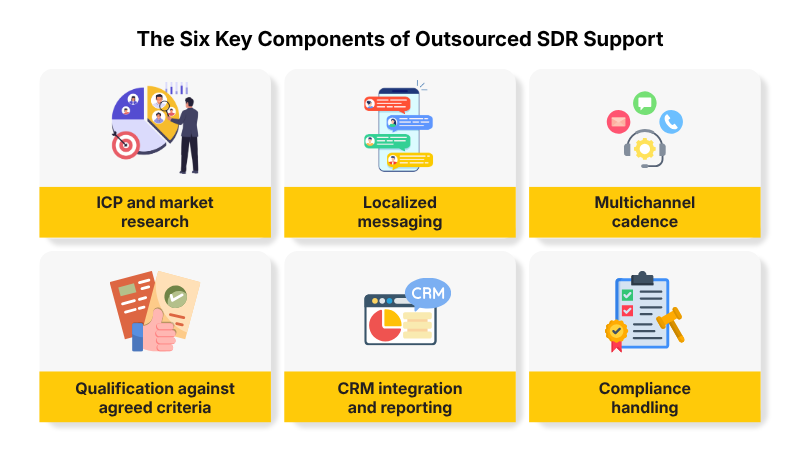
A complete outsourced SDR program covers everything from list to booked meeting: research, messaging, multichannel outreach, qualification and reporting. If a provider only sends email, it’s an email agency, not an SDR team.
At minimum, expect:
- ICP and market research: account and contact lists built for each target country, with buying committees mapped.
- Localized messaging: scripts and sequences written natively in Spanish or Portuguese, adapted by market and vertical.
- Multichannel cadence: calls, email, LinkedIn and messaging apps, run in the prospect’s language and working hours.
- Qualification against agreed criteria: every meeting checked against your BANT or custom criteria before it reaches your calendar.
- CRM integration and reporting: activity, meetings and pipeline logged in your CRM, with weekly reviews and continuous optimization.
- Compliance handling: consent records, opt-out processing and do-not-call list checks for each country.
Ready to outsource your LATAM lead generation campaign?
What data privacy rules apply to B2B outreach in LATAM?
Every major LATAM market has a national data protection law, and several add their own calling rules. B2B outreach is allowed, but you need a lawful basis for using contact data, a clear privacy notice, a working opt-out and a check against local do-not-call lists.
Country | Main law | What to watch for outbound | Status (Nov 2026) |
Brazil | LGPD (Law 13.709/2018), enforced by the ANPD | Legitimate interest must be documented. The 0303 telemarketing prefix became optional in August 2025; Anatel now favors verified caller ID (“Origem Verificada”) for high-volume callers. Check the Não Me Perturbe list, an industry-run block list that covers telecom and bank offers. | In force; federal prosecutors have asked Anatel to restore 0303 |
Mexico | New LFPDPPP, in force since March 21, 2025 | Privacy notice (aviso de privacidad) required; oversight moved from INAI to the Secretaría Anticorrupción y Buen Gobierno. Check PROFECO’s REPEP do-not-call registry. | In force; a stricter consumer-law reform (fines up to MXN 2.35 million, covering WhatsApp and outsourced call centers) passed the Senate in October 2026 and is pending in the lower house |
Colombia | Law 1581 of 2012 (Habeas Data) and Law 2300 of 2023 | Commercial calls, texts, messaging-app messages and emails limited to Monday to Friday 7 a.m. to 7 p.m. and Saturday 8 a.m. to 3 p.m., never Sundays or holidays. Check the CRC’s Registro de Números Excluidos, which covers all of those channels. The law protects consumers; treat it as the default for B2B too. | In force |
Chile | Law 21.719, replacing Law 19.628 | New Data Protection Agency; fines up to 20,000 UTM, rising to 2% or 4% of annual revenue for repeat serious breaches by larger companies. | Takes effect December 1, 2026; a bill to delay it to December 2027 is pending in the Senate |
Peru | Law 29733 and its new regulation (Supreme Decree 016-2024-JUS, in force March 30, 2025) | Consent-based regime; personal databases must be registered with the national authority. | In force |
Argentina | Law 25.326 and Law 26.951 (Registro Nacional No Llame) | Check the No Llame registry before calling or texting. | In force |
This table is a planning guide, not legal advice. Confirm current requirements with local counsel before launch.
How to stay compliant in practice: process only business contact data (corporate email, job title, company phone), document your lawful basis per country, include a one-step opt-out in every touch, scrub lists against each do-not-call registry before every campaign, and honor opt-outs across all channels, including WhatsApp. Hiring a partner doesn’t transfer your legal responsibility, so ask how they handle each step. Callbox applies the same data minimization and legitimate-interest approach it uses for GDPR compliance to its LATAM programs.
Which metrics should you track in a LATAM SDR program?
Track qualified meetings and pipeline per country, not activity volume.
Metric | Why it matters in LATAM |
Connect rate by channel and country | Shows whether phone, email, LinkedIn or WhatsApp works best in each market |
Qualified meetings per month | The core output; define “qualified” before launch |
Meeting-to-opportunity rate | Tells you whether meetings are real or just polite |
Time to first qualified meeting | Your ramp benchmark for each new country |
Pipeline value and win rate by country | Shows which market deserves more budget |
Opt-out and complaint rate | An early warning for compliance and messaging problems |
How do you launch B2B lead generation in LATAM in 90 days?
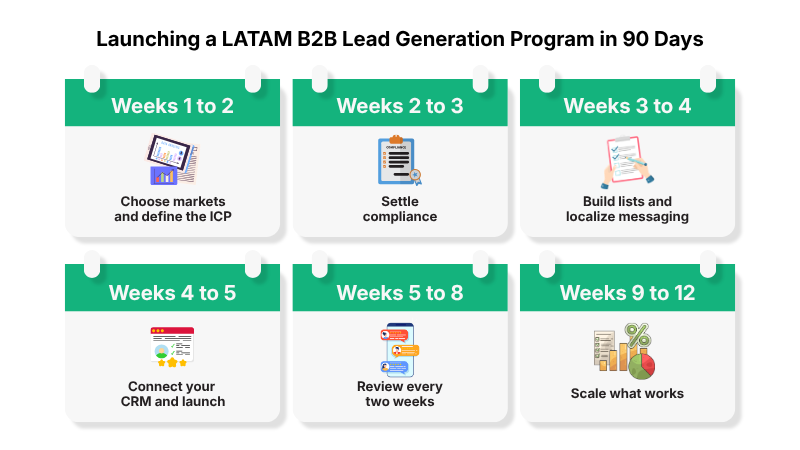
You can go from decision to a steady flow of qualified meetings in about 90 days if you launch one or two countries and review results every two weeks.
- Weeks 1 to 2: Choose markets and define the ICP. Score countries using the table above, pick one or two, and agree on what a qualified meeting means.
- Weeks 2 to 3: Settle compliance. Document your lawful basis, update privacy notices and set up do-not-call scrubbing for each country.
- Weeks 3 to 4: Build lists and localize messaging. Source accounts and contacts per country, then write native Spanish or Portuguese scripts and sequences.
- Weeks 4 to 5: Connect your CRM and launch. Start multichannel outreach in local working hours and log every touch.
- Weeks 5 to 8: Review every two weeks. Compare channels by qualified meetings, rework weak messages and test new segments.
- Weeks 9 to 12: Scale what works. Add SDR capacity or a second country only after the first one hits its meeting target.
With an outsourced SDR team, steps 1 to 4 often run in parallel, which is why programs can book first meetings within the first month. Discover why US companies are expanding B2B sales into Latin America and how outsourcing SDR teams can accelerate market entry, streamline prospecting, and generate qualified sales meetings.
Ready to open pipeline in Latin America?
The fastest path is one or two well-chosen markets, native-language outreach and compliance built in from day one. Callbox has run 1,000+ LATAM campaigns across Mexico, Brazil, Colombia, Chile, Peru and Argentina. See how Callbox handles B2B lead generation in Latin America and request a strategic diagnosis for your target markets.
Sources
- LinkedIn: 100 million members in Brazil (June 2026)
- NapoleonCat: LinkedIn users in Mexico (2026)
- MercoPress: IMF LATAM 2026 outlook (October 2026)
- Meio & Mensagem: Anatel ends mandatory 0303 (August 2025)
- Olhar Digital: MPF asks Anatel to restore 0303 (January 2026)
- Garrigues: Mexico’s new LFPDPPP (March 2025)
- CRC Colombia: Law 2300 scope and RNE channels (March 2025)
- BCN Chile: Law 21.719 and Cuatrecasas: proposed delay
- Prey: Law 21.719 fines (May 2026)
- El Imparcial: Mexico Senate approves stricter call fines (October 2026)
- Peru: Supreme Decree 016-2024-JUS (November 2024)
- Argentina: Registro Nacional No Llame
Frequently Asked Questions
What hours should a LATAM SDR team work?
The prospect’s local business hours. In Colombia, commercial calls and messages are legally limited to weekdays 7 a.m. to 7 p.m. and Saturdays 8 a.m. to 3 p.m., and that window is a sensible default across the region.
Which languages does a LATAM SDR program need?
Native Spanish for Spanish-speaking markets and native Portuguese for Brazil. English helps with multinationals’ regional offices but shouldn’t be the default.
How is outsourced SDR support priced?
Most programs use a monthly retainer based on SDR capacity, sometimes with performance components per qualified meeting. See Callbox’s LATAM pricing for current models.
Is cold calling legal in LATAM?
Yes, B2B cold calling is legal in the major markets, provided you follow each country’s data protection law, contact-hour rules and do-not-call registries.