How to Choose an Appointment Setting Company: 12 Questions to Ask Before You Sign
Hiring an appointment setting company? Ask these 12 questions about qualification, no-shows, handoff and pricing before you sign.
 Jude Neilson
Jude Nielson is a Business Development Manager at Callbox Inc, with 16 years of experience driving B2B growth through strategic lead generation and sales development.
View full bio of Jude Neilson
To choose an appointment setting company, ask every vendor on your shortlist the same 12 questions about qualification, data, callers, show rates, no-shows, reporting, handoff, CRM access and pricing. Then pick the one that answers in writing, with specifics, and lets you test before you commit.
That’s the whole method. The rest of this guide explains what a good answer sounds like, and what a bad one usually turns into three months later.
Why this decision is harder than it looks
Here’s a scene most sales leaders will recognize. It’s Tuesday morning. Your account executive has three meetings booked by an outside team. The first prospect doesn’t show. The second is a junior analyst who “was just curious.” The third is a good fit, but the rep walks in knowing nothing beyond a name and a phone number, so the first fifteen minutes go to discovery the caller should already have done.
On paper, that’s three appointments delivered. In practice, it’s one usable conversation and a rep who has started to distrust every meeting on the calendar.
That gap between meetings booked and meetings worth taking is what separates appointment setting companies from each other. It rarely shows up in a sales pitch. Everyone says they book qualified meetings with decision-makers. The difference shows up in how a vendor answers specific, slightly uncomfortable questions.
The stakes are real. Reps spend only about two hours a day actively selling, according to HubSpot’s sales statistics. Every no-show or poor-fit meeting comes out of that time.
We’ve run outsourced appointment setting at Callbox since 2004, so the questions below come from the calls we have with buyers who’ve been burned before. Use them on every vendor you talk to. That includes us.
Want a Consistent Flow of Qualified Sales Appointments?
What does an appointment setting company actually do?
An appointment setting company runs outreach to the accounts you want to win, has real conversations with the people inside them, and books qualified sales meetings on your reps’ calendars. In a full-service setup, that usually covers five jobs:
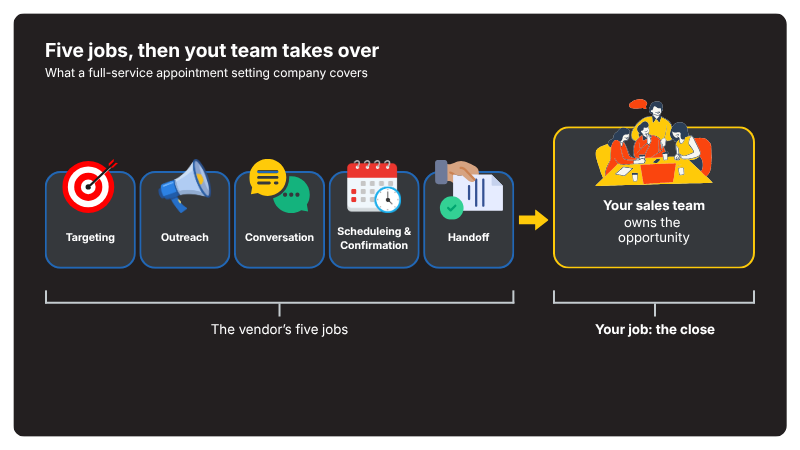
- Targeting: turning your ideal customer profile into a verified list of accounts and the people who influence the purchase.
- Outreach: phone, email and LinkedIn working as one campaign, not three disconnected sequences.
- Conversation: an appointment setter who can talk about the buyer’s problem, handle a pushback and judge whether a meeting is worth anyone’s time.
- Scheduling and confirmation: getting the meeting on both calendars and making sure it actually happens.
- Handoff: passing your rep the context they need to pick up where the caller left off.
What it shouldn’t be doing is closing deals, inventing your positioning or quietly redefining “qualified” to hit a monthly number. Your sales team owns the opportunity and the close. A good partner is clear about where its job ends.
It’s also worth knowing what you’re not buying. A contact list is data. An AI tool that sends sequences is software. Both can be useful, but neither is an appointment setting company, because neither takes responsibility for the conversation that turns interest into a meeting.
From the Callbox floor: AI now does a lot of the research work in our campaigns: enriching data, mapping buying committees and prioritizing accounts. But our SDRs still make the calls. Automation without human judgment falls flat, and human effort without data doesn’t scale. The vendors worth hiring use both, and can tell you exactly where one hands off to the other.
Related: Finding The Right Clients with Appointment Setting
Before you call a single vendor
The best vendor conversations happen when you’ve done some homework first. Settle three things inside your own team, and every answer you hear afterward becomes easier to judge.
1. Write down your ideal customer profile. Industry, company size, region, the roles involved and the problems they’re trying to solve. Callbox team puts it simply in its guide to doing appointment setting right: a clearly defined ICP lets you focus on the leads most likely to convert, which saves time and improves results. If your team can’t agree on the profile, no vendor will fix that for you.
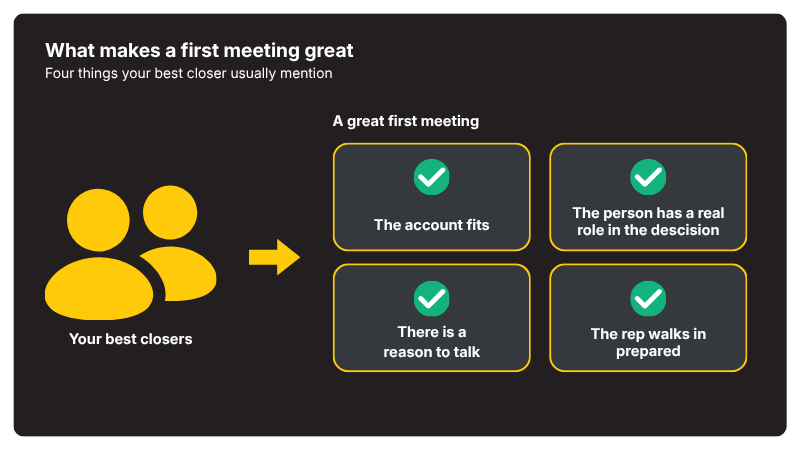
2. Agree what a “good meeting” means to your reps. Ask two or three of your best closers what made their last great first meeting great. You’ll usually hear some version of the same four things: the account fit, the person had a real role in the decision, there was a reason to talk, and the rep walked in prepared. Those become your qualification criteria.
3. Check that someone will take the meetings. It sounds obvious. But if your reps can’t follow up within a day or two, good meetings go cold, and you’ll end up blaming the vendor for a capacity problem.

US-based IT GRC Services Company Gains 180 Sales Appointments
Over the course of the campaign, the Callbox team was able to set 180 Sales Appointments and 320 Marketing-Qualified Leads.
View Case StudyWith those three settled, you’re ready for the questions.
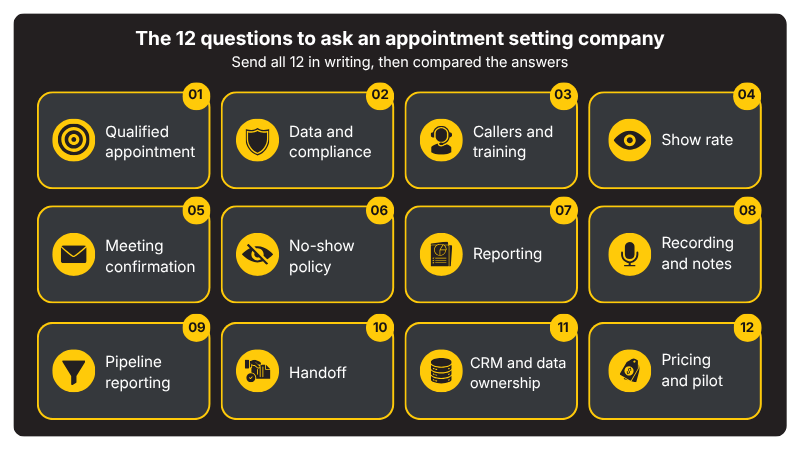
The 12 questions to ask an appointment setting company
- How do you define a qualified appointment, and can we set the criteria?
- Where does your contact data come from, and how do you keep it compliant?
- Who will be calling our prospects, and how do they learn our product?
- What is your show rate, and how do you measure it?
- How do you confirm meetings before they happen?
- What happens when a prospect doesn’t show up?
- What will we see in reporting, and how often?
- Can we listen to call recordings and read conversation notes?
- Do you report on pipeline, or only on meetings booked?
- How do you hand off each appointment to our sales team?
- Will you work inside our CRM, and who owns the data?
- How is pricing structured, and can we start with a pilot?
1. How do you define a qualified appointment, and can we set the criteria?
This is the question that decides everything else, so ask it first.
A qualified appointment is a meeting with someone who meets criteria you and the vendor agreed on before launch. That usually means company size, role, a confirmed business need and some sense of timing. The strongest appointment setting companies write those criteria into the statement of work, so a meeting that misses them doesn’t count toward what you pay for.
Listen for whether the vendor asks about your sales motion before answering. A vendor that hands you a fixed definition is telling you its meetings will fit its model, not yours. At Callbox, qualifying questions are set per campaign, and the dashboard shows each prospect’s answers next to the booked meeting.
 Tip: Once the campaign is live, pull five booked meetings in week two and check each one against the criteria. Catching drift early is far cheaper than arguing about invoices in month three.
2. Where does your contact data come from, and how do you keep it compliant?
Every meeting starts with a list, and a bad list wastes weeks. Ask which databases the vendor uses, how often records are re-verified and how opt-outs are handled under rules such as GDPR and TCPA.
Our own view is blunt: appointment quality is only as good as the data behind it. That’s why Callbox combines ZoomInfo, LinkedIn and its own database, keeps a team enriching records continuously, and maps buying committees rather than single contacts. Ask any vendor to walk you through the same thing, and to show you its compliance policy.
Red flag: “We have millions of contacts.” Size isn’t the point. Freshness and fit are.
3. Who will be calling our prospects, and how do they learn our product?
The person on the phone is your brand for the length of that call. Find out whether callers are dedicated to your account or shared across clients, what industries they’ve worked in and how they’re trained on your offer.
Ask who writes and approves the script, and how your reps’ feedback gets back to the callers. Good scripts change. Callbox’s guidance to its own teams is to A/B test messaging regularly, because what worked last quarter can fall flat today, and to keep scripts natural enough to leave room for a real conversation.
Then ask for a case study in your industry. A team that books IT directors may struggle with plant managers.
Related: Best B2B Appointment Setting Companies in the USA
4. What is your show rate, and how do you measure it?
Show rate is the share of booked meetings the prospect actually attends. It sounds simple, but ask how it’s calculated. Some vendors quietly drop rescheduled or cancelled meetings from the count, which makes the number look better than your reps’ calendars do.
Treat any single headline figure with caution. Show rates move with industry, buyer seniority, offer and even the time of year, so another client’s number says little about your campaign. What matters more is how the vendor protects attendance, which is what the next two questions cover. Check out the B2B Prospecting Strategies
5. How do you confirm meetings before they happen?
One calendar invite isn’t a confirmation process. Good appointment setting companies confirm more than once, across more than one channel: an invite when the meeting is booked, a reminder email the day before and a confirmation call on the day.
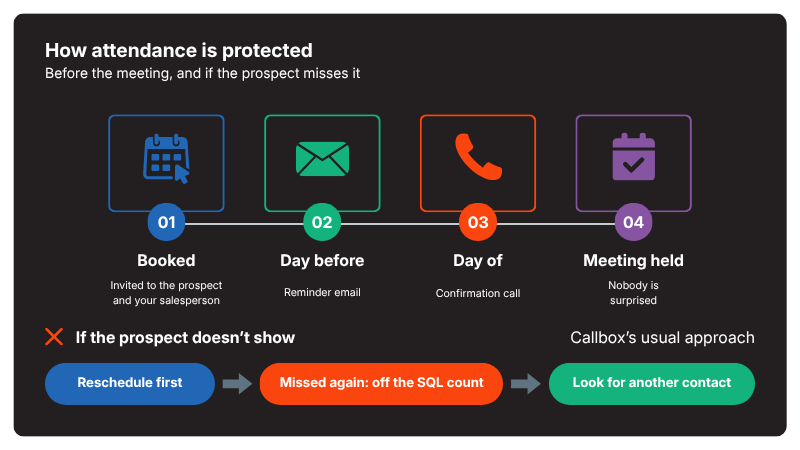
Each touch catches conflicts early. In our experience, multi-touch engagement does more for show rates than almost anything else a vendor controls. At Callbox, the calendar invite goes to both the prospect and your salesperson, so nobody is surprised.
6. What happens when a prospect doesn’t show up?
A vendor’s no-show policy tells you who carries the risk of a missed meeting. Ask whether the company reschedules it, replaces it or removes it from what you’re billed for.
A vendor that’s confident in its qualification will rebook or replace a missed meeting rather than count it as delivered. Terms vary by contract, but Callbox’s usual approach is to reschedule first. If the prospect misses again, the meeting comes off the count of sales-qualified leads, and the team looks for another contact at the same company. If no one is found, it stays off the count.
Get the policy in writing. It’s the clause you’ll care about most in month two.
Tired of Cold Calls That Never Turn Into Conversations?
7. What will we see in reporting, and how often?
A monthly total tells you almost nothing. You want to see every booked appointment, the details behind it and the work still in progress: outreach activity, conversations, meetings booked and meetings held. That’s how you spot a weak list or a tired message while there’s still time to fix it.
Ask for a live demo of the actual dashboard, not a slide of it. In Callbox Pipeline, each sales-qualified lead appears with its call details, the prospect’s company profile and their answers to the qualifying questions, alongside MQL counts and the prospects the team is still trying to reach.
Also ask how often you’ll review results together. Data is useful. A conversation about what the data means is where campaigns get better.
Related: Learn How to Identify MQL vs SQL vs SQO
8. Can we listen to call recordings and read conversation notes?
Recordings and notes let you hear how your brand is represented and why prospects said yes or no. They’re also the fastest way to sharpen messaging.
Vendors handle this differently. Some put recordings in the dashboard. Others, Callbox included, provide them on request. Either works as long as the process is clear and notes on every booked meeting come as standard. A vendor that won’t share recordings at all leaves you no way to check the conversations you’re paying for.
One practical note: recording consent rules vary by country and state, so ask how the vendor handles them in your target regions.
9. Do you report on pipeline, or only on meetings booked?
Meetings are an early signal, not the result. A good vendor reports every stage, from identified prospects to marketing-qualified leads to sales-qualified appointments, and works with your CRM data to see which meetings turn into opportunities.
Vendors that only report meetings will, sooner or later, optimize for meeting volume. In one Callbox logistics campaign, reporting tracked 144 MQLs alongside 82 appointments, so the client could see pipeline that hadn’t yet turned into meetings.
Industry insight: Enterprise deals rarely hinge on one meeting. HubSpot puts the average at five decision-makers per sale (HubSpot). Ask vendors how they book follow-up conversations with other stakeholders at the same account, not just the first contact.
10. How do you hand off each appointment to our sales team?
Remember the rep from the opening, walking into a meeting with nothing but a name? This question is how you avoid that.
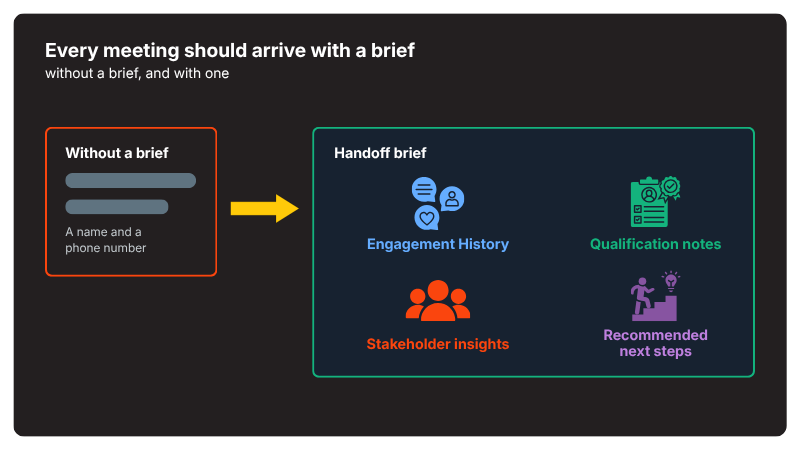
Every booked meeting should arrive with a brief. At Callbox, every appointment is delivered with engagement history, qualification notes, stakeholder insights and recommended next steps. That lets your rep open the call as someone who already understands the prospect’s situation, not as another cold caller.
Ask to see a real, anonymized handoff, and ask when it’s delivered. A brief that lands five minutes before the call isn’t much help. You can see how the Callbox handoff works in this short video.
11. Will you work inside our CRM, and who owns the data?
Appointments, notes and contact updates should flow into your CRM, because your CRM is where your team works and where your revenue is measured. Your contract should also say, plainly, that you keep all contact and conversation data when the engagement ends.
Data that lives only in a vendor’s system leaves with the vendor, along with everything you learned during the campaign. Ask which CRMs the vendor supports and whether the sync is automatic. Callbox integrates with the CRM a client already uses, so appointments land where the team already works.
12. How is pricing structured, and can we start with a pilot?
Appointment setting pricing usually follows one of three models: per appointment, a monthly retainer or a mix of both. Your number will depend on market, coverage, channels and languages.
The definition of a billable meeting matters more than the rate. A vendor that bills for no-shows or poor-fit meetings costs more than its price suggests. Ask what’s included, what counts as billable and how long the minimum term is.
Then ask about a pilot. A short test with agreed success metrics lets you judge fit before you sign anything long. See how appointment setting is priced for more on the common models.
How to work out whether an appointment setting company pays off
Judge ROI on closed revenue, not meetings booked. You need five numbers, and most of them are already in your CRM:
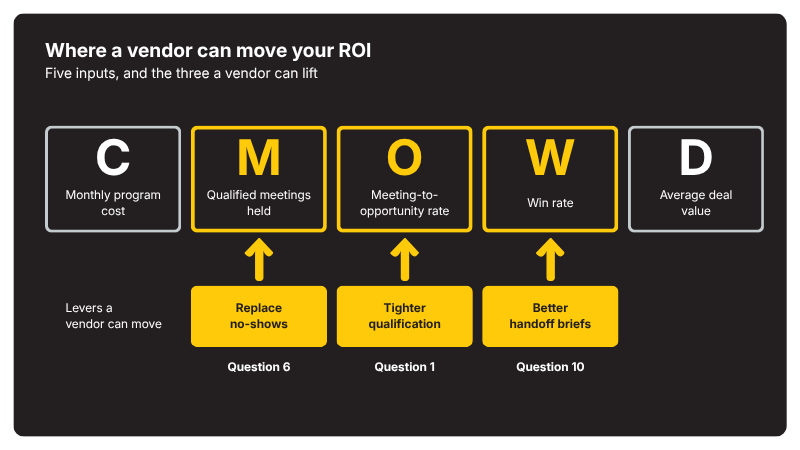
- Monthly program cost (C): the retainer plus any per-appointment fees.
- Qualified meetings held (M): meetings that met your criteria and actually happened, after no-shows are replaced.
- Meeting-to-opportunity rate (O): the share of held meetings your reps turn into real opportunities.
- Win rate (W): your own close rate on those opportunities. HubSpot puts the average sales win rate at 21% (HubSpot), but use your own number.
- Average deal value (D): first-year contract value, or lifetime value if you sell renewals.
Here’s a worked example. These are illustrative numbers, not a benchmark. Twenty qualified meetings a month, a 40% meeting-to-opportunity rate and a 21% win rate produce about 1.7 closed deals. At $30,000 per deal, that’s roughly $50,400 in revenue. Against a $10,000 monthly program cost, ROI comes out at about 4x.
Run the numbers with your own data. Your deal size, win rate and sales cycle will change this math a lot. See how Callbox prices lead generation and appointment setting to plug in a realistic program cost, or talk to our appointment setting team about what qualified meetings could look like for your market.
Notice which inputs a vendor can actually move. Tighter qualification lifts O. Replacing no-shows protects M. Better handoff briefs help your reps lift W. That’s why questions 1, 6 and 10 matter more than the headline price.
One caution: measure over at least one full sales cycle. Enterprise deals often close months after the first meeting, and a program judged in week six usually gets judged unfairly.
Still building your shortlist? Our roundup of the top appointment setting companies in the USA compares providers side by side, so you can run this ROI check on each one.
How to compare appointment setting companies side by side
Run every vendor through the same process, so you’re comparing answers rather than sales skills:
- Shortlist three to five vendors that serve your market and buyer level. Independent rankings help narrow the field; Callbox keeps a running list of the rankings it appears in, with links to each source so you can read the methodology yourself.
- Send all 12 questions in writing. Written answers are easier to compare and harder to walk back.
- Ask for proof. A live dashboard demo and a sample handoff brief settle questions 7 and 10 faster than any sales call.
- Check reviews and references using the steps in the next section.
- Score each answer as strong, acceptable or red flag, using the table below.
- Start with a pilot that has agreed success metrics.
# | Question | Strong answer | Red flag |
1 | Qualified appointment criteria | Written framework you can edit | “Anyone who agrees to a call” |
2 | Data sources and compliance | Named sources, refresh process, public policy | Unknown or purchased lists |
3 | Callers and training | Onboarding, script approval, industry results | Rotating callers, no training |
4 | Show rate | Clear formula and context | High number, no method |
5 | Meeting confirmation | Multi-touch sequence with timing | One calendar invite |
6 | No-show policy | Rebooks or replaces, in writing | No-shows count as delivered |
7 | Reporting | Live dashboard plus review calls | Monthly totals only |
8 | Recordings and notes | Clear access process, notes on every meeting | Won’t share recordings |
9 | Pipeline reporting | Every funnel stage, reviewed with you | Stops at the booked meeting |
10 | Handoff | Sample brief, delivered well before the call | Name and phone number only |
11 | CRM and data ownership | Integrates; ownership confirmed in writing | Data held in vendor system |
12 | Pricing and pilot | Clear model; defined pilot with exit terms | Long lock-in up front |
Red flags that should end the conversation
Some answers aren’t worth scoring. Walk away if you hear any of these:
- A price quoted before anyone asks about your market, deal size or sales cycle.
- A guaranteed number of meetings with no agreed qualification criteria behind it.
- No access to call notes, recordings or activity data.
- A long contract with no review point after onboarding.
- Reporting that stops at “meetings booked.”
How to check an appointment setting company’s reviews and references
Vendor answers tell you what a company promises. Past clients tell you what it delivers. Check both before you sign.
- Read reviews on independent platforms. Clutch and G2 verify reviewers. Skip past the five-star headlines and read the three- and four-star reviews; they usually describe the real trade-offs. For reference, Callbox is rated 5.0 on Clutch from 100+ reviews and 4.4 on G2 from 90+.
- Look for patterns, not one-offs. One unhappy client says little. Repeated comments about lead quality, caller turnover or slow reporting say a lot.
- Ask for a reference whose buyers look like yours. Same industry, similar deal size, ideally the same region.
- Ask references the hard questions. How many meetings became opportunities? What happened when one fell through? Would they sign again?
- Check the dates. A glowing review from three years ago may describe a team or process that has since changed.
It also helps to look at published results with real numbers. Callbox’s case studies include 57 sales appointments in three months for a US office-solutions business and 48 sales-qualified appointments for an AI software firm. Each reflects one specific campaign, not a promise for yours, and any honest vendor should say the same about its own case studies.
Ready to see how your pipeline stacks up?
The right appointment setting company will answer all 12 questions clearly, in writing, before you sign. Vague answers about qualification, no-shows or data ownership don’t get clearer once a campaign is live. They usually turn into the same vagueness on your invoice.
If you’re comparing vendors now, start with your own numbers. Book a pipeline audit with a Callbox strategist. We’ll look at your current outbound program, where qualified meetings are leaking out of your funnel, and how our appointment setting company team would answer these 12 questions for your market.
About Callbox: Callbox is a B2B lead generation agency founded in 2004. AI supports account research and prioritization; Callbox SDRs make the calls, qualify interest and book sales meetings for clients across North America, Asia-Pacific, Europe and Latin America.
Sources
- HubSpot sales statistics: selling time, decision-makers per sale, average win rate.
- Clutch review summary for Callbox: annual client spend range.
- Callbox: Why Callbox Ranks Among Top B2B Appointment Setting Agencies: data, multi-touch, AI-plus-human and handoff practices.
- Callbox Singapore: Appointment Setting, How To Do It Right: ICP and script-testing tips.
- Callbox case studies: campaign results cited.
Frequently asked questions
What does an appointment setting company do?
It runs outreach to your target accounts, qualifies interest in real conversations and books sales meetings for your reps, with a handoff brief for each one. Your team takes the meeting and owns the close.
What's the difference between appointment setting and lead generation?
Lead generation finds and qualifies potential buyers. Appointment setting turns qualified prospects into scheduled sales meetings. Many providers of B2B appointment setting services offer both, so check which outcome you’re paying for: leads, meetings or both.
Should we outsource appointment setting or hire in-house SDRs?
Outsourced appointment setting gives you a trained team, data and tools without the time and cost of hiring, ramping and managing SDRs. An in-house team gives you more direct control over messaging. Many companies outsource first to test a market or segment, then build in-house once the playbook is proven.
How long does it take to see the first appointments?
It depends on your market, your offer and how quickly onboarding, list building and script approval get done. Ask each vendor for a written timeline from contract signing to the first booked meeting, and hold them to it.
Do appointment setting companies use AI?
Most do, mainly for research, data enrichment and prioritizing accounts. The real difference is whether people or automation handle the live conversation and the qualification. Ask every vendor where that line sits.