Why Your Sales Team Needs Consistent Lead Generation
Is your sales team missing targets? See how lead generation strengthens the pipeline, frees reps to sell, and keeps quota in reach. Get a free consultation.
 Rebecca Matias
Rebecca Matias is Callbox's COO with 18 years of experience scaling B2B pipeline through data-driven outbound marketing, lead generation, and sales development.
View full bio of Rebecca Matias
Your sales team can only close opportunities that actually enter the pipeline.
When targets are missed, the immediate response is often to look at rep performance. Are reps making enough calls? Are they following up? Are they moving deals forward? Those questions matter, but sometimes the problem starts much earlier. Without a steady flow of qualified leads, even capable sellers eventually run out of real opportunities to work with.
That makes lead generation more than a top-of-funnel activity. It’s the system that keeps new conversations flowing into the pipeline, so reps can spend more of their time moving qualified buyers toward a decision.
Is your sales team ready for Q4’s lead gen challenges?
Missed Quota Is Often a Pipeline Problem
A sales target assumes there will be enough opportunities available to support it. When lead flow slows down, that assumption starts to fall apart.
Pipeline coverage gives sales leaders a clearer way to see whether the opportunities already in the funnel are enough to support the revenue target. HubSpot defines sales pipeline coverage as the ratio between the total value of opportunities in the pipeline and the revenue target for a given period. Tracking that coverage helps teams assess whether they have enough potential deals to meet quota and spot gaps before they become missed targets.
 Expert Tip:
Run a coverage check before a quota conversation, not after. If the funnel is below 3x the target at the start of the period, the gap was set in the previous quarter and no amount of rep pressure closes it.
A thin pipeline gives reps fewer deals to work with, less room for inevitable losses, and more pressure on every opportunity already in progress. The result can look like a closing problem even when the problem started further up the funnel.
This is why pipeline health needs to be examined alongside individual performance. Before asking a sales team to close more, sales leaders should also ask whether enough qualified prospects are entering the funnel to support the target.
So why don’t sales teams simply generate more pipeline themselves? For many teams, the answer comes down to time.

Callbox’s Expertise Powers LynnCo’s Sales Pipeline
Callbox’s AI-driven multi-channel approach and client focus have driven LynnCo’s growth in lead generation and sales. Their professionalism, flexibility, and real-time reporting make them a valuable partner in LynnCo’s growth.
View Case StudyYour Sales Team Doesn’t Have Time to Do Everything
Sales reps are expected to prospect, research accounts, update CRM records, follow up with leads, attend meetings, prepare proposals, and still find enough time to sell.

Salesforce’s 2026 State of Sales report shows how crowded that workload has become. Reps spend 60% of their week on non-selling work, and prospecting alone takes up almost a full day. Nearly half of reps (47%) say their team lacks the bandwidth for cold outreach.
That creates a difficult trade-off. The more time closers spend finding their next opportunity, the less time they have to advance the deals already in front of them.
That trade-off would be easier to manage if prospecting itself were getting easier. It isn’t.
Industry Insight
The 60% non-selling figure is often misread as a productivity problem. Most of that work is necessary, which is why the practical fix is reassigning tasks rather than asking reps to be more efficient at all of them.
Why B2B Buyers Are Harder to Reach
Finding prospects is only part of the challenge. Getting their attention requires more relevance than simply sending another generic sales message.

A 2025 Gartner survey of B2B buyers found that 73% actively avoid suppliers that send irrelevant outreach. Buyers still want seller input when it counts, though, such as when deciding whether a solution actually fits their needs.
Separate Gartner research on buying groups found they can range from 5 to 16 people across as many as four functions. Reaching these groups means understanding different priorities, identifying the right stakeholders, and keeping messaging relevant across the account. That’s where an account-based approach helps: outreach centers on high-value accounts and coordinates engagement with everyone involved in the purchase.
Industry Insight
A five to sixteen person buying group cannot be worked by one rep alongside a full close list. That arithmetic is the clearest argument for a dedicated prospecting function.
What Lead Generation for Sales Teams Actually Fixes
Lead generation for sales teams means more than a longer contact list. If done well, it addresses three problems that make pipeline growth difficult: capacity, relevance, and predictability.
First, it separates prospecting from closing. Dedicated resources can identify accounts, research contacts, qualify fit, and book qualified appointments with decision-makers while account executives stay focused on active opportunities.
Second, it improves relevance. Instead of broad outreach built around volume alone, lead generation can be organized around an ideal customer profile, buying signals, account context, and the stakeholders most likely to influence a decision.
Third, it creates a more predictable rhythm at the top of the funnel. A steady prospecting motion gives the sales team new opportunities to pursue instead of waiting until pipeline coverage drops before scrambling for leads.
Reps may still prospect, especially into strategic accounts. The difference is that closing no longer stops every time the funnel needs refilling.
The Hidden Cost of Building Pipeline In-House
One way to create that dedicated function is to build an internal SDR team. For companies with the management capacity and established outbound process to support it, an in-house model can make sense. But the operational burden extends beyond salary.
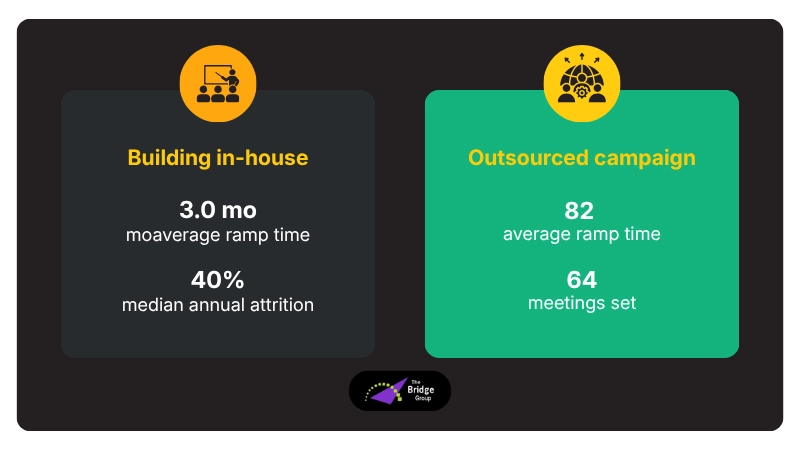
The Bridge Group’s 2025 SDR research, based on 351 B2B companies, reported an average SDR ramp time of 3.0 months and a median annual attrition of 40%. The sample leans North American and SaaS, so these figures are best treated as directional benchmarks.
Even with a relatively fast ramp, turnover can restart the recruiting, onboarding, and training cycle before a team has fully stabilized. Every departure also pulls managers back into hiring and coaching instead of pipeline strategy.
For teams weighing the two models, a full in-house vs. outsourced SDR cost breakdown can help separate the visible headcount expense from the broader cost of maintaining a sales development function.
Outsourcing Lead Generation Benefits for Sales Teams
Outsourcing offers another way to create a dedicated pipeline engine without building every part of it internally. A strong program brings together trained SDRs, reliable data, and multichannel outreach around a defined sales objective. A dedicated outsourced SDR team can handle that execution while the internal team focuses on qualified conversations.
The model can also produce measurable pipeline results. In one North American Callbox campaign, a U.S.-based cloud services provider generated 82 sales-qualified leads and set 64 meetings while targeting mid-market and enterprise buyers across North America.
Faster Time to Pipeline
An established partner already has SDRs, campaign processes, data resources, and outreach infrastructure in place. That removes much of the recruiting and setup work required to build a new team from scratch. For companies facing an immediate pipeline gap, that can make it easier to launch prospecting without waiting for a full internal hiring cycle.
Less Ramp-up and Turnover Risk
When an outsourced team handles sales development, the provider absorbs much of the day-to-day responsibility for recruiting, onboarding, training, and replacing SDRs. Internal sales leadership can stay focused on pipeline strategy, qualification standards, and closing rather than repeatedly rebuilding the prospecting team.
More Time for Closers to Close
If a partner handles research, outreach, qualification, and appointment setting, account executives get that time back for discovery, stakeholder alignment, and moving deals forward—areas where buyers want seller expertise most.
More Flexibility to Test New Markets
Outsourcing can also give companies room to test a new industry, territory, or account segment before committing to permanent headcount. The company still needs to own its positioning, ideal customer profile, qualification criteria, and sales strategy, but execution capacity can scale without rebuilding the internal team for every new initiative.
When Outsourcing Works Best
Outsourcing still needs a strategy behind it. Handing a vague target list to an external team and expecting a predictable pipeline is unlikely to solve the underlying problem.
The strongest programs start with clear definitions. Which accounts fit the ideal customer profile? Which roles matter inside those accounts? What makes a lead qualified? What information needs to be captured before a meeting is handed to sales? What happens after the handoff?
The internal sales team and the lead generation partner also need a feedback loop. If certain accounts convert better, messaging falls flat, or meetings repeatedly fail to meet qualification criteria, those insights should feed back into targeting and outreach.
In other words, outsourcing works best when it operates as an extension of the sales process, not as a disconnected appointment factory.
Is Your Target Problem Really a Pipeline Problem?
Before changing quotas, adding more pressure, or blaming closing performance, look at what is happening upstream. A few questions can help identify whether the real constraint is a lack of pipeline:
- Are reps spending a meaningful part of the week prospecting instead of advancing active deals?
- Does the team regularly enter a new month or quarter without enough qualified pipeline to support the target?
- Is lead flow uneven, with strong periods followed by long gaps?
- Are reps reaching the right stakeholders, or are opportunities stalling because outreach is too broad or too shallow?
- Are new markets, products, or territories being added without dedicated resources to create pipeline for them?
If several of these sound familiar, look at how your pipeline gets built before you look at how your reps perform.
Keep Your Sales Team Selling
Sales targets become harder to reach when pipeline generation is uneven. Closers can improve their follow-up, discovery, and negotiation skills, but they still need qualified prospects to work with.
A steady lead generation engine gives sales teams the capacity and pipeline coverage to spend their time turning the right conversations into revenue. Whether you build that function internally or with a partner, the objective is the same: keep the pipeline full before a shortage turns into a missed target.