SDR Outsourcing vs In-House: The Real Cost Math
Compare SDR outsourcing vs in-house costs, hiring, technology, and ROI. Find the most cost-effective sales development model for your business.
 Rebecca Matias
Rebecca Matias is Callbox's COO with 18 years of experience scaling B2B pipeline through data-driven outbound marketing, lead generation, and sales development.
View full bio of Rebecca Matias
What is outsourced SDR for Enterprise?
Outsourced SDR for enterprise means partnering with a specialized agency to manage top-of-funnel sales activities, including lead generation and appointment setting, cold outreach, and sales development. With experienced SDRs, proven outbound strategies, and advanced tools, businesses can keep their sales pipeline full while internal teams focus on closing high-value deals and driving revenue.
Why Are Mid-Market Leaders Shifting to SDR Outsourcing?
Look, we have all been in this exact position. You close a new funding round or hit a fresh fiscal year, and the board demands triple the pipeline growth by next quarter. The traditional playbook dictates that you should immediately hire ten new internal Sales Development Representatives, put them through a rigorous boot camp, and hope they start booking meetings quickly.
But if you are a Chief Revenue Officer or VP of Sales in 2026, you already know that model is fundamentally broken. Building an in-house sales development team from scratch is incredibly slow, highly expensive, and terribly fragile. Many organizations instead adopt outsourced SDR services to accelerate pipeline generation without expanding internal headcount. You end up paying for a full quarter of zero output, gaining perhaps a year of peak productivity, and then repeating the exhausting hiring cycle all over again.
This is exactly why top revenue leaders in the 50M to 100M USD revenue range are changing their approach. According to sdr outsourcing data from HubSpot, roughly 38 percent of B2B companies now outsource some portion of their sales operations to drive efficiency. It is no longer just a cost-cutting tactic for early-stage startups. Relying on an external partner has become a mainstream strategic lever for mature enterprises looking to scale predictably.
Furthermore, as outlined in HubSpot’s research on the cost of outsourcing lead generation, this strategy is incredibly effective when your Average Contract Value is high. If your product is a premium B2B solution, the unit economics of an outsourced model scale beautifully.
Is your current sales team struggling to hit revenue targets?
How Do You Calculate the True ROI of Outsourced Sales Development?
When evaluating whether to build internally or partner with a specialized agency, most sales leaders run the math incorrectly. They are often asked to justify headcount to a CFO who sees only the base salary line. Comparing a base salary directly against a monthly retainer misses a massive portion of the actual expense and completely ignores the timing risk.
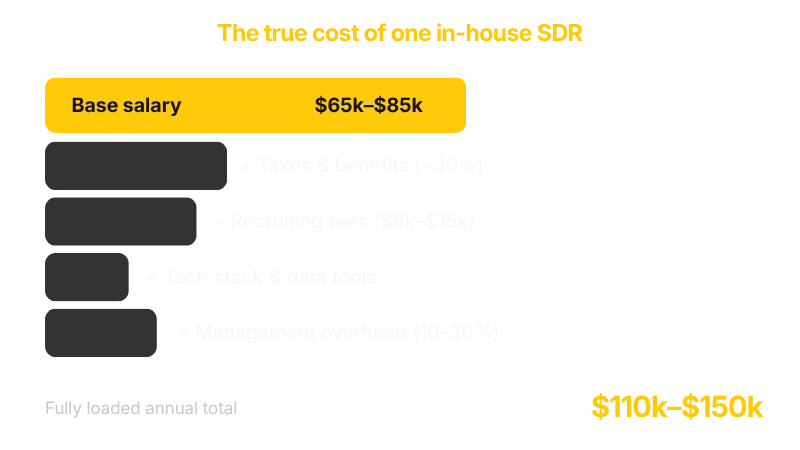
If you want to protect your margins, you need to understand the true cost of building from the ground up. Here is a structured Total Cost of Ownership framework to evaluate your true ROI.
Step 1: Calculate Fully Loaded Internal Costs
An in-house SDR might have a base salary of $65,000 to $85,000. However, the fully loaded cost commonly lands between $110,000 and $150,000 per year. You have to factor in payroll taxes, healthcare benefits, and retirement matching, which typically add 30 percent to the base salary. Then add the recruitment fees, which often run $8,000 to $15,000 per hire. Do not forget the technology stack. CRM seats, data enrichment platforms, and intent data software add thousands to the annual bill. Finally, calculate the management overhead. Your sales managers will spend 10 to 20 percent of their bandwidth simply coaching and auditing junior reps.
Related: Understanding B2B Lead Generation Pricing
Step 2: Factor in the Ramp Lag Penalty
Time kills deals, but ramp time kills companies. Internal reps require three to six months to hit their quota stride. During this time, they are burning cash while producing virtually zero pipeline. The sales motion involves navigating complex buying committees and multi-year digital transformation initiatives. Successful providers combine account-based marketing with multithreaded outreach to engage multiple stakeholders across enterprise accounts.
Step 3: Compute Attrition and Replacement Costs
The hidden killer of internal sales teams is turnover. When an SDR leaves after fourteen months, you lose the institutional knowledge they built, and you have to pay the recruitment fee and suffer the ramp lag penalty all over again. Outsourced agencies absorb this attrition risk entirely. If a rep leaves the agency, the partner replaces them and handles the training at zero additional cost to you.
Step 4: Cost Comparison Table
To give you a clear visual for your next board deck, here is a fully loaded three-year cost model comparing one in-house SDR pod against an outsourced pod.
| Cost Category | In-House SDR Pod (3 Reps) | Outsourced SDR Pod (3 Reps) |
| Base Salaries (Annual) | $210,000 | $0 (Included in retainer) |
| Taxes & Benefits | $63,000 | $0 |
| Tech Stack & Data | $25,000 | $0 (Included in retainer) |
| Management Overhead | $45,000 | $15,000 (Internal liaison time) |
| Recruiting & Attrition | $30,000 | $0 |
| Estimated Annual Total | $373,000 | $180,000 to $210,000 |
| Ramp Time to Full Quota | 3 to 5 Months | 4 to 6 Weeks |
 Expert Tip: Do not outsource your core sales strategy. You must maintain ownership of your pricing, Ideal Customer Profile, and late-stage closing motions. You are handing off the execution of the outbound engine, not the strategic steering wheel.
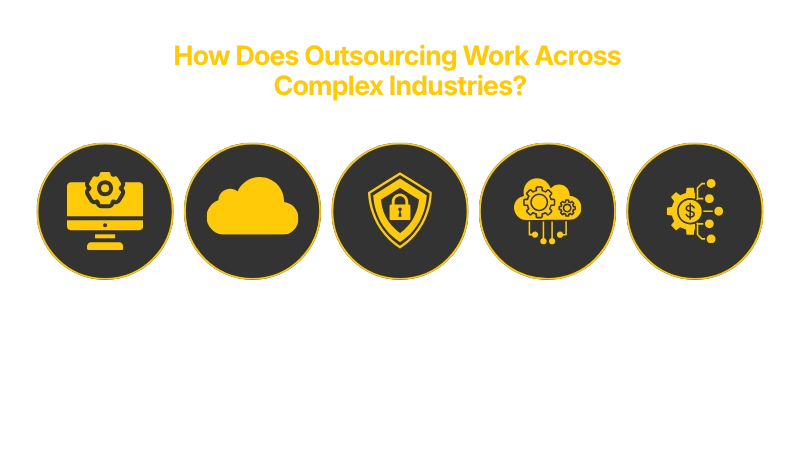
How Does Outsourcing Work Across Complex Industries?
Outbound sales development is not a one-size-fits-all endeavor. The tactics that work for a transactional software company will fail miserably for a highly regulated enterprise firm. Here is how top CROs adapt the model across specialized verticals.
Technology and IT Services
For enterprise IT services, the sales motion involves navigating complex buying committees and multi-year digital transformation initiatives. An outsourced team targeting this sector must excel at account-based marketing and multithreading. They need to research a prospect’s legacy infrastructure constraints and reach out with highly personalized insights rather than generic scripts. The goal is to secure a discovery call with a Chief Information Officer, meaning the external rep must sound like a seasoned technical consultant acting as a natural extension of your brand.
Cloud Solutions
Selling cloud infrastructure requires a deep understanding of scalability, data sovereignty, and consumption-based pricing models. Buyers in this space are tired of generic pitches about cost savings. Outsourced SDRs must speak the language of DevOps and cloud architecture. The right agency trains SDRs to recognize buying signals using buyer intent data, including mergers, rapid hiring, funding announcements, and cloud migration initiatives
Cybersecurity
Cybersecurity sales are notoriously complex. Buyers are highly skeptical, incredibly technical, and heavily guarded. Representatives in this space cannot rely on fear-based marketing. They need deep technical training to understand the difference between endpoint detection, zero-trust architecture, and compliance mandates. The right partner will deploy senior reps who can hold their own in a conversation with a Chief Information Security Officer.
B2B SaaS
In the SaaS world, speed to market is everything. The product is ready, the total addressable market is massive, but scaling an internal team takes too long. SaaS companies leverage B2B SaaS lead generation together with outsourced sales development to rapidly validate new markets and build a predictable outbound pipeline. Because SaaS products are often easier to demo, the external team can focus on securing a high volume of top-of-funnel meetings. This lets the internal Account Executives handle the technical deep dives and focus purely on closing.
Financial Technology (Fintech)
Fintech bridges the gap between fast-moving software and heavily regulated financial institutions. SDRs in this vertical must understand open banking APIs, Payment Card Industry compliance, and legacy banking infrastructure. Outsourcing in this sector requires a premium partner that invests heavily in specialized financial training. You cannot hire a generalist agency to sell a complex treasury management platform to a conservative bank executive. The external team must build undeniable trust from the first cold call.
How Do You Evaluate and Select a Partner?
The market is flooded with lead generation agencies promising the moon. However, data from industry experts reveals a brutal reality. A massive percentage of outsourced programs crash and burn within six months. They fail because companies sign with the cheapest vendor they can find and throw them over the fence with zero enablement.
If you want to avoid burning cash and ruining your brand reputation, follow this transparent step-by-step selection methodology when evaluating sdr outsourcing companies.
Step 1: Audit Their Quality Control Rhythms
Ask the vendor exactly how they monitor call quality. Strong vendors operate quality control as a core function. They should run weekly call reviews, track show rates to meetings, and provide transparent coaching notes. If they cannot clearly articulate their quality assurance process, walk away immediately.
Step 2: Define the Tech Stack Synergy
You need to know where the data lives. The best partners operate directly within your existing CRM architecture. They will use your domain for emails and route calls through recognizable local numbers. Prospects should never know they are talking to a third party. Ensure the vendor integrates seamlessly with your revenue operations rather than forcing you into a siloed proprietary platform that holds your data hostage.
Step 3: Analyze Their Ramp-Up Architecture
A premium partner will not start blindly dialing on day one. They require a rigorous onboarding phase. Review their playbook timeline. They should spend the first two to three weeks deeply understanding your Ideal Customer Profile, interviewing your internal Subject Matter Experts, and refining the messaging architecture. However, they should also commit to launching live campaigns within four to six weeks. Any timeline longer than that defeats the purpose of agile outsourcing.
Step 4: Establish Ironclad Handoff Criteria
Misalignment on what constitutes a qualified meeting is the number one source of friction between a client and an agency. You must draw hard lines. Build a mutually agreed-upon checklist. For example, a meeting is only qualified if the prospect matches the correct job title, belongs to a company with the right employee count, and has a confirmed timeline to evaluate solutions. Do not pay for vanity metrics or unqualified calendar fillers.
Industry Insight: Record your absolute best internal Account Executive handling ten cold calls or discovery phases. Use those exact phrases, objection-handling techniques, and tonality as the foundational script for your outsourced team. Do not let an external agency guess what resonates with your buyers.
Related: Everything You Need to Ask When Choosing a Lead Gen Company
Why Do Most Outsourcing Programs Fail?
Why do so few software founders and enterprise leaders feel that external teams really work? The deciding factor is rarely the vendor alone. The failure almost always stems from the client’s internal setup.
First, many companies outsource before they have a proven sales motion. If your internal team has not figured out how to sell the product, an external team will not magically solve your product-market fit issues. You must hand them a proven playbook. They are an execution engine, not a strategic consulting firm.
Second, companies treat these teams like disposable vendors rather than trusted employees. Companies that treat their external reps like internal team members see dramatically higher ROI. Invite them to your product training sessions. Include them in your weekly all-hands meetings. The closer they feel to your company culture, the harder they will hunt for your pipeline.
Related: Reasons Outsourcing Fails and What Works Better
Conclusion: Is Outsourcing Right for Your Revenue Engine?
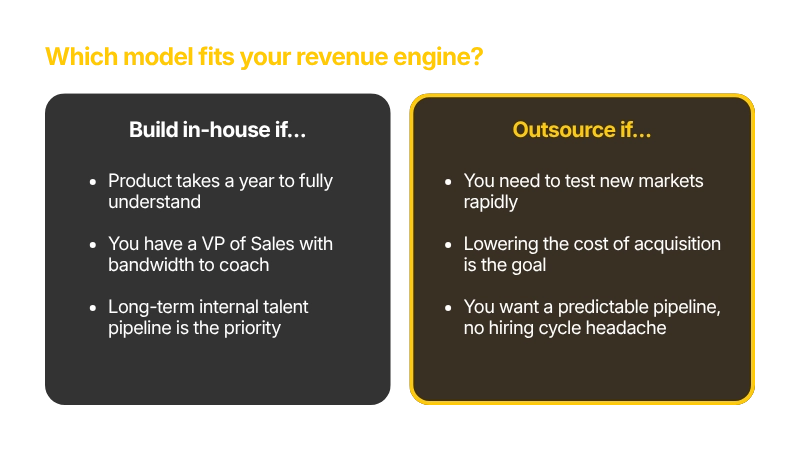
Ultimately, the decision between in-house and outsourced models comes down to speed, cost, and your internal management bandwidth.
If you have a deeply specialized product that takes a year to understand, and you have a VP of Sales with the rare bandwidth to coach junior reps consistently, building an internal academy might make sense for your long-term talent pipeline.
But if you need to rapidly test new markets, drastically lower your cost of customer acquisition, and generate predictable pipeline without the headache of constant hiring cycles, an outsourced partner is the clear winner. You get immediate access to top-tier talent, proven playbooks, and a modern tech stack at a fraction of the fully loaded cost of an internal team. Your competitors are not waiting three to six months to build an internal team. They are deploying agile, highly trained outbound pods to capture market share right now.
Frequently Asked Questions About SDR Outsourcing
How long does it take for an outsourced SDR team to launch?
A premium outsourced SDR team typically requires four to six weeks to fully launch your campaign. The first few weeks involve deep technical onboarding, refining your Ideal Customer Profile, and building custom messaging sequences. If a vendor promises to start cold calling on day two, they are likely skipping vital research steps.
Does an external SDR team use their own CRM or ours?
The most successful agencies will integrate directly into your existing CRM system. This ensures that your revenue operations team maintains complete visibility over all lead generation activities. Operating in your CRM also guarantees that your proprietary data remains fully secure and under your control.
What is the difference between SDR outsourcing and a traditional BPO?
A traditional Business Process Outsourcing provider often relies on massive, generalized call centers focused on high volume and low cost. SDR outsourcing is a highly specialized service deploying trained sales professionals who understand B2B buyer psychology, account-based marketing tactics, and complex technology sales cycles.
Will my prospects know they are speaking to an outsourced agency?
No, a professional SDR partner operates as a white-labeled extension of your internal brand. They will utilize email addresses hosted on your primary or secondary domains and leverage localized phone numbers. Their tone, product knowledge, and messaging will seamlessly match your company culture.