Enterprise Sales Cycle: Stages, Length, and How to Shorten It
Understand the enterprise sales cycle, its key stages and timelines, and how B2B teams can reduce delays and accelerate revenue opportunities.
 Jude Neilson
Jude Nielson is a Business Development Manager at Callbox Inc, with 12 years of experience driving B2B growth through strategic lead generation and sales development.
View full bio of Jude Neilson
Golden Snippet: An enterprise sales cycle is the multi-month process of selling to large organizations, typically running six to nine or more months across prospecting, discovery, evaluation, procurement, and negotiation. Unlike SMB sales, it involves six to ten or more stakeholders, formal security and legal review, and consensus building at every stage before a contract gets signed.
If you have ever watched a promising deal sit in “contract review” for eleven weeks while your CFO asks why pipeline isn’t converting fast enough, you already understand the enterprise sales cycle even if you have never put a name to it. For complex enterprise deals, working with an experienced appointment setting company can help sales teams create qualified conversations without adding more work to internal reps.
In plain terms, it is the full journey a large organization takes from first contact to signed contract, and for true enterprise accounts, generally companies with 1,000 or more employees, that journey routinely stretches past six months. This is where an experienced B2B lead generation company can help identify the right accounts and stakeholders before sales engagement begins.
The length isn’t a flaw in your process. It is a structural feature of how big companies buy, and the sooner your team designs around it, the faster deals actually close. A structured enterprise lead generation strategy helps sales teams account for these longer timelines, multiple stakeholders, and complex buying processes from the start.
Need someone to help you shorten your enterprise sales cycle?
How Enterprise Sales Differs From SMB Sales
SMB deals are usually decided by one or two people with a fairly quick internal approval loop. Enterprise deals are decided by committee, and that committee typically includes six to ten or more stakeholders across IT, security, legal, procurement, finance, and the end-user department, according to widely cited B2B buying research. Each of those stakeholders has their own veto power and their own definition of risk.
That changes what “selling” even means. In SMB sales, you are mostly persuading a buyer. In enterprise sales, you are mostly equipping a champion to persuade a room full of people you will probably never meet. Messaging that works for a single decision-maker (fast ROI, quick setup, low commitment) often falls flat with a procurement or security stakeholder whose only job is to slow things down until every box is checked.
$3.6M+ Qualified Pipeline Added in 120 Days for a Cybersecurity Solutions Provider
Callbox enabled the client to build valuable connections with key decision-makers — including CISOs, IT Directors, and Compliance leads — enhancing sales outreach across three distinct prospect segments.
View Case StudyThe Stages of the Enterprise Sales Cycle
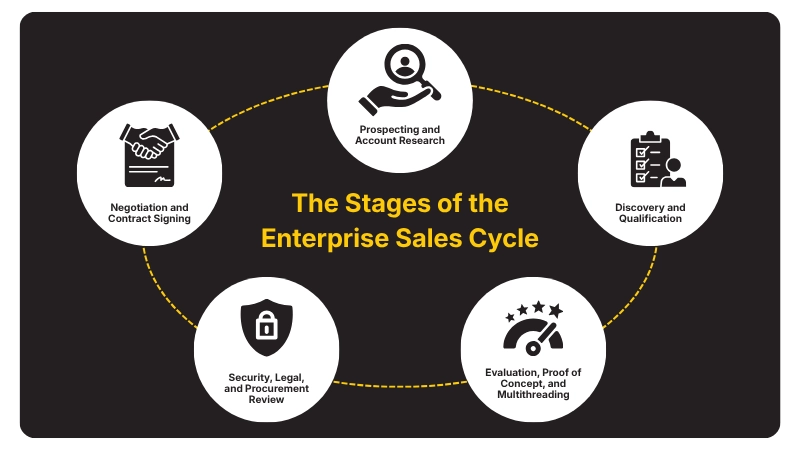
Prospecting and Account Research
Enterprise prospecting starts with account selection, not contact collection. Before a single email goes out, the strongest teams build a real account profile: org chart, technology stack, recent leadership changes, and trigger events like funding rounds or executive hires. Generic list-based outbound rarely survives first contact with an enterprise buyer who can tell in one sentence whether you understand their business.
For organizations without the internal resources to manage this process, lead generation companies for enterprise sales can provide the research, targeting, and outreach support needed to build a qualified account pipeline.
Discovery and Qualification
This is where you separate a genuinely qualified opportunity from a curious click. Strong discovery goes past budget and timeline into how the account actually makes large purchasing decisions and who else needs to be in the room. Skipping this stage is the single most common reason deals stall in month four instead of closing in month four.
The goal is to determine whether the account can become a genuine sales-qualified opportunity, not simply whether a prospect has shown initial interest.
Evaluation, Proof of Concept, and Multithreading
This stage is where deals live or die. Technical evaluations and proof-of-concept periods give the buying committee evidence, but they also expose every stakeholder you haven’t engaged yet. Multithreading, building relationships across the buying committee instead of relying on a single champion, is the difference between a deal that survives a champion’s job change and one that dies with it.
The right lead generation tools can also help sales teams identify account signals, enrich prospect data, and prioritize companies that match their ideal customer profile.
Security, Legal, and Procurement Review
This is the stage most sales training barely covers, and it is often the longest one. SOC 2 documentation, data processing agreements, and vendor risk assessments can add weeks to a deal that was otherwise ready to close. Teams that keep this documentation current and ready to share the moment it is requested consistently outrun competitors who scramble to produce it after the ask.
Negotiation and Contract Signing
By the time a deal reaches negotiation, pricing is rarely the only variable left. Payment terms, contract length, and data residency requirements all come into play, and enterprise buyers often time signatures to fiscal quarters, which is why a deal that feels “basically done” in October can still slip to January.
What Enterprise Sales Strategies Actually Work?
The strategies that move enterprise deals forward share one trait: they reduce the buyer’s internal risk instead of just pitching your product’s features. That means named case studies from similar-sized organizations, security documentation prepared in advance, and messaging tailored to each stakeholder’s actual concern rather than a single generic pitch reused across the whole buying committee.
Common Enterprise Sales Methodologies
Most enterprise sales organizations build their process around a named methodology rather than improvising. MEDDIC (Metrics, Economic Buyer, Decision Criteria, Decision Process, Identify Pain, Champion) qualifies deals early and hard. Challenger Sale pushes reps to lead with insight rather than reactive questions. SPICED (Situation, Pain, Impact, Critical Event, Decision) is a newer framework built around urgency. Solution Selling still fits industries where the buyer needs significant education before they can define the problem. None is universally “best.” The right one depends on how technical your buyer is and how much education the deal requires.
 Industry Insight: In a recent multi-channel ABM program for a manufacturing client selling capital equipment, the deals that closed fastest were never the ones with the most enthusiastic single champion. They were the ones where our team had identified and engaged the skeptical stakeholder, usually someone in finance or operations, by week three. Deals that skip that step tend to stall right at proof-of-concept, not because the product failed but because nobody built a relationship with the person who could say no.
Why Do Enterprise Deals Stall (and How to Fix Them)?
Most stalled enterprise deals do not die from a lost competitive bid. They die from internal inertia: a champion who goes quiet, a budget freeze, or a reorg that changes who owns the decision. None of that shows up cleanly in a CRM stage report, which is why it gets ignored until the deal is already cold.
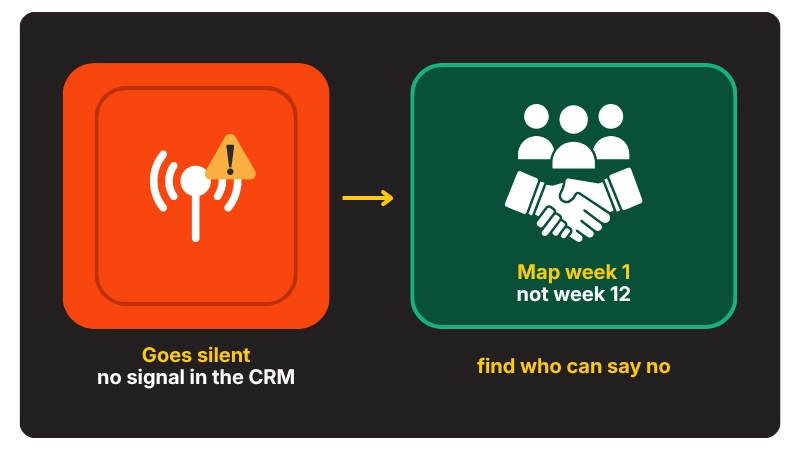
The fix is proactive stakeholder mapping from week one, not week twelve. Teams that identify the full buying committee early, including the people who are likely to object, rarely get blindsided by a stall they could not have predicted. Teams that rely on a single enthusiastic contact are building their entire pipeline on somebody else’s job security. These obstacles are among the most common enterprise lead generation challenges, particularly when multiple stakeholders and lengthy approval processes are involved.
Expert Tip: Ask your champion directly, early and often: "If this stalls, who stalls it?" Most champions know the answer immediately. Most sales reps never ask the question until the deal is already stuck.
How Do You Shorten an Enterprise Sales Cycle?
Shortening an enterprise sales cycle rarely means rushing the buyer. It means removing friction from your own side of the process so the buyer’s natural timeline is the only thing left slowing you down, starting with prospecting and qualification, where outsourced enterprise SDR and ABM programs earn their keep.
How Do You Calculate Sales Cycle Length?
Sales cycle length is the average number of days between first contact and closed-won, averaged across your closed deals for a given period.
Track this by segment (SMB, mid-market, enterprise) rather than as one blended company-wide number, since combining them will make your enterprise benchmark look artificially short and your SMB benchmark look artificially long. Also track cycle length stage by stage: how long deals sit in discovery versus evaluation versus procurement. That stage-level view is usually where the actual bottleneck hides, not in the total number itself.
Frequently Asked Questions
What is considered an enterprise sales cycle?
An enterprise sales cycle is the full process of selling to large organizations, typically those with 1,000 or more employees, from first contact through signed contract. It generally runs 6 to 9 or more months due to multiple stakeholders, formal procurement, and security and legal review.
What is enterprise sales prospecting?
Enterprise sales prospecting is the account-based research and outreach process used to identify and engage the right organizations and the right stakeholders within them, rather than casting a wide net across individual contacts with no account context.
Why are enterprise sales cycles so long?
Enterprise sales cycles are long because large organizations involve more decision-makers, formal security and legal review, and fiscal-year budget timing that is often outside the seller’s control.
What is the best enterprise sales methodology?
There is no single best methodology. MEDDIC works well for early, disciplined qualification. Challenger Sale suits insight-led selling. SPICED emphasizes urgency. Solution Selling fits deals that require significant buyer education. The right choice depends on your buyer’s technical sophistication and how much education the deal requires.
How can software companies shorten enterprise sales cycles?
Software enterprise sales cycles shorten most reliably when security and compliance documentation is prepared before it is requested, when multiple stakeholders are engaged early instead of relying on one champion, and when qualification is rigorous enough that only genuinely ready accounts enter the pipeline.
Ready to see where your own enterprise pipeline is losing time? Book a pipeline audit consultation and we will map your actual sales cycle stage by stage, flag exactly where deals are stalling, and show you what a Callbox Pipeline Campaign Pod would look like against your specific enterprise motion.