What Is a B2B Buying Committee? Roles and How to Win It
Understand B2B buying committee roles, size, and decision-making dynamics to engage key stakeholders and move complex deals forward.
 Jude Neilson
Jude Nielson is a Business Development Manager at Callbox Inc, with 12 years of experience driving B2B growth through strategic lead generation and sales development.
View full bio of Jude Neilson
 Quick Answer: A B2B buying committee is the group of stakeholders inside a company who jointly research, evaluate, and approve a business purchase. It typically includes an economic buyer, a champion, technical evaluators, end users, and executives with veto power. Gartner's 2025 research puts these groups at five to 16 people across up to four functions.
Who sits on the committee, how B2B buying committees reach a decision, and how to reach every stakeholder before a silent inbox stalls your deal.
Your champion loved the demo. Then the deal went quiet for six weeks, and when it came back, someone from procurement you had never spoken to wanted to restart the evaluation. That is the B2B buying committee at work. Forrester puts the average at 13 stakeholders per purchase, and Gartner’s long-cited range for complex solutions is six to ten stakeholders. Either way, the person you are talking to is rarely the person who decides alone. An experienced appointment setting company can help sales teams engage multiple stakeholders rather than relying on one contact.
This guide covers what a buying committee is, the roles on it, how it reaches a decision, and the part most guides skip: how to actually reach, engage, and qualify every stakeholder once you know who they are. A B2B lead generation company can help identify and engage decision-makers across target accounts.
Looking how to target the decision-maker?
Why Do B2B Buying Committees Exist?
B2B buying committees exist because most purchases now touch too many parts of the business for one person to own the risk. Gartner reports that 99% of B2B purchases are driven by organizational change, which means the problem being solved usually spans departments. Forrester’s State of Business Buying, 2024 found that 89% of purchases involve two or more departments.
Spreading the decision across a committee reduces the chance that one person makes a costly mistake. It also creates a new problem: disagreement. In a Gartner survey of 632 B2B buyers, 74% of buyer teams showed unhealthy conflict during the decision, such as conflicting objectives or being overruled by outside decision-makers. Groups that reached consensus were 2.5 times more likely to call their deal high quality.
That is why a B2B purchase today looks less like a sale and more like a negotiation among the buyer’s own people. Forrester found that 86% of purchases stall at some point, and 81% of buyers end up dissatisfied with the provider they chose. Much of modern B2B purchasing friction happens inside the buyer’s walls, out of the seller’s view.
How Many Stakeholders Are in B2B Buying Groups?
Most B2B buying groups include five to 16 stakeholders, and Forrester’s average across more than 16,000 buyers is 13 people per purchase. Gartner’s widely cited earlier benchmark put complex-solution committees at six to ten decision makers, and its 2025 survey widened that range to five to 16 people across as many as four functions.
The numbers differ because the studies count different things. Some count only the core group that votes; others count everyone who contributes research or requirements. For planning purposes, assume the committee is bigger than the contacts in your CRM. Enterprise buying committee size sits at the top of these ranges, and regulated industries push it higher still.
Industry Insight: The most useful B2B buying group insights from Gartner's 2025 research are not the headcounts. They are about buying group personalization. Content tailored narrowly to one individual had a 59% negative impact on group consensus, while content relevant to the whole buying group made buyers three times more likely to report a high-quality deal. Tailor by role, but make sure every message still points at the shared goal.
Who Is on a B2B Buying Committee? Core Roles Explained
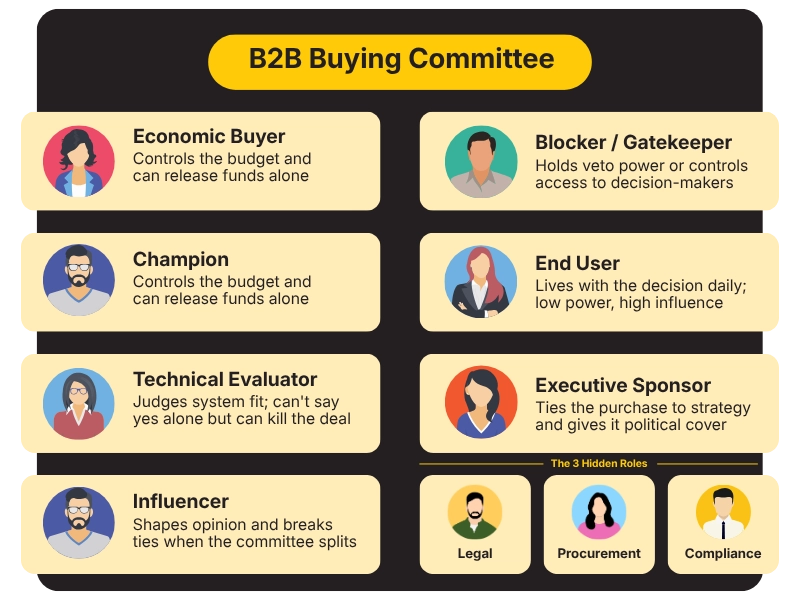
If you are asking what are the roles in a buying committee, the practical answer is to sort people by what they do in the decision, not by title. A useful B2B buyer role classification framework asks six questions: who funds it, who wants it, who validates it, who uses it, who shapes opinion, and who can stop it. The seven roles below cover those jobs. One person can hold two roles, and on smaller deals often does.
Economic Buyer: Who Controls the Budget?
Economic buyer definition: the economic buyer is the person who controls the budget for the purchase and can release funds without asking anyone else. They care about return on investment, payback period, and whether this spend beats the other things competing for the same money. They rarely join early calls, so your champion usually has to carry your business case to them.
Typical titles: CFO, VP of Finance, budget-owning department head. How to reach them: a short, numbers-first message that references the problem their team already flagged.
Champion: How Is a Champion Different From a Decision Maker?
A champion is the internal advocate who wants you to win and sells for you when you are not in the room. The difference between a champion and a decision maker is authority. A decision maker can approve the purchase; a champion can only push for it. Many deals die because a rep mistakes an enthusiastic champion for the person who signs.
Typical titles: Sales Ops or RevOps manager, marketing director, team lead who owns the pain. How to reach them: give them material they can forward, such as a one-page business case and a slide for their boss.
Technical Evaluator: Can It Actually Work Here?
The technical evaluator judges whether your product or service fits the company’s systems, security standards, and workflows. They cannot say yes on their own, but a failed security review or integration concern can end a deal on the spot. Bring them in early, before their objections harden.
Typical titles: IT director, systems architect, security analyst. How to reach them: documentation, certifications, and a technical call with someone who can answer without escalating.
Influencer: Whose Opinion Carries Weight?
An influencer shapes the decision without formally owning it. This might be a respected senior analyst, a peer at another company, or an outside consultant the buyer trusts. When the committee splits, the influencer often breaks the tie.
Typical titles: solutions architect, strategy lead, external advisor. How to reach them: peer proof, analyst coverage, and third-party reviews they can verify independently.
Blocker or Gatekeeper: Who Holds Veto Power?
A blocker or gatekeeper is anyone with the power or motive to stop the deal or control access to the people who decide. Some hold formal veto power, like a CISO who rejects a vendor over data risk. Others are protecting an incumbent vendor, a competing budget line, or their own workload. Gatekeepers include executive assistants and procurement teams who control the calendar and the paperwork.
Typical titles: CISO, head of compliance, procurement manager, incumbent vendor’s internal owner. How to reach them: surface their concern directly and early; a blocker you know about is a risk you can manage.
End User: Who Lives With the Decision?
End users are the people who will use the product or work with the service every day. They have little formal power but a lot of informal influence, because a rollout they resist will not deliver the promised return. Winning them early also protects renewal.
Typical titles: account executives, analysts, SDRs, operations staff. How to reach them: hands-on demos, pilots, and customer stories from people doing the same job.
Executive Sponsor: Who Ties It to Strategy?
The executive sponsor is the senior leader who connects the purchase to company goals and gives it political cover. They care about outcomes like revenue growth, cycle time, or risk reduction, not features. If you cannot explain your value in terms of a metric they report to the board, the deal tends to stall at their desk.
Typical titles: CRO, CMO, COO, VP of Sales. How to reach them: a brief executive summary tied to one metric, delivered through your champion or a warm introduction.
Buying Center Roles Most Maps Miss: Legal, Procurement, and Compliance
Many role lists stop at seven, which leaves out three buying center roles that appear late and cause the most surprise delays. Legal reviews liability, data processing terms, and contract language. Procurement runs vendor onboarding, pricing negotiation, and competitive bids. Compliance checks whether the vendor meets regulatory obligations, which matters a great deal when you are buying an outsourced service that will contact prospects on your behalf under rules like TCPA or GDPR. Treat all three as committee members from the start, not as a final hurdle.
Expert Tip: Ask your champion one question early: "Who would be upset if this went ahead without them?" The answer surfaces blockers and hidden reviewers far faster than asking "Who else is involved?", which most people answer with the names already in your inbox.
How Does a B2B Buying Committee Reach a Decision?
Understanding the B2B buying process helps sales teams identify what information the committee needs at each stage. Gartner describes six jobs that buyers loop through rather than completing in order. A good buying committee analysis asks which job the group is on right now and what it needs to finish it.
- Problem identification. Someone frames the issue as worth solving. Whoever frames it shapes the criteria: if IT defines the problem, integration becomes the priority; if finance does, cost does.
- Solution exploration. Buyers often turn to lead generation reviews when researching potential providers. Your content, reviews, and presence in AI search results do the selling here.
- Requirements building. The group agrees on what the purchase must do. This is where conflicting priorities surface, and where a seller who helps write clear criteria gains an edge.
- Supplier selection. The committee compares vendors against those requirements and builds a shortlist.
- Validation. Legal, security, and finance pressure-test the favorite. Deals often loop back to earlier jobs here when new concerns appear.
- Consensus creation. The group works toward a consensus decision everyone can defend. In a complex sale, this is the job that most often stalls.
Gartner also found that buyers who use supplier-provided digital tools together with a sales rep are 1.8 times more likely to complete a high-quality deal than those who go it alone. In other words, the committee still wants a human guide; it just wants one who shows up with the right material at the right stage.
How Do You Identify, Map, and Manage Buying Groups? A B2B Buying Group Management Framework
To identify buying committee members, start from the roles the purchase requires, then find the people who fill them, then confirm the list with the buyer. Mapping is not a one-time exercise. Good B2B buying group management means keeping the map current as people join, leave, and change their minds. Here is a five-step approach built for teams that need to act on the map, not just look at it.
- List the roles before the names. For each target account, write down which of the roles above this purchase will need. A security product needs a strong technical evaluator; an outsourced service needs procurement and compliance. Empty roles are your first gaps.
- Build decision-maker profiles. Use the org chart, LinkedIn, and CRM history to put a name, title, and reporting line against each role. Note what each person is measured on, because that is what they will judge you by.
- Score stance, not just seniority. For every name, record whether they are a supporter, neutral, skeptic, or unknown, and how much sway they hold. A junior supporter with the CFO’s ear can matter more than a disengaged VP.
- Validate in conversation. Ask your champion who else will weigh in and who typically approves deals like this. Confirm the committee in discovery calls before you are deep in the deal.
- Assign a next touch to every name. Each stakeholder gets an owner, a channel, and a date. A map without next actions is a picture of a deal, not a plan to win it.
A simple coverage table is enough to manage buying groups across a handful of accounts:
Role | Name and title | Stance | Last meaningful touch | Next action |
Economic buyer | VP Finance | Unknown | None | Champion to forward one-page business case |
Champion | RevOps Manager | Supporter | Discovery call, last week | Send slide for leadership review |
Technical evaluator | IT Director | Neutral | Email opened, no reply | Call with security documentation |
Procurement | Gap | Unknown | None | Ask champion who runs vendor onboarding |
At scale, this is the core of account-based marketing: pick the accounts, profile the committee in each, and coordinate outreach so every stakeholder hears a consistent story.
Short on SDR time to build these maps? Callbox’s ABM programs build decision-maker profiles across the buying committee for each target account, then run the outreach to fill the gaps.
How Do You Multi-Thread and Sell to a Buying Committee?
Multi-threading in B2B sales means building active relationships with several members of the buying committee at the same time, so the deal does not depend on one contact. A practical target is three to five engaged stakeholders per account, covering at least the budget holder, the champion, and one technical or risk reviewer. ZoomInfo reports in its guide to stakeholder mapping that sellers who multi-thread the buying committee drive 31% larger deals.
Single-Threading vs. Multi-Threading
A single-threaded deal has a single point of failure. When the champion goes quiet, changes jobs, or turns out to have less authority than you thought, you lose your only window into the account. A multi-threaded deal keeps moving because someone else on the committee still knows who you are and why you matter.
Factor | Single-threaded | Multi-threaded |
Visibility into internal debate | Whatever one contact chooses to share | Several viewpoints you can compare |
Risk if a contact leaves | Deal resets or dies | Other relationships carry it forward |
Blocker detection | Late, often at contract stage | Early, while concerns are still fixable |
Forecast accuracy | Based on one person’s optimism | Based on signals from across the group |
How to Sell to Multiple Departments With Differing Priorities

Enter through the person who owns the problem, then thread up to the executive sponsor and economic buyer and across to the technical and risk reviewers. Match the angle to the role: finance hears payback and cost certainty, IT hears security and integration, operations hears rollout effort, and end users hear what gets easier. Then keep every message tied to the shared outcome, because Gartner’s data shows that narrowly individual messaging can split the group apart.
How to Navigate Buying Committee Dynamics
Use multi-channel outreach, because different roles respond on different channels. Executives often respond to a short, well-timed call or a warm introduction; technical evaluators engage through documentation and LinkedIn; finance responds to email they can forward with numbers attached. Whenever possible, get two or more departments into the same meeting so they hear each other’s priorities, and leave behind one shared summary instead of separate versions for each person.
A structured approach can help simplify the customer buying process while keeping stakeholders aligned.
One more consideration: every stakeholder you add is another consent and opt-out record your outreach has to respect. Calls, texts, and emails to a larger committee raise the stakes on TCPA, CAN-SPAM, and GDPR compliance, especially if your team or vendor relies on automated dialers.
Expert Tip: Before you celebrate a booked meeting, check who else is on the invite. A discovery call with the champion alone is one thread. The same call with the champion plus someone from IT or finance is two, and it tells you the committee is starting to take you seriously.
How Does B2B Buying Group Size Change by Deal Size or Industry?
A B2B buying group grows with deal size, risk, and regulation. The ranges below are directional, consistent with the Gartner and Forrester figures above and with practitioner guides like Traction Complete’s deal-size breakdown. Use them to plan coverage, not as hard benchmarks.
Deal type | Typical buying team | Roles that dominate | What usually slows it | Seller priority |
SMB and smaller mid-market | 3 to 5 people | Champion doubles as economic buyer | Competing priorities, owner bandwidth | Fast, clear value and a simple ROI case |
Mid-market to enterprise | 6 to 10 people | Finance, IT, operations | Security review, integration questions | Engage technical reviewers early |
Large enterprise and strategic | 10 to 20 people | Executive sponsors, legal, procurement | Multi-region approvals, contract review | Full committee map and patient multi-threading |
Buying Services vs. Buying Software
Software committees lean technical: IT and security review integrations, data flows, and certifications. Services committees, such as those buying outsourced sales development, consulting, or managed programs, lean toward people and process risk. Procurement scrutinizes the statement of work, legal reviews liability and data handling, and the operational owner who will manage the vendor day to day carries a lot of weight. If you sell services, expect fewer technical questions and more questions about who does the work, how quality is checked, and how compliance is handled.
Vertical-Specific Committee Patterns
Each industry adds its own reviewers, so plan a vertical-specific committee map rather than a generic one.
Industry | Reviewers that often join | Likely veto point |
Cybersecurity | CISO, security architects, risk officers | Security and data-handling review |
Healthcare | Clinical leads, compliance, privacy officers | Patient data and regulatory fit |
Financial services | Risk, compliance, internal audit | Regulatory and vendor-risk assessment |
Manufacturing and ERP | Operations, supply chain, procurement, finance | Rollout disruption and total cost |
SaaS and IT | IT, RevOps, security, end-user teams | Integration and adoption risk |
What Mistakes Do Sales and Marketing Teams Make With Buying Committees?
The most common buying committee mistakes come from treating a group decision like an individual one. Watch for these:
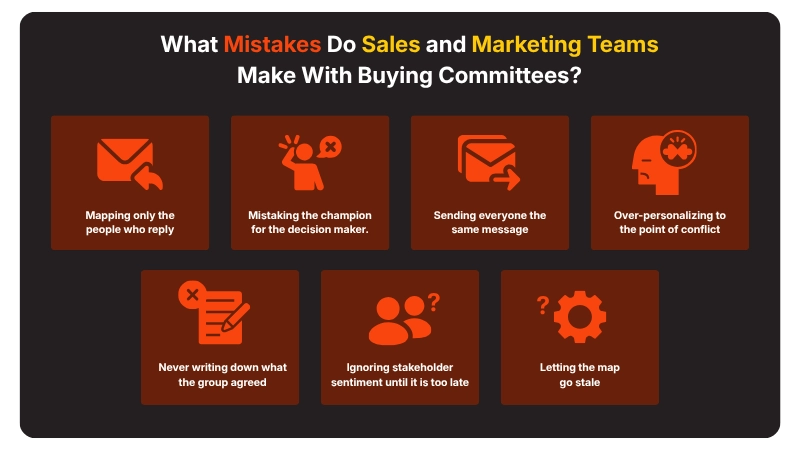
- Mapping only the people who reply. The stakeholders who stay silent are often the ones with veto power. If a role has no name against it, treat that as a risk, not a blank.
- Mistaking the champion for the decision maker. Enthusiasm is not authority. Confirm who signs and who funds before you forecast the deal.
- Sending everyone the same message. A CFO and an IT director judge the same purchase on different terms. One generic pitch wastes the insight your map gave you.
- Over-personalizing to the point of conflict. Messages that promise each person something different can pull the group apart. Tie every role-specific message back to the shared outcome.
- Never writing down what the group agreed. Without a short consensus brief that records goals, required capabilities, and open risks, every new stakeholder restarts the debate. Share it and update it as the deal moves.
- Ignoring stakeholder sentiment until it is too late. Track stakeholder sentiment after every interaction, not just at stage gates. A contact moving from supporter to neutral is an early warning you can still act on.
- Letting the map go stale. People change jobs and priorities shift mid-deal. Review the committee at every stage, and re-verify contacts before a big push.
Is Outsourced Appointment Setting Right for Teams Selling to Buying Committees?
Outsourced appointment setting makes sense when your team knows which accounts to target but lacks the SDR capacity to thread five or more stakeholders in each one. Multi-threading is labor-intensive: it means researching every role, running role-specific sequences across several channels, and following up until each stakeholder engages. An outsourced SDR team can run that sales development work at scale, while your account executives focus on the conversations that close.
It is a good fit if you sell into mid-market or enterprise accounts with committees of six or more, your deal values justify multi-stakeholder outreach, and your in-house SDRs spend more time researching than talking to buyers. Pair it with account-based marketing when you have a defined list of target accounts.
It is not the right fit if your deals close with one or two approvers in a single call, your average contract value is too low to justify researching a full committee, or you have not yet defined your ideal customer profile. In those cases, fix targeting first or keep outreach in-house. An outsourced team can book qualified appointments, but it cannot fix a market or offer that is not ready.
Want to see how this works in your market? Callbox’s guide to enterprise lead generation challenges breaks down role-by-role outreach for committees in complex deals.
Frequently Asked Questions
What is a buying center?
A buying center is the academic term for everyone involved in an organizational purchase decision. The concept dates to Webster and Wind’s 1972 model of organizational buying. In practice, buying center, buying committee, and buying group describe the same thing: the set of people who jointly research, evaluate, and approve a B2B purchase.
What are the roles in the buying center?
The classic roles in the buying center are users, influencers, buyers, deciders, and gatekeepers, with initiators often added as a sixth. Modern sales teams usually translate these into economic buyer, champion, technical evaluator, influencer, blocker or gatekeeper, end user, and executive sponsor, plus legal, procurement, and compliance reviewers.
What is the buying center in marketing, and is it the same as a buying committee?
In marketing, the buying center is the group of stakeholders a campaign has to reach and persuade, not a single lead. It is effectively the same as a buying committee. The difference is mostly usage: buying center comes from academic marketing theory, while buying committee and buying group are the terms sales and ABM teams use day to day.
How do you identify buying committee members?
Start with the roles the purchase requires, then find the people who fill them. Use org charts, LinkedIn, and CRM activity to build a list, ask your champion who else will weigh in or sign off, and confirm the list in discovery calls. Mark every role you cannot yet name as a gap to close.
What is multi-threading in B2B sales?
Multi-threading in B2B sales means building active relationships with several people on the buying committee at once, instead of relying on one contact. A common target is three to five engaged stakeholders per account, covering the budget holder, the champion, and the technical and risk reviewers who can block the deal.
How does ABM engage the buying committee?
Account-based marketing engages the buying committee by treating the account, not the lead, as the unit of marketing. ABM teams select target accounts, profile the decision-makers in each, and run coordinated, role-specific outreach across phone, email, LinkedIn, and events so every stakeholder hears a consistent story.
What is the difference between an org chart and a buying committee map?
An org chart shows formal reporting lines. A buying committee map shows who influences a specific purchase, what each person cares about, and where they stand on your deal. Use the org chart to find names, then build the map to capture actual influence, which often does not follow the hierarchy.