How to Overcome B2B Enterprise Lead Generation Challenges
Solve your enterprise lead generation challenge. Master account-based strategies, buying committee coverage and managed sales pipeline execution.
 Rebecca Matias
Rebecca Matias is Callbox's COO with 18 years of experience scaling B2B pipeline through data-driven outbound marketing, lead generation, and sales development.
View full bio of Rebecca Matias
B2B revenue teams face severe pipeline friction when applying mid-market volume tactics to high-ACV deals. Cold email response rates fell to 3.43% as of August 2026, forcing sales leaders to confront a fundamental enterprise lead generation challenge: traditional single-contact prospecting fails when selling complex solutions.
Solving this enterprise lead generation challenge requires recognizing that enterprise deals ($100k+ ACV) do not collapse because of low lead volume. They fail because single-point outreach targets individual contacts rather than entire buying committees.. They fail because single-point outreach targets individual contacts rather than entire buying committees. Modern enterprise purchasing groups include 11.2 decision makers on average, stretching sales cycles to 218 days for $100k+ ACV deals as of August 2026. Relying on broad MQL production creates friction between sales and marketing teams, leading to rejected leads and inflated customer acquisition costs.
Revenue leaders must shift from high-volume list scraping to structured account-based pipeline generation, supported by appointment setting and lead generation strategies designed to engage multiple enterprise stakeholders.
Looking for someone to help you overcome enterprise challenges?
Deconstructing the Enterprise Lead Generation Paradox
Traditional demand generation engines break down when entering complex B2B enterprise sales motions due to five operational structural traps.
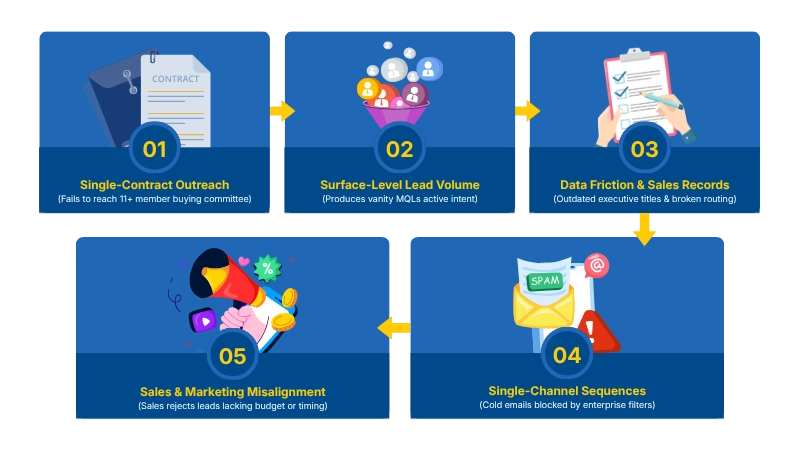
Buying Committee Complexity
Enterprise deals require buy-in across IT, legal, finance, security, and executive sponsors. An outsourced SDR team for enterprise appointment setting can help identify and engage these stakeholders instead of relying on a single contact within the account.
Misaligned Qualification Benchmarks
Generic lead generation vendors optimize for booked appointments rather than account fit. An appointment without budget, timeline, or stakeholder consensus creates empty pipeline that fails to convert into revenue.
Stale Enterprise Data and Organizational Shifts
Corporate restructuring and role changes degrade B2B database accuracy rapidly. Using the right lead generation tools for data discovery, enrichment, and verification helps revenue teams maintain accurate account and contact information throughout the campaign.
Single-Channel Reach Limitations
Relying solely on automated email sequences limits reach among executive buyers. Enterprise teams should combine phone, email, social, and other coordinated channels to create the multi-touch engagement required for complex B2B sales.
Funnel Friction and Disconnected Metrics
Marketing teams celebrate vanity metrics like clicks and content downloads, while sales teams prioritize closed revenue. A structured enterprise lead generation program aligns targeting, qualification, outreach, and pipeline outcomes around revenue rather than activity volume.
Mapping the Enterprise Buying Committee Matrix
Overcoming your enterprise lead generation challenge requires coordinating role-specific messaging across all decision-makers in a target account.
| Committee Member | Primary Operational Focus | Messaging Priority | Preferred Outreach Channel |
| Executive Sponsor / C-Suite | Top-line growth & margin expansion | Financial ROI & strategic market advantage | Peer-to-peer phone & executive briefings |
| Functional Decision Makers | Team efficiency & operational friction | Workflow automation & implementation speed | Case studies & product demonstrations |
| Technical & IT Reviewers | Architecture fit & API stability | System interoperability & uptime SLAs | Technical documentation & sandbox access |
| Security & Compliance | Risk mitigation & regulatory standards | Data encryption, SOC 2 & privacy compliance | Compliance whitepapers & audit attestations |
| Procurement & Finance | Contract terms & working capital | Unit economics & payment terms flexibility | Pricing models & ROI calculation sheets |
Engaging all five stakeholder groups simultaneously builds multi-threaded account coverage. Multi-threaded accounts convert at 41% higher win rates compared to single-contact opportunities as of August 2026.
Deep-Dive Analysis of Enterprise Platform Architecture
Revenue leaders must evaluate whether their enterprise prospecting needs raw software intelligence, internal RevOps tools, or fully managed execution services.
Demandbase
Demandbase operates as an enterprise-grade account-based marketing platform designed to unify intent signals and targeted display advertising.
- Primary Category: Account-based marketing software and intent intelligence
- Target Regional Reach: Global enterprise account coverage
- Best Used For: Mature revenue teams requiring deep CRM integration and multi-channel advertising coordination across named account lists
- Competitive Advantage: Aggregates intent data, web traffic, and CRM history into unified account health scores to guide sales prioritization
Deploying account intelligence software ensures reps focus outreach on accounts showing active buying interest. Centralizing intent data prevents sales teams from wasting time on disengaged prospects.
6sense
6sense uses predictive machine learning algorithms to reveal dark funnel research activity long before prospects submit a form.
- Primary Category: Predictive intent engine and ABM orchestration platform
- Target Regional Reach: Global coverage across enterprise industries
- Best Used For: Advanced RevOps teams building automated, trigger-based sales workflows
- Competitive Advantage: Analyzes anonymous web signals to identify active buying stages and automatically trigger targeted ad campaigns and SDR tasks
Catching buyer intent early gives your sales team a competitive advantage in crowded markets. Predictive scoring allows reps to reach decision-makers before competitors spot the opportunity.
Informa TechTarget Priority Engine
Priority Engine provides real-time intent data specifically designed for business-to-business technology and software vendors.
- Primary Category: Tech-focused buyer intent platform and contact database
- Target Regional Reach: Global coverage across enterprise technology sectors
- Best Used For: Enterprise software sales teams seeking contact-level intent data for active technology buyers
- Competitive Advantage: Tracks content consumption across a vast network of technology publications to highlight specific individuals actively researching software solutions
Accessing contact-level intent data ensures sales messages align with current research topics. Reps approach prospects with relevant solutions rather than generic sales pitches.
Callbox
Callbox provides hybrid lead generation and appointment setting solutions that combine proprietary campaign software with human SDR execution to resolve the enterprise lead generation challenge.
- Primary Category: Managed B2B demand generation and multi-channel appointment setting
- Target Regional Reach: Global coverage across North America, APAC, EMEA, and LATAM
- Best Used For: Enterprise B2B firms, software providers, and IT organizations targeting complex buying committees across global regions
- Competitive Advantage: Utilizes a human-plus-AI model to map global buying committees, source verified direct-dial data, and execute multi-touch phone, email, and social outreach to secure qualified sales meetings
Outsourcing sales execution removes the burden of internal SDR hiring while expanding your account reach. External specialists build verified target lists and secure meetings with key stakeholders directly on your sales team calendar.
Evaluating Software vs. Managed Execution Services
Deciding between buying raw software platforms or hiring a managed execution partner depends on your internal team infrastructure. Companies that lack sufficient SDR capacity can use an outsourced SDR team to execute prospecting, qualification, and appointment setting without expanding internal headcount.
| Evaluation Metric | Software-Only Solutions (Demandbase / 6sense) | Managed Execution Partners (Callbox) |
| Core Operational Output | Intent data, analytics dashboards, and workflow triggers | Booked, qualified sales appointments with key decision-makers |
| Internal Resource Requirement | High (requires dedicated RevOps staff and SDRs to run outreach) | Low (external SDRs handle list building, phone, and email touchpoints) |
| Time to First Campaign Launch | Eight to 16 weeks for technical setup and integration | Two to four weeks for campaign onboarding and script approval |
| Primary Cost Factor | Fixed annual software licensing fees per seat | Campaign-based service fees tied to target account scale |
| Best Operational Alignment | Large internal sales teams with underutilized SDR capacity | Scaling firms expanding into new markets without adding internal headcount |
Balancing technology investments against internal execution capacity prevents bottlenecked pipelines. Selecting a managed partner guarantees active outreach while your internal team focuses on closing deals.
The 30-Day Multi-Threaded Outreach Sequence
Executing an account-based campaign requires coordinating personalized touches across the entire buying committee simultaneously.
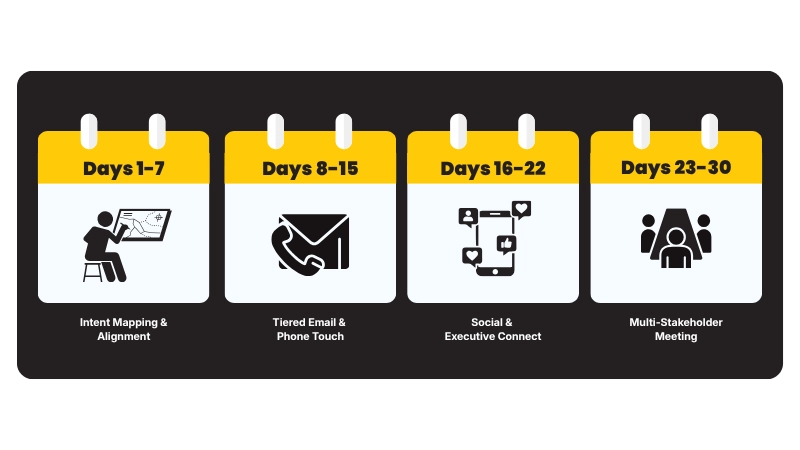
Days 1–7: Intent Mapping and Account Identification
Review intent signals across target accounts using software intelligence platforms. Identify key decision-makers across executive, technical, financial, and compliance roles to build full account profiles.
Days 8–15: Role-Specific Outreach Initiation
Launch tailored email and phone outreach to executive sponsors and technical directors. Deliver financial ROI metrics to C-suite contacts while providing technical documentation to IT leads.
Days 16–22: Multi-Touch Engagement and Social Touches
Connect with finance and legal decision-makers using personalized LinkedIn messaging and case studies. Follow up on previous phone touches to address role-specific objections.
Days 23–30: Meeting Coordination and Committee Alignment
Synthesize interest across engaged stakeholders to secure a multi-department discovery call. Confirm that representatives from IT, finance, and clinical departments attend the initial meeting.
Related: Effective Sales Cadence Examples for B2B
Pipeline Velocity
Pipeline velocity measures how fast target accounts convert from initial outreach to closed revenue. Use this formula to track velocity:
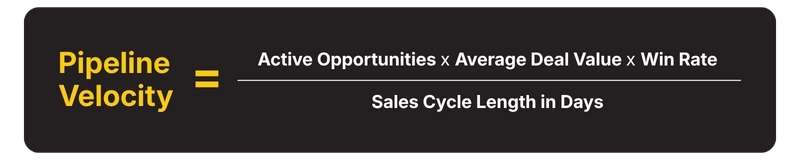
Improving intent targeting and buying committee coverage increases win rates and reduces sales cycle duration, accelerating total revenue generation.
Buying Committee Coverage Rate
Track the percentage of target accounts where your sales reps hold active conversations with three or more decision-makers. High coverage rates directly correlate with reduced deal slippage during final procurement reviews.
Step-by-Step Framework to Overcome Enterprise Lead Generation Challenges
Building a predictable enterprise pipeline requires restructuring your go-to-market motion around account depth rather than lead volume.
- Define your ideal account profile using firmographic, technographic, and intent parameters.
- Map out full buying committees for each named account before launching outreach.
- Deploy multi-channel messaging tailored specifically to each stakeholder role.
- Align sales and marketing on a strict definition of a Sales Qualified Opportunity.
- Track cost per qualified meeting and pipeline velocity to confirm acquisition profitability.
Following this systematic evaluation process protects your acquisition budget from wasted outbound effort. You build repeatable pipeline while expanding market share across target accounts.
Solving the Enterprise Lead Generation Challenge
Overcoming your enterprise lead generation challenge requires shifting from high-volume lead sourcing to multi-threaded account engagement. Assessing your internal SDR bandwidth against target account volume clarifies whether software platforms or managed execution services offer the highest return. Speaking with a qualified sales strategy advisor can clarify how to structure your go-to-market engine for maximum pipeline velocity.