Top Data Center Lead Generation Companies for 2026
Compare leading data lead generation companies and learn how they help data centers identify prospects, book meetings, and accelerate sales growth.
 Rebecca Matias
Rebecca Matias is Callbox's COO with 18 years of experience scaling B2B pipeline through data-driven outbound marketing, lead generation, and sales development.
View full bio of Rebecca Matias
If you run growth for a data center, colocation facility, or hyperscale campus, you already know the sales cycle is brutal: seven to twenty stakeholders, six figure contracts, and a buying committee that includes a CFO who has never heard your name.
The fastest way to generate data center leads is to hand outbound prospecting to a specialized B2B lead generation partner who already speaks CIO and can run multi-channel outreach, email, LinkedIn, phone, and events, across every stakeholder in that committee simultaneously. The right appointment setting services can turn that multi-stakeholder prospecting challenge into a structured process, with outreach, qualification, and meeting-setting handled across the buying committee.
Most data center providers try in-house outbound first, and most stall for the same reason. A single SDR, or even a small internal team, can run email and maybe LinkedIn. They cannot easily run coordinated, multi-touch campaigns across five channels while also qualifying leads against firmographic, technographic, and intent signals specific to colocation and hyperscale buyers. That gap is exactly what a dedicated data center lead generation company is built to close.
Struggling with how to reach the right data center decision-makers?
Who Are the Top Data Center Lead Generation Companies?
The seven agencies below split into two groups. Four have documented, verifiable data center or colocation work: a dedicated vertical page, a named data center client, or public case study evidence in this space. The other three are established B2B outbound and appointment-setting agencies with a strong general technology track record; none of them publish a data center-specific case study as of this writing, so ask for one directly before you sign. Here is how all seven compare on the fundamentals.
| Company | HQ | Best For | Core Strength | Global Reach |
| Callbox | Encino, CA, USA | Enterprise data center providers who need global, multilingual account based marketing at scale | Human plus AI multi-channel execution on the proprietary Callbox Pipeline platform; a six month nationwide colocation campaign delivered 67 sales qualified leads and 912 marketing qualified leads | 60+ countries across North America, APAC, EMEA, and LATAM |
| Launch Leads | Salt Lake City, UT, USA | Colocation and interconnection providers who want infrastructure-fluent SDRs | SDRs trained on colocation, interconnection, and power and cooling terminology, screening every lead against a three-point standard, verified need, budget authority, and an active deployment timeline, before it reaches your calendar | Primarily United States and North America |
| JSA (Jaymie Scotto and Associates) | Las Vegas, NV, USA | Data center and telecom providers who want PR, account based marketing, and lead nurturing built around long buying cycles | Public relations, account based marketing, and lead nurturing programs built specifically around the long, technical buying cycles common to data center and telecom deals | Clients across North America, EMEA, and APAC |
| Percepture | New York, NY, USA | Data center and colocation providers who want inbound demand built through SEO, PR, and AI-search visibility rather than outbound SDR | SEO, PR, and generative engine optimization built to make a data center brand visible and citable across both traditional and AI-powered search | Clients across North America, EMEA, and APAC |
| SalesRoads | Boca Raton, FL, USA | Data center companies that want a process-driven, phone-first outbound partner without vertical-specific overhead | Research-based, phone-verified appointment setting that qualifies decision-makers on fit and interest before a meeting ever reaches your calendar | Primarily United States-based delivery |
| EBQ | Austin, TX, USA | Data center and infrastructure firms who want full-funnel outsourcing, data, SDR, and CRM, under one roof | Dedicated BDR teams that work directly inside your own CRM and marketing stack, paired with data, marketing, and full-cycle sales support under a single retainer | Primarily United States-based delivery |
| SalesHive | Denver, CO, USA | Mid-market data center vendors who want a tech-forward, no long-term contract model | US-based SDRs running cold calling and email outreach on a proprietary AI platform, with a dedicated strategist owning targeting and messaging | Primarily United States-based delivery |
 Industry Insight
Total leads delivered is a vanity metric in data center lead generation. Ask any agency on this list for their sales qualified lead to marketing qualified lead ratio and their average sales cycle compression. A partner who shortens your sales cycle by even 20 to 30 percent, the way a tight qualification standard tends to do, usually returns more revenue than one that floods your CRM with unverified names.
If you are also comparing providers beyond the data-center niche, reviewing the top B2B lead generation companies in the USA can provide additional context on capabilities, delivery models, and specialization.
How Do You Calculate ROI on a Data Center Lead Gen Agency?
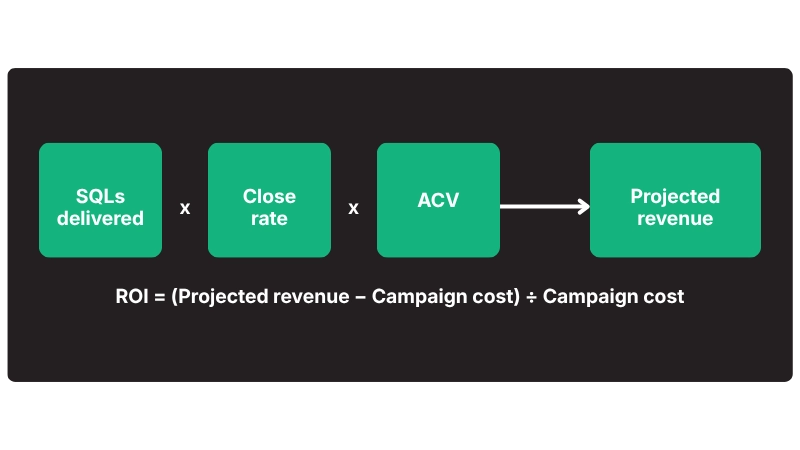
Because data center deals are large and infrequent compared to typical SaaS sales, ROI has to be modeled at the deal level, not the lead level. The framework below is the one we walk prospects through, and you can run it against any agency’s numbers, including ours.
For campaigns that use events as part of the acquisition strategy, event attendee acquisition strategies can also help turn conferences, webinars, and executive events into additional pipeline opportunities.
Step 1: Establish your average contract value (ACV). Use trailing twelve month data if you have it. Colocation and managed hosting deals commonly range from the low six figures to well into seven figures for hyperscale or wholesale capacity.
Step 2: Estimate your SQL-to-close rate. Pull this from your CRM. If you do not have enough closed-won data yet, use a conservative 15 to 20 percent as a placeholder and revise it after your first full quarter with the agency.
Step 3: Total the fully loaded campaign cost. Add the monthly retainer, any platform or data fees, and the internal hours your team spends on qualification calls and follow-up.
Step 4: Run the formula. Projected revenue equals SQLs delivered multiplied by your close rate, multiplied by your ACV. ROI equals projected revenue minus campaign cost, divided by campaign cost, expressed as a percentage.
MQL and SQL definitions vary between providers, it is important to establish exactly what each stage represents before comparing campaign performance. See this guide to MQL vs SQL vs SQO for a clearer qualification framework.
Lead Generation Boosts Data Center Pipeline Nationwide
Callbox helped executed a 6-month ABM program focused on US enterprise market expansion, increased brand awareness and engagement through multiple channels
View Case StudyHow Should You Evaluate a Data Center Lead Gen Partner?
Price and lead volume are the two easiest numbers to compare and the two least predictive of results. Use this six step process instead.
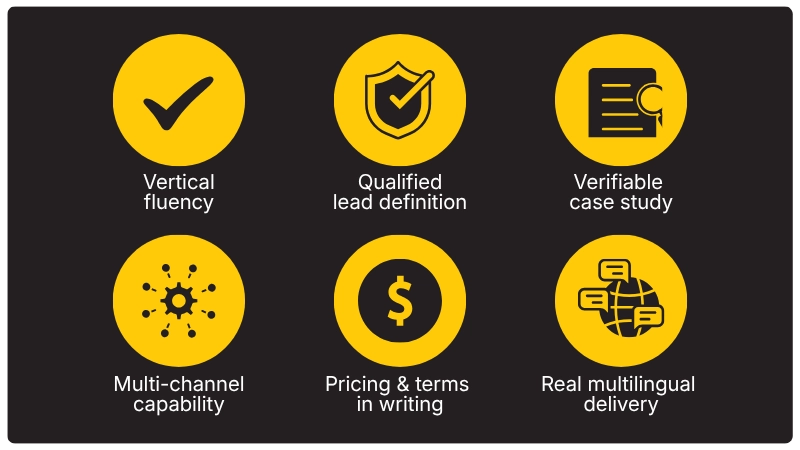
1. Confirm vertical fluency before the contract, not after. Ask the agency to explain, in their own words, the difference between colocation, hyperscale, and edge deployments, and how messaging should differ for a CIO versus a VP of Infrastructure. If you are doing the educating, you are paying for training, not lead generation.
2. Ask exactly how they define a qualified lead. Fit, intent, and readiness are the three components that matter. A vague answer here is the single biggest predictor of a disappointing engagement.
3. Request a named, verifiable case study in data center or closely adjacent infrastructure verticals. Ask for numbers you can sanity check: sales qualified leads, marketing qualified leads, and campaign length, not just a testimonial quote.
4. Confirm true multi-channel capability. Data center deals rarely close on outbound email alone; you want coordinated email, LinkedIn, phone, and, ideally, event support reaching the same buying committee.
5. Get pricing and contract length in writing early. Watch for agencies that will not specify how they define “qualified” in the contract itself, since that definition is what you are actually paying for.
6. If you sell across regions, confirm real multilingual and multi-country delivery, not just a claim of it. APAC, EMEA, and LATAM buying committees behave differently than North American ones, and an agency without local-language capability will underperform outside its home market.
Data center providers also operate within a broader technology buying ecosystem, so experience with IT lead generation can be a useful indicator of whether an agency understands technical buyers and complex infrastructure sales cycles.
Expert Tip:Treat "guaranteed lead volume" as a caution flag in data center lead generation. Deals in this category run seven to twenty stakeholders deep. A partner promising volume without a defined qualification bar is optimizing for a number your sales team will have to re-qualify from scratch, which costs you time twice.
Who Should Hire a Data Center Lead Gen Agency?
This approach is not the right fit for every provider at every stage. It works well for data center companies with an established offer, a defined ideal customer profile, and an internal sales team ready to take qualified meetings and run them to close. It is a poor fit if you are still pre-revenue, have not yet nailed down who your ideal buyer is, or sell exclusively through channel and reseller partners with no direct outbound motion of your own. Outsourced lead generation accelerates a sales process that already works. It cannot substitute for one that is not built yet.
What’s the Bottom Line on Data Center Lead Gen?
Data center lead generation only works when the partner actually understands how colocation, hyperscale, and edge deals get bought: long cycles, seven to twenty stakeholders, and buyers who filter out generic pitches within the first sentence. Of the seven agencies compared above, four have documented, verifiable data center work behind them, and the other three bring a strong general B2B outbound track record and are worth a conversation if you ask for a data center reference first.
Whichever partner you choose, run the ROI framework from this article against their numbers before you sign, hold them to a defined qualification standard rather than a raw lead count, and confirm upfront that the campaign is built for a sales cycle measured in months, not weeks. The agencies that win in this category are the ones that treat a slow, technical buying committee as the whole point, not an inconvenience to work around.
What Are Common Questions About Data Center Lead Gen?
How much does a data center lead generation agency cost?
Most agencies price on a monthly retainer, typically five to fifteen thousand dollars a month depending on channel mix, target account volume, and whether SDR staffing, content, or event support is included.
What is a good SQL-to-MQL ratio for a data center campaign?
A healthy campaign converts roughly one sales qualified lead for every twelve to fifteen marketing qualified leads, though this shifts with deal size and how tightly the agency defines its qualification criteria.
How long does it take to see results?
Most providers surface qualified conversations within four to six weeks of launch, with a fuller pipeline view after a full quarter. Long, multi-stakeholder sales cycles mean early meetings can still take months to close.
How is an agency different from a lead list?
A list gives you names and titles with no verification. An agency runs outreach, qualifies fit and intent, and hands your team a booked conversation with a stakeholder who has confirmed budget authority and an active project.
Should we build an in-house SDR team instead?
In-house makes sense once you have proven messaging and steady deal flow that justifies full-time headcount. An outsourced agency makes more sense earlier, or when testing a new region without the ramp time of hiring an internal team from scratch.