How to Increase Event Attendee Acquisitions and Show-Ups
Discover how to increase event attendee acquisitions with proven strategies that attract more registrants and improve event attendance rates.
 Jude Neilson
Jude Nielson is a Business Development Manager at Callbox Inc, with 12 years of experience driving B2B growth through strategic lead generation and sales development.
View full bio of Jude Neilson
Securing registration forms for your virtual webinars, executive roundtables, or regional roadshows is only half the battle. To turn registrations into meaningful participation, businesses need a structured event marketing services strategy that keeps prospects engaged before, during, and after the event. Across the B2B landscape, attendance drop-off remains a costly reality: average virtual event attendance rates hover between 35% and 45%, meaning over half of your registered prospects fail to show up.
When B2B event registrants ghost your sessions, pipeline velocity stalls and customer acquisition costs spike. Understanding the root causes of registrant drop-off and implementing structured event attendee acquisition workflows is essential to transforming sign-ups into actual attendees and a qualified pipeline. A specialized lead generation agency can help bridge this gap by combining audience targeting, multi-channel engagement, and sales follow-up to move event registrants further down the funnel.
Currently running your event and need more registrants and attendees?
Why Do B2B Event Registrants Fail to Attend Live Sessions?
Direct Answer: B2B event registrants fail to show up due to registration friction, lack of perceived immediate value, calendar conflicts, and ineffective reminder sequences. When prospects register weeks in advance without receiving ongoing, value-driven touchpoints, competing daily priorities take precedence, leading to high drop-off rates on event day.
For organizations focused on converting event engagement into sales opportunities, appointment setting services can help turn qualified attendees and engaged registrants into conversations with the sales team. To understand why prospects ghost, revenue leaders must look at the psychological friction points that occur between the moment a form is submitted and the start time of the session.
1. The “Bookmark” Mentality
B2B buyers frequently fill out forms merely to receive the on-demand recording later. They view the registration page as a gated content download rather than an appointment. When no incentive exists to participate live, the registrant intentionally skips the live broadcast.
2. The Calendar Overload Factor
C-level executives and enterprise department heads manage packed schedules. A webinar scheduled 3 weeks in advance easily gets buried beneath urgent internal meetings, client emergencies, and competing deadlines unless active multi-channel nudges maintain the event’s priority status.
3. Attendance Benchmarks by Event Format
Drop-off rates vary significantly depending on the format, commitment level, and audience tier of your event:
| Event Format | Target Audience | Industry Avg Attendance | Typical Drop-Off Rate |
| Broad Educational Webinars | Top-of-Funnel (ToFu) Leads | 30% to 40% | 60% to 70% |
| Executive VIP Roundtables | C-Level / VP Decision-Makers | 60% to 75% | 25% to 40% |
| In-Person Regional Roadshows | Local Enterprise Accounts | 50% to 65% | 35% to 50% |
| Product Demos & Partner Briefings | Middle-of-Funnel (MoFu) Prospects | 45% to 55% | 45% to 55% |
Working with event marketing services agencies in the US can help organizations address these challenges through targeted audience acquisition, personalized engagement, and structured pre-event follow-up.
Callbox Event Marketing for RPA Enterprise Pipeline
Enabled the Client to build valuable connections with key decision-makers, enhancing their sales outreach and marketing effectiveness ahead of and following their flagship event.
View Case StudyHow Does Low Event Attendance Impact Your Pipeline Economics?
Direct Answer: Low event attendance inflates cost-per-acquisition (CPA) and wastes marketing spend by stalling high-intent prospects at the top of the funnel. When attendance drops below 40%, sales development reps lose direct engagement opportunities, extending B2B sales cycles and diminishing event return on investment.
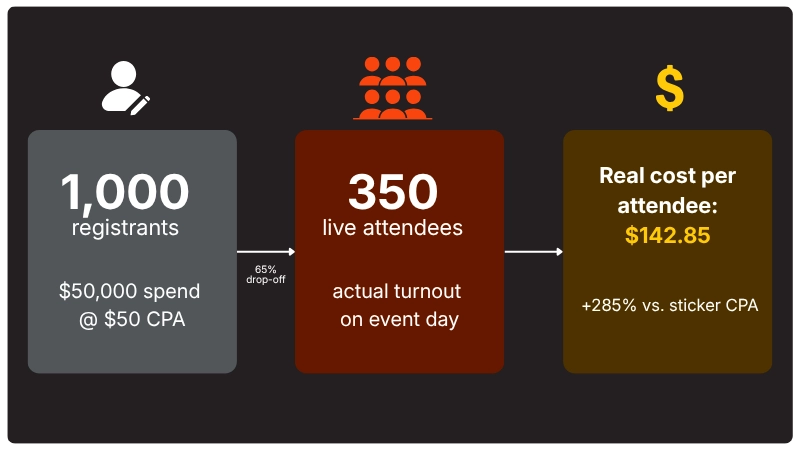
When over 60% of registrants fail to attend, marketing teams incur significant financial waste. The cost per registrant might look healthy on paper, but the actual cost per live attendee balloons rapidly.
Analyzing the economic disparity between generic registration tactics and a structured acquisition methodology reveals the true cost of event drop-off:
| Event Metric | Generic Broad Outreach | Targeted Multi-Touch Method | Impact on Pipeline |
| Average Attendance Rate | 30% to 40% | 55% to 70% | Higher conversion to live sales conversations |
| Registrant Qualification Rate | Low (unfiltered sign-ups) | High (ICP-vetted contacts) | SDRs spend time on decision-makers |
| Post-Event Sales Velocity | Slow (cold email follow-ups) | Accelerated (same-day booking) | Shorter deal cycles and higher win rates |
| No-Show Follow-up Rate | Single automated email | Multi-channel SDR touchpoint | Recovers up to 20% of no-shows |
For companies without the internal resources to manage these activities, outsourcing event marketing services can provide the specialized resources needed to promote events, engage registrants, and improve attendance without adding a full in-house team.
What Methodology Prevents Event Attendance Drop-Off?
Direct Answer: Preventing event drop-off requires shifting from single-channel email blasts to a multi-touch event attendee acquisition framework. This method combines audience pre-qualification, personalized multi-channel nudges (phone, LinkedIn, email), interactive session design, and real-time SDR outreach to maintain engagement from sign-up to event day.
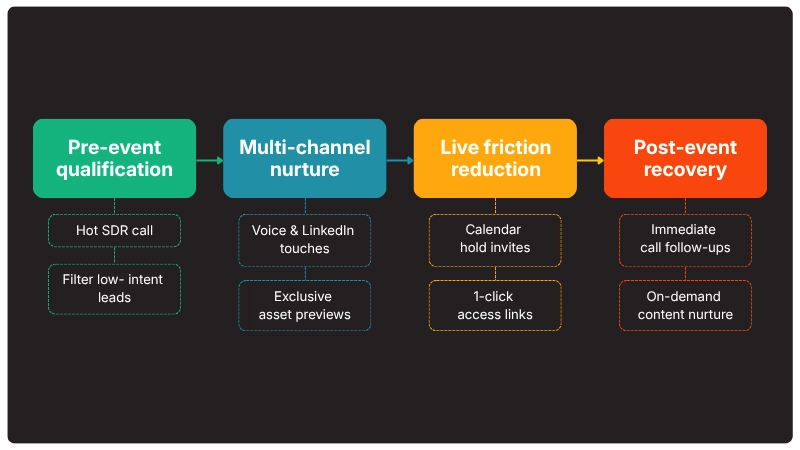
Stage 1: ICP-First Audience Filtering
High attendance begins with strict targeting. Unfiltered broad registration campaigns attract low-intent attendees, students, or competitors who have no intention of buying. Filtering for your Ideal Customer Profile (ICP) during the initial promotion stage raises the baseline commitment level.
Stage 2: Multi-Touch Touchpoint Sequencing
Relying solely on automated marketing emails guarantees low open rates, as corporate spam filters frequently isolate automated calendar notifications. Combining phone calls, personalized LinkedIn messages, and SMS alerts ensures your reminders reach the prospect’s direct line of sight.
Stage 3: Live-Only Engagement Triggers
Give prospects a compelling reason to show up live rather than waiting for the recording. Effective live-only incentives include:
- Access to downloadable executive toolkits or industry benchmark reports.
- Unscripted, live Q&A sessions with industry analysts or keynote speakers.
- Live diagnostic audits or product teardowns offered exclusively to participants.
A key part of increasing event RSVPs is maintaining engagement throughout the period between registration and the event, rather than relying on a single confirmation email.
How Can You Fix Low Attendance and Boost Event Turnout?
Direct Answer: You can fix low attendance by implementing a 14-day multi-channel cadence, offering 1-click calendar integrations, sending personalized voice reminders to high-value VIP accounts, and using live engagement incentives. Additionally, dedicated SDR teams should contact registrants 24 hours prior to confirm attendance.
Executing actionable solutions across every stage of the event lifecycle will turn sign-ups into active attendees:
Solution 1: Deploy a 14-Day Multi-Touch Nurture Sequence
Execute a synchronized nurture campaign across email, phone, and LinkedIn as the event date approaches:
- T-14 Days: Registration Confirmation + 1-Click Calendar Add Link
- T-7 Days: Content Teaser (Exclusive Video/Report Excerpt via Email)
- T-3 Days: SDR Voice/LinkedIn Check-In for Enterprise Accounts
- T-24 Hours: SMS/Email Reminder with Direct Access Link
- T-1 Hour: Final “Starting Soon” Alert with Access Credentials
A multi-channel event attendee acquisition strategy can strengthen this process by combining email, phone, LinkedIn, and other touchpoints to keep high-value registrants engaged throughout the event lifecycle.
Solution 2: Utilize SDR Teleprospecting for VIP Accounts
For high-value target accounts, automated marketing messages are insufficient. Having SDRs call registered executives 48 hours prior confirms attendance, builds rapport, and provides an opportunity to gather preliminary discovery data.
Sample Pre-Event SDR Confirmation Script:
“Hi [Prospect Name], this is [SDR Name] with [Company]. I noticed you registered for our upcoming session on [Event Topic] this [Day]. I wanted to make sure you received your calendar invite and direct login link. We are also compiling a quick question list for our panel, is there a specific challenge regarding [Topic] you would like our speakers to address live?”
Solution 3: Execute the “No-Show” Recovery Playbook
Do not treat non-attendees as lost opportunities. Up to 50% of eventual event-generated pipeline comes from no-shows who are properly nurtured after the event.
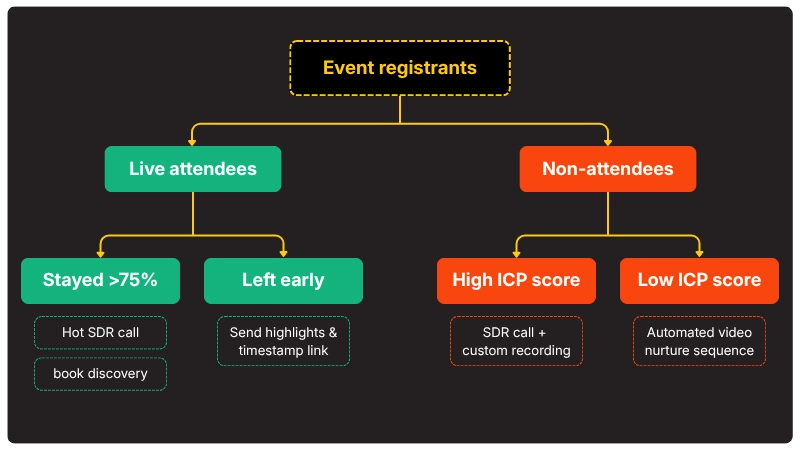
Segment your post-event outreach into three distinct follow-up tracks within 24 hours:
- Hot Attendees (Stayed >75% of Session): SDRs place a direct phone call within 4 hours to schedule a discovery meeting while the session content is fresh.
- Early Leavers (Attended <30 Minutes): Send a personalized email featuring timestamps pointing to key topic highlights they missed.
- High-Value No-Shows: SDRs execute a 3-touch follow-up sequence offering the recording alongside an offer for a 1:1 briefing with the speaker.
Conclusion
B2B event registration is only the first step in driving meaningful attendance. High drop-off rates can result from low perceived value, calendar conflicts, registration habits, and insufficient engagement between sign-up and event day. A structured event attendee acquisition strategy helps address these challenges through ICP-focused targeting, multi-channel reminders, live engagement incentives, and timely pre-event communication that keeps the event relevant to registrants.
However, improving event performance should not stop at increasing live attendance. No-shows, early leavers, and engaged attendees can all represent different opportunities for follow-up and pipeline development. By tracking attendance, engagement, attendee quality, and post-event conversions, B2B teams can identify where prospects drop off and optimize each stage of the event journey to generate more qualified opportunities.