Top 8 Event Marketing Services Agencies in the US
Discover 8 leading event marketing agencies in the US that help B2B brands plan, promote, and execute events that generate qualified leads.
 Rebecca Matias
Rebecca Matias is Callbox's COO with 18 years of experience scaling B2B pipeline through data-driven outbound marketing, lead generation, and sales development.
View full bio of Rebecca Matias
You generate more event attendees by treating registration as a sales motion instead of a marketing broadcast. That means a named target account list built before the invitation goes out, a phone or LinkedIn touch layered on top of every email, a confirmation call inside the 48 hours before the doors open, and a follow-up sequence that launches the same week the event ends. Broad promotion fills seats with the wrong people. Sequenced human outreach fills seats with buyers. Every other decision in your event program sits downstream of that one.
Which is why choosing an event marketing agency is harder than it looks. The market is crowded with firms that are excellent at very different things, and the directories that rank them tend to flatten those differences into a single leaderboard. This guide separates the categories, shows you the financial model to judge any of them by, and profiles eight US firms worth a conversation. For events where the goal extends beyond attendance, B2B appointment setting can turn event engagement into qualified sales conversations before and after the event.
How do you generate more event attendees?
Registration numbers lie. Attendance numbers do not. Most B2B teams we talk to are running a 40 to 50 percent show rate against their registration list and treating that as normal. It is not normal, it is a symptom. When half your registrants never walk in, the problem is almost never the invitation creative. It is the absence of human contact between the moment someone registers and the moment the event starts.
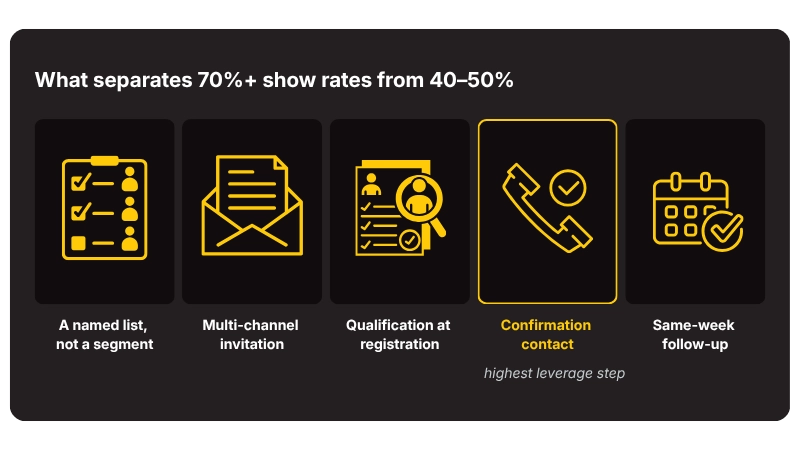
The programs that hit 70 percent and higher share the same five-layer stack:
- A named list, not a segment. Titles and firmographics get you an audience. Named accounts with named buying committees get you a pipeline.
- Multi-channel invitation. Email opens the door. Voice and LinkedIn are what actually get the calendar block.
- Qualification at registration. Ask two budget or timing questions on the form. You will lose some registrations and gain far better attendance.
- Confirmation contact. A live confirmation touch in the final 48 hours is the single highest-leverage activity in the entire program.
- Same-week follow-up. Attention decays fast. A lead worked on day two converts at a materially different rate than one worked on day fourteen.
For teams without the internal resources to execute this consistently, outsourcing event marketing services can provide the targeting, outreach, confirmation, and follow-up infrastructure needed to improve attendance.
Notice what is missing from that list: bigger budgets, better swag, a more famous keynote. Those things help fill a room. They do not help fill a room with the twelve accounts your CRO actually cares about.
Callbox Turned In 1000+ RSVPS and 100s of Appointments for PR and Event Management Expert
Callbox successfully completed a 3-month large-scale event marketing and appointment setting campaign for a PR and events management company’s global IT firm customer.
View Case StudyWhat does the event marketing data actually show?
The macro case for events is not in dispute. HubSpot’s event marketing research reports that 80.4 percent of businesses treat in-person events as their most impactful marketing channel, and that Forrester found 48 percent of teams now consider events more important than they were before the pandemic. On the buyer side, 87 percent of attendees say discovering new products and solutions is the most valuable part of an in-person experience, and 77 percent report increased trust in a brand after meeting it at a live event.
The same research surfaces the operational tell. When marketers were asked what contributed most to event success, 39 percent pointed to email marketing tools. Email is the cheapest channel in the stack and the easiest to over-index on, which is precisely why so many event programs stall at the registration line. The channel that scales invitations is not the channel that converts them.
 Industry Insight
Ask any prospective agency for their average registration-to-attendance ratio across the last four client programs, in writing. Not their best case. Their average. Agencies with genuine attendance discipline answer immediately because they track it as a core KPI. Agencies selling creative production will change the subject to impressions and engagement.
How do you calculate ROI on an event agency?
Most event ROI decks stop at cost per lead, which is the least useful number in the model. Here is the framework we run with clients before a single dollar of agency spend is committed. It has three layers, and you need all three.
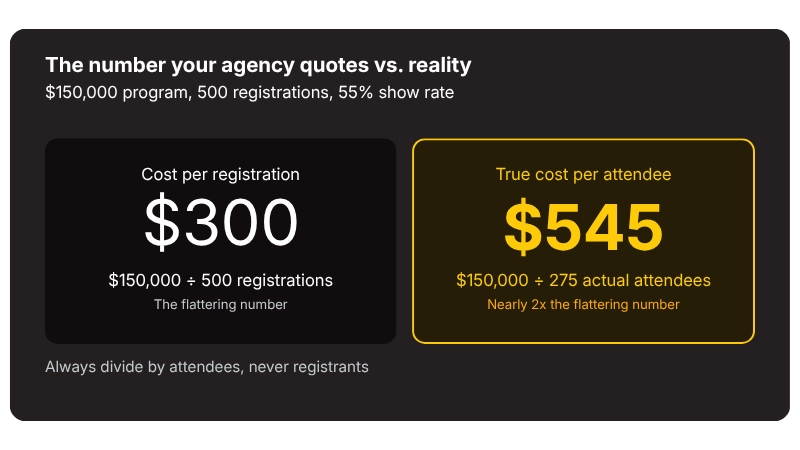
What is your true cost per event attendee?
Total fully loaded program cost divided by actual attendees, not registrants. Fully loaded means agency retainer, booth or venue, travel, content production, and internal team hours. Take a $150,000 program that produces 500 registrations at a 55 percent show rate. That is 275 attendees and a true cost per attendee of roughly $545. If your agency quotes cost per registration instead, you are being shown a number that is nearly twice as flattering as reality.
How much is one event-sourced opportunity worth?
Multiply your average contract value by your historical win rate on event-sourced deals. At a $120,000 ACV and a 25 percent win rate, each qualified opportunity carries $30,000 of expected value. Use event-sourced win rates specifically, not your blended company number. Event-sourced deals usually close at a higher rate, and if you use the blended figure you will underprice the channel and defund it.
That is why lead generation events should ultimately be measured by qualified conversations and opportunities generated, not registrations alone.
What break-even number should you demand?
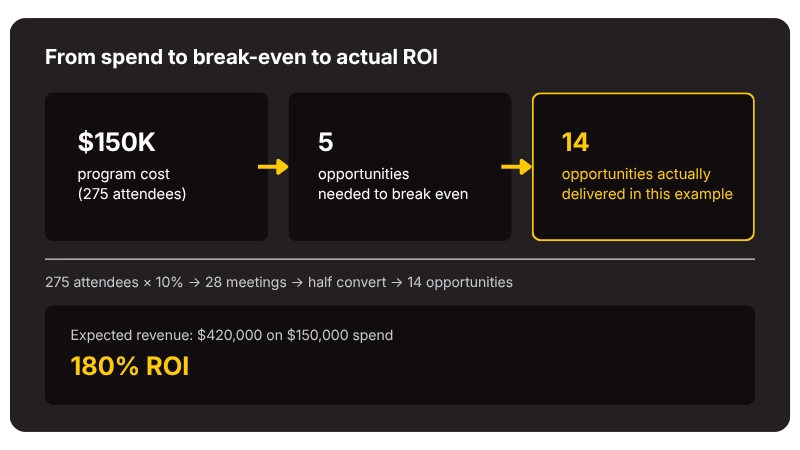
Divide total program cost by expected value per opportunity. In the example above, $150,000 divided by $30,000 means the program must generate five qualified opportunities to break even. That single number should appear in your agency contract as the floor. Continue the model out: 275 attendees converting at 10 percent to qualified meetings yields 28 meetings, half of which become opportunities, which is 14 opportunities against a break-even of five. Expected revenue of $420,000 on $150,000 of spend puts the program at 180 percent ROI.
Industry Insight
Write the break-even opportunity count into the statement of work, then tie the final retainer installment to it. Agencies that are confident in their attendance and qualification process will accept this without much negotiation. The ones that push hard against it are telling you where their real capability ends. We have never regretted including that clause.
How should you evaluate an event marketing agency?
Here is the seven-step process, in the order we would actually run it.
- Define the outcome, not the deliverable. Write down the number of qualified opportunities the event must produce. If you cannot write that number, you are not ready to brief an agency.
- Classify the work. Decide whether you are buying demand generation, creative and production, or logistics. Very few firms are genuinely strong at more than one, and paying a production shop to drive attendance is the most common budget leak in the category.
- Screen for audience access. Ask how they will reach your ICP if your own list underperforms. The honest answer involves owned data, outbound capacity, and named-account research. The evasive answer involves paid social.
- Audit the attribution plumbing. Confirm how registrations, attendance, and meetings will flow into your CRM, at what cadence, and who owns the mapping. Ambiguity here is where event ROI arguments are born.
- Interview the delivery team. Insist on meeting the people who will run the program, not the strategist who runs the pitch. Ask the account lead how many concurrent programs they carry.
- Reference-check on the failures. Ask for a client where the show rate came in below target and what changed afterward. An agency that cannot describe a miss has either not been doing this long or is not being straight with you.
- Pilot before you commit. Run one event or one region on a short scope. Measure against the break-even number. Then scale, renegotiate, or walk.
For multinational programs, also evaluate whether the agency can coordinate marketing events across Europe and other target regions without losing consistency in targeting, messaging, or follow-up.
Industry Insight
The most expensive mistake in this category is scope drift into fabrication. A firm hired to fill your executive roundtable will happily quote the staging, the AV, and the branded environment, and those line items carry markup that quietly consumes the budget you needed for outreach. Keep attendance spend and production spend on separate lines with separate owners.
Which event marketing agencies lead the US market?
All eight firms below are headquartered in the United States. They are grouped by what they are genuinely best at rather than ranked, because a trade show fabricator and a demand generation partner are not competing for the same brief.
| Company | HQ | Best For | Core Strength | Global Reach |
| Callbox Inc. | Encino, CA | B2B teams that need attendance and pipeline, not staging | Multi-touch invitation, qualification, confirmation, and post-event follow-up run inside Callbox Pipeline | Offices in the US, Australia, Singapore, Malaysia, Colombia, and the Philippines serving clients in 50 or more countries |
| George P. Johnson | Auburn Hills, MI | Enterprise flagship events and technology launches | Large-scale B2B event programs with lead capture and data infrastructure built in | Roughly 30 offices across six continents |
| Jack Morton | Boston, MA | Brand experience creative at flagship scale | Concept-to-stage creative for keynotes, launches, and cultural activations | Roughly 20 offices following its 2026 merger with Impact XM |
| Momentum Worldwide | New York, NY | Brands that want award-winning creative with a B2B practice attached | Named Campaign US Experiential Agency of the Year in 2024, 2025, and 2026 | Offices from New York and London through Tokyo and Sydney |
| Sparks | Philadelphia, PA | Trade show exhibits and branded environments | In-house design and fabrication, Adweek Experiential Agency of the Year in 2024 | US-led with international project delivery |
| Freeman | Dallas, TX | Large-format trade shows and expositions | Venue-scale logistics, AV, and exhibitor services | North America plus international event operations |
Which agency type fits your event program?
If your calendar is built around one or two flagship events with heavy creative expectations, you are shopping for a brand experience firm. Momentum, Jack Morton, and George P. Johnson live in that world. Expect strategy and creative fees that scale with production ambition, and expect to own demand generation yourself or contract it separately.
If you are running a high-volume trade show calendar, the constraint is operational rather than creative. Sparks and Freeman are built for that reality, with fabrication and logistics infrastructure that a creative-first agency has to subcontract. Ask about drayage, storage, and refurbishment costs across a full year, not per show.
If your problem is that seats stay empty or the seats fill with the wrong titles, none of the above solves it. That is a demand problem, and it wants an outbound and qualification partner. Our webinar and virtual event marketing programs exist for exactly this scenario, and the same motion applies to in-person events.
What else do revenue leaders ask about agencies?
What do event marketing services actually cost?
Mid-market B2B programs typically land between $8,000 and $30,000 per month for demand generation and attendance work, with production and venue costs sitting outside that figure. Flagship creative and production engagements run considerably higher and are usually priced per event rather than on retainer.
Should you hire one agency or two?
Two, in most cases, once your program passes roughly $250,000 in annual event spend. Pair a production or creative partner with a separate demand partner, and keep the attendance KPI with the demand partner. Single-vendor convenience almost always costs you the show rate.
How long before an event program shows pipeline?
Attendance results appear within the first campaign cycle, usually four to six weeks from launch. Pipeline attribution takes one full sales cycle beyond that, so plan for two quarters before judging ROI on closed revenue rather than qualified opportunities.
Do virtual events still produce qualified pipeline?
Yes, when they are qualified at registration rather than promoted for volume. The show rate is lower than in-person by design, but the cost per attendee is a fraction of it, and the follow-up window behaves the same way. The mistake is measuring virtual events on attendance count instead of meetings booked.