Data Center Marketing: From Target Accounts to Pipeline
Learn how data center marketing turns target accounts into qualified pipeline, from ICPs and buying committees to qualification and KPIs. Read the guide.
 Mitos Aguadera
 is VP of Sales and Marketing at Callbox, leading go-to-market strategy and demand generation for B2B clients across tech and SaaS.
View full bio of Mitos Aguadera
Quick Answer: Data center marketing combines targeted account research, technical education, multichannel outreach, and sales alignment to help providers connect with qualified buyers. By understanding each account’s infrastructure requirements and buying committee, providers can turn engagement into sales conversations and measurable pipeline opportunities.
Table of Contents
- What Makes Data Center Marketing Different?
- Define Your ICP and Prioritize Target Accounts
- Map the Data Center Buying Committee
- Build Proof That Technical Buyers Trust
- Run Coordinated Multichannel Outreach
- Qualify Leads and Hand Off to Sales
- Nurture Long-Cycle Opportunities
- Measure Data Center Lead Generation
What Makes Data Center Marketing Different?
Data center marketing requires more than promoting available capacity or highlighting facility specifications. Buyers must evaluate technical requirements, operational reliability, security, connectivity, location, and long-term costs before making significant infrastructure decisions.
The market is evolving as AI and cloud services increase demand for digital infrastructure. In its Base Case, the International Energy Agency (IEA) projects that global data center electricity consumption will roughly double, from about 415 terawatt-hours (TWh) in 2024 to around 945 TWh by 2030. Access to power and suitable infrastructure remains an important consideration as providers respond to changing workload requirements.
For providers, data center lead generation helps turn growing market demand into qualified opportunities. A prospect may need additional capacity, but its location requirements may not match your footprint, or it may not yet have a budget or implementation timeline. Another may be evaluating several providers without having a defined purchasing process.
Effective data center marketing connects market demand with specific business requirements. It identifies the accounts most likely to benefit from an offering, addresses the concerns of relevant stakeholders, and gives sales teams the information needed to qualify opportunities.
Ready to take your data center services into international markets but unsure where to start?
Define Your ICP and Prioritize Target Accounts
An ideal customer profile (ICP) describes the types of organizations most likely to benefit from your services. A well-defined ICP helps marketing and sales focus their resources on accounts that match your capabilities and commercial objectives, much like the account-focused approach used in enterprise lead generation.
Start with your service model
Different data center offerings attract different buyers. Your targeting criteria and messaging should reflect what you sell.
Service model | Typical buyers or influencers | Messaging emphasis |
Retail colocation | IT infrastructure leaders, IT directors, and operations teams | Rack availability, connectivity, security, and operational requirements |
Wholesale and hyperscale capacity | Infrastructure executives, cloud teams, and capacity planners | Power availability, scalability, site readiness, and expansion requirements |
Interconnection | Network architects, network operations teams, and connectivity leaders | Carrier access, network performance, and connectivity options |
Managed and hybrid infrastructure | CIOs, CTOs, infrastructure managers, and cloud architects | Workload placement, integration, management, and operational support |
Edge infrastructure | Network leaders, application owners, and regional operations teams | Latency, geographic coverage, and proximity to users or devices |
Products and services sold to data center operators | Facilities, engineering, procurement, and operations leaders | Technical compatibility, deployment requirements, and service capabilities |
These are starting points rather than universal buyer profiles. Actual decision-makers depend on the provider’s offering, target market, and deployment model.
Build account-fit criteria
Use firmographic and technical information to determine whether an organization fits your offering. Relevant criteria may include company size, industry, geographic footprint, existing infrastructure, cloud adoption, compliance requirements, and anticipated capacity needs.
For example, a provider offering colocation to regulated enterprises may prioritize financial services, healthcare, and technology companies. Each industry has different operational and compliance considerations, so messaging should reflect the requirements relevant to each account.
Monitor buying signals and tier accounts
Look for observable changes that could indicate a need for new infrastructure. These include geographic expansion, AI or GPU initiatives, cloud migration, contract renewals, mergers and acquisitions, new compliance obligations, and infrastructure-related hiring.
Treat these as signals to investigate, not proof that a company is ready to buy.
Group accounts into three tiers based on fit, potential value, and the strength of available signals:
- Tier 1: High-fit accounts with timely signals. Use individualized research and outreach.
- Tier 2: Good-fit accounts with some relevant activity. Use tailored campaigns for similar groups of companies.
- Tier 3: Accounts that fit the broader market but have limited evidence of immediate demand. Use scalable education and nurture programs.
Review account tiers regularly as new information becomes available.
Lead Generation Boosts Data Center Pipeline Nationwide
Callbox Success executed a 6-month ABM program focused on US enterprise market expansion and generated 67 SQLs and 912 MQLs..
View Case StudyMap the Data Center Buying Committee
Data center purchases often involve several stakeholders, each evaluating a different aspect of the proposed solution. Engaging only one contact can leave important objections or requirements undiscovered.
Map the buying committee before launching a campaign.
Role | What they evaluate | Useful supporting evidence |
CIO, CTO, or infrastructure leadership | Strategic fit, scalability, and operational impact | Architecture overviews, deployment options, and business cases |
Network and interconnection teams | Connectivity, network design, and performance | Network specifications, connectivity options, and technical documentation |
CISO and security teams | Security controls, risk, and compliance | Relevant security documentation and audit evidence |
CFO and finance teams | Total cost, financial commitments, and business value | Cost comparisons, pricing assumptions, and financial analysis |
Procurement | Commercial terms, supplier requirements, and contract conditions | Service terms, pricing details, and vendor documentation |
Facilities and operations | Power, cooling, reliability, and operational readiness | Facility specifications, capacity information, and operating procedures |
Legal and compliance teams | Contractual obligations, data handling, and regulatory considerations | Contract documentation and applicable compliance evidence |
Not every account will involve every role, and some responsibilities may overlap. Use the map to identify the stakeholders relevant to each opportunity.
Tailor communication to each stakeholder’s concerns. A technical leader may need architecture details, while finance may need a clear explanation of costs and operational implications. Both should receive consistent information about the proposed solution.
Related: Data Lead Generation Strategies
Build Proof That Technical Buyers Trust
Technical buyers need evidence that a provider can meet their requirements. Broad claims about reliability, security, or scalability are less useful than documentation that addresses a specific concern.
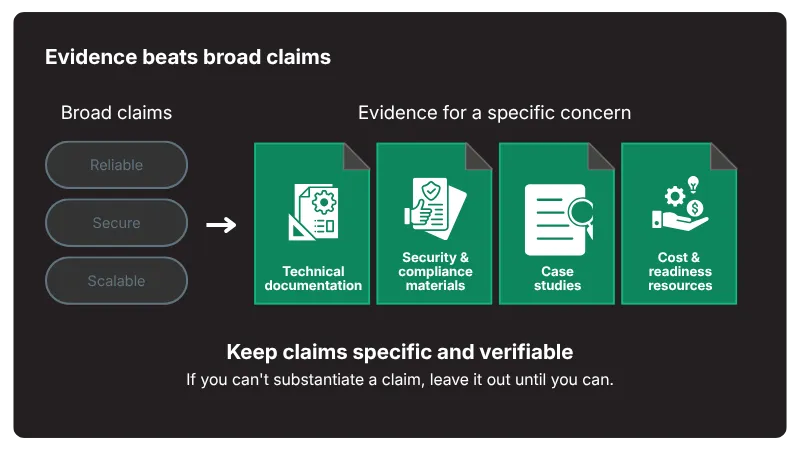
Build a content library that supports different stages of evaluation.
- Technical documentation: Facility specifications, connectivity options, capacity information, and deployment requirements.
- Security and compliance materials: Applicable certifications, audit documentation, security controls, and relevant regulatory information. Distinguish between certifications the provider holds and requirements it supports customers in meeting.
- Case studies: Examples of deployments or projects that demonstrate relevant experience while respecting client confidentiality.
- Cost and readiness resources: Comparison worksheets, infrastructure assessment checklists, and tools that help buyers identify requirements before requesting a proposal.
Match each asset to the audience and stage of the buying process. Early-stage prospects may need educational guides, while accounts actively evaluating providers may require technical documentation and more detailed discussions.
Keep claims specific and verifiable. If a provider cannot substantiate a performance, security, or sustainability claim, leave it out until the necessary evidence is available.
Related: Top Data Center Lead Generation Companies for 2026
Run Coordinated Multichannel Outreach
Reaching the right account is only the first step. The next step is coordinating channels so each stakeholder hears a consistent message where they already research and communicate.
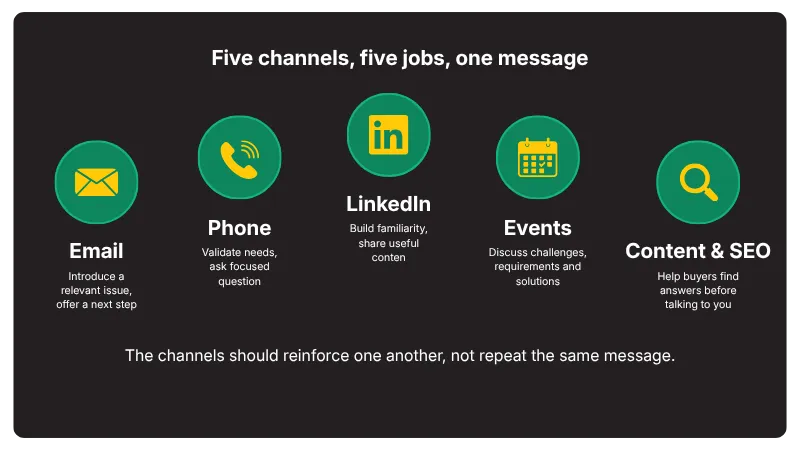
Give each channel a job
- Email: Introduce a relevant business issue, explain why it may matter to the account, and offer a useful next step.
- Phone: Validate requirements, ask focused questions, and establish whether a conversation with sales would be appropriate.
- LinkedIn: Build familiarity with relevant stakeholders and share useful industry or technical content.
- Events and webinars: Create opportunities to discuss infrastructure challenges, emerging requirements, and potential solutions through targeted event marketing services.
- Content and SEO: Help buyers researching infrastructure options discover answers before they are ready to speak with a provider. A strong inbound lead generation strategy can support this discovery process.
The channels should reinforce one another rather than repeat the same message. Personalization should reflect the account’s service needs, business context, and stakeholder responsibilities.
An illustrative Tier 1 outreach sequence
A campaign might follow this sequence over several weeks, with timing and channel selection adjusted to the account’s circumstances.
- Research the account. Identify its infrastructure footprint, relevant business developments, and likely stakeholders.
- Send a tailored introduction. Explain a potential challenge or opportunity and offer a useful resource.
- Connect on LinkedIn. Engage with their professional content without repeating the sales pitch.
- Follow up by phone. Ask whether the identified issue is relevant and who else may be involved in evaluating a solution.
- Share role-specific evidence. Send technical documentation or a business-oriented resource suited to the stakeholder’s concerns.
- Agree on the next step. If a genuine requirement exists, arrange an appropriate conversation. Otherwise, document the outcome and establish a suitable follow-up plan.
This is an example, not a mandatory cadence. Respect communication preferences, opt-out requests, and applicable privacy requirements.
Follow up after events and inbound inquiries
Record the prospect’s stated interests and requirements, then follow up with information relevant to the conversation. A generic message sent to every event attendee is unlikely to address individual needs.
Prioritize follow-up according to the prospect’s expressed interest, fit, and timing. Avoid treating every download, event registration, or inquiry as evidence of purchase intent.
Qualify Leads and Hand Off to Sales
Marketing activity becomes commercially useful when it helps identify genuine requirements and gives sales the context needed to evaluate them. This is a core objective of B2B appointment setting, where outreach should lead to relevant, qualified sales conversations.
Use a qualification checklist
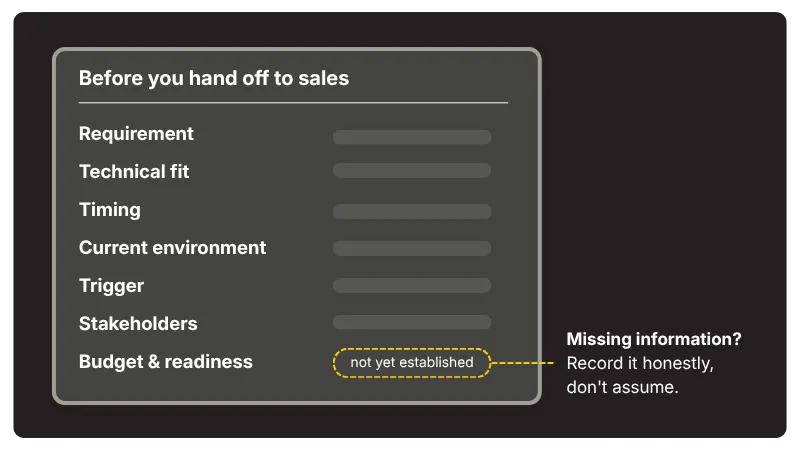
Before passing a lead to sales, establish what is known about the opportunity.
- Requirement: Is there a defined need for colocation, connectivity, managed infrastructure, or another service?
- Technical fit: Are the capacity, power density, rack, connectivity, and location requirements understood?
- Timing: Is the prospect planning an immediate deployment, a future expansion, or an eventual renewal?
- Current environment: What infrastructure or provider does the organization use today, if it’s appropriate to ask?
- Trigger: What prompted the evaluation, such as expansion, migration, a contract renewal, or a compliance requirement?
- Stakeholders: Who is involved, and who will influence or approve the decision?
- Budget and commercial readiness: Is funding available, under consideration, or not yet established?
These are recommended criteria to adapt to your sales process, not a universal qualification standard. Record missing information honestly rather than making assumptions.
Agree on MQL and SQL definitions
Marketing and sales should agree on what qualifies as a marketing-qualified lead (MQL) and a sales-qualified lead (SQL) before a campaign launches. Teams using outsourced SDR services should align these definitions with their provider before outreach begins.
An MQL typically meets your agreed fit and engagement criteria. An SQL has been checked against your qualification criteria, such as a confirmed requirement, timing, and the stakeholders involved, and is ready for a sales conversation.
Document the definitions, handoff requirements, and feedback process. Review rejected leads to determine whether the issue was targeting, insufficient information, timing, or a mismatch between the offering and the requirement.
Make the handoff complete
Provide sales with the account background, contact’s role, stated requirement, known stakeholders, expected timeline, relevant engagement history, and outstanding questions.
Not every prospect needs immediate sales attention. Smaller deployments or early-stage inquiries may be better suited to inside sales or a nurture program, depending on commercial fit. A clear routing process prevents potentially useful relationships from being discarded simply because they do not meet the criteria for an enterprise opportunity.
Nurture Long-Cycle Opportunities
Infrastructure projects can take time to progress from initial interest to a defined purchasing decision. Prospects may need to complete internal reviews, secure funding, compare locations, or coordinate several teams.
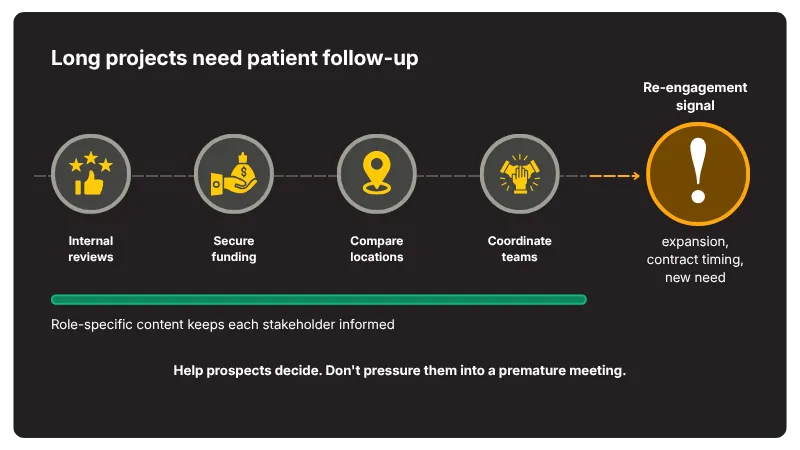
Keep these accounts engaged with communication tied to their requirements.
- Create role-specific content tracks. Provide technical material to infrastructure teams and business-case resources to financial stakeholders.
- Monitor re-engagement signals. Changes in expansion plans, contract timing, or stated requirements may justify another conversation.
- Maintain relationships across the committee. Keep each stakeholder informed without overwhelming them with duplicate messages.
- Use automation carefully. AI-assisted research and follow-up can help organize activities, but a human should review messages for accuracy, relevance, and appropriateness before they are sent.
Record why an account is not ready and agree on a sensible next action. Nurturing should help prospects make informed decisions, not pressure them into a premature meeting.
Measure Data Center Lead Generation from Engagement to Pipeline
Measure performance across the entire funnel rather than relying on raw lead volume. The right indicators help identify where a campaign is progressing and where it needs adjustment.
Stage | Example KPIs |
Account engagement | Engaged target accounts; engagement by account tier |
Marketing-qualified leads | MQL volume; percentage meeting agreed criteria |
Sales-qualified leads | SQL volume; MQL-to-SQL progression |
Meetings | Meetings booked and held; attendance rate |
Opportunities | Qualified opportunities created; opportunity progression |
Pipeline | Value of sourced and influenced opportunities; stage movement |
Closed business | Wins; revenue and other agreed commercial outcomes |
Define each metric consistently and distinguish between booked meetings and meetings actually held. Likewise, distinguish sourced pipeline from influenced pipeline so results are not attributed to marketing without a clear basis.
Review the data with sales regularly. If engagement is strong but few leads qualify, revisit account fit and messaging. If qualified leads rarely become opportunities, examine the qualification process, sales follow-up, and alignment between buyer needs and the offering.
Set performance targets using your own historical data and commercial objectives rather than applying unsupported industry benchmarks.
Case Study: Expanding a Data Center Provider’s Pipeline
Callbox’s published case study describes a US-based data center provider specializing in colocation, cloud connectivity, and managed IT infrastructure. Although the client had established recognition in markets such as Dallas and Northern Virginia, it faced challenges expanding into emerging regions where local competitors had stronger positions.
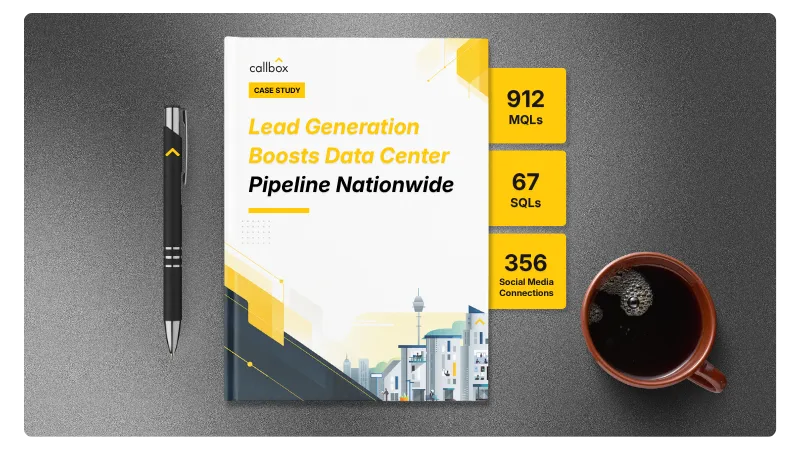
The campaign targeted US enterprise accounts across financial services, healthcare, technology, manufacturing, and professional services. The published results were:
- 912 marketing-qualified leads
- 67 sales-qualified leads
- 356 social media connections
The case study describes a six-month account-based marketing program focused on US market expansion.
The broader lesson is to define the target market, identify relevant stakeholders, and measure results across multiple stages of the campaign. Read the full data center campaign case study for the published details.
Turn Data Center Marketing into Qualified Pipeline
Effective data center marketing connects the right accounts with relevant information, engages the stakeholders who influence decisions, and gives sales a clear view of genuine requirements. Define your ICP, coordinate outreach, qualify opportunities consistently, and measure progress beyond initial engagement.
Need help reaching qualified data center buyers? See how Callbox supports data center providers with targeted outreach and qualification.
Frequently Asked Questions
Should you outsource data center lead generation or build it in-house?
An in-house team may be appropriate when you have the resources, expertise, and systems to manage research, outreach, qualification, and follow-up. Outsourcing lead gen for data center providers can help when you need additional capacity or specialized prospecting support. Compare both options based on cost, control, data quality, technical knowledge, and how well each approach integrates with your sales process.
Which industries buy data center services?
Potential buyers include organizations in financial services, healthcare, technology, manufacturing, and professional services. Their requirements vary according to infrastructure needs, connectivity, compliance, workload characteristics, and expansion plans. Prioritize industries where your offering solves a clear problem rather than assuming every company within a sector is a suitable prospect.
What should you do with prospects that only need a small deployment?
Evaluate the requirement against your service capabilities, commercial model, and delivery costs. If the prospect is a good fit but not suited to your enterprise sales process, consider routing it to inside sales or a lower-touch nurture program. This preserves potentially valuable relationships without diverting resources from higher-priority opportunities.
How often should you update your ICP and account tiers?
Review your ICP and account tiers regularly, with a formal review cadence suited to your sales cycle. Reassess them when campaign results, market developments, product changes, or customer feedback reveal a meaningful change in fit. Update individual account priorities sooner when new buying signals or requirements emerge.
Do SEO and AI search matter for data center marketing?
Yes. Buyers may research infrastructure requirements, compare solutions, and evaluate providers before contacting sales. Useful, technically accurate content can help your company become discoverable during that process. SEO and AI search visibility should complement targeted outreach and sales enablement rather than replace qualification, stakeholder engagement, and pipeline measurement.