Outbound Lead Qualification: The B2B Tech Playbook
Master outbound lead qualification in B2B tech. Discover a 10-point framework, provider evaluation criteria, and HubSpot data benchmarks.
 Rebecca Matias
Rebecca Matias is Callbox's COO with 18 years of experience scaling B2B pipeline through data-driven outbound marketing, lead generation, and sales development.
View full bio of Rebecca Matias
 What Is Outbound Lead Qualification?
Outbound lead qualification is the process of assessing whether a proactively contacted prospect is worth your sales team's time. Since the prospect never raised their hand, it verifies firmographic fit, decision authority, and genuine business need before advancing the account, turning cold outreach into a predictable source of sales qualified leads.
Most outbound pipelines fail not because reps contact too few accounts, but because they advance the wrong ones. When qualification is loose, discovery calendars fill with prospects who lack budget, authority, or a real problem to solve. A disciplined framework fixes that at the source.
Qualifying outbound leads is fundamentally different from filtering inbound ones. You are building interest from a cold target list rather than validating a prospect who already raised their hand, which means fit and authority must be confirmed before genuine need ever surfaces. This guide walks through how to qualify outbound prospects at every stage, from firmographic screening at the list level to scoring and a disciplined MQL-to-SQL handoff, so your team spends discovery time only on accounts with real closing potential.
Are you wasting SDR time on unqualified tech prospects?
How Is Outbound Qualification Different From Inbound?
Inbound qualification filters down self-reported interest from prospects who submitted a form or requested a demo. Outbound qualification builds up interest from a target account list that your team carefully selected.
| Dimension | Inbound Lead Qualification | Outbound Lead Qualification |
| Starting Signal | Self-reported interest (form submit) | Targeted account list selection |
| First Priority | Validate stated interest and timing | Verify firmographic fit and authority |
| Primary Risk | Wasting time on unqualified leads | Reaching out to wrong accounts |
| Cycle Dynamics | Catching existing active demand | Creating demand through engagement |
Related: How to Generate Quality Leads Using Outbound Lead Gen
The 10-Point Outbound Lead Qualification Framework
Use this 10-point checklist to evaluate cold prospects systematically and maintain high outbound lead quality across your team.
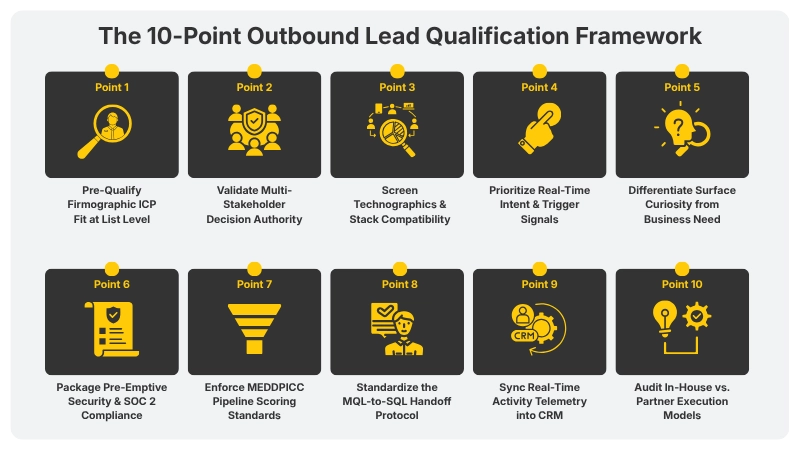
Point 1: Pre-Qualify Firmographic ICP Fit at List Level
Outbound qualification starts at list building, well before sending a single cold email or LinkedIn touchpoint. Filter target accounts strictly by revenue tiers, employee headcount, sub-industry, and geographic location. Screening accounts upfront prevents reps from pitching non-viable prospects.
Related: Multichannel Lead Generation through Effective B2B Marketing
Point 2: Validate Multi-Stakeholder Decision Authority
North American enterprise purchases routinely involve six to ten decision-makers across various corporate departments. Identify key contacts across IT, security, finance, and operations before launching your campaign. Validating authority early prevents deals from stalling due to single-threading.
Point 3: Screen Technographics & Stack Compatibility
Pitching prospects who run incompatible software stacks wastes outbound bandwidth and slows deal velocity. Screen target accounts for current software installations, cloud setups, and renewal schedules. Targeting companies with legacy tools allows reps to anchor discussions around clear migration pain points.
Point 4: Prioritize Real-Time Intent & Trigger Signals
Timing dictates whether a cold prospect engages with your message or deletes it immediately. Monitor intent signals like recent funding rounds, executive hiring surges, or technology changes. Leveraging buyer intent data allows sales teams to identify accounts showing active research behavior and prioritize prospects that are more likely to engage.
Point 5: Differentiate Surface Curiosity from Business Need
A prospect agreeing to a brief introductory call is demonstrating initial curiosity rather than active buying intent. During discovery calls, reps must dig beneath polite interest to uncover underlying business risks. This qualification process is a key component of effective B2B appointment setting, where sales teams validate business needs before advancing opportunities.
Expert Insight: Continuous Qualification Governance
Outbound qualification is an ongoing discipline rather than a single event. Re-confirm prospect authority, project priorities, and timeline changes as discussions develop. Continually updating qualification criteria prevents dead opportunities from cluttering your forecast.
Point 6: Package Pre-Emptive Security & SOC 2 Compliance
Enterprise tech buyers in the US mandate strict security standards before evaluating new software providers. Prepare lightweight compliance summaries covering SOC 2 Type II, ISO 27001, or regional data privacy rules. Sharing security documentation early removes friction before reaching formal procurement reviews.
Point 7: Enforce MEDDPICC Pipeline Scoring Standards
Traditional frameworks like BANT often fail in outbound sales because cold prospects rarely have established budgets. Using structured sales qualification frameworks such as MEDDPICC helps teams evaluate buying authority, urgency, business impact, and deal readiness.
Point 8: Standardize the MQL-to-SQL Handoff Protocol
Misalignment between sales development reps and account executives leads to dropped opportunities and friction. Establishing a clear MQL-to-SQL conversion process ensures both teams agree on qualification requirements before opportunities enter the sales pipeline. Require documented decision authority and confirmed meeting attendance before accepting the lead.
Point 9: Sync Real-Time Activity Telemetry into CRM
Delayed follow-ups destroy sales momentum when cold prospects show active digital intent. Connect your outbound tools directly to your CRM to track email opens, link clicks, and content engagement. Proper CRM integration gives sales teams real-time visibility into prospect interactions and enables faster follow-up.
Point 10: Audit In-House vs. Partner Execution Models
Scaling an internal sales development team requires recruiting cycles, management overhead, and software investments. Audit whether building internal seats or hiring an outbound lead generation partner better fits your growth goals. External partners provide immediate outbound infrastructure and proven qualification workflows.
Related: Top Outbound Lead Generation Tools
How Does HubSpot Data Ground Outbound Benchmarks?
HubSpot benchmarking data reveals clear operational standards for B2B outbound campaigns in North America. Comparing your metrics against regional averages ensures realistic pipeline forecasting and accurate team performance tracking.
| Metric | Global Average | US Enterprise Average | Strategic Adaptation |
| Outbound Email Open Rate | High Initial Visibility | Moderate Benchmark | Domain warming and clean list hygiene are essential for deliverability. |
| Response-to-Meeting Rate | Standard Conversion | Selective Commitment | Use hyper-personalized value props to earn calendar time. |
| MQL to SQL Conversion | General Pipeline | Strictly Qualified | Enforce MEDDPICC scoring to maintain pipeline health. |
| Average Sales Cycle | Standard Timeline | Extended Consensus | Maintain engagement using targeted mid-funnel case studies. |
How Do You Select an Outbound Lead Generation Partner?
If Point 10 points toward working with an external agency, follow a structured vendor evaluation framework. Using a step-by-step selection model ensures your partner delivers verified SQLs rather than low-quality appointment volume.
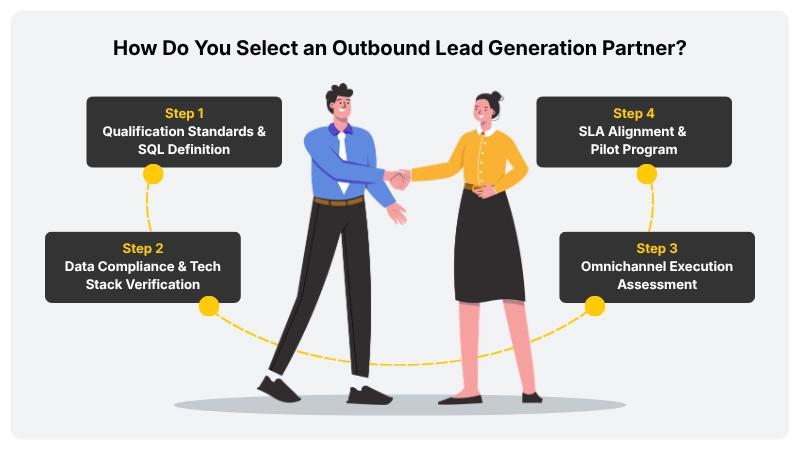
Step 1: Qualification Standards & SQL Definition
Verify how the vendor defines a qualified lead before signing any service contract. Ensure they commit to delivering vetted Sales Qualified Leads based on your ICP rather than raw meeting volume. A quality-focused agency aligns deliverables directly with your pipeline revenue targets.
Step 2: Data Compliance & Tech Stack Verification
Examine how the outbound lead generation partner sources, enriches, and validates prospect contact data. Ensure strict compliance with US data privacy laws like CAN-SPAM and CCPA to protect your primary domain reputation. Clean data hygiene guarantees lower email bounce rates and protects domain deliverability.
Step 3: Omnichannel Execution Assessment
Avoid agencies that rely exclusively on single-channel automated email blasts. The provider must demonstrate multi-touch execution combining direct phone calls, personalized LinkedIn touchpoints, and custom email sequences. Multi-channel execution ensures your message cuts through noise across preferred buyer touchpoints.
Step 4: SLA Alignment & Pilot Program
Establish clear Service Level Agreements covering target account match rates, lead handoff protocols, and CRM integration. Begin with a 90-day proof-of-concept pilot program to evaluate lead quality before signing long-term contracts. Clear SLAs align agency incentives directly with your internal revenue targets.
Frequently Asked Questions
Where does outbound lead qualification actually start?
It starts at list building, not at the first reply. Filtering target databases by company size, job title, and industry ensures you only reach decision-makers who can approve purchases.
What defines a Sales-Qualified Lead (SQL) in outbound?
An outbound SQL is a decision-maker within your target ICP who demonstrates genuine interest during engagement and agrees to evaluate your solution. Interest earned through direct conversation is the primary qualifying signal.
Can you qualify outbound leads on need and timing upfront?
Usually no. Because the prospect did not raise their hand, specific business needs and project timelines emerge during conversation rather than as pre-qualification gates.