How to Increase Healthcare Appointment Setting
Learn how to increase healthcare appointment setting, navigate hospital gatekeepers, and generate qualified hospital sales leads with multi-channel outreach.
 Rebecca Matias
Rebecca Matias is Callbox's COO with 18 years of experience scaling B2B pipeline through data-driven outbound marketing, lead generation, and sales development.
View full bio of Rebecca Matias
Healthcare appointment setting improves when a B2B team verifies its target list of clinical, IT, procurement, and compliance decision-makers, tailors messaging to each buyer’s specific concern, and qualifies every meeting against a shared standard before it counts as booked. Volume without accuracy burns through healthcare contacts fast.
That is the short version. The longer version is that healthcare buying groups do not behave like buying groups in software or manufacturing, and a generic program built around standard appointment setting services underperforms the moment it meets a hospital system’s procurement process.
Fixing that starts with treating healthcare as its own discipline instead of a vertical bolted onto a generic playbook. As a lead generation agency that has run outbound programs across dozens of B2B verticals, Callbox has found healthcare to be the buying environment where targeting discipline and message-to-persona fit matter more than raw outreach volume.
This guide builds the ROI math, the vendor criteria, and the messaging discipline to close that gap, drawing on patterns from Callbox’s own Healthcare lead generation programs and the wider healthcare appointment setting market.
Looking how to increase your healthcare sales appointments?
Why Is Healthcare Appointment Setting So Hard to Scale?
Every B2B seller complains that reaching a decision-maker takes too many attempts. In healthcare, that complaint understates the problem. A typical healthcare technology purchase now moves through 12 to 15 stakeholders across clinical, IT, procurement, finance, and compliance roles before a vendor gets a signed contract, according to research from DemandWorks. That is not a single gatekeeper to get past. It is a small internal negotiation your outreach has to survive multiple times over. For the broader picture of how this fits into pipeline strategy, see this guide to healthcare sales lead generation.
Who Actually Sits on a Healthcare Buying Committee?
Clinical leads care about patient outcomes and workflow disruption. IT and security teams care about integration risk and data protection. Procurement cares about total cost and contract terms. Compliance cares about regulatory exposure. Finance cares about budget cycles that often run six to twelve months longer than a typical enterprise deal. A single generic pitch cannot answer all of those questions at once, which is why messaging built for one persona routinely stalls with the other four.
This is also why appointment count alone is a misleading success metric in healthcare. A program that books twenty meetings with the wrong single stakeholder produces less pipeline than one that books ten meetings that each open the door to the rest of the committee. Mapping the committee before outreach starts, not after a deal stalls, is what separates programs that compound over a sales cycle from programs that reset every quarter.
Why Do Cold Outreach Attempts Get Ignored?
Reaching any decision-maker is hard. Roughly a quarter of sales professionals say getting in direct contact with the person who can say yes is one of the biggest challenges in their job, according to HubSpot. Healthcare adds a second layer on top of that: physicians and administrators are trained to be evidence-driven, so a pitch without a specific, named result reads as noise. Buyer expectations are also shifting fast, and it helps to track the broader healthcare marketing trends shaping how these buyers research and respond before your outreach ever reaches them. The fix is not more volume. It is a shorter, verified list, reached through more channels, with a proof point attached to every message.
 Industry Insight: Vague social proof does not move healthcare buyers. A generic ``we’ve helped hundreds of companies`` line gets ignored by a hospital administrator who has heard it from every vendor calling this month. Naming the buyer type and the number works better.
How Do You Calculate Healthcare Appointment ROI?
A healthcare appointment setting program is only working if the math behind it works. Four numbers tell you whether it does.
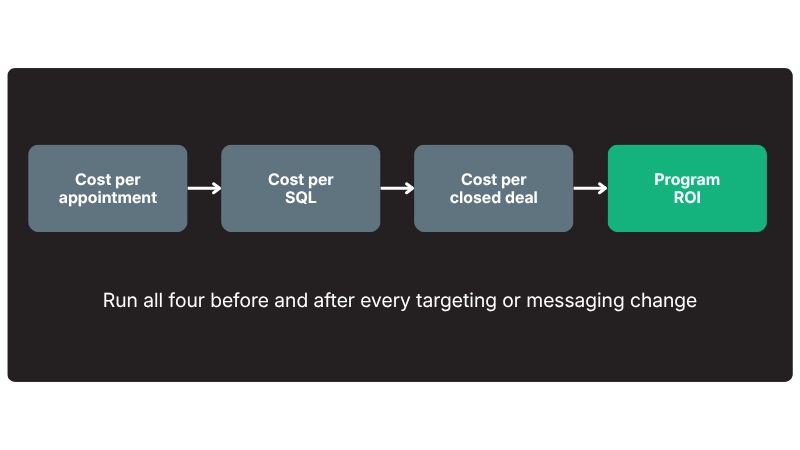
- Cost per appointment: total program investment divided by appointments booked in the period.
- Cost per sales qualified lead (SQL): cost per appointment divided by the percentage of appointments your sales team accepts as sales-ready.
- Cost per closed deal: cost per SQL divided by your SQL-to-close rate.
- Program ROI: deals closed multiplied by average contract value, minus total program cost, divided by total program cost.
Run those four numbers before and after any change to targeting or messaging, not just once at quarter end.
How Do You Vet a Healthcare Appointment Setting Partner?
Use this sequence before signing with any outsourced healthcare appointment setting vendor.
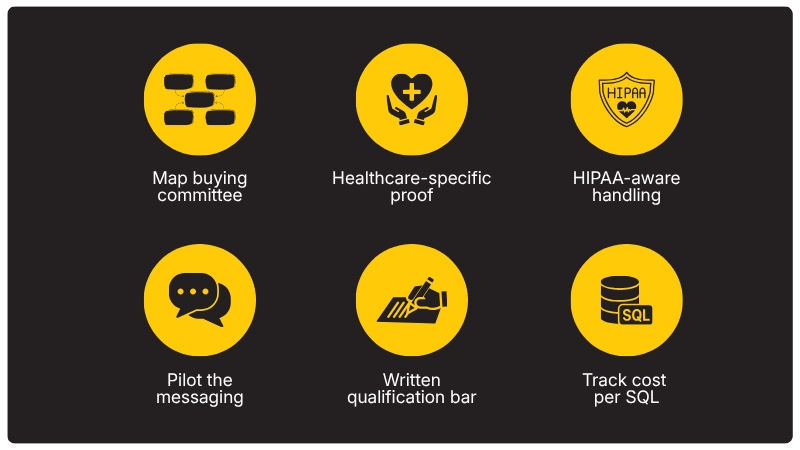
- Map your buying committee first. List every role your deal actually needs (clinical, IT, procurement, compliance, finance), not just the champion.
- Ask for healthcare-specific proof, not general B2B proof. A vendor’s total case study count matters less than whether they can show a named healthcare client, a target persona list, and a real appointment number.
- Confirm HIPAA-aware handling. Ask exactly how call scripts, data storage, and CRM access are controlled whenever a conversation touches protected information, even indirectly.
- Pilot the messaging before committing to volume. A short test batch against real decision-makers tells you more than any deck.
- Agree on a shared qualification bar in writing. Define what counts as a qualified appointment (title, authority, timeline, budget signal) before the first call is made, so cost-per-appointment numbers mean the same thing to both sides.
- Track cost per SQL, not just cost per appointment. A cheap appointment that never converts is not actually cheap.
Which Companies Set the Most Healthcare Sales Appointments?
The appointment setting and outsourced SDR market includes dozens of vendors, but a much smaller group has real, demonstrable healthcare experience. The table below profiles five US-based firms active in healthcare and medical B2B appointment setting. For a deeper side-by-side breakdown, see this roundup of leading healthcare lead generation companies, which Callbox was independently ranked among in 2026.
| Company | HQ | Best For | Core Strength | Global Reach |
| Callbox | Encino, CA | Mid-market and enterprise healthcare, medtech, and life sciences vendors needing multilingual, multi-region ABM programs | AI-assisted multi-channel outreach through Callbox Pipeline, built around named clinical, IT, and procurement personas | US, APAC, EMEA, and LATAM delivery across 50+ countries |
| SalesRoads | Boca Raton, FL | Healthcare vendors wanting a dedicated outsourced SDR team with a documented healthcare vertical playbook | Healthcare-specific case studies and a structured outbound calling methodology | Primarily US-focused delivery |
| SalesHive | Denver, CO | Companies wanting an AI-personalized email and dialer platform paired with human SDRs | Proprietary email personalization engine paired with a power dialer | US and Philippines-based calling teams |
| EBQ | Austin, TX | Companies that need appointment setting bundled with CRM and Salesforce optimization | Combined outsourced SDR and CRM consulting under one contract | US-based delivery only |
| Leadium | Las Vegas, NV | SMBs and startups entering the healthcare vertical for the first time | Dedicated healthcare industry practice with research-driven ICP targeting | US-based delivery, healthcare-focused |
A Note on Fit (Disqualifier) This framework and vendor list is for B2B companies selling products or services into hospitals, health systems, medical practices, or healthcare technology buyers. It is not about patient-facing scheduling or medical answering services. If your practice needs help answering patient calls or booking clinical visits, a patient communications vendor is the right fit, not a B2B lead generation partner.
What Should You Say to Healthcare Decision-Makers?
Three rules hold up across almost every healthcare vertical Callbox has worked in. They apply to appointment setting specifically, but they sit inside a wider set of digital marketing strategies for healthcare that shape how a buyer perceives your outreach before a rep ever calls.
- Lead with the outcome, not the feature. A hospital administrator does not care about your product’s architecture. They care about patient throughput, staff time saved, or audit risk reduced, stated as a specific number wherever possible.
- Match the proof to the persona. A CMO wants clinical or operational evidence. A procurement director wants total cost of ownership. A compliance officer wants to know exactly how data is handled. Sending the same proof point to all three wastes the meeting before it happens.
- Use more than one channel, in sequence. Buyers who prefer the phone still respond better to a call that follows a relevant, personalized email than to either channel alone.
How Does Appointment Setting Quality Drive Revenue?
A booked meeting is not the finish line. The appointments that actually close are the ones where the setter qualified for authority, timeline, and real interest before handing off the meeting, not just for a calendar slot filled. Programs that track appointment-to-SQL and SQL-to-close rates alongside raw appointment counts catch quality problems weeks before a quarterly pipeline review would. If your current reporting does not show that level of detail, that is usually the first thing to fix, before increasing outreach volume.
Treat qualification standards as a living document, not a one-time agreement. Healthcare buying committees change composition as deals move through review, a champion moves departments, or a new compliance requirement adds a stakeholder mid-cycle. A quarterly check-in between marketing, the appointment setting team, and sales on what a qualified meeting actually looks like keeps the cost-per-SQL number honest and prevents the slow drift toward booking meetings that are easy to get instead of meetings that are likely to close.
What Do Teams Ask About Appointment Setting?
What Does a Healthcare Appointment Setter Do?
In a B2B context, a healthcare appointment setter identifies verified decision-makers inside hospitals, health systems, or healthcare vendor organizations, then runs multi-channel outreach across phone, email, and LinkedIn to book qualified sales meetings for a client’s sales team.
How Many Appointments Should a Program Deliver?
It depends on target account count and vertical, but healthcare B2B programs commonly benchmark around 45 or more qualified sales appointments per quarter once a program is fully ramped.
Is In-House or Outsourced Appointment Setting Better?
In-house works well when you already have healthcare-specific data, scripts, and compliance training in place. Outsourcing is usually faster to launch and easier to scale up or down around campaign volume and seasonal demand.
How Fast Can a New Program Start Booking Meetings?
Most outsourced healthcare programs need two to four weeks for targeting, list building, and messaging approval before the first meetings appear on the calendar, with volume ramping over the following month.