Healthcare Sales Lead Generation: A Practical 2026 Guide
How can you improve healthcare sales lead generation? Discover proven strategies to reach healthcare buyers, qualify leads, and grow your pipeline.
 Rebecca Matias
Rebecca Matias is Callbox's COO with 18 years of experience scaling B2B pipeline through data-driven outbound marketing, lead generation, and sales development.
View full bio of Rebecca Matias
 Quick Answer:
Healthcare sales lead generation is the process of identifying, engaging, and qualifying healthcare decision-makers to generate sales opportunities while navigating complex buying cycles, compliance requirements, and multiple stakeholders.
The scale of the difference is worth stating plainly. Where a general B2B software deal might close in three months with a handful of stakeholders, healthcare organizations commonly take 12 to 24 months and involve six to ten decision-makers spread across clinical, technical, financial, and compliance functions. Gartner’s research on complex B2B purchases puts the buying group at six to ten people, and Forrester’s 2024 State of Business Buying found an average of 13 stakeholders with 89 percent of decisions crossing departmental lines.
Neither of those numbers is the real problem. The real problem is that clinical, IT, finance, and compliance stakeholders evaluate the same solution against four different sets of criteria, and a single champion cannot carry a deal through all four gates. For organizations looking to build a structured healthcare pipeline, healthcare lead generation services can help align targeting, outreach, and qualification with the healthcare buying process.
This guide covers what changes in healthcare, the six steps of a working program, sub-sector specifics, and how to measure results on a timeline that reflects how healthcare buys.
Want to generate more qualified healthcare sales opportunities this quarter?
Key takeaways
- Segment before you target. Healthcare is not one market. A hospital system, a payer, a device manufacturer, and a 12-physician group practice buy in completely different ways.
- Map the approval path, not just the org chart. Titles mislead. A department director at a community hospital may hold more real authority than a VP at an academic medical center where everything goes to committee.
- Get compliance scope right. Most B2B outreach to healthcare executives does not touch protected health information and therefore does not trigger HIPAA obligations. Competing content routinely overstates this. Where PHI genuinely enters the picture, the obligations are serious.
- Build four proof packages, not one deck. Clinical stakeholders want evidence, finance wants return, IT wants integration and security detail, compliance wants risk posture.
- Measure on the healthcare clock. Judging a program at 60 days measures it during the phase when it has produced conversations and no closed revenue.
What Is Healthcare Sales Lead Generation?
Healthcare sales lead generation is the systematic identification, engagement, and qualification of buyers inside healthcare organizations, including hospitals and health systems, physician groups, payers, long-term care operators, diagnostics providers, medical device manufacturers, and healthcare technology vendors.
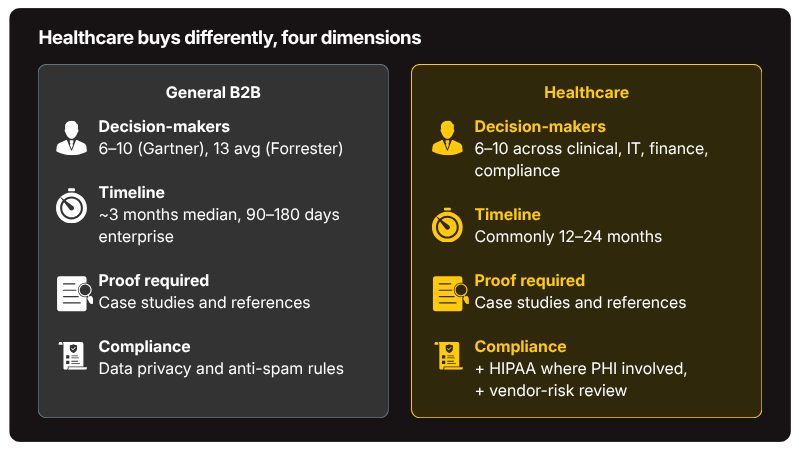
It differs from general B2B lead generation in four structural ways rather than in tone or tactics.
| Dimension | General B2B | Healthcare |
| Decision-makers per deal | 6 to 10 (Gartner), 13 average in enterprise (Forrester) | 6 to 10 across clinical, IT, finance, and compliance functions |
| Evaluation timeline | Median around three months for software, 90 to 180 days at enterprise ACV | Commonly 12 to 24 months, extended by budget cycles, pilots, and regulatory review |
| Proof required | Case studies and references | Clinical evidence, security audit results, reference calls with peer institutions, often a pilot |
| Compliance layer | Data privacy and anti-spam rules | The same, plus HIPAA obligations where protected health information is involved, plus procurement and vendor-risk review |
Two figures from monday.com’s 2026 analysis are worth knowing while treating them carefully, since the underlying source is not published: [VENDOR CLAIM] lead-to-opportunity conversion in healthcare running roughly 15 to 25 percent against 30 to 40 percent in general B2B, and healthcare conversions requiring roughly 12 to 20 touchpoints against six to eight in general B2B. Directionally, both match what long-cycle sellers report, particularly in specialized healthcare and medical device markets. For additional context on the unique lead-generation challenges in this sector, see our guide to leading medical device lead generation companies. Verify against your own CRM before quoting these figures to a board.
Expert tip: Healthcare sales lead generation is the process of identifying, engaging, and qualifying healthcare decision-makers to generate sales opportunities while navigating complex buying cycles, compliance requirements, and multiple stakeholders.

AI-Powered Healthcare Platform Expands Sales Pipeline with Callbox
Callbox helped increase brand awareness and engagement through multiple channels and generate 86 sales appointments
View Case StudyStep 1: Segment the Healthcare Market Before You Define an ICP
“Healthcare” is not a target market. It is a collection of markets that share a regulatory environment and almost nothing else about how they buy.
The most common failure is building one ideal customer profile and one message for everything with a medical adjacency. A 400-bed nonprofit health system, a private equity-backed dermatology group, a regional Medicare Advantage plan, and a Class II device manufacturer have different budget mechanics, different approval structures, and different vocabularies.
Start by choosing sub-sectors deliberately:
- Hospitals and health systems, including academic medical centers and integrated delivery networks
- Physician groups and outpatient clinics, including private equity-backed rollups
- Payers, meaning insurers, third-party administrators, and managed care organizations
- Medical device and equipment manufacturers
- Pharmaceutical and life sciences organizations
- Healthcare IT and digital health vendors
- Post-acute and long-term care operators
- Diagnostics, laboratories, and imaging providers
Related: How to Increase Healthcare Appointments
Then layer targeting signals on top of firmographics. ZoomInfo’s approach is the useful one here: combine technographic data about the existing stack with sector-specific performance indicators. A digital patient engagement vendor targeting mid-sized hospitals can filter for organizations with below-average patient experience scores, which turns a generic list into a list of organizations with a documented, measurable problem.
Trigger events that create genuine urgency in healthcare:
- A move into value-based care or risk-bearing contracts
- Quality measure penalties or reimbursement changes
- An EHR migration, a merger, or a facility expansion
- New compliance or reporting deadlines
- Leadership changes in clinical informatics, revenue cycle, or IT
- Service line expansion, particularly telehealth and behavioral health
Expert tip: Fit and timing are separate qualifiers, and healthcare punishes teams that conflate them. A perfect-fit hospital that just signed a five-year EHR contract is not a lead this year. Score timing explicitly so reps stop working accounts that cannot transact.
Related: Leading Healthcare Marketing Agencies
Step 2: Map the Buying Committee and the Real Approval Path
Gartner reports that B2B buyers spend only about 17 percent of their total purchase time meeting with vendors, and that sliver is divided across every vendor under consideration. In healthcare, with more stakeholders and longer timelines, your share of attention is thinner still.
That makes committee mapping a targeting activity, not an account-planning nicety. Sales teams can also use proven tips for medical sales reps to improve conversations with healthcare decision-makers and better understand how to engage different stakeholders.
| Stakeholder | What they are measured on | What earns engagement |
| Chief Medical Officer, Chief Nursing Officer | Patient outcomes, clinical quality, staff workflow | Peer-reviewed evidence, outcome data, clinical workflow detail |
| Clinical department directors | Throughput, staffing burden, care quality in their unit | Practical operational specifics, not strategic framing |
| CIO, CTO, clinical informatics | Integration burden, security posture, technical debt | EHR integration specifics, architecture, uptime, support model |
| CFO, VP Finance, revenue cycle | Cost, reimbursement impact, payback period | Total cost analysis, reimbursement modeling, comparable outcomes |
| Compliance and privacy officers | Regulatory exposure, audit readiness | Security audit results, data handling documentation, risk mitigation |
| Supply chain and procurement | Contract terms, vendor risk, GPO alignment | Clean documentation, references, no surprises in diligence |
| Clinical end users | Daily workload and disruption | Honest detail about what changes in their shift |
Two structural realities to build around:
Titles do not equal authority. A director at a community hospital may hold approval authority that a VP at an academic medical center does not, because the academic center routes decisions through committee. Score authority based on the approval process you have verified, not the title on the badge.
Large systems have two decision layers. Corporate headquarters and individual facilities often run separate evaluations with separate stakeholders. Selling into one does not give you the other, and assuming otherwise costs months.
Multi-threading is not optional here. It is the only structural defense against the single most common way healthcare deals die: the champion changes jobs.
Expert tip: Ask directly, early, and without apology: who else needs to see this before a decision gets made, and what does each of them need to sign off? Most reps avoid the question because it feels presumptuous. Healthcare buyers answer it readily, because they know the answer is complicated and they would rather you knew.
Need a faster way to fill your healthcare sales pipeline?
Step 3: Get the Compliance Scope Right
This section corrects a claim that circulates widely in healthcare marketing content, including in one of the most visible articles on this topic: that every email, form, and database in a healthcare lead generation program must meet HIPAA requirements.
That is not how HIPAA scope works, and getting it wrong is costly in both directions. Teams that assume total coverage spend on infrastructure they do not need. Teams that assume no coverage create real exposure.
This is not legal advice. Compliance obligations depend on your specific data flows, your contracts, and your jurisdictions. Have counsel review your program.
When HIPAA Applies and When It Does Not
HIPAA obligations attach to protected health information, meaning individually identifiable data about a person’s health status, care, or payment for care. The obligations fall on covered entities, which are providers, health plans, and clearinghouses, and on business associates, meaning organizations that handle PHI on a covered entity’s behalf.
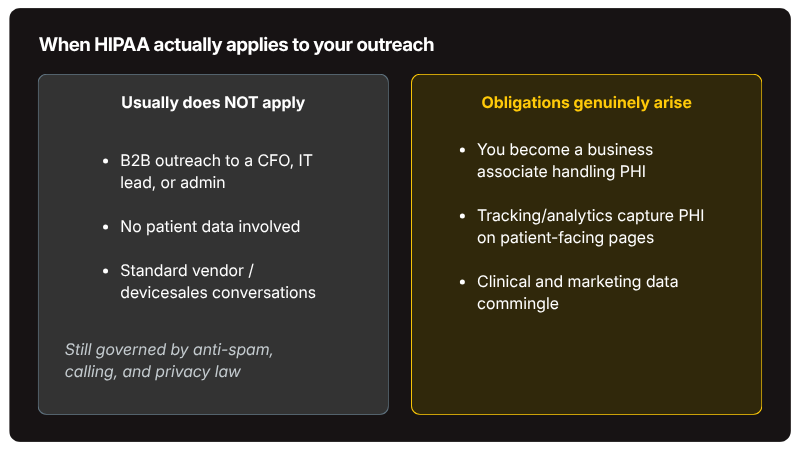
A straightforward implication: outreach to a hospital CFO about a revenue cycle platform, containing no patient data of any kind, does not involve PHI. A B2B transaction between a device manufacturer and a hospital generally sits outside HIPAA scope because no individually identifiable patient data is part of it.
Where obligations genuinely arise:
- You become a business associate. If your solution or your services touch PHI on a client’s behalf, a Business Associate Agreement is required and the Privacy and Security Rules apply to you.
- Tracking and analytics capture PHI. This is the most commonly missed exposure. Pixels and analytics on pages where patients or identifiable individuals interact can capture regulated data.
- Clinical and marketing data commingle. Marketing lists should contain professional and organizational information only: title, organization, department, professional interests. Patient data should never enter the marketing stack, which is a data governance requirement rather than a tooling one.
What Actually Governs Your Outreach
For most healthcare B2B outreach programs, the operative rules are the same ones that govern all outbound, and they deserve more attention than they usually get:
- Anti-spam law in each market you contact, covering identification, opt-out mechanics, and consent where required
- Calling regulations including do-not-call obligations and consent rules, which vary substantially by jurisdiction
- State and national privacy law governing how contact data is collected, stored, and processed
- Data residency and cross-border transfer rules if your program spans regions
- Your prospect’s own procurement and vendor-risk requirements, which in practice bite harder than statute
That last one is worth emphasizing. Security questionnaires and vendor risk reviews are now standard even at mid-market deal sizes and add weeks to a cycle. Preparing your security documentation before the first meeting removes calendar time from every deal you run.
Expert tip: Build the security and compliance package before you need it: SOC 2 report, penetration test summary, data flow diagram, BAA template, subprocessor list, and a completed standard security questionnaire. Deals do not stall because the answers are bad. They stall because nobody can find them for three weeks.
Step 4: Build Proof for Four Different Audiences
Healthcare buyers are skeptical for good reason. A poor technology decision in this sector affects patient care, and the sector has a long institutional memory for implementations that went badly. That skepticism is the reason healthcare requires more proof than any other vertical, and the reason generic content fails here faster than anywhere else.
You need four proof packages, not one deck with four slides. Healthcare organizations can also benchmark their approach against best healthcare marketing companies to identify effective strategies for healthcare-specific messaging and engagement.
For clinical stakeholders. Peer-reviewed evidence where it exists, outcome data, workflow demonstrations showing what changes at the bedside or in the clinic. Named references at comparable institutions matter enormously; clinical buyers trust peers over vendors, consistently and by a wide margin.
For financial stakeholders. Total cost of ownership, reimbursement implications, payback period, and comparable results at organizations of similar size and payer mix. Percentage improvements without a baseline read as marketing.
For technical stakeholders. EHR integration specifics named by platform, architecture documentation, security audit results, implementation resource requirements, and an honest account of the support model.
For compliance stakeholders. Data handling documentation, audit trail capability, risk assessment materials, and regulatory alignment stated precisely rather than claimed generally.
Both reference articles recommend building four to five assets per stakeholder type. That is right in principle and usually wrong in sequence. Build one strong asset per stakeholder first, put it into live outreach, and let reply patterns tell you which stakeholder is actually gating your deals before you invest in the full library.
Expert tip: One named reference call with a peer institution moves a healthcare deal further than any asset you can produce. Build the reference program deliberately: which customers will take calls, for which sub-sectors, and what you offer them in return. Treat it as infrastructure, not a favor you ask under pressure.
Lead Generation Services for Healthcare IT Companies
Discover how Callbox provides sales enablement solutions to Healthcare IT companies to help them carry out effective sales and marketing campaigns.
LEARN MOREStep 5: Run Multi-Channel Outreach on Healthcare Timing
Healthcare stakeholders are among the hardest B2B contacts to reach, for a mundane reason: clinical leaders are not at desks. That single fact reshapes channel strategy. It also reflects broader B2B trends driving healthcare marketing, particularly the shift toward more targeted, multi-channel engagement.
What Each Channel Contributes
| Channel | Role in healthcare programs | Notes specific to this sector |
| Phone | Often the highest-value channel for clinical and operational roles | Direct-dial data quality determines everything. Switchboard numbers waste dials. Timing around clinical schedules matters more than in desk-based sectors. |
| Carries evidence and detail, scales, sets up calls | Benchmark reply rates for cold B2B email sit around 3.4 percent platform-wide, with 5 percent-plus considered good. Educational framing outperforms sales framing here. | |
| Builds recognition, works well for administrative and IT roles | Clinical leaders are less active than executives. Adjust expectations by role rather than treating it as one channel. | |
| Webinars and virtual events | Unusually effective in healthcare because continuing education has genuine professional value | Attendees self-select on the exact problem, and registration data qualifies them. |
| Conferences and associations | Where a large share of real relationship building happens | Sector-specific and calendar-driven. Plan outreach around the event calendar, not against it. |
| Partners and referrals | Highest-trust channel available | Implementation consultants, systems integrators, and associations produce pre-validated introductions. |
Time Outreach to Healthcare’s Calendar
This is where generic outbound advice fails hardest. Healthcare buying is calendar-bound in ways most sectors are not:
- Fiscal year timing differs across systems and drives capital planning windows
- Capital versus operating budget classification changes who approves and when
- Grant and funding cycles matter for academic and nonprofit institutions
- Regulatory and reporting deadlines create genuine urgency you can plan around
- Clinical seasonality, including respiratory season and staffing crunches, makes some months effectively unreachable for clinical stakeholders
A cadence that ignores the budget calendar produces meetings that cannot lead anywhere for eight months. A cadence built around it reaches people while money is actually being allocated.
Cadence and Follow-Up
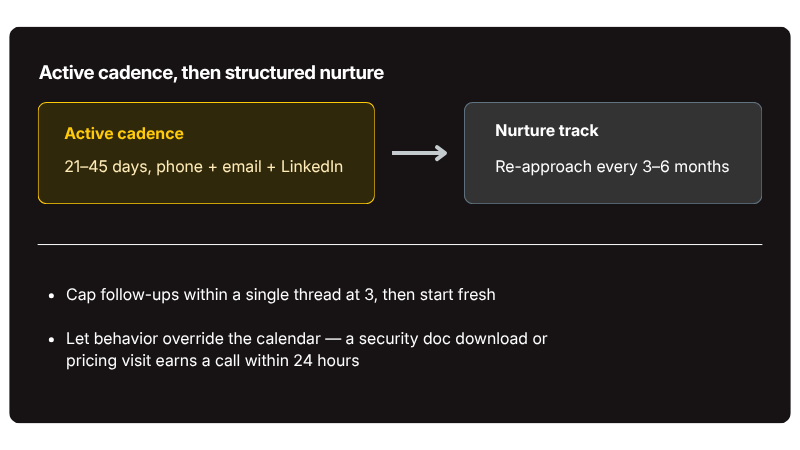
The general outbound instinct is a three-week sequence and then a decision. Healthcare needs the opposite posture: an active sequence followed by structured long-cycle nurture rather than disposal.
- Active cadence of roughly 21 to 45 days across phone, email, and LinkedIn, sequenced so each touch references the last
- Nurture track for ICP-fit contacts who did not engage, with re-approach every three to six months tied to budget and regulatory calendars
- Cap follow-ups within a single email thread at three, then start a new thread with new positioning rather than extending a dead chain
- Let behavior override the calendar. A security documentation download or a pricing page visit is a stage change, and a call within 24 hours converts far better than waiting for the next scheduled touch
Every follow-up should carry something new: a regulatory development, a peer outcome, a benchmark. “Just checking in” teaches a busy clinical executive that your messages are safe to ignore.
Expert tip: Ask early which budget the purchase would come from, capital or operating, and when that budget gets set. It sounds like a finance question. It is actually the fastest way to learn whether your deal has a realistic close date or a hopeful one, and it changes how you forecast the entire account.
Related: 5 Winning Sales Cadence Examples
Step 6: Score, Nurture, and Measure on the Healthcare Clock
Score for Authority and Urgency, Not Engagement Volume
Standard lead scoring rewards content consumption. In healthcare, content consumption is often a clinician doing professional reading with no purchase intent behind it. A stronger approach combines qualification, targeting, and engagement, similar to the principles outlined in healthcare lead capture strategies.
Weight the things that actually predict a deal:
- Verified budget authority, established through the approval process rather than inferred from title
- Clinical seniority, because clinical stakeholders can veto regardless of executive support
- A dated compliance or regulatory driver, which is the single strongest urgency signal in this sector
- Multiple stakeholders from the same account engaging, which indicates an internal evaluation has begun
- Late-stage behaviors, meaning pricing requests, security documentation downloads, and multi-stakeholder demo scheduling
- Recency and frequency together. Weekly engagement over three months means something very different from the same total activity spread across a year
Building In-House Versus Partnering
Everything above is buildable internally. Whether it should be depends on three variables, and the honest answer differs by company.
Time to pipeline. Building healthcare-literate SDR capability takes time that a quarterly number does not allow. Reps who cannot hold a credible conversation about EHR integration, value-based care, or reimbursement get filtered out inside 90 seconds by clinical and IT buyers.
Where your team’s edge is. In a sector with 12 to 24 month cycles, senior sales capacity is better spent advancing live deals through committees than building lists.
Bringing a Healthcare Sales Lead Generation Program Together
Healthcare sales lead generation rewards precision and punishes volume more than any other B2B vertical. The programs that work share five characteristics.
They segment before they target, because a payer and a clinic are not the same buyer. They map the approval path rather than the org chart. They get compliance scope right, neither overbuilding nor exposing themselves. They build proof for four audiences instead of one. And they measure on a timeline that matches how healthcare actually buys, which protects good programs from being cancelled in month three.
None of that requires more spend. It requires deciding which of the six steps above is currently your weakest, fixing that one, and measuring again.
If you want an outside read on where your healthcare pipeline is leaking before you rebuild it, a conversation with a Callbox healthcare strategist gets you a diagnosis of the constraint rather than a pitch.
Healthcare Sales Lead Generation FAQs
How is healthcare lead generation different from general B2B lead generation?
Four structural differences. Buying groups of six to ten people spanning clinical, IT, finance, and compliance functions. Evaluation timelines commonly running 12 to 24 months. Proof requirements that include clinical evidence, security audits, and peer references. And a compliance layer that includes HIPAA obligations where protected health information is involved.
How long is the healthcare sales cycle?
Commonly 12 to 24 months for hospitals, health systems, and payers, extended by annual budget cycles, pilot programs, and regulatory review. Physician groups and independent clinics can move far faster, sometimes in weeks, because authority is concentrated in one or two people.
Who are the decision-makers in healthcare purchases?
Typically six to ten people including clinical leadership such as the CMO or CNO, department directors, IT and clinical informatics leadership, finance, compliance and privacy officers, supply chain or procurement, and clinical end users. Authority does not track titles reliably, so verify the approval process rather than inferring it from seniority.