Why You Should Outsource Enterprise Lead Generation
Discover how outsourced enterprise lead generation helps B2B teams expand outreach, connect with qualified prospects, and create more sales opportunities.
 Rebecca Matias
Rebecca Matias is Callbox's COO with 18 years of experience scaling B2B pipeline through data-driven outbound marketing, lead generation, and sales development.
View full bio of Rebecca Matias
What is Enterprise Outsourced Lead Generation?
Enterprise outsourced lead generation is the practice of hiring a specialized external agency to run top-of-funnel prospecting, account mapping, and multi-stakeholder outreach for large B2B organizations. It replaces the fixed cost and hiring lag of an internal SDR team with a flexible, faster-to-deploy pod built specifically for long, complex enterprise sales cycles.
Somewhere in your org chart right now, a fully loaded, well-trained Account Executive is sitting on their hands. Not because they can’t sell. Because nobody handed them anything to sell into.
That’s the quiet failure mode of enterprise pipeline: the deal cycle is long, the buying committee is a small conference room’s worth of skeptics, and the top of the funnel is being fed by a team that’s either too thin, too green, or too busy fighting fires to go find the next ten accounts.
For large-scale B2B organizations with multi-million-dollar pipelines, lead generation was never a volume game. It’s a precision instrument, closer to surgery than to fishing with a net. And yet most companies still staff it like they’re running a call center.
As buying committees swell and deal cycles stretch from 6 to 18 months, leaning entirely on an internal SDR bench tends to produce three predictable symptoms: bloated overhead, a revolving door of reps, and a pipeline chart that looks like a heart monitor.
This is exactly the gap that enterprise outsource lead generation exists to close. Hand top-of-funnel prospecting to a dedicated outside team, and the numbers move fast: acquisition overhead down as much as 60%, time-to-market accelerated by 3.5x.
Not because outside reps are smarter. Because the machine they’re plugged into was built for exactly this job, and yours probably wasn’t.
Struggling to reach your target enterprise audience?
What Enterprise Outsource Lead Generation Actually Is
Strip away the buzzwords and it’s simple: enterprise outsource lead generation is a partnership where a company at $50M+ ARR or 500+ employees hands high-touch, high-complexity prospecting to a specialized outside agency. This is not the high-volume call center model, and treating it like one is the fastest way to waste the budget.
Enterprise-grade outsourcing lives and breathes Account-Based Marketing (ABM), multi-threaded stakeholder engagement, intent-data modeling, and account profiling deep enough to know the org chart before the first call happens. The target isn’t “a lead.” It’s a qualified meeting with a VP or C-suite decision-maker, inside a buying committee that might have six to ten people with a vote.
SMB Lead Gen and Enterprise Lead Gen Are Different Sports
Calling them the same discipline is like comparing darts to archery because both involve a target. SMB prospecting rewards volume and speed to a single decision-maker. Enterprise prospecting rewards patience, precision, and the ability to hold a conversation with ten different stakeholders who each define “value” differently.
| Feature | SMB Lead Generation | Enterprise Lead Generation |
| Primary Objective | High volume of single-persona leads | Precise account penetration (ABM) |
| Buying Committee | 1 to 2 decision-makers | 6 to 10+ decision-makers (IT, Security, Finance, C-Suite) |
| Sales Cycle | 1 to 3 months | 6 to 18 months |
| Outreach Channels | Standard email blasts, basic PPC | Intent signals, phone outreach, custom gifting, social selling |
| Targeting Deliverables | Contact list (Email, Phone) | Org mapping, tech-stack profiling, intent verification |
| Primary Metric | Cost Per Lead (CPL) | Pipeline Velocity & Customer Acquisition Cost (CAC) |
8 Warning Lights on Your Enterprise Lead Gen
Cars have warning lights so you don’t find out about engine trouble on the highway. Your revenue engine has warning lights too, they just show up as spreadsheet rows instead of a dashboard icon. If more than a couple of these are blinking, the bottleneck isn’t effort. It’s architecture.
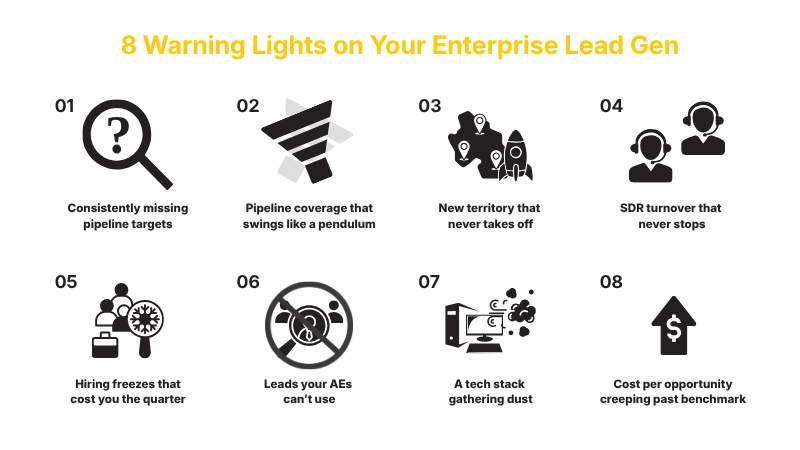
- Consistently missing pipeline targets: the gap between your growth goals and actual qualified pipeline keeps widening instead of closing.
- Pipeline coverage that swings like a pendulum: wild quarter-to-quarter fluctuations in early-stage opportunities leave your AEs guessing whether next month is feast or famine.
- New territory that never takes off: product lines or regions you expanded into stall out because nobody’s building localized market intelligence there.
- SDR turnover that never stops: constant churn eats management bandwidth on hiring and retraining, and knowledge walks out the door every time.
- Hiring freezes that cost you the quarter: HR restrictions or a thin talent pool delay headcount growth by 3 to 6 months, right when you need bodies now.
- Leads your AEs can’t use: low-intent handoffs burn closing cycles and tank your MQL-to-SQL conversion rate.
- A tech stack gathering dust: the sales engagement platforms and databases you’re paying for sit underused without dedicated RevOps care.
- Cost per opportunity creeping past benchmark: the fully loaded price of internal lead gen is eating into margin, quietly.
 Expert Tip: If you can only track one of these, track pipeline coverage volatility. It's the earliest tell. Turnover and cost problems show up on a P&L eventually, but coverage volatility shows up in your forecast call next Tuesday.
What an In-House SDR Team Really Costs
Ask a CFO what the SDR team costs and you’ll usually get a number that only counts base salary. That’s like pricing a car by the sticker and forgetting insurance, gas, and the inevitable transmission repair. The fully loaded cost of internal prospecting has four line items most budgets never see coming.
1. Direct Compensation & Benefits
- Enterprise SDR compensation: base pay of $65,000 to $85,000 plus On-Target Earnings pushes total comp to $85,000 to $110,000 per rep.
- Sales Development Manager: someone has to own coaching, playbooks, and daily performance, and that role runs $135,000 to $175,000 a year.
- Fringe benefits: healthcare, retirement matching, payroll taxes, and hardware tack on another 20% to 30%, north of $20,000 per employee annually.
2. The Enterprise Software Stack
- CRM & Sales Engagement (HubSpot Enterprise / Salesforce): roughly $10,000 a year.
- B2B Contact Intelligence (ZoomInfo, LinkedIn Sales Navigator): roughly $18,000 a year.
- Intent Data & Deliverability (6sense, Bombora): roughly $15,000 a year.
- Total: a basic internal tech stack lands between $27,000 and $40,000 annually, and that’s before anyone’s fully using it.
3. Ramp Time and the Turnover Tax
New reps can take up to 120 days to hit full productivity. That’s four months of full salary for partial output, every single time you hire. And when a rep leaves, which happens more often than anyone wants to admit, the true cost of recruiter fees, onboarding, and lost pipeline momentum clears $100,000 per departure.
What You Actually Buy Beyond the Cost Savings
If the only pitch for outsourcing were “it’s cheaper,” it wouldn’t be worth a 2,000-word playbook. The real case is operational, not just financial.
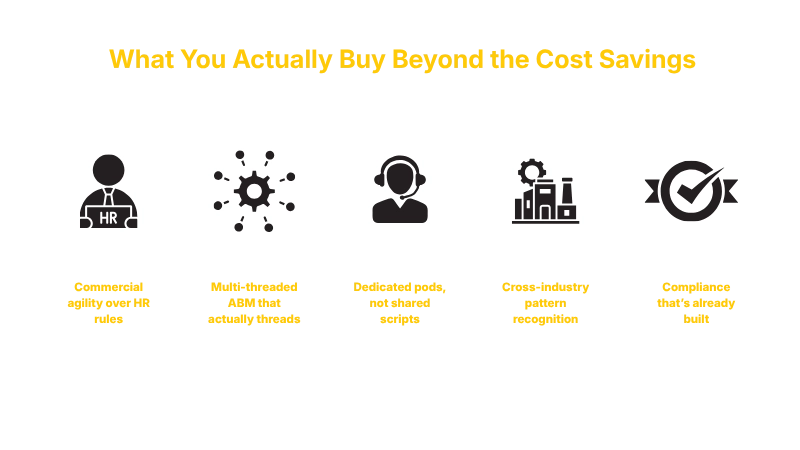
- Commercial agility over HR rules: scaling an internal team means hiring cycles and fixed payroll commitments. Outsourcing lets you dial capacity up or down on demand, on your quarter’s timeline instead of HR’s.
- Multi-threaded ABM that actually threads: enterprise agencies map the entire org chart and run tailored, parallel campaigns to every stakeholder in the room at once, instead of hoping one champion carries the deal alone.
- Dedicated pods, not shared scripts: unlike high-volume call centers rotating reps through a script, an enterprise agency gives you a dedicated BDR pod that sits in your Slack or Teams like they’re on payroll.
- Cross-industry pattern recognition: a partner running campaigns across dozens of B2B sectors sees what’s converting, what’s landing in spam, and what’s getting objected to, in real time, across accounts you’ll never see.
- Compliance that’s already built: the agencies worth hiring carry SOC2 Type II, GDPR, and CCPA compliance as table stakes, so your brand isn’t the one exposed if something goes wrong.
Industry Insight: The shift toward outsourced enterprise pods mirrors what already happened in IT infrastructure a decade ago: companies stopped buying servers and started buying compute. RevOps leaders are increasingly buying pipeline capacity the same way, as a flexible resource instead of a fixed asset.
How to Evaluate and Onboard a Partner Without Getting Burned
- Audit data compliance standards. Confirm SOC2 Type II certification and strict GDPR/CCPA adherence before you hand over your ideal customer profile data. This is the one step you don’t skip to save time.
- Configure secondary outreach infrastructure. Set up dedicated sending domains with SPF, DKIM, and DMARC authentication so cold outreach never touches your primary corporate domain.
- Establish native CRM integration. Insist on bi-directional syncing with HubSpot Enterprise or Salesforce, so attribution stays clean and nobody double-touches the same account.
- Formalize acceptance benchmarks. Lock in SLAs that define exactly what counts as an accepted SQL: verified budget, timeline, tech fit, and decision-maker seniority, in writing, before the first call is dialed.
Our Selection Methodology
The benchmarks, cost figures, and pricing ranges cited throughout this playbook are drawn from aggregated enterprise RevOps engagement data, publicly reported SDR compensation benchmarks, and standard enterprise software pricing as of 2026. Figures are presented as ranges to reflect real variation by industry, region, and deal complexity, and should be validated against your own fully loaded cost structure before budgeting decisions.
Stop Letting Your AEs Wait on a Pipeline That Isn't Coming
Enterprise outsource lead generation isn't a cost cut. It's a faster, more precise version of the top-of-funnel engine you're already trying to build in-house, minus the 120-day ramp and the six-figure turnover tax.
Frequently Asked Questions
How long does it take to generate pipeline with an outsourced enterprise agency?
Most enterprise campaigns need a 30-day onboarding phase for messaging calibration, domain warming, CRM sync, and account mapping. Consistent outsourced enterprise leads and meeting volume typically start ramping between days 30 and 60, not day one, and any partner promising instant volume is telling you what you want to hear, not what’s true.
Should we replace our internal SDR team with an outsourced provider?
No, and be skeptical of anyone who says otherwise. The strongest enterprise strategy is a hybrid model: internal SDRs stay focused on high-priority named accounts, inbound leads, and warm upsells, while the outsourced partner handles territory expansion, cold list building, and preliminary qualification. Think of it as division of labor, not replacement.
How do we prevent an outsourced agency from damaging our brand?
Top enterprise agencies run thorough onboarding workshops in the first 14 days, establishing strict messaging guidelines, persona playbooks, and call recording review cycles so every outreach touch sounds like you, not like a generic script wearing your logo.