B2B Leader’s Guide to Hiring a Full-Funnel Marketing Agency for 2026
Looking for the best full-funnel marketing agency? Discover how to evaluate, compare, and hire the right partner to drive pipeline from awareness to close.

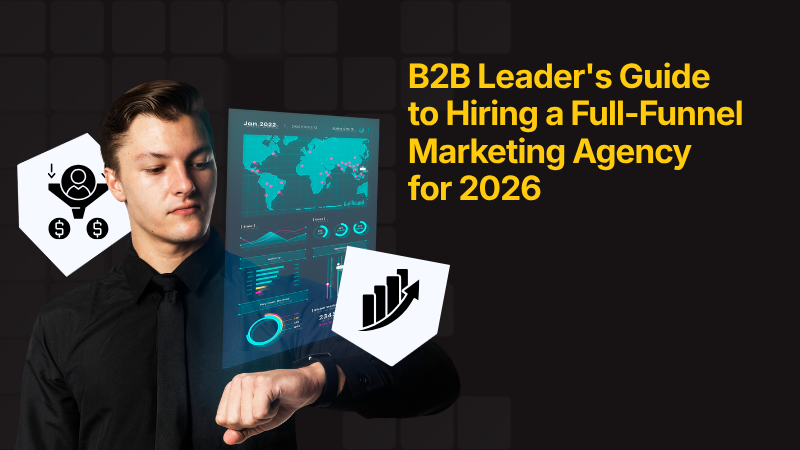
A full-funnel marketing agency is a specialized partner that manages every stage of your buyer’s journey, from the first brand touchpoint at the top of the funnel all the way through lead nurturing, sales enablement, and post-sale retention. Unlike a traditional digital agency that optimizes one channel in isolation, a full-funnel agency builds and owns the entire revenue architecture, aligning marketing and sales under one unified strategy. For B2B companies that are tired of chasing disconnected campaigns that generate impressions but not pipeline, this model is no longer optional. It is the operational standard for 2026.
If you are evaluating whether to partner with one, or trying to figure out which agency deserves your budget, this guide breaks down exactly what to look for, what to ask, and who the serious contenders are.
Ready to expand your business in Canada but didn`t know where to start?
What Is a Full-Funnel Marketing Strategy and Why Does It Matter in B2B?
Most marketing teams are fighting a structural problem they misidentify as a talent problem. They hire great demand gen people, great content people, great paid media people. And then those people work in silos, handing off leads to sales at the MQL stage and hoping for the best.
The full-funnel marketing model fixes that structural flaw. It operates across three distinct phases:
- Top of Funnel (TOFU): Awareness and demand creation through content, SEO, paid social, thought leadership, and brand.
- Middle of Funnel (MOFU): Lead nurturing, webinars, email sequences, retargeting, and sales enablement assets that move buyers from consideration to intent.
- Bottom of Funnel (BOFU): Conversion-focused tactics like personalized outreach, case studies, demos, competitive positioning, and closed-loop attribution.
Here is why this matters in hard numbers. According to Forrester, companies where marketing and sales are truly aligned achieve 2.4x higher revenue growth and 2x higher profitability than their misaligned peers. Yet Forrester’s own 2024 survey found that 65% of sales and marketing professionals still report a lack of real alignment at their organization, even as 82% of C-suite leaders believe alignment already exists. That perception gap is precisely where a full-funnel agency closes the loop.
MSP’s 14-Month ABM Campaign Generated 700 Appointments
Successfully completed a 14-month ABM Lead Generation and Appointment Setting campaign for a leading managed solutions provider.
View Case StudyHubSpot’s State of Marketing Report reinforces this reality: 69% of marketers say their primary goal is converting contacts and leads into customers, and 48% are actively working to improve their sales funnel. The agencies that deliver on that goal are the ones worth hiring.
Industry Insight: Before you hire anyone, calculate what misalignment is already costing you. If your average deal size is $40K and your MQL-to-closed-won rate is under 10%, a significant portion of that lost pipeline is a structural ``silo tax.`` Research from Forrester estimates that misalignment between marketing and sales costs businesses an estimated $1 trillion annually across the B2B landscape. A full-funnel agency`s first job is to audit that gap, not add another channel on top of it.
How to Evaluate a Full-Funnel Marketing Agency: A Step-by-Step Selection Methodology
Not all agencies that claim “full funnel” actually deliver it. Here is a transparent, step-by-step methodology B2B firms should use when vetting partners.
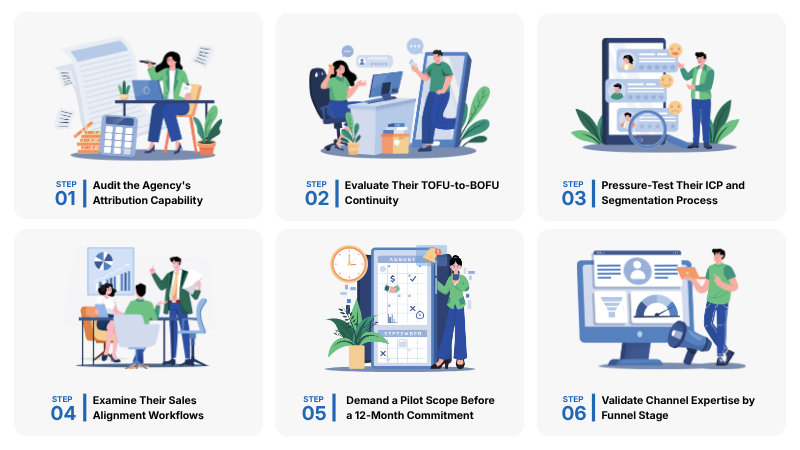
Step 1: Audit the Agency’s Attribution Capability
Any agency worth its retainer should be able to show you multi-touch attribution, not just last-click conversions. Ask to see a sample attribution dashboard during the sales process. If they can only report on leads generated but not on revenue influenced across the cycle, they are a lead gen vendor operating as a full-funnel agency. Those are very different things.
Step 2: Evaluate Their TOFU-to-BOFU Continuity
Request a case study that tracks a single buyer from first touchpoint (a LinkedIn ad, an organic search visit, a podcast mention) to closed revenue. Pay close attention to how they handled the MOFU stage, specifically what nurturing sequences ran between the first conversion and the eventual sales conversation. Weak agencies skip this stage entirely or outsource it to an email drip no one monitors.
Step 3: Pressure-Test Their ICP and Segmentation Process
A strong full-funnel agency should be able to walk you through how they define and continuously refine your Ideal Customer Profile, how they segment audiences by buying stage, and how messaging changes at each stage. If their answer is a single static persona document and one blanket email sequence, keep looking.
Step 4: Examine Their Sales Alignment Workflows
Ask directly how they hand off MQLs to sales. What does the SLA look like? How quickly do SQL-stage leads get followed up? Do they build sales enablement assets, including battle cards, one-pagers, and objection-handling guides, as part of the core engagement, or is that a separate billable scope?
Step 5: Demand a Pilot Scope Before a 12-Month Commitment
The best agencies are confident enough in their approach to offer a 90-day pilot with defined success milestones. Be cautious of any firm that insists on a full-year contract before proving they can move your specific metrics.
Step 6: Validate Channel Expertise by Funnel Stage
Not every agency is strong at every funnel stage. Some are exceptional at paid acquisition but mediocre at nurture. Map their team’s core competencies to your biggest revenue gaps before you commit. Look for a team with dedicated strategists for TOFU, MOFU, and BOFU rather than generalists claiming fluency across everything.
Expert Tip: Ask for ``Funnel Handoff Proof`` Request documentation of how the agency handles a specific scenario: a prospect who downloaded a whitepaper three months ago, visited your pricing page last week, and opened your last two sales emails but never responded. If they can describe a precision playbook for that exact situation with specific triggered actions and timelines, they understand full-funnel execution at the operational level. If they say ``we would put them back in the nurture sequence,`` that tells you everything you need to know.
Related: Best Outsourced Sales and Marketing Companies
What Does Full-Funnel Marketing Actually Cost, and How Do You Calculate ROI?
This is the section most agencies skip in their own content. Let’s not.
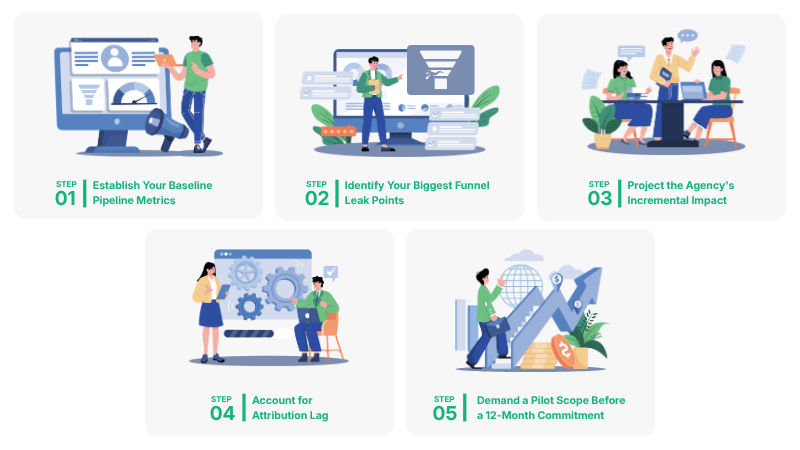
The B2B Full-Funnel Marketing ROI Framework
Use this structured financial model to evaluate any agency investment before you sign the contract.
Step 1: Establish Your Baseline Pipeline Metrics
Start with what you actually have, not what you hope for. Document your current monthly MQL volume, your MQL-to-SQL conversion rate, your SQL-to-Closed-Won rate, your average contract value, and your average sales cycle length. These five numbers are the inputs every serious calculation depends on.
See the success story of a SaaS firm that needed to maximise attendance and pipeline. Callbox filled its pipeline of 129 SQLs and 352 MQLs.
Step 2: Identify Your Biggest Funnel Leak Points
Calculate how many MQLs are dropping between each stage. Useful benchmarks: for B2B SaaS companies, MQL-to-SQL typically runs 40-70% with a well-aligned team, while SQL-to-Closed-Won lands between 20-40% (HubSpot, 2025). If your numbers fall below those benchmarks at any single stage, that stage is where the agency’s focus should be concentrated first.
Check out how Callbox amplifies CRM sales pipeline growth for 6 months.
Step 3: Project the Agency’s Incremental Impact
Most quality full-funnel agencies should deliver a 20-30% improvement in qualified MQL volume and a 10-15% lift in conversion rates within 6-12 months when working within a well-defined ICP. To make that concrete:
If you currently generate 100 MQLs per month and your end-to-end MQL-to-closed-won rate is 8%, you are closing 8 deals. At a $40,000 average contract value, that is $320,000 per month in new ARR.
A conservative 25% lift in MQL volume produces 125 MQLs. A 10% improvement in conversion rate raises your close rate to 8.8%. That produces 11 deals per month, adding $120,000 in incremental monthly ARR.
At a $15,000 monthly agency retainer, your payback period on the incremental revenue is less than two months. Your annualized incremental ROI exceeds 600%. This is not an unusual outcome; HubSpot’s own research shows that businesses using aligned marketing and sales infrastructure report a 505% ROI over three years from their platform investment alone.
A logistics firm’s success seals 3 high-value deals with Callbox’s 12-month appointment-setting campaign.
Step 4: Account for Attribution Lag
Full-funnel programs have longer attribution windows than direct-response paid campaigns. Budget for a 3-4 month lag before BOFU results materialize from TOFU investment. Any agency promising immediate TOFU-to-revenue conversion is misrepresenting how B2B buying cycles actually work.
Step 5: Set a Clear 12-Month ROI Threshold
A reasonable expectation: for every $1 invested in a quality full-funnel agency, B2B companies should target $4-7 in attributed pipeline by month 12. Anything below $3 in attributed pipeline per dollar spent by the end of year one warrants a serious conversation about whether the program or the partner needs to change.
Industry Insight: Stop Comparing Retainer to Lead Volume The single biggest mistake B2B leaders make when evaluating agency ROI is comparing the retainer cost to lead volume rather than to revenue impact. Full-funnel programs must be measured on pipeline created, pipeline advanced, and pipeline closed. If your agency cannot tie their work to at least two of those three metrics, you need either a different agency or a materially different contract structure.
Top Full-Funnel Marketing Agencies for B2B in 2026
The agencies listed below have been evaluated based on their demonstrated ability to operate across all three funnel stages, their specific B2B expertise, and their geographic and industry reach.
| Company | Best For | Core Strength | Funnel Focus |
| Callbox | B2B companies scaling pipeline globally with multi-channel, AI-assisted outbound | Proprietary Smart Engage platform combining voice, email, LinkedIn, web, and content; 20+ years B2B experience; multilingual outreach in 15+ languages; dedicated SDR + data + content team per client | Full-funnel |
| Directive Consulting | B2B SaaS companies tying paid media and SEO directly to pipeline and revenue | Proprietary Customer Generation model aligning PPC, SEO, CRO, and RevOps around TAM-verified targeting; clients include ZoomInfo, Chili Piper, Sumo Logic | Full-funnel |
| Refine Labs | Mid-market and enterprise SaaS teams modernizing GTM away from MQL-based reporting | Demand creation through dark social, thought leadership, and narrative-driven campaigns that build intent before form fills; strong in 6sense, Clari, and Zappi verticals | TOFU |
| Ironpaper | B2B tech and industrial companies with complex, long sales cycles and high ACVs | Agile demand strategy, ABM, and digital marketing with buyer-centric messaging; strong in industrial and hardware-adjacent verticals where generic SaaS playbooks fail | Full-funnel |
| FullFunnel | High-ACV B2B companies (ACV >$50K) building internal ABM capabilities | ABM and demand generation consulting with playbooks for in-house teams; founded by 30+ years combined B2B experience; virtual event strategy and 1-to-few webinar models | MOFU |
| Transmission (+ Earnest) | Global enterprise B2B brands connecting brand marketing to demand generation at scale | Proprietary Propulsion OS integrating AI, data, strategy, and creative; original behavioral science research informing campaign strategy; world’s largest independent B2B agency post-Earnest acquisition | Full-funnel |
| SmartBug Media | B2B companies running HubSpot and needing lifecycle marketing, CRM strategy, and RevOps | HubSpot Elite Partner specializing in full-lifecycle marketing automation, revenue operations, and closed-loop attribution across the entire buyer journey | MOFU |
What Separates a Great Full-Funnel Agency from a Good One?
Good agencies run your campaigns. Great agencies challenge your ICP.
Specifically, the best full-funnel marketing agencies bring proprietary process and data to three areas where most B2B firms are flying blind.
Intent Signal Integration: Leading agencies use intent data platforms like Bombora, G2 Buyer Intent, and TechTarget Priority Engine to identify in-market accounts before they raise their hand. This allows your BOFU tactics to activate at the moment of peak consideration rather than relying entirely on form fills and demo requests that represent only a fraction of in-market buyers.
Revenue Attribution Architecture: They build attribution models that distribute appropriate credit across the full buyer cycle, not just the last touch. For B2B sales cycles averaging 6-9 months, this matters enormously when deciding where to shift budget and where to double down.Feedback Loops Between BOFU and TOFU: The strongest agencies systematically route closed-lost and closed-won insights back into targeting and content strategy. If your best customers all share three firmographic or behavioral characteristics your current TOFU campaigns are not selecting for, that intelligence should reshape your paid audiences, content themes, and outreach sequencing within 30 days, not at the next quarterly review.
Expert Tip: The Reverse-Pipeline Test Ask any agency you are seriously evaluating to start from your revenue target and work backwards with you. ``If we need to close $2M in new ARR this year and our average ACV is $50K, that means 40 new logos. At a 25% win rate, we need 160 SQLs. At a 40% MQL-to-SQL conversion rate, we need 400 MQLs per year.`` Any agency that can walk you through that math fluidly in the first conversation, and then show you with specifics how their program delivers each stage of it, is worth serious consideration. Most agencies lead with channels and tactics. The best always start with your revenue number.
How Full-Funnel Agencies Are Evolving with AI in 2026
Generative AI has changed full-funnel marketing more in the past 18 months than in the previous decade combined. The agencies pulling ahead are using AI to compress the research-to-execution cycle, not to replace human strategy with automated content.

Practically, this looks like AI-assisted ICP research and lookalike modelling at account level, AI-generated first drafts of email sequences that human strategists refine for voice and context, AI-powered content personalization at scale across the buyer journey, and predictive lead scoring that weights behavioral signals far more granularly than traditional rule-based qualification systems.
HubSpot’s research found that 97% of B2B marketers now consider generative AI tools either effective or somewhat effective for their work. But the operational gap between “effective tools” and “systematically embedded in a revenue workflow” is still enormous. The agencies that have closed that gap, where AI is baked into every stage of funnel operations rather than used episodically on individual deliverables, are the ones delivering measurably better pipeline outcomes for clients in competitive markets.
If you want to see what an AI-integrated full-funnel program actually looks like in practice, download our framework for AI-powered B2B pipeline programs and benchmark your current approach against it.

How to Know When You Are Ready to Hire a Full-Funnel Marketing Agency
Not every B2B company needs a full-funnel agency right now. Here are the clearest signals that you are ready.
You have product-market fit but pipeline volume is the binding constraint. You are closing deals when you get in front of the right people. You simply do not have enough of those conversations happening at the right pace.
Your current marketing investment is generating leads but not consistent revenue. High MQL volume with low closed-won rates is almost always a funnel integration problem, not a lead quality problem.
You are entering a new vertical or geographic market. Full-funnel agencies accelerate market entry because they can run all three stages simultaneously rather than building TOFU brand awareness for 12 months before any meaningful sales activity begins.
Your sales team is consistently complaining about lead quality. Sales and marketing misalignment almost always lives in the MOFU stage. The wrong leads are being advanced too quickly with too little context. A full-funnel agency redefines the qualification criteria and owns the middle-stage nurturing that actually fixes this dynamic rather than just refereeing the blame game between teams.
Ready to Close the Gaps in Your Pipeline? Book a Free Audit.
If you are serious about building a B2B revenue engine that performs at every funnel stage, the next right move is understanding specifically where your current program is breaking down. Our team runs a complimentary 30-minute Pipeline Audit that benchmarks your TOFU, MOFU, and BOFU performance against current B2B industry standards and identifies the two or three highest-leverage changes you can make in the next 90 days.
Frequently Asked Questions
How long does it take to see results from a full-funnel marketing program?
The timeline depends on which funnel stage needs the most immediate attention. BOFU programs, such as outbound sequences targeting in-market accounts, can begin producing qualified meetings within 30 to 60 days.
Can a small or mid-size B2B company benefit from hiring a full-funnel marketing agency, or is this only for enterprises?
Mid-size B2B companies ($5M–$100M in revenue) often benefit most from full-funnel agencies because they have strong sales teams but limited demand generation resources. For businesses with product-market fit, a defined ICP, and deal sizes above $20,000, agencies can typically deliver ROI within 6–9 months.
What is the difference between a full-funnel marketing agency and a traditional digital marketing agency?
A traditional marketing agency focuses on specific channels like SEO, PPC, or social media and measures success through clicks, traffic, and leads. A full-funnel agency manages the entire buyer journey and is accountable for pipeline growth, sales progression, and revenue. For B2B companies with longer sales cycles, this approach ties marketing investment directly to business outcomes rather than activity metrics.