Sales Outreach Strategy: A 5-Phase Guide for B2B Teams in 2026
Discover how a sales outreach strategy works across five phases to help B2B teams reach prospects, improve engagement, and generate qualified opportunities.
 Rebecca Matias
Rebecca Matias is Callbox's COO with 18 years of experience scaling B2B pipeline through data-driven outbound marketing, lead generation, and sales development.
View full bio of Rebecca Matias
 Quick Answer:
A sales outreach strategy helps teams identify target accounts, reach decision-makers, and convert engagement into qualified opportunities. For enterprise teams, enterprise lead generation and appointment setting help turn targeted outreach into sales conversations.
Most outbound programs that fail in 2026 do not fail on messaging. They fail earlier, on data quality and deliverability, and the symptoms only show up later as a reply rate nobody can explain.
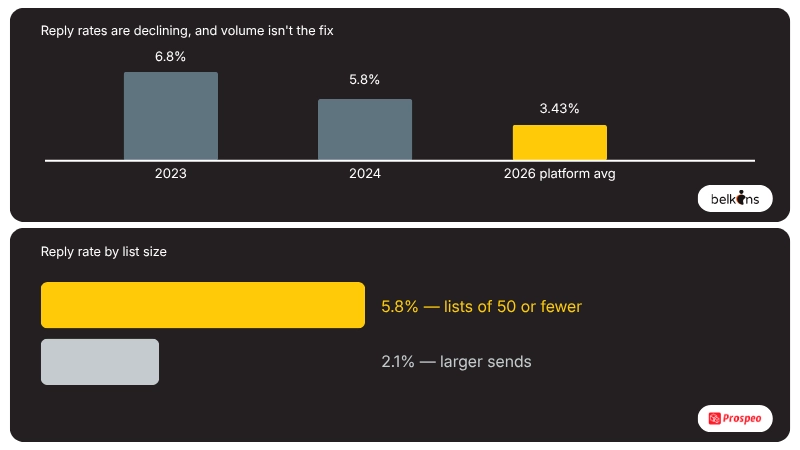
The pressure is real. Cold email reply rates have been sliding: Belkins reported a drop from 6.8 percent in 2023 to 5.8 percent in 2024 across a dataset of 16.5 million emails. Instantly’s Cold Email Benchmark Report 2026 puts the platform-wide average at 3.43 percent based on billions of cold email interactions.
The response should not be more volume for volume’s sake. Automating a low-relevance message simply delivers the same indifference to more people, faster, while increasing pressure on the sending domain.
Struggling to reach the right decision-makers through sales outreach?
This guide breaks a sales outreach strategy into five phases, in the order they actually have to be built.
The 5 Phases of Sales Outreach
- Targeting and data. Define who is worth contacting and build a list that reflects it.
- Infrastructure. Protect your domain and your sending capacity before the first send.
- Relevance. Design messages around the buyer’s situation, not their first name.
- Orchestration. Sequence email, phone, and LinkedIn into one coordinated motion, then follow up with discipline.
- Measurement. Track the metrics that predict revenue and cut the ones that only prove activity.
A complete sales outreach strategy answers six questions:
- Who are we contacting, and what condition makes them worth contacting now?
- Where did the contact data come from, and how do we know it is accurate?
- How do our emails reach the inbox rather than the spam folder?
- What does the first message say, and why would this specific person care?
- When does each touch land, across which channels, and for how long?
- How do we know it is working, and what do we change when it is not?
Teams that can answer all six run predictable pipeline. Teams that can answer only the fourth have a copywriting habit, not a strategy.
Why a Documented Sales Outreach Strategy Matters
Three operational advantages separate a documented strategy from ad hoc prospecting.
Predictable pipeline. When targeting, cadence, and conversion rates are known, meeting volume becomes a function of input volume rather than a matter of luck. See these sales cadence examples to understand how structured outreach can make forecasting possible.
Buying committee coverage. Given that Gartner puts complex purchases at six to ten decision-makers and Forrester at an average of 13 stakeholders, a single-contact deal is a single point of failure. Structured outreach engages several stakeholders in parallel, so one champion changing jobs does not end the deal.
Control over deal size. Inbound delivers whoever arrives. Outbound lets you decide which accounts and which annual contract values you pursue, which is the only reliable way to move average deal size upward on purpose.
Expert tip: Write the strategy down. Not as a slide, as an operating document that names the ICP, the disqualifiers, the channel sequence, the daily send caps, and the metrics you review weekly. Teams that keep it in their heads cannot diagnose a failing campaign, because they cannot tell which variable moved.
Canadian Cybersecurity Firm Hits Q2 Sales Target with Callbox Lead Generation
Callbox enabled the client to meet its Q2 sales pipeline target by building a qualified, pipeline-ready opportunity base across different industry
View Case StudyPhase 1: Targeting and Data, the Part That Decides Everything Downstream
Outreach performance is set before a single message is written. Two inputs do most of the work: who you decided to contact, and how accurate the contact record is.
Narrow the ICP to a Problem-Aware Segment
The common mistake is treating the total addressable market as the target list. A useful ideal customer profile is smaller than that. It describes the subset that fits your solution and is currently under pressure to solve the problem it addresses.
Build it from evidence you already own. Review closed-won deals and your most successful accounts, then look for shared conditions rather than shared attributes:
- Firmographics: industry, revenue band, headcount, geography, growth stage
- Technographics: existing stack, integration requirements, recent platform changes
- Trigger events: funding, leadership hires, expansion into a new market, regulatory deadlines, security incidents, contract renewal windows
- Disqualifiers, written down explicitly, so reps stop spending time on accounts that will never buy
The distinction between fit and timing matters more than most teams treat it. Two identical companies respond very differently depending on whether the problem is urgent this quarter. Targeting the condition rather than the category is what turns a cold list into a warm one. Strong sales prospecting starts with the right accounts, contacts, and buying signals.
Map the Buying Committee Before You Write Anything
Gartner reports that buyers spend only about 17 percent of their total purchase time meeting with potential vendors, and that time is divided across every vendor under consideration. You are not competing for a decision. You are competing for a sliver of attention inside a process already underway.
That argues for mapping the committee up front and using B2B outbound sales strategies that address each stakeholder’s priorities. For each target account, identify the roles and what each one is measured on:
| Role | What they care about | What earns their attention |
| Initiator | The problem is unsolved and it is their problem | Evidence you understand the operational pain |
| Economic buyer | Cost, risk, and defensible return | Numbers, payback period, comparable outcomes |
| Technical evaluator | Integration, security, maintenance burden | Specifics about architecture and compliance posture |
| End user | Daily workload and workflow disruption | Practical detail, not strategic vision |
| Procurement or legal | Terms, vendor risk, precedent | Clean documentation and no surprises |
| Gatekeeper | Protecting a calendar | Brevity and a clear reason to pass it along |
Value propositions should differ by role. The same message sent to a CFO and a systems engineer will underperform with both.
Data Quality Is the Highest-Leverage Investment
Contact data decays continuously as people change roles. Cross-verification across more than one source is not redundancy, it is the only way to keep bounce rates low enough to protect the domain.
Two practical standards:
- Bounce rate under 2 percent. Above that, deliverability starts eroding regardless of message quality.
- Direct-dial numbers, not switchboard numbers. Connect rates on general company lines are a fraction of direct mobile rates, which makes phone effort look like a channel problem when it is a data problem.
Smaller, better lists genuinely outperform larger ones. Analysis of B2B cold email data cited by Prospeo found campaigns sent to 50 recipients or fewer averaged a 5.8 percent reply rate, against 2.1 percent for larger sends. The instinct to maximize list size works directly against reply rate.
Expert tip: Avoid pre-built or resold lists entirely. They underperform on fit, and because the same contacts have been hit repeatedly by other senders, they carry real spam-complaint risk to a domain you are trying to protect. Build to your criteria or have a partner build to them.
Related: Intent-based Marketing for B2B
Phase 2: Infrastructure, Where Silent Failures Happen
A strong message in the spam folder performs exactly as badly as a weak one. This is why teams should address deliverability before scaling sales outreach with AI tools. Deliverability is a technical discipline and it is where a large share of outbound programs quietly break.
Isolate Your Sending Domain
Do not run volume cold outreach from your primary corporate domain. A reputation problem there affects invoices, support replies, and customer conversations, not just prospecting. Use secondary domains that clearly resemble the primary one so recipients can still recognize you.
One useful refinement: for a small set of highest-value target accounts, send from a dedicated mailbox on the primary domain. Those inboxes inherit established domain reputation, which improves both placement and credibility. Reserve this for accounts where it is worth the risk exposure, and keep broad volume on the secondary domains.
Configure DNS Authentication Before the First Send
Three records are non-negotiable, and misconfiguration here is the most common root cause of deliverability problems:
- SPF declares which servers may send on behalf of your domain.
- DKIM attaches a cryptographic signature that verifies the sender. This is the one most often missing entirely.
- DMARC tells receiving servers what to do with mail that fails SPF or DKIM.
Warm Up, Then Respect the Caps
New domains and mailboxes need two to three weeks of gradually increasing volume to establish sender reputation. Warm-up traffic should resemble real campaign traffic in structure and variation, because mailbox providers evaluate content patterns and engagement behavior, not just volume.
A warmed mailbox is not a licence to send more. Keep per-inbox daily volume conservative and scale by adding inboxes rather than by raising caps. To reach several hundred sends per day, rotate across a pool of mailboxes.
Treat open rate as directional only. Roughly 27.7 percent is the 2026 cold email average, but Apple Mail Privacy Protection preloads tracking pixels and accounts for close to half of recorded opens, which makes the figure unreliable as a performance measure.
Related: Ultimate Guide to Outsourced Appointment Setting for Every Sales Rep
Respect LinkedIn’s Limits
LinkedIn restricts connection requests to roughly 100 to 200 per week depending on account age, activity, and standing. Exceeding it triggers restrictions. Higher Social Selling Index scores and genuine platform activity tend to raise the ceiling. Automation that pushes past it costs you the account.
Expert tip: Audit DNS records before blaming copy. Most deliverability problems trace to configuration rather than content, and most of them are fixable in under an hour. Run the audit first, because every messaging test you run on a broken sending setup produces data you cannot trust.
Phase 3: Relevance, Not Personalization
Cold outreach is an interruption by definition. The only thing that buys forgiveness is relevance, which is why effective sales outreach strategies focus on buyer conditions rather than superficial personalization.
Most of what gets called personalization is decoration: a mention of the recipient’s alma mater, a reference to a post they liked, a compliment about a recent funding round. It signals that someone spent thirty seconds on a profile. It does not signal that anyone understood the business.
Relevance means the message speaks to a live priority, constraint, or pressure the recipient is dealing with right now. The test is simple: if the same sentence could be sent to a hundred other companies with only the merge fields changed, it is not relevant.
Build the Message Around a Specific Condition
A strong first touch has four components and does them in order:
- The trigger. Something observable that makes now the right moment. A hire, an expansion, a compliance deadline, a stack change.
- The consequence. What that condition typically costs teams in their position, stated in their terms.
- The proof. One comparable situation and one specific outcome. Not a customer logo wall.
- The ask. Sized to the stage of the relationship.
Keep first touches short. Current benchmark data consistently associates sub-80-word first emails with stronger performance, and the reason is structural: a short message forces you to lead with the one thing that matters, and it reads as written rather than generated.
Escalate the Ask Across the Sequence
The goal of a first touch is not a booked meeting. It is a reply.
Early messages should ask for interest, not commitment. Questions like “is this a priority this quarter?” or “worth sending the comparison?” cost the recipient nothing to answer. Once familiarity has been established across several touches and channels, a direct meeting request becomes reasonable and converts better than it would have on touch one.
Test the escalation point rather than assuming it. Some sequences perform better with an early direct ask; longer-cycle enterprise motions almost never do.
Turn Objections Into Messaging
Objections are market research arriving one call at a time. When the same one surfaces repeatedly, the fix is not better handling on the call. The fix is addressing it in the outreach, before it becomes an objection.
Audit the last three to six months of replies and call recordings, group the objections by role, and rewrite the sequences that keep producing them. An incumbent-vendor objection appearing in 40 percent of conversations means your messaging should already be explaining where you fit alongside that incumbent.
Expert tip: Before a sequence goes live, read the first email as the recipient and ask one question: what does this tell me that I could not have guessed from the sender's website? If the answer is nothing, the message is about you, not about them, and it will get the reply rate that deserves.
Phase 4: Orchestration Across Email, Phone, and LinkedIn
Single-channel outreach forces the buyer to engage on the one channel you chose. Multi-channel outreach meets them on the one they actually use.
The distinction between multi-channel and true orchestration matters. Multi-channel means several channels are in use. Orchestration means each touch is aware of the others: the call references the email, the LinkedIn engagement precedes the connection request, and behavior on one channel changes the timing on another.
What Each Channel Is For
| Channel | Role in the sequence | Primary metric | Realistic 2026 target |
| Carries the argument, scales, creates context for the call | Reply rate and positive reply rate | 3 to 5 percent average, 5 to 10 percent good, 10 percent plus elite (Instantly, Prospeo) | |
| Builds recognition and credibility before the ask | Connection acceptance, reply rate | Varies widely by profile strength and ICP seniority | |
| Phone | Converts interest into a booked meeting faster than any other channel | Connect rate, call-to-meeting rate | Highly dependent on direct-dial data quality |
| Intent-triggered calling | Reaches prospects while attention is live | Meeting booked rate | Consistently the highest-converting motion in the mix |
Note what is not in that table. Emails sent and dials made are workload measures. They confirm effort occurred, not that it worked.
Worth knowing before anyone declares email dead: Prospeo’s research found 61 percent of decision-makers still prefer cold email over LinkedIn messages or cold calls. The channel is not the problem.
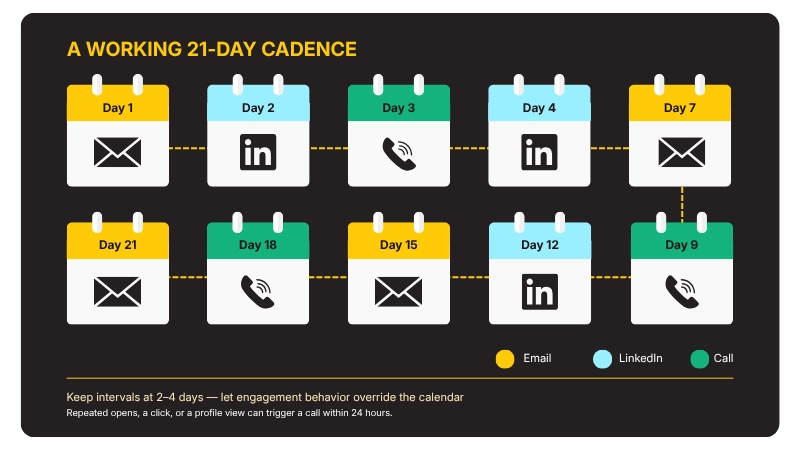
A Working 21-Day Cadence
his is a starting structure, not a rule. Adjust the interval and channel mix by vertical, seniority, and buying cycle. See these sales outreach cadence examples for additional sequencing models.
| Day | Touch | Purpose |
| 1 | Email 1 plus account research | Lead with the trigger and the consequence. Research the committee while the message lands. |
| 2 | LinkedIn engagement | Light, genuine interaction with recent activity. Build recognition before any request. |
| 3 | Call 1 plus voicemail | Reference the email. The voicemail exists to make the email get opened. |
| 4 | LinkedIn connection request | Personalized to role and priority, not generic. |
| 7 | Email 2 | New information: a benchmark, a comparable outcome, a market shift. Never “just following up.” |
| 9 | Call 2 | Discuss what Email 2 raised. Surface objections early. |
| 12 | LinkedIn message | Share something useful. No ask. |
| 15 | Email 3 | Tighten to one specific, concrete offer of value. |
| 18 | Call 3 | Qualification-focused. Establish fit and timing honestly. |
| 21 | Email 4 | Close the loop gracefully and leave the door open. |
Two rules that matter more than the grid itself:
Keep intervals at two to four days. Longer and you are a stranger again. Shorter and you are a nuisance.
Let behavior override the calendar. Repeated opens, a link click, a profile view, and an asset download in the same week are a buying signal. A call within 24 hours converts far better than waiting for day 18 because the spreadsheet said so.
Follow-Up and Long-Cycle Nurture
This is where most programs lose the deals they already earned.
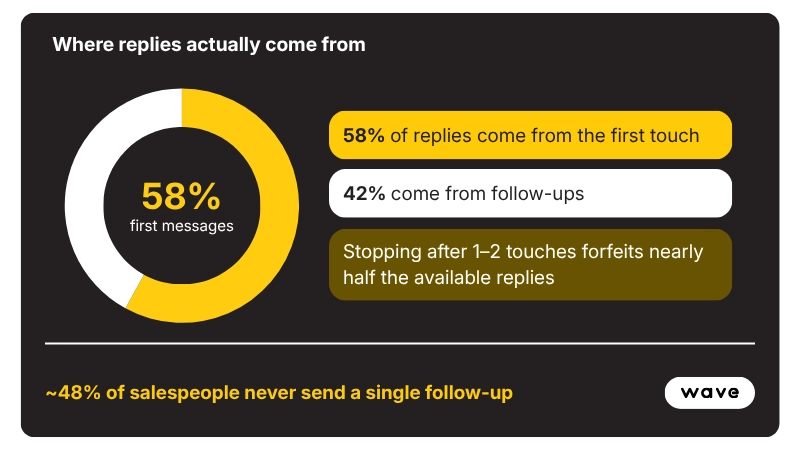
Instantly’s 2026 data shows 58 percent of replies come from the first message, with the remaining 42 percent spread across follow-ups. Teams that stop after one touch forfeit nearly half their potential replies. Teams that never stop create a different problem: each additional follow-up in a thread returns less and raises unsubscribe and complaint risk.
Three practical limits:
- Cap follow-ups within a thread at three. After that, start a new thread with a new subject line and refreshed positioning rather than adding to a dead chain.
- Pause on disinterest signals. A polite “not now” is worth more than a forced yes. Trust preserved is pipeline preserved.
- Recycle, do not discard. Contacts that fit the ICP but did not engage are timing misses, not failures. Re-engage every three to six months, calibrated to your deal cycle.
The scale of the follow-up problem is well documented. Wave Connect’s 2026 compilation cites data showing roughly 48 percent of salespeople never make a single follow-up attempt after initial contact. The bar is low. Clearing it is a competitive advantage.
Match the follow-up channel to the buyer:
- Digital-first sectors such as software and technology services respond well to email plus light LinkedIn presence.
- Field and operations sectors such as manufacturing, logistics, and construction respond better to phone.
- Senior executives need timing and visible credibility more than volume.
- Mid-level managers are generally reachable through a straightforward mix of calls and email.
Expert tip: The worst follow-up in B2B is "just checking in." It adds nothing and it teaches the recipient that your messages are safe to ignore. Every follow-up should carry one new thing: an insight, a comparable result, a shift in their market. If you have nothing new, wait until you do.
Phase 5: Measurement, Cutting the Metrics That Lie
Not all outreach metrics are useful. Some are misleading, and one is actively broken.
The Metric That Predicts Revenue
Pipeline velocity is the single most useful number for a revenue leader, because it combines volume, quality, price, and speed into one figure:
Pipeline velocity = (number of qualified opportunities x win rate x average deal size) / sales cycle length in days
It tells you the rate at which the system converts effort into revenue. Tracking this alongside qualified opportunities helps identify sales-qualified opportunity gaps before they become pipeline problems. It does not tell you where the system is failing, which is what the operational metrics are for.
Operational Benchmarks Worth Tracking
| Metric | Calculation | Realistic target |
| Deliverability rate | Delivered / sent | Above 98 percent |
| Bounce rate | Bounced / sent | Under 2 percent |
| Reply rate | Replies / delivered | 3 to 5 percent average, above 5 percent good |
| Positive reply rate | Interested replies / delivered | 0.5 to 2 percent typical for cold B2B |
| Spam complaint rate | Complaints / delivered | As close to zero as possible |
| Meeting booked rate | Meetings / prospects contacted | 0.5 to 2.5 percent depending on offer and deal type |
| Meeting show rate | Attended / scheduled | Above 80 percent |
| Cost per qualified meeting | Total program cost / qualified meetings | Benchmark against your ACV, not against averages |
Report positive and negative reply rates separately. A campaign showing 10 percent replies looks excellent until you find that most of them are removal requests.
On open rate: treat it as a directional signal only. Apple Mail Privacy Protection inflates it substantially, and some teams have found that removing tracking pixels lifts reply rates. If you have to choose between measuring opens and maximizing replies, choose replies.
Set Expectations Against the Real Cycle
Outbound gets judged on the wrong timeline more often than it gets judged on the wrong metrics. 6sense’s research puts the average B2B sales cycle at roughly ten months, with enterprise deals involving large committees running longer. Median B2B software cycles sit near 84 days, with deals above 100,000 dollars commonly running 90 to 180 days or more.
A program evaluated at 60 days is being judged during the phase when it has produced conversations but not yet closed revenue. Agree on the review window and the leading indicators before launch, not after the first invoice.
Expert tip: Review one operational metric per week, not the whole dashboard. Pick the constraint. If bounce rate is above 2 percent, nothing else on the dashboard is trustworthy, so fix that first and leave the messaging tests for when the data means something.
Building In-House Versus Partnering for Execution
Everything above is buildable internally. Whether it should be is a resourcing question, particularly when teams face common enterprise lead generation challenges around data, staffing, and scalability.
Time to pipeline. Building the data operation, warming domains, hiring and training SDRs, and iterating messaging to a working state takes months. If a number has to move this quarter, that timeline is the constraint.
Total cost per qualified meeting. Compare fully loaded internal cost, meaning salary, tooling, data subscriptions, management time, and ramp period, against the cost per meeting a partner quotes. Many teams find the comparison is closer than expected once management overhead is counted honestly. Comparing internal resources with outsourced sales and marketing companies can clarify which model offers the better path to scale.
Where your team’s advantage actually is. Account executives closing deals is usually a better use of senior sales capacity than list building and deliverability maintenance.
Bringing the Sales Outreach Strategy Together
A sales outreach strategy that works in 2026 is not louder than the one that worked in 2020. It is narrower and better instrumented.
The teams filling pipeline right now share five habits. They target conditions rather than categories. They treat deliverability as engineering rather than as marketing. They write to a situation rather than to a merge field. They orchestrate channels so each touch reinforces the last. And they measure pipeline velocity rather than activity volume.
None of that requires more headcount or more spend. It requires deciding which of the five phases is currently your weakest, fixing that one, and then measuring again.
Sales Outreach FAQs
What is a sales outreach strategy? A sales outreach strategy is the documented system a team uses to identify target accounts, contact the right people inside them, and convert interest into qualified sales conversations. It covers targeting, data quality, sending infrastructure, message design, channel sequencing, follow-up, and measurement.
How is sales outreach different from lead generation? Lead generation is the outcome, meaning qualified prospects entering the pipeline. Sales outreach is one of the methods that produces it, specifically the proactive contacting of buyers who have not raised their hand. Inbound marketing is the other main method.
How many touches should a B2B outreach sequence include? A working sequence typically runs 8 to 12 touches across email, phone, and LinkedIn over roughly three weeks. Instantly’s data shows 58 percent of replies come from the first message and 42 percent from follow-ups, so stopping after one or two touches forfeits close to half the available replies.
Which channel performs best for B2B sales outreach? None of them alone. Email scales and carries the argument, LinkedIn builds recognition, and phone converts interest into booked meetings fastest. Prospeo’s research found 61 percent of decision-makers still prefer cold email as a first touch, but coordinated sequences consistently outperform any single channel.