AI Demand Generation in 2027 for Singapore B2B Teams
Learn how Singapore B2B teams use AI demand generation for lead scoring, AI search visibility and PDPA-aware outreach.
 Lene Tabucanon
I'm a journalism graduate and content writer at Callbox. My work covers topics related to B2B marketing, lead generation, and sales, with a focus on creating content that's informative, practical, and easy to understand.
View full bio of Lene Tabucanon
AI demand generation is becoming part of everyday marketing and sales for Singapore B2B teams. Buyers research suppliers independently, often using AI chatbots, and may have a shortlist before speaking to sales. Meanwhile, teams are expected to reach more APAC markets without adding headcount.
This guide explains how AI supports the Create, Capture and Convert stages, where people remain essential, how Singapore’s data-protection and Do Not Call rules affect outreach, and how to test a measured 90-day pilot.
 Quick Answer: AI demand generation uses artificial intelligence to find, educate and engage potential buyers before and after they begin actively shopping. It supports targeting, intent analysis, content, AI search visibility, lead scoring and prospecting, while people remain responsible for conversations and relationships.
Why Singapore B2B Teams Are Rethinking Demand Generation for 2027
Bigger buying groups, earlier shortlists
B2B buying decisions often involve several stakeholders, and buyers may research options independently before speaking with sales. Industry surveys suggest that AI tools are becoming part of this research process, but findings vary by market and sample. Treat global survey results as directional context rather than Singapore-specific benchmarks.
Explore top demand generation tools to drive more B2B leads
Selling across APAC from a Singapore HQ
Selling from Singapore into Malaysia, Indonesia, Vietnam, Thailand and the Philippines means adapting to different languages, etiquette and buying habits. Translation alone is not localisation. Have local reviewers check whether each message fits the market and audience.
Callbox’s regional SDR teams engage Southeast Asian buyers in their own language and business culture, then hand your team qualified meetings ready for the next step.
More pipeline from leaner teams
In Salesforce’s State of Sales research, conducted in August–September 2025 and based on 4,050 sales professionals including 100 in Singapore, 64% of Singapore sales leaders using AI said disconnected systems were slowing their initiatives. This is a useful signal about data readiness, not a universal benchmark.
Industry Insight: For Singapore teams, the most practical starting points are often bounded tasks such as account research, content adaptation and workflow support. Choose a use case that can be reviewed by a person and measured against a clear baseline.
Creating Demand with AI-Powered Marketing
Demand creation reaches buyers before they actively shop, so your brand is more likely to be considered when a need emerges. Many potential buyers may not be ready to purchase at a given moment, which is why useful educational content and consistent visibility matter over time.
Sharper ICPs and target accounts
AI can analyse won and lost deals, CRM history and firmographic data to refine an ideal customer profile (ICP). For example, a Singapore cybersecurity provider might find that its strongest-fit accounts have regional offices, a dedicated security team and compliance responsibilities. Sales should validate the pattern before it becomes a targeting rule.
A pattern like this only pays off when it becomes a focused, testable target list. A real campaign from a Singapore cybersecurity company shows what that focus looks like in practice.
Case in point: A focused ICP for a regional push
A Singapore-headquartered cybersecurity company had already built branch offices in North America and Europe and was ready to grow closer to home, in Singapore, Australia and New Zealand. Instead of targeting every business that might need cyber protection, the campaign focused on one segment, service providers, and a defined set of decision-makers: CTOs, CEOs, technical directors, support directors and chief revenue officers.
With Callbox running the lead generation campaign, the client gained:
- 48 sales appointments
- 60 marketing-qualified leads (MQLs)
- 179 social media connections
Read how a cybersecurity provider won the SG and ANZ markets
Intent signals and timing
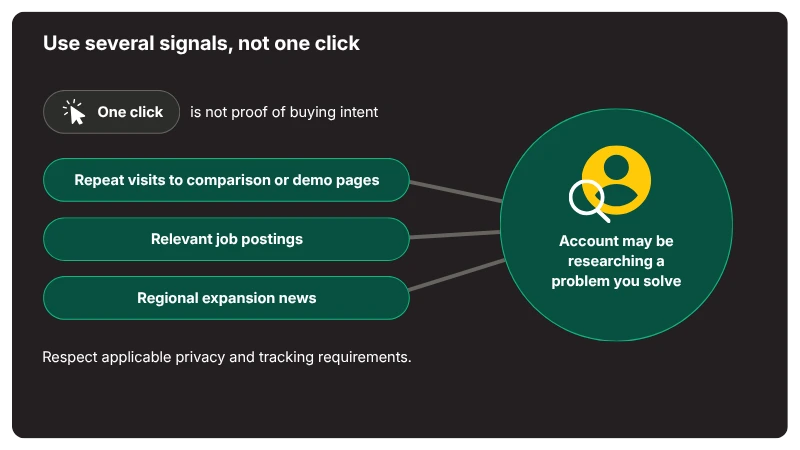
Intent signals—such as repeat visits to your product comparison or demo pages, relevant job postings or regional expansion news—may indicate that an account is researching a problem you solve. Use several signals rather than treating one click as proof of buying intent, and respect applicable privacy and tracking requirements.
Personalised content that does not sound generic
Use AI to adapt a strong core asset by role, industry and market, grounding it in your own customer insights. Have a subject expert check accuracy and a local reviewer check language and cultural fit. Personalisation should make a message more relevant, not simply insert a name.
Showing up in AI search
AI-assisted search is changing how some buyers discover and compare software vendors. Survey findings are not universal and may not reflect Singapore B2B buyers specifically, so treat them as directional rather than a forecast of how every prospect will search.
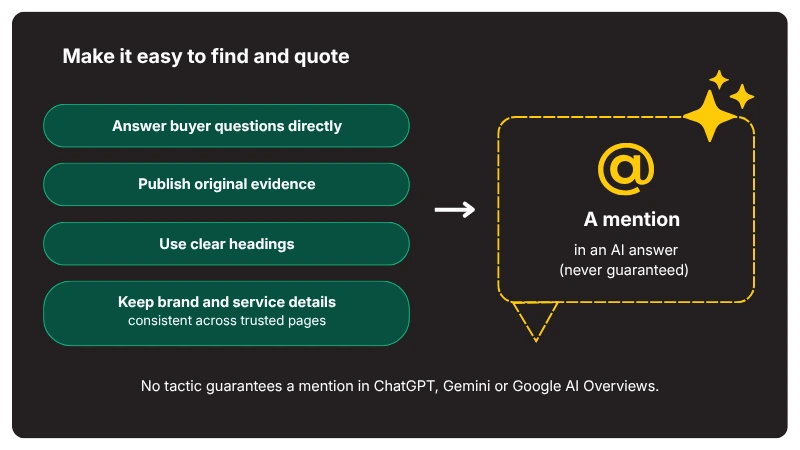
No tactic guarantees a mention in ChatGPT, Gemini or Google AI Overviews. Make useful information easy to find and quote: answer buyer questions directly, publish original evidence, use clear headings, and keep brand and service details consistent across trusted pages.
Expert Tip: Each month, ask ChatGPT, Gemini, Perplexity and Google the ten questions your buyers actually ask. Record whether your brand appears, which sources are cited and how competitors are described. Treat this as a directional check, not a complete visibility measurement.
Capturing Demand with AI Lead Generation and Sales Prospecting
Demand capture means responding well to buyers who are ready, or nearly ready, to talk.
Enrichment, lead scoring and data hygiene
AI lead-generation tools can enrich records with job title, company size and location; score leads by fit and intent; and flag duplicates or missing data. A regional finance director at a Singapore-based firm, for example, may deserve priority if the company fits your ICP and has a relevant trigger event.
Data quality determines whether AI outputs are useful. Before adding more tools, check whether customer and account records are accurate, current and accessible to the people and systems that need them.
AI for sales prospecting
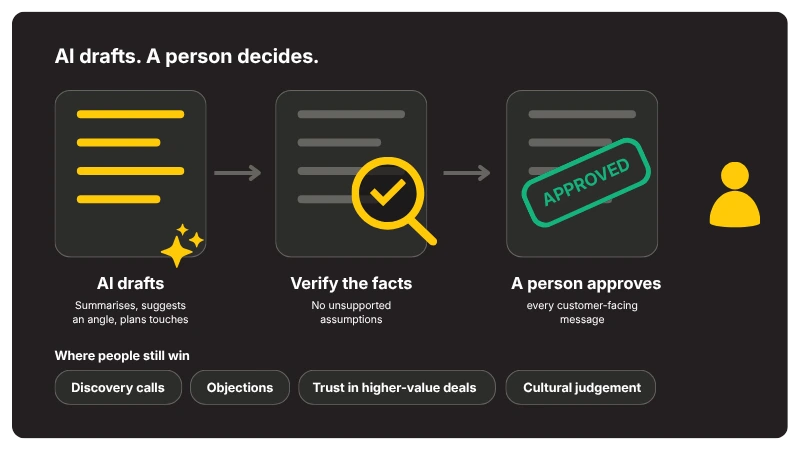
AI can summarise an account’s news, hiring and regional footprint, suggest a relevant angle and help plan email, phone and LinkedIn touches. Treat the result as a first draft: verify the facts, avoid unsupported assumptions and have a person approve customer-facing outreach.
Where people still win
People remain essential for discovery calls, objections, trust in higher-value deals and cultural judgement. Formality, the timing of commercial discussions and decision-making norms vary across APAC, so regional teams should adapt the conversation rather than rely on a generic AI script.
How Callbox can help: Callbox describes an approach that combines AI-enhanced targeting with native-language outreach and dedicated regional SDR teams. Its Smart Engage platform supports account-based engagement.
Using AI in Sales Without Losing the Human Touch
Conversion turns demand into revenue, and it stays human-led. AI’s job is to make each conversation better prepared and better followed up.
Smarter handoffs and SDR support
AI can prepare a concise handoff for each qualified lead: why the account fits, what it engaged with, the agreed contact permissions and the questions sales should resolve. Define the qualification criteria with sales and marketing, and make sure the team can see the source and limits of the data.
For sales development representatives (SDRs), AI can research accounts, draft messages for review and summarise calls. Keep people responsible for judgement, approval, conversations and follow-up. If calls are recorded or transcribed, tell participants as a prudent practice and confirm any campaign-specific legal requirements.
Callbox’s dedicated SDRs in Singapore pair AI-assisted research with human-led outreach to book qualified meetings with your target accounts. Explore Outsourced SDR Services in Singapore.
Why AI is not a replacement for sales teams
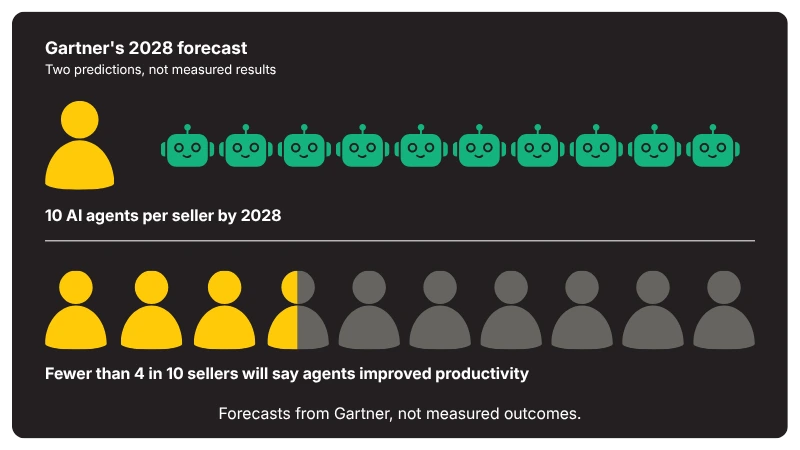
Gartner forecasts that by 2028 AI agents will outnumber sellers 10 to 1, while fewer than 40% of sellers will say agents improved their productivity. These are forecasts, not measured outcomes. The practical question is which tasks AI can handle reliably and which still need human judgement.
Keeping AI Demand Generation PDPA Compliant
AI does not change Singapore’s rules, but it can make mistakes easier to repeat at scale. This section is general information, not legal advice. Ask your legal or data-protection team to review the specific data, audience, channels and tools used in each campaign.
Personal data and AI tools
Before putting personal data into an AI tool, know where each contact came from, what information is being shared, how the provider stores it and whether it may be used to train models. Minimise the data you provide and check vendor terms and internal policies.
Rules for using personal data depend on the type of information, purpose, context and applicable exceptions. Do not assume that information about a business contact, sole proprietor or personal mobile number is automatically exempt. Minimise the personal data shared with AI tools and ask your legal or data-protection reviewer to confirm the requirements for the campaign.
Singapore’s data-protection regulator has published guidance on personal data used in AI recommendation and decision systems. Guidance may have a defined scope and may not answer every question about a generative-AI use case. Ask the legal or data-protection reviewer to identify which guidance applies.
Calls, texts and the DNC Registry
Before marketing to Singapore telephone numbers, review whether the Do Not Call requirements apply to the intended call, text or fax and whether a valid exception or consent applies. Do not assume that every B2B contact is exempt. Confirm the approach with your legal or data-protection reviewer before launch.
The treatment of business contacts can depend on the recipient, message purpose and circumstances. Flag uncertain cases—including sole proprietors and personal mobile numbers—for legal review rather than relying on a blanket B2B exemption.
Email and other electronic messages
Singapore has rules governing certain unsolicited commercial electronic messages sent in bulk. Requirements can depend on the message and campaign, so check the current requirements for labelling, contact details and unsubscribe handling with your legal reviewer before launch. Do not assume that a message is permitted simply because it is B2B outreach.
A practical compliance checklist
- Record the source and collection date for each contact list.
- Flag personal mobiles and sole proprietors for legal review where needed.
- Check AI vendor terms on storage, retention, access and model training.
- Check the relevant DNC register or retain evidence of applicable consent before outreach, where required.
- Do not use phone numbers obtained through prohibited number-generation or harvesting methods.
- Have a person review AI-generated messages and apply opt-outs across relevant channels.
Expert Tip: Keep a campaign log of list sources and dates, consent records, DNC check dates and results, the checker used, and who approved message templates. A clear record is easier to defend than reconstructing decisions later.
Your 90-Day AI Demand Generation Rollout and ROI Framework
Start small, measure results against a baseline and make the pilot easy to change or stop.
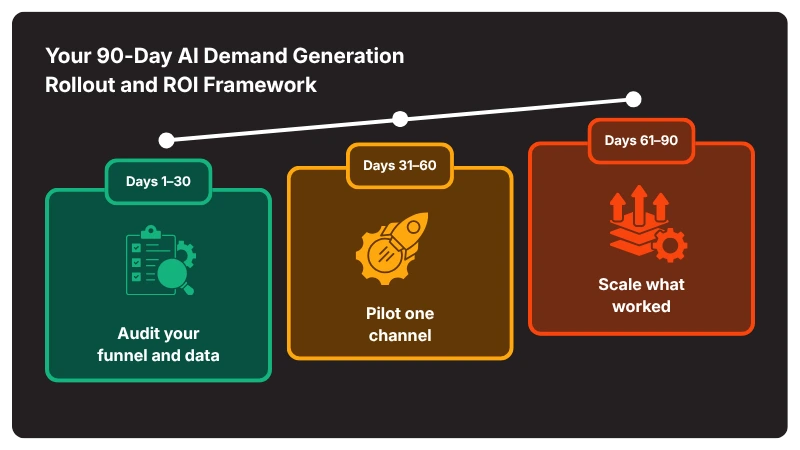
Days 1–30: Audit your funnel and data
Map how leads are sourced, qualified and handed to sales. Identify data issues, bottlenecks and repetitive tasks; record baseline metrics from at least the previous quarter; then choose one contained use case, such as AI-assisted account research or inbound lead scoring.
Days 31–60: Pilot one channel
Test one workflow—for example, AI-prepared account briefs and draft emails for 200 target accounts in Malaysia, reviewed and sent by SDRs. Assign reviewers and approvers, apply compliance controls, compare results with the baseline every two weeks and ask sales whether the leads were useful.
Days 61–90: Scale what worked
Refine the workflow using the results and team feedback. Expand only when the evidence supports it, document prompts, owners and review steps, and review performance monthly before deciding whether to expand, adjust or stop.
How to measure ROI
The following formulas show how B2B teams can measure demand generation performance. They are general calculations, not industry benchmarks. Use your own campaign costs, sales data, conversion rates and customer economics.
- Cost per sales-qualified lead (SQL) = campaign cost ÷ number of SQLs.
- Pipeline velocity = (number of opportunities × average deal value × win rate) ÷ sales cycle in days. Use this as a directional measure, not a guarantee of daily revenue.
- Meeting-to-opportunity conversion rate = opportunities created ÷ meetings held.
- Customer acquisition cost (CAC) = total sales and marketing costs ÷ new customers acquired.
- CAC payback period = CAC ÷ monthly gross margin per customer.
Interpret these metrics together. A lower cost per SQL is not necessarily an improvement if lead quality, opportunity conversion or customer profitability declines. Compare like-for-like periods and use consistent definitions across campaigns.
Where AI fits across the funnel
Funnel stage | AI use case | Human role | KPI | Compliance check |
Create | ICP and target account selection | Validate the list with sales | Pipeline share from target accounts | Data sources documented |
Create | Intent monitoring and content adaptation | Choose signals; expert and native-speaker review | Engagement; AI answer mentions | Tracking disclosed; no personal data in public AI tools |
Capture | Enrichment and lead scoring | Review the model quarterly | Lead-to-SQL conversion | Business contact information confirmed |
Capture | Account research and sequencing | Approve every message | Reply rate; cost per SQL | DNC check or evidenced consent; bulk email unsubscribe |
Convert | Handoff summaries | Agree MQL and SQL definitions | Speed to follow-up | Consent status passed on |
Convert | Meeting prep and follow-ups | Run the conversation; check follow-ups | Pipeline velocity; win rate | Recording disclosed |
How these use cases were chosen: they are common AI demand-generation applications mapped to practical data-protection and outreach review questions. This is not a legal compliance assessment, a paid ranking or an endorsement of particular vendors. The best starting point depends on each team’s data, risk and goals.
Planning a pilot? Callbox’s enterprise lead-generation team in Singapore describes a model combining AI-powered, human-verified data with dedicated SDRs. Contact Callbox to discuss whether this approach fits your team.
Build Demand That Lasts
AI demand generation works best when AI helps with scale and people remain responsible for trust, judgement and compliance. Start with one measured pilot, keep humans in charge of conversations, and expand only when the evidence supports it.
To explore a human-plus-AI approach, visit Callbox’s B2B lead-generation and contact the team to discuss your goals.
Frequently Asked Questions
Is AI demand generation PDPA compliant in Singapore?
It can be, but compliance depends on the data, tool, purpose and channel. Review the data shared with AI providers, the basis for using personal data, applicable DNC requirements and opt-out handling. Ask a qualified legal or data-protection professional to review the campaign.
What's the difference between AI for lead generation and AI for demand generation?
AI for lead generation focuses on finding and qualifying prospects who may be ready to talk now. AI demand generation is broader: it also builds awareness and trust among buyers who are not yet actively shopping, so the brand is considered when a need arises.
Will AI replace SDRs?
AI can take on research, drafting and administration, but people remain important for judgement, trust, objections and relationship-building. SDR roles are likely to change as routine work is automated; teams should measure whether the tools improve the quality and productivity of their work.
What should a Singapore SME automate first?
Start with a repetitive, low-risk task you can measure, such as CRM clean-up, account research or meeting notes. Keep customer-facing messages under human review until the workflow is reliable and approved.
How long does it take for AI demand generation to show ROI?
Time savings may appear within weeks, but revenue impact depends on the sales cycle. If a cycle lasts four months, closed revenue may take two quarters to show. Track leading indicators during the pilot and revenue outcomes over a longer period.