Why We Took AI Out of Our Headline
Callbox has launched a new homepage. See what’s changed, what the new logo animation means, and how we define a qualified B2B sales meeting.
 Ben B.
Ben-Larry Belgica writes about B2B marketing, lead generation, and sales outreach for Callbox. His content explores practical strategies, emerging trends, and proven techniques that help businesses accelerate growth and build stronger sales pipelines in competitive markets.
View full bio of Ben B.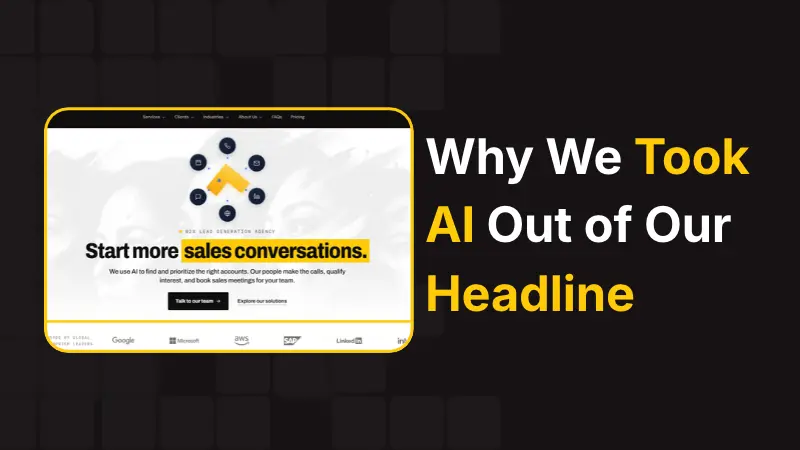
Our new homepage is live, and the most deliberate decision on it is something we left out. AI is not in the headline. It appears in the second sentence, doing a specific job: prioritizing the right accounts so our people can spend their calls on conversations worth having. The headline is about sales conversations, and the section halfway down the page says the rest of it plainly — AI supports the work, our people make the connection.
That is a strange position to take in a market where every competitor is racing to claim more automation. Here is why we took it, what the new logo animation is actually arguing, and why we published our definition of a qualified meeting on a page anyone can read before they ever talk to us.
New to Callbox? 20+ years, 15,000+ companies served, offices in 7 countries.
Every lead gen agency is leading with AI. We moved ours to the second sentence.
For most of the last two years, the fastest way to sound modern in this category was to put AI at the top of the page. We did it too. The previous version of this homepage opened with an AI claim and worked outward from there.
The problem is what happened to the claim itself. AI has made two things cheap that used to be hard: volume and personalization. Any provider can now research a prospect, write a message that references their funding round, and send it at a scale no human team could match. When everyone can do a thing, that thing stops being a reason to choose anyone.
What did not get cheap is judgment. Deciding which accounts are worth working. Reading a reply and knowing whether the interest is real or polite. Hearing hesitation on a call and choosing whether to push, wait, or walk away. Knowing that a prospect who asked one sharp question matters more than ten who opened the email twice. None of that is a volume problem, and none of it has been automated away.
So the page is ordered the way the work is ordered. AI narrows the field and tells us where to point. People make the calls, run the conversations, and decide what is actually a meeting. The same thinking shows up in how we report results: the page carries specific appointment and lead counts from named campaigns rather than round multipliers, because a number with a campaign and a timeframe attached can be checked and a bare multiplier cannot.
See where AI fits in a Callbox campaign.
What the logo animation is actually saying
At the top of the page, a ball moves between channels and a caret turns to send it onward. It is worth explaining, because it is the same argument in a different form.
The ball is opportunity. A buyer signal, a new connection, a flicker of interest that could become a sales conversation. It carries potential and nothing else. It does not know where to go.
The channels are reach. Email, calls, LinkedIn, messaging, the web. Different ways to put something in front of a buyer. Reach is necessary and, on its own, undirected.
The caret is Callbox. It is the turning point, the moment activity becomes a deliberate next move. Every shift of it stands for a decision: recognizing which signal is worth acting on, choosing the message, picking the channel, and knowing when to move. That is where AI, our people, and twenty years of accumulated campaign knowledge meet. AI contributes speed and scale. Our people contribute the commercial judgment and practical know-how that only comes from thousands of real buyer conversations. Ten thousand campaigns is not a vanity number here; it is the reason the caret knows which way to turn.
The loop matters as much as the turn. Each response informs the next move. That is what running a campaign actually looks like from the inside — listening, adjusting, following through — rather than firing a sequence and sorting the wreckage.
Opportunity carries the potential. Callbox directs the progress. The short version we use internally: the ball brings the energy, the caret decides what happens next.
One process behind 10,000+ campaigns. From ICP to booked meeting, here is how a Callbox program runs, step by step.
We published our definition of a qualified meeting
Most disagreements between a company and its lead gen provider come down to one thing: nobody agreed in advance what a qualified meeting was. The provider counts a booked calendar slot. The sales team counts a conversation that could become a deal. Both parties are reporting honestly against different definitions, and the relationship sours over a number neither of them defined.
So we put our bar on the homepage, before anyone signs anything. Four questions, and a meeting has to clear all four.
The question | What it screens for |
Does the account fit? | Industry, company profile, geography, and the accounts you want to be in. A meeting with the wrong company is a cost, not a result. |
Is this the right contact? | Whether the person has a role and relevance to the buying conversation — not simply whether they answered. |
Is there a reason to talk? | A business need, an expressed interest, or a clear purpose for the next conversation. Politeness is not interest. |
Is the handoff useful? | The context, the participants, and an agreed next step your sales team needs to run the meeting well. |
The fourth one is the one most providers skip, and it is where a lot of pipeline quietly dies. A meeting handed over without context forces your rep to start cold on a conversation someone else already had. We treat the handoff as part of the deliverable, not as an email sent afterwards.
Publishing this is slightly uncomfortable, which is the point. A bar you state publicly is a bar you can be held to.
Going into a new market is not a translation problem
The global section carries its own version of the same idea: go global, keep it human.
Translation is the part of market entry that is now effectively solved. A model will render your message into Japanese or Portuguese in seconds. What it will not tell you is how a procurement conversation actually opens in Singapore, which seniority level will take a cold call in Germany, or why the sequence that worked in Texas stalls in São Paulo.
That is account selection, local buyer context, and follow-through — and it needs people who work in those markets. The languages listed on the page are the easy half of the claim. The teams behind them are the half that matters.
Go global, keep it human. Multilingual campaigns run by local teams who know how buyers in each market actually say yes.
How to evaluate any provider claiming AI
This part is not about us. If you are shortlisting outbound partners right now, every one of them will tell you they are AI-powered, and that sentence no longer separates them. These four questions do.
- Who decides which accounts get worked? If the answer is that the model scores them and the list runs, ask what happens to a high-scoring account in a segment that has never bought from you.
- What happens when the AI is wrong? Every system misreads intent. The useful question is who catches it, how fast, and whether anything changes as a result.
- Where exactly does a human enter the sequence? Ask for the specific step. “Humans are involved throughout” usually means a person reviews a report at the end of the month.
- What is your written definition of a qualified meeting? If they cannot give you one before the contract, you will be negotiating it afterwards, in a worse position.
A provider who answers all four crisply is probably worth your time, whoever they are.
Hold us to the same four questions. See named campaigns with the appointment counts and timeframes attached.
Frequently asked questions
What is a qualified meeting in B2B lead generation? A qualified meeting is a sales conversation with the right contact at a target-fit account, with a genuine reason to talk and enough context for your rep to run it well. Callbox screens every meeting against four tests: account fit, the right contact, a reason to talk and a useful handoff.
Does Callbox still use AI? Yes. AI prioritizes accounts, reads buyer signals and personalizes outreach at scale. Callbox SDRs make the calls, run the conversations and decide what counts as a qualified meeting.
Why isn’t AI in the Callbox homepage headline? Because AI-powered outreach no longer separates one provider from another. The headline leads with what clients buy, qualified sales conversations, and AI appears in the second sentence, where it describes the job it does.
What’s next
The new homepage is the first piece. Our regional sites and service pages roll out on the same thinking over the coming months, and the campaign work behind the results on the page will get its own deeper treatment.
If you are weighing up an outbound partner, the four questions above are a reasonable place to start, with us or anyone else. If you want to put them to us directly, a strategy session is a conversation, not a pitch — we will tell you where we would point first and what we would expect in the first quarter.