Callbox vs. Belkins vs. CIENCE: Deciding the Best Lead Gen Partner for Enterprise Tech in 2026
Comparing Callbox vs. Belkins vs. CIENCE for enterprises. Discover which lead generation agency offers the best ROI and quality appointments.
 Rebecca Matias
 is Callbox's COO with 18 years of experience scaling B2B pipeline through data-driven outbound marketing, lead generation, and sales development.
View full bio of Rebecca Matias
If you are comparing Callbox, Belkins and CIENCE, the three now differ less on channels than on how you pay and what you are buying. All three run email, phone and LinkedIn. The real decision is this: Callbox sells a managed campaign with in-market teams and multilingual coverage, billed as a scoped engagement. Belkins sells guaranteed appointment volume, with a pay-per-meeting option. CIENCE sells SDR capacity on a fixed fee plus a commission for every meeting that is actually held, month to month.
This guide compares all three on model, coverage, commercial terms and fit, with figures verified against each provider’s own site in November 2026.
The fastest way to narrow a shortlist in 2026 is to ask how each provider charges. Pay-per-meeting pricing rewards volume; scoped retainers reward complex, multi-stakeholder campaigns where a single meeting can be worth six figures. Match the pricing model to your deal size before you compare case studies.
What Makes Callbox Different?
Most lead generation providers describe the same channels. The differences show up in who does the work, where they sit, and what counts as a finished meeting.
- AI finds the accounts. People have the conversations. AI handles research and account prioritisation. Callbox SDRs check relevance, shape the message, make the calls, and qualify interest before anything reaches your calendar. Nothing is auto-sent to a decision-maker without a person behind it.
- In-market teams, not translated campaigns. Callbox runs campaigns in Thai, Bahasa, Vietnamese, Mandarin, Filipino, Portuguese and Spanish alongside English, across North America, Asia-Pacific, Europe and the UK, and Latin America. For a US or European vendor opening APAC or LATAM, this is the capability that is hardest to buy elsewhere.
- Qualification agreed before launch, not after. Account fit, contact relevance, the reason for the conversation and the handoff context are defined with your sales team up front. A booked appointment, a held meeting and a sales opportunity are reported as three different things.
- Twenty-plus years in B2B only. Callbox was founded in 2004 and has worked exclusively in B2B since. Campaigns have run for Google, Microsoft, AWS, SAP, LinkedIn and Intel.
- Your CRM stays the source of truth. Callbox hands over context; your team owns the opportunity and the close. No parallel system to reconcile.
Evidence, from published Callbox case studies:
| Programme | Market | Duration | Reported outcome |
|---|---|---|---|
| Supply chain and logistics leader | United States | 12 months | 146 sales appointments, 500+ MQLs |
| Enterprise managed services provider | North America | 4 months | 70 sales-qualified leads, 140 MQLs |
| Office and workplace solutions | United States | 3 months | 57 sales appointments, 41 MQLs |
Each reflects a specific campaign, not a forecast. See all case studies
Callbox vs. Belkins vs. CIENCE at a glance (verified November 2026)
| Callbox | Belkins | CIENCE | |
|---|---|---|---|
| Founded | 2004 | 2017 | 2015; now part of the graph8 group |
| Entry price | From $6,667/mo | Quoted per programme; pay-per-meeting option | Fixed monthly fee + commission per held meeting |
| Contract | 6–12 months, billed quarterly | Quoted per programme | Month to month |
| Stated volume | Scoped to the campaign | 100–400+ appointments a year | 5–20+ qualified meetings a month per SDR |
| Time to launch | Weeks, after ICP and qualification are agreed | Campaign live in 14 days | Campaign live in under 14 days |
| Channels | Phone, email, LinkedIn, webinars and events | Email, phone, LinkedIn, voicemail, SMS/WhatsApp, paid ads | Phone, email, LinkedIn |
| Non-English campaigns | Thai, Bahasa, Vietnamese, Mandarin, Filipino, Portuguese, Spanish | Not published | Not published |
| Regions | North America, APAC, Europe and UK, LATAM | North America and Europe | North America, with APAC and Europe programmes |
| Public ratings | Clutch 4.6 (100+), G2 4.5 (90+), Google 4.5 (85+) | Clutch 4.9 (230), G2 4.8 (93) | Clutch 4.4, G2 4.0, 4.4 average across 7 platforms |
Sources: Callbox Inc., Belkins, Cience, each accessed 10 November 2026.
Two notes on writing this table honestly. Belkins rates higher on public review platforms — publish it. A reader who finds that out elsewhere stops trusting the rest of the page. And CIENCE’s month-to-month term is a genuine advantage for a buyer testing the water; the counter-argument belongs in the pricing section, not hidden by omission.
Deep dive: The Three Providers

Callbox: managed campaigns with in-market teams
Callbox runs the campaign end to end and staffs it with people in the markets being called. The sequence is the same on every programme: AI research and account prioritisation, then a coordinated campaign across phone, email and LinkedIn, then human SDRs who call, listen, qualify and hand over context to your sales team. Campaign reviews feed your feedback back into the next round of outreach.
The strongest fit is a company selling a complex product into more than one country, especially where the buying conversation does not happen in English. Callbox runs campaigns in seven non-English languages with teams in those regions, which is the capability neither Belkins nor CIENCE publishes.
The weakest fit is a company that wants to test outbound for a month before committing. Callbox engagements run 6 to 12 months and are billed quarterly, starting at $6,667 a month. That structure exists because enterprise cycles need the runway, but if you want to try outbound cheaply and leave, CIENCE’s month-to-month arrangement is the honest answer.
 Expert insight: In enterprise technology, the first call rarely lands cold. The value of a coordinated programme is that a CISO has already seen your name in a LinkedIn engagement or attended a webinar before an SDR dials. Single-channel outreach cannot build that familiarity, which is why reply rates and show rates diverge so sharply between the two approaches.

Belkins: guaranteed appointment volume
Belkins has repositioned since this article was first published. Describing them as an email-led, North American appointment setter is no longer accurate.
As of November 2026, Belkins markets an omnichannel programme spanning cold email, cold and intent calling, voicemail, SMS and WhatsApp, LinkedIn and paid advertising. They state 100 to 400+ qualified appointments a year, work across 50+ B2B industries, and claim $2B+ in client revenue since 2017. They publish dedicated enterprise, SMB and startup tracks, and a pay-per-meeting programme for buyers who want cost per meeting fixed up front.
They are also the highest-rated of the three on public review platforms, at 4.9 on Clutch across 230 reviews and 4.8 on G2.
Where Belkins fits: a company with a well-defined ICP, concentrated in North America or Europe, that wants a committed appointment number rather than a scoped campaign. Where it does not: markets requiring non-English, in-country conversations, which Belkins does not publish coverage for.

CIENCE: SDR capacity, paid on held meetings
CIENCE has changed more than either of the other two. It now operates as the services arm of the graph8 group, alongside the graph8 platform and Tenbound. The old GO Data positioning has been replaced by a “Revenue Ontology” data layer and the octa models. Anything in older comparisons about CIENCE as a standalone data platform is out of date.
The commercial model is the headline. CIENCE charges a fixed monthly fee plus a commission for each meeting that is actually held, month to month with no long contract. They state 5 to 20+ qualified meetings a month per SDR, campaigns live in under 14 days, 2,500+ clients over 10+ years, 115+ published case studies, and SOC 2 Type II compliance.
Where CIENCE fits: a company that wants a low-commitment trial of outbound, or one that wants its spend tied directly to meetings held rather than activity. Where it does not: programmes where the meeting is not the unit of value — complex ABM against a named account list, where the goal is penetration of a buying committee over quarters, not a monthly meeting count.
What each provider charges, and how
The three providers price on three different logics, and the logic matters more than the number.
Callbox starts at $6,667 per month, on a 6 to 12 month engagement billed quarterly. You are buying a scoped campaign — the research, the multichannel outreach, the SDR team and the reporting — rather than a meeting count. The quarterly billing and the minimum term exist because enterprise programmes need two to three months before targeting and messaging settle, and a 30-day window cannot tell you whether a campaign works.
Belkins quotes per programme against a committed appointment range of 100 to 400+ a year, and offers a pay-per-meeting option for buyers who want cost per meeting fixed in advance.
CIENCE charges a fixed monthly fee plus a commission for each meeting that is held, month to month with no long contract.
How to read the difference
Pay-per-meeting pricing is attractive when a meeting is a meeting. It gets harder to use when your deals are large and your buying committee has ten people, because the provider is paid on an event that may not correlate with pipeline. A meeting with a mid-level evaluator counts the same as one with the economic buyer.
Scoped engagements work the other way. You pay for the programme and judge it on pipeline contribution, which is slower to read and harder to game. It suits companies where one closed deal pays for the year.
The honest trade-off to state on the page: CIENCE’s month-to-month term is lower risk for a first trial. Callbox’s 6 to 12 month term is a real commitment, and the case for it is that enterprise outbound does not produce a readable signal inside 30 days. Say that plainly. A comparison page that pretends a minimum term is purely an advantage reads as marketing; one that explains why the term exists reads as expertise.
Link to Callbox pricing at the end of the section.
What counts as a qualified meeting — and why providers disagree
Every provider on your shortlist will quote you a meeting number. Those numbers are not comparable until you define the unit.
Four questions settle it, and they should be answered before a campaign launches rather than argued about in month three:
- Does the account fit? Industry, company profile, geography, and the specific accounts you want included or excluded.
- Is this the right contact? The person’s role and their actual relevance to the buying conversation — not just their title.
- Is there a reason to talk? A stated business need, expressed interest, or a clear purpose for the next conversation.
- Is the handoff useful? The context, participants and agreed next step your sales team needs to run the meeting well.
The second point matters most in enterprise technology. A meeting with someone who cannot sponsor a purchase is cheap to book and expensive to attend. If a provider’s commercial model pays them per meeting booked, ask explicitly how they handle this — and ask whether you are charged for a meeting that is booked, a meeting that is held, or a meeting that becomes an opportunity. Those are three different numbers and providers quote whichever flatters them.
Callbox reports booked appointments, held meetings and sales opportunities separately, and agrees the qualification bar with your sales team before the first call.
Top Lead Generation Companies for ERP Software
Enterprise Resource Planning (ERP) sales are uniquely difficult due to high implementation costs. The following companies specialize in this high-stakes vertical:
- Callbox: (Top-rated for SAP, Oracle, and Microsoft Dynamics targeting).
- UnboundB2B: Focused on intent-based leads for enterprise software.
- Ziff Davis Performance Marketing: Strong in tech-stack identification for ERP displacement.
The ROI calculation for Outsourced Lead Generation
Cost per lead is the wrong first metric in enterprise technology. A $500 lead that closes a $100,000 contract beats a $50 lead that never leaves the CRM. Work from pipeline instead:
Worked example, using the Callbox entry point:
A 12-month engagement at $6,667 a month costs $80,000. If the programme generates $900,000 in qualified pipeline and you close 20% of it, that is $180,000 in closed revenue. ROI = ($180,000 − $80,000) ÷ $80,000 = 1.25, or 125%.
The figures above are illustrative. Substitute your own average contract value and historical close rate — the close rate is the variable that moves this calculation most, and it is yours, not the agency’s.
Three things to track alongside it
- Cost per opportunity, not cost per lead. Divide programme cost by the meetings that reached opportunity stage. This is the number to compare across providers, and it is the only one that makes a per-meeting model and a scoped retainer comparable.
- Ramp cost avoided. An in-house SDR carries roughly $120,000 in loaded cost plus months of ramp before producing. Include that in the comparison, not just the agency invoice.
- Sales velocity. Does coordinated multichannel nurture shorten the cycle? If a 9-month cycle becomes 7, that is worth more than a small change in meeting volume.
Set the evaluation window at 90 days, not 30. Measure pipeline contribution — meetings that moved to opportunity stage — rather than closed revenue, which will lag a full sales cycle behind the programme.
Why Callbox, and the final verdict
Callbox is the strongest fit when the hard part of your pipeline is not volume but reach into the right rooms, in more than one country.
Three situations where that is true:
- You sell into markets that do not buy in English. Campaigns run in Thai, Bahasa, Vietnamese, Mandarin, Filipino, Portuguese and Spanish, with teams in those regions. A translated email sequence is not the same thing as a local SDR who can hold the call.
- Your buying committee has ten people in it. ABM against a named account list, where the goal is penetrating an organisation over quarters, does not fit a monthly meeting quota. It fits a scoped programme with an agreed qualification bar.
- You need the conversation, not just the calendar invite. AI does the research and prioritisation; people make the calls and qualify. In a year when decision-makers are deleting automated outreach by reflex, that distinction is the campaign.
All three providers now say some version of “AI for research, humans for conversation” — CIENCE states it almost identically. The claim no longer separates anyone. What separates them is where the humans are. Callbox staffs campaigns with SDRs in the markets being called, which is why the multilingual coverage above is the sharper differentiator to lead with than the AI stack.
- Choose Callbox if you sell a complex product into multiple regions, need non-English in-market conversations, and can commit to a 6 to 12 month programme measured on pipeline rather than meeting count.
- Choose Belkins if your ICP is tight, concentrated in North America or Europe, and you want a committed appointment volume or a fixed cost per meeting.
- Choose CIENCE if you want to test outbound with minimal commitment, or want spend tied directly to meetings held, and your deal economics make a meeting a fair unit to pay for.
If you are still weighing the three, the question that separates them fastest is not capability. It is whether a booked meeting is the outcome you are buying, or a proxy for it.
Frequently asked questions
Which is better for global enterprise technology, Callbox or Belkins?
For companies selling into Asia-Pacific or Latin America, Callbox is the stronger fit. Callbox runs campaigns in Thai, Bahasa, Vietnamese, Mandarin, Filipino, Portuguese and Spanish with teams in those regions. Belkins publishes coverage across North America and Europe and does not publish non-English campaign capability. For a North American or European ICP, Belkins is a strong option and currently holds higher public review ratings — 4.9 on Clutch, 4.8 on G2 as of November 2026.
How do Callbox and CIENCE differ?
Mainly in what you pay for. CIENCE charges a fixed monthly fee plus a commission for every meeting held, month to month with no long contract, and states 5 to 20+ qualified meetings per SDR per month. Callbox sells a scoped campaign starting at $6,667 a month on a 6 to 12 month term billed quarterly, measured on pipeline contribution rather than meeting count. CIENCE is also now part of the graph8 group, alongside the graph8 platform and Tenbound.
What does a B2B lead generation agency cost in 2026?
The three main models are scoped retainer, committed appointment volume, and pay-per-meeting. Callbox starts at $6,667 a month on a 6 to 12 month engagement billed quarterly. Belkins quotes per programme against a 100 to 400+ annual appointment range and offers a pay-per-meeting option. CIENCE charges a fixed monthly fee plus a per-held-meeting commission with no minimum term. Compare them on cost per opportunity rather than monthly fee, since the models are not otherwise comparable.
How long before an outsourced campaign produces results?
All three providers launch within roughly two to four weeks of signing, after ICP definition, list building, copy approval and domain warmup. First meetings typically land in month one. Targeting and messaging usually settle by month two. For enterprise accounts, set a 90-day evaluation window rather than 30 days, and measure pipeline contribution — meetings that reached opportunity stage — rather than closed revenue, which lags a full sales cycle.
Can these agencies handle technical lead generation for ERP or infrastructure software?
Yes, with the caveat that multi-stakeholder displacement cycles need SDRs who can hold a technical conversation. Ask any provider how they handle a buying committee that includes an economic buyer, a technical evaluator and an end-user champion, and whether their SDRs are dedicated to your account or rotating across clients.
Is outsourcing better than an in-house SDR team?
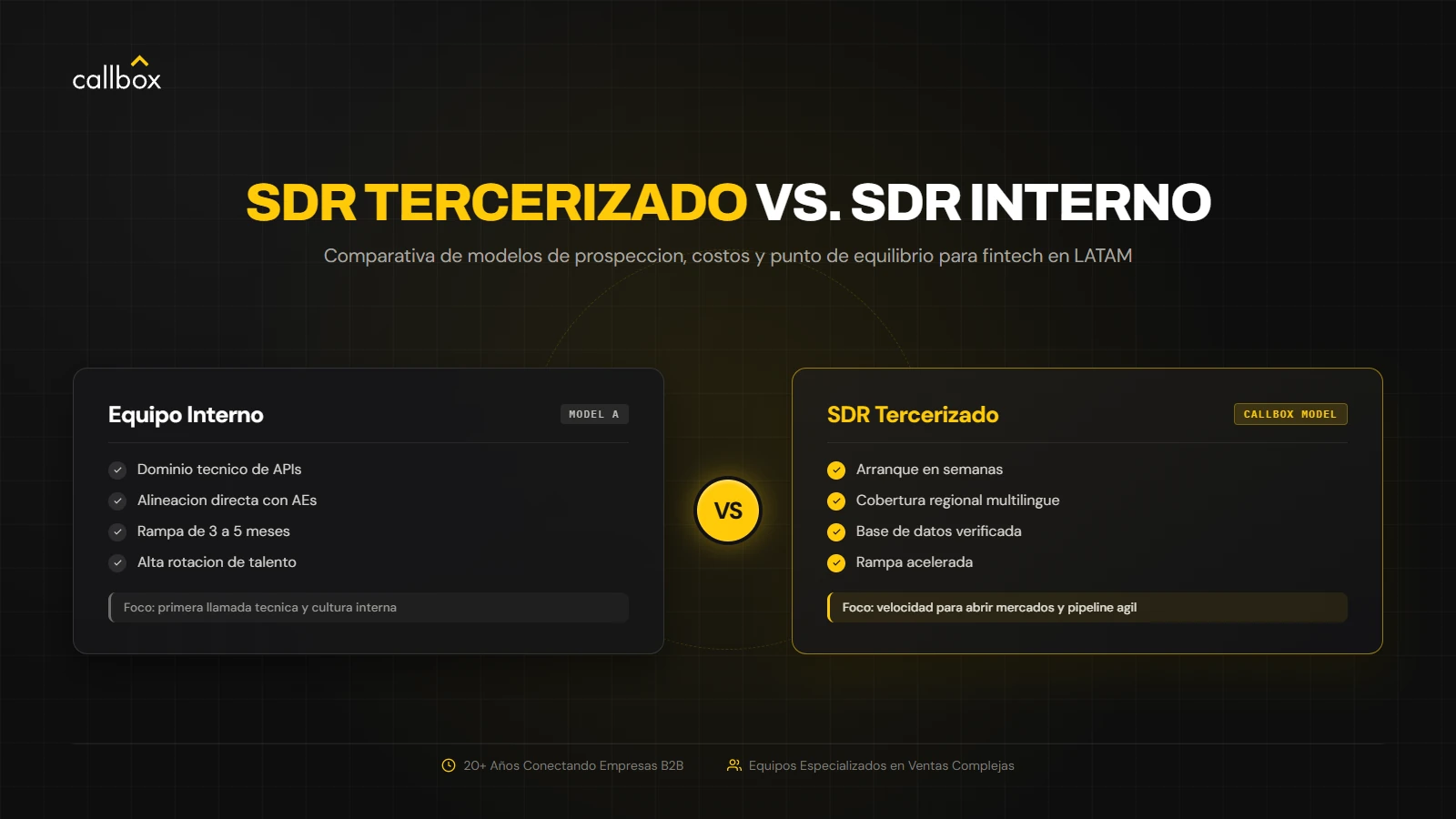
Most enterprise technology firms run both. An in-house SDR carries roughly $120,000 in loaded cost plus several months of ramp before producing; an outsourced programme is operational in weeks. The usual split is outsourcing top-of-funnel reach — particularly into new regions — while the internal team works warm pipeline and closes. The honest counter-argument: if your first conversation requires deep product knowledge that takes months to teach, keep it in-house.
What is the best enterprise lead generation strategy in 2026?
Three things in combination: intent-triggered outreach that reaches buyers while they are actively researching, multi-stakeholder ABM sequencing that gives each role its own message, and channel coordination — email, LinkedIn and voice sequenced within a 72-hour window so the name is familiar before anyone picks up the phone. Single-channel programmes underperform because enterprise buyers need several exposures before agreeing to a discovery call.