Night of the Living Leads: How AEO for Lead Generation Brings Dead Prospects Back
Dead prospects aren’t gone, they’re asking ChatGPT. Learn how AEO for lead generation brings ghosted B2B leads back to life, plus a 5-step revival plan.
 Jude Neilson
Jude Nielson is a Business Development Manager at Callbox Inc, with 12 years of experience driving B2B growth through strategic lead generation and sales development.
View full bio of Jude Neilson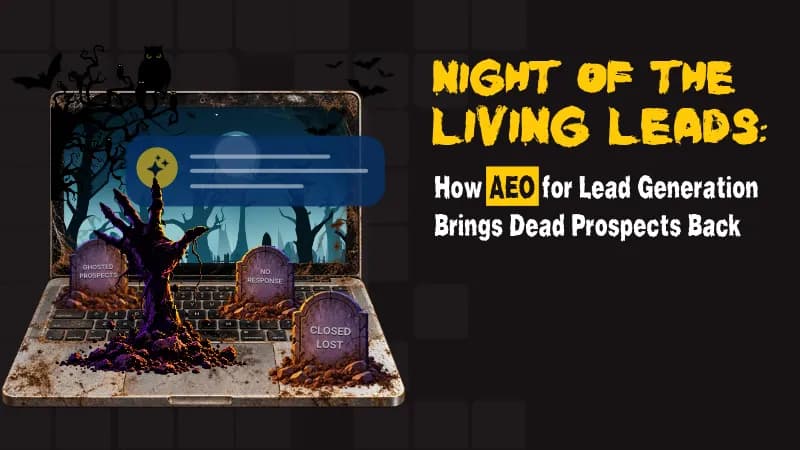
Your ghosted prospects never stopped researching. They just started asking ChatGPT instead of answering your emails.
Every B2B pipeline has a graveyard. It’s the CRM view nobody likes to open: closed-lost deals, ghosted demos, and that VP who promised to “circle back next quarter” three quarters ago.
Most sales teams leave some flowers and move on. But here’s a plot twist worthy of a midnight movie marathon: most of those prospects aren’t dead. They’re just researching somewhere you can’t see. AEO for lead generation is how you show up there, inside the ChatGPT, Perplexity, Gemini and Google AI Overview answers your old prospects are reading right now, and then hand them to a human who can finish the resurrection.
Why your “dead” prospects are still walking around
Start with the autopsy. In The JOLT Effect, Matthew Dixon and Ted McKenna analyzed roughly 2.5 million recorded sales conversations and found that 40 to 60 percent of lost B2B deals end in no decision. Nobody beat you. The buyer simply froze. And a deal that died of indecision is the easiest kind to bring back, because the problem that started the conversation is usually still there.
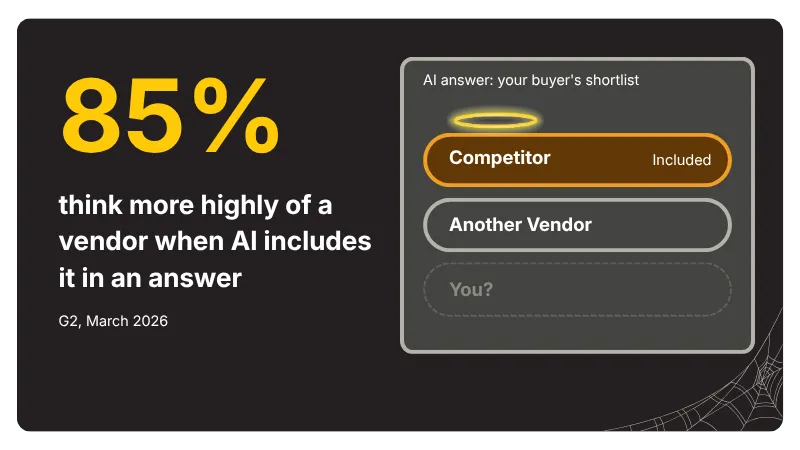
The catch is where those buyers go when they thaw out. They rarely dig up your old email thread. They open a chatbot. G2’s March 2026 survey of 1,076 B2B software buyers found that 51% now begin research in an AI chatbot more often than in Google, up from 29% in G2’s 2025 buyer report. Even scarier for anyone with a full graveyard: buyers rank AI chatbots as the top source shaping their vendor shortlists, and 85% think more highly of a vendor that AI cites in its answer.
Translation: your prospect may come back to life, just in a competitor’s pipeline.
By the numbers:
- 40–60% of lost B2B deals end in “no decision,” not a competitor win (Dixon and McKenna, The JOLT Effect)
- 51% of software buyers start research in AI chatbots more often than Google (G2, March 2026)
- 85% think more highly of a vendor cited in an AI chatbot’s answer (G2, March 2026)
- 94% of business buyers use AI somewhere in their purchase process (Forrester)
 Industry insight: Forrester's Buyers' Journey Survey, 2025 found that 94% of business buyers now use AI in their buying process. Twice as many buyers named generative AI or conversational search as their most meaningful information source as named any other source, well ahead of vendor websites, product experts and sales. The shortlist now forms before your SDR even knows the deal is breathing again. If your brand isn't in the AI answer, your dormant leads will rise from the dead without you.
Meet the undead: 5 dead prospects and how AEO for lead generation revives each
Not every dead prospect died the same way, so they don’t all come back the same way either. Here’s a field guide to the creatures haunting your CRM, what they’re quietly asking AI tools, and the answer engine optimization move that puts you back in their path.
Prospect type | How they “died” | What they’re asking AI now | AEO revival tactic | Human follow-through |
The Ghost | Went silent after a promising first call | “Is [category] worth it for a company our size?” | Publish ROI and sizing answers with real numbers | Check in with one relevant data point, not “just following up” |
The Zombie | Closed-lost to “no decision” | “How do other [industry] teams solve [problem]?” | Industry use-case pages written in Q&A format | Reopen with a peer story from their vertical |
The Vampire | Downloaded every gated asset, never took a meeting | “Best [category] providers in 2026” | Earn spots in the rankings and reviews AI engines cite | Offer a working session instead of another ebook |
The Mummy | Wrapped up in budget freezes and procurement | “[Your brand] vs [competitor] pricing” | Transparent pricing ranges and honest comparison pages | Time outreach to the new fiscal year or budget cycle |
The Werewolf | Champion left and a new stakeholder transformed the account | “What should I ask a [category] vendor?” | Buyer’s guides and evaluation checklists | Multi-threaded outreach to the new decision maker |
6 AEO strategies to raise dead prospects from the CRM graveyard
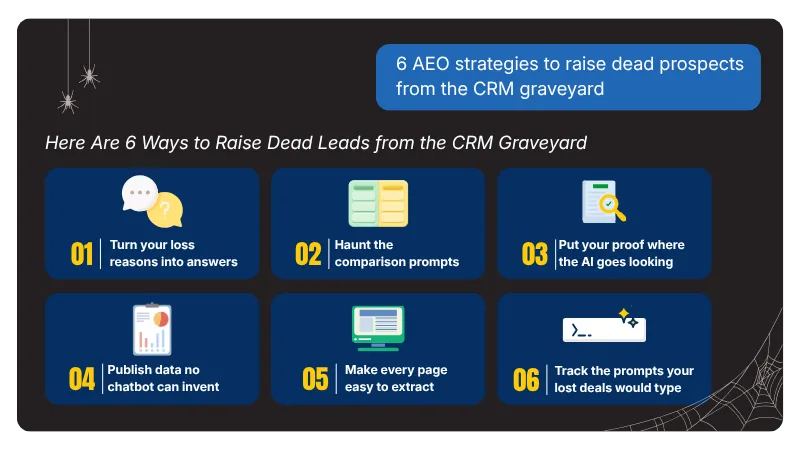
1. Turn your loss reasons into answers
Every closed-lost reason is a question your prospects are still asking. “Too expensive” becomes “How much does [service] cost for a mid-market company?” “Bad timing” becomes “When is the right time to outsource [function]?” Write a page for each, and lead with the answer in the first 50 words, because AI engines lift clear, direct responses far more often than buried ones.
Expert tip: Don't trust the CRM dropdown alone. Reps often pick a closed-lost reason in seconds at the end of a quarter just to clean up their pipeline, so the logged reason is frequently a guess. Read the actual call notes, or interview five lost buyers, before deciding which questions to answer first.
2. Haunt the comparison prompts
According to G2’s 2026 research, comparing vendor strengths and weaknesses is the single most common way buyers use AI chatbots. That means prompts like “X vs Y” and “alternatives to X” are where revived prospects make their shortlist. Build fair, specific comparison pages. AI engines are good at spotting one-sided fluff, and buyers are even better.
3. Put your proof where the AI goes looking
Answer engines build recommendations from consensus across many sources: review sites, industry rankings, trade publications, analyst commentary and community threads. A brand mentioned consistently across those places is a brand the AI trusts. Collect your awards, rankings and case studies on structured pages with schema markup so they’re easy for machines to read and cite.
Not sure which prompts your lost buyers are asking, or whether you show up? Callbox AEO Lead Generation Services start by mapping the questions your buyers actually type into AI tools.
4. Publish data no chatbot can invent
AI engines can summarize anything, but they can’t generate your proprietary numbers. Original benchmarks become citation magnets: average sales cycle by industry, meeting-to-opportunity rates, cost per qualified appointment. One solid benchmark report can earn you citations that a generic blog post never will.
5. Make every page easy to extract
Structure is the spellbook here. Use question-style H2s, short definitional paragraphs, comparison tables and FAQ sections. Add schema markup (Organization, Article, FAQPage) so engines understand who you are and what each page answers. If a paragraph only makes sense after reading three others, an AI engine will probably skip it.
6. Track the prompts your lost deals would type
Build a list of 25 to 50 prompts per buyer persona, then test them monthly across ChatGPT, Perplexity, Gemini and Google AI Overviews. Record whether your brand is mentioned, cited as a source or actually recommended. That’s your AI search visibility baseline, and it tells you which revival tactics are working.
Expert tip: Write your tracking prompts the way a stressed buyer types at 11 p.m., not the way your marketing team writes keywords. "We tried outsourcing SDRs before and it flopped, what should we do differently?" reveals far more about your visibility than "best outsourced SDR company."
Why AEO for lead generation needs a human at the séance
Here’s the part most AEO pitches leave out: an AI citation is a sighting, not a meeting. Forrester’s State of Business Buying, 2026 found that buyers embrace generative AI for research but don’t trust it enough to rely on it alone. Someone has to answer the follow-up questions, handle the objection that killed the deal the first time, and actually book the call.
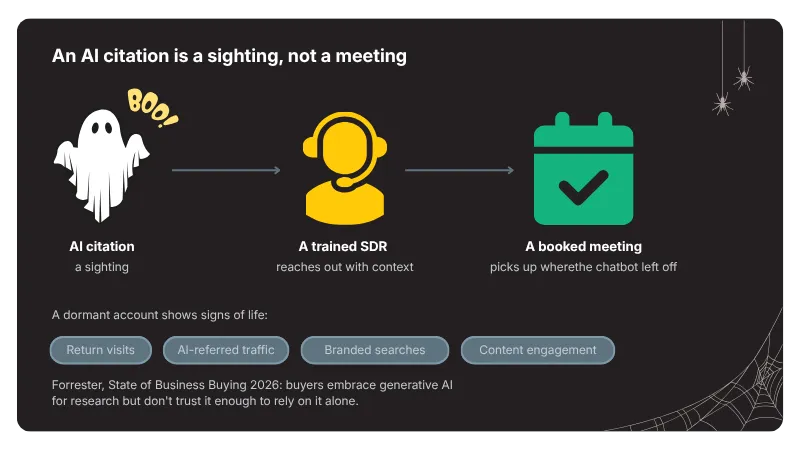
That’s where outbound lead generation takes over. A dormant account shows signs of life: return visits, AI-referred traffic, branded searches or content engagement. Then a trained SDR reaches out by phone, email and LinkedIn with context instead of a cold script. The prospect already met you in the AI answer. The human conversation just picks up where the chatbot left off.
This is exactly how Callbox runs its AEO Lead Generation program. Answer engine optimization and multichannel appointment setting are managed as one engine, so visibility turns into booked meetings instead of stopping at a citation. In one engagement, a San Francisco-based digital transformation company ran a combined Lead Generation and AEO program with Callbox. It generated 95 enterprise meetings, 4 closed deals and a 240% ROI across the US.
Already running outbound but your closed-lost list keeps growing? Callbox’s AEO services are available as a standalone program or as an add-on to an existing lead generation engagement.
What dead prospects are asking AI, industry by industry
The revival questions change depending on who’s doing the haunting. A few patterns we see across B2B sectors:
- SaaS and technology: Buyers ask for head-to-head comparisons and integration fit, like “Does [tool] integrate with HubSpot?” Tech and software buyers lean on generative AI for vendor discovery far more than other industries, so comparison and integration pages matter most here.
- Manufacturing: Prompts focus on reliability, lead times and supplier vetting, such as “How do I qualify a new contract manufacturer?” Detailed capability pages and certifications give AI engines something concrete to cite.
- Healthcare: Compliance and security dominate, with questions like “Is [vendor] HIPAA compliant?” Clear, factual compliance pages often decide whether you appear at all.
- Financial services: Buyers ask about risk, regulation and proof, for example “Which providers work with regulated banks?” Third-party validation and case studies carry the most weight in this sector.
- Professional services: Prompts lean on reputation and specialization, such as “Best firms for [niche] in [region].” Rankings, reviews and named expertise pages help you get recommended.
The 5-step revival ritual: an ROI framework for AEO-powered reactivation
Halloween is fun. Unmeasured marketing spend is genuinely scary. Use these five steps to prove whether AEO for lead generation is bringing your dead leads back.
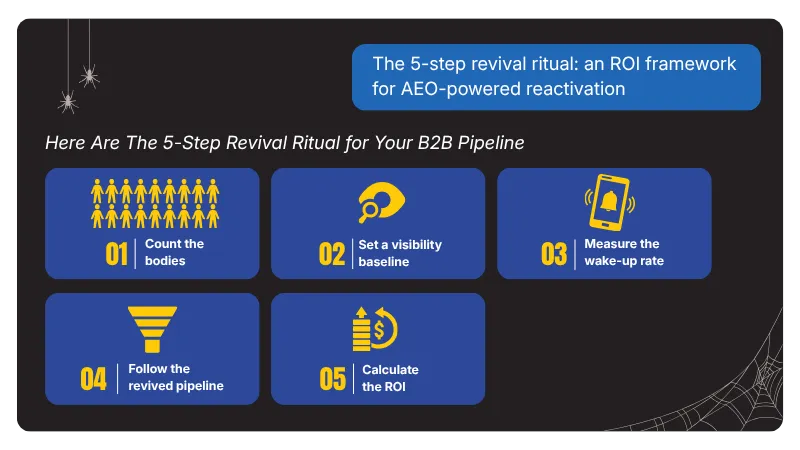
- Count the bodies. Pull every closed-lost and no-decision deal from the last 24 months and multiply by your average deal value. That’s the size of the pipeline you’re trying to revive.
- Set a visibility baseline. Run your tracked prompt list and record the percentage of prompts where your brand is mentioned, cited or recommended. Repeat monthly.
- Measure the wake-up rate. Track the share of dormant accounts showing renewed activity each quarter: AI-referred sessions, branded searches, replies or form fills.
- Follow the revived pipeline. Tag reopened opportunities in your CRM so you can report pipeline value and closed revenue from reactivated accounts separately from net-new leads.
- Calculate the ROI. Compare revived revenue to program cost:
ROI = (Revived revenue − Program cost) ÷ Program cost Hypothetical example: 300 dormant deals at $40,000 each is a $12M graveyard. Revive 5% into 15 opportunities, close 25% of those, and you win roughly 4 deals worth $160,000. Against a $60,000 quarterly program cost, that’s a 167% ROI from leads you’d already written off.
Don’t let your pipeline stay buried past Halloween
Your dead prospects are already asking AI who to buy from. Callbox makes sure your brand is the answer, then puts a trained SDR on the line to turn that second chance into a booked meeting.
Frequently asked questions about AEO for lead generation
What is the difference between AEO and SEO?
SEO works to rank your pages in a list of search results. AEO works to make your brand the answer an AI engine gives. It does this by structuring content, data and third-party proof so tools like ChatGPT, Perplexity, Gemini and Google AI Overviews cite and recommend you.
Can AEO really bring back closed-lost deals?
AEO puts your brand back in front of dormant buyers when they return to the problem and ask AI tools for help. It works best paired with outbound follow-up, so a human reaches out with context once the account shows renewed interest.
How long does AEO take to show results?
Timelines vary by industry, competition and how much citable content you already have. Track AI visibility monthly and judge results over a full quarter or more rather than week to week.
Does AEO replace a lead generation program?
No. AEO earns visibility inside AI answers, while lead generation turns that visibility into qualified conversations and booked meetings. The two work best as one program.
How we chose these strategies
We selected the tactics in this guide using three criteria:
- They map to buyer behavior documented in 2026 research from G2 and Forrester.
- They can be measured inside a standard CRM.
- They reflect what we see working in Callbox programs that combine answer engine optimization with outbound lead generation.
Statistics come from the published research linked in each section. The ROI example is hypothetical and meant to show the math, not to predict your results. No vendor or publication paid to be referenced.