How to Improve B2B Appointment Show Rates
Learn how to improve B2B appointment show rates with proven strategies that increase attendance, reduce no-shows, and create more sales opportunities.
 Rebecca Matias
Rebecca Matias is Callbox's COO with 18 years of experience scaling B2B pipeline through data-driven outbound marketing, lead generation, and sales development.
View full bio of Rebecca Matias
Setting discovery meetings is only half the battle in outbound pipeline creation. B2B revenue organizations frequently suffer from a silent conversion killer: high prospect no-show rates. Across enterprise software and professional services, average B2B appointment show rates linger between 60% and 75%, meaning sales teams lose 25% to 40% of their hard-won meetings before the discovery call even begins. Once prospects are identified and qualified, B2B appointment setting services can help turn those opportunities into scheduled sales conversations.
When a prospect ghosts a scheduled meeting, it wastes SDR outreach effort, burns account executive calendar time, and inflates customer acquisition costs (CAC). To increase sales appointment attendance, revenue leaders must look beyond basic calendar reminders and fix the structural breakdowns in their discovery workflow. This guide diagnoses why prospects drop off, establishes a 72-hour pre-call nurture methodology, and demonstrates how managed SDR execution restores pipeline velocity.
Looking for how to increase your qualified sales appointments?
Part 1: The Problem — Why Do B2B Prospects Ghost Scheduled Appointments?
High no-show rates rarely stem from simple forgetfulness. In B2B sales, ghosting is almost always a symptoms of low perceived value, poor prospect qualification, or friction during the booking handoff.
The Cost of Inaction on Pipeline Metrics
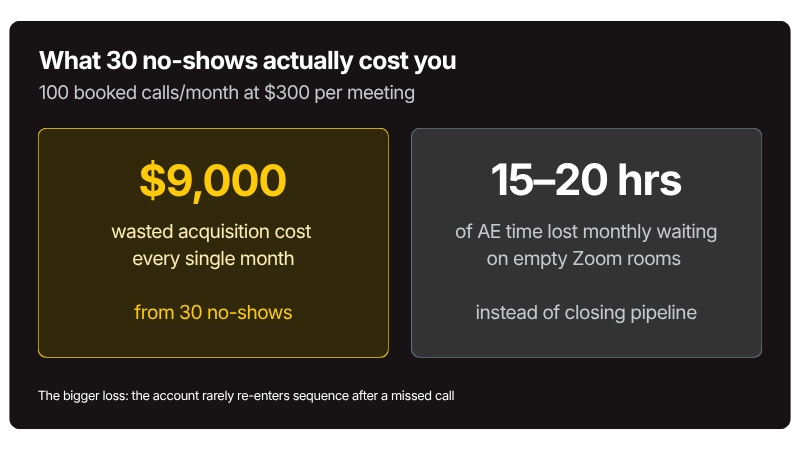
Losing 30% of scheduled appointments severely damages sales efficiency. If an SDR team books 100 discovery calls per month at an average cost of $300 per booked meeting:
- 30 No-Shows = $9,000 in direct acquisition cost wasted every single month.
- Account Executives spend 15–20 hours monthly waiting on empty Zoom rooms instead of closing active pipeline.
- Pipeline forecasting accuracy degrades, making quarterly revenue estimates unreliable.
Fixing this problem requires replacing passive scheduling with active engagement. For teams lacking internal resources, outsourcing B2B sales can provide consistent follow-up and improve meeting attendance.
 Industry Insight
No-show cost is understated in most models because it counts only the wasted meeting. The bigger loss is the account, which rarely re-enters sequence once a call is missed.
Part 2: The 72-Hour Pre-Call Nurture Framework
To improve appointment rates consistently, sales organizations must treat the time window between booking and call delivery as an active engagement phase.
Step 1: Enforce Strict Upfront Qualification
Prevent fake or low-intent meetings from reaching the calendar by establishing strict qualification criteria during initial outreach:
- Verify Active Pain: Never book an appointment without confirming at least one operational challenge your solution solves.
- Confirm Economic Relevance: Ensure the prospect holds influence over budget or operates directly within the buying committee.
- Secure Verbal Commitment: Train SDRs to ask: “Is there any reason your schedule might shift before Thursday at 2 PM?”
Expert Tip
"The best no-show predictor is how the prospect answers the scheduling question. Hesitation at booking becomes an empty room 72 hours later. Book it anyway, then nurture harder."
Discover the Sales Qualification Opportunities.
Step 2: Optimize Calendar Invites for Clarity
A calendar invite is a micro-landing page. Structure every calendar invitation to include:
- Clear Meeting Objective: State the specific problem being analyzed (e.g., “Exploring Multi-Channel Lead Gen Strategy for [Company Name]”).
- Three-Point Agenda: Outline exact discussion topics (1. Current workflow audit, 2. Peer benchmark comparison, 3. Potential ROI models).
- Direct Meeting Links: Place direct video conferencing links in both the location field and body text.
Industry Insight
A named agenda in the invite gives the prospect something to forward internally. Invites that read as a generic intro call have nothing a champion can circulate.
Step 3: Execute Multi-Touch Pre-Call Nurturing
Keep prospect interest high through structured touchpoints:
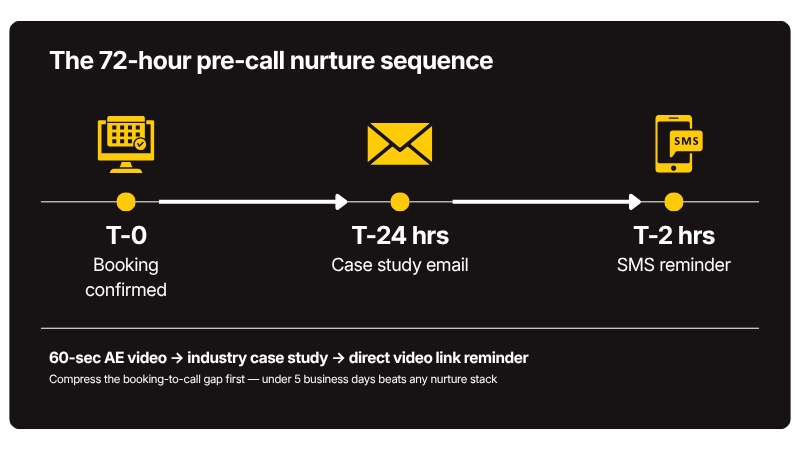
| Timeframe | Communication Channel | Primary Action & Content |
| Immediate (T-0) | Automated Email | Send calendar confirmation featuring a 60-second video introduction from the Account Executive. |
| T-24 Hours | Personalized Email | Share a relevant 2-page case study or peer benchmark data sheet tied to their industry. |
| T-2 Hours | SMS / Short Email | Send a concise reminder: “Looking forward to our call at 2 PM! Here is the direct video link.” |
Industry Insight
"Compress the booking-to-call gap before adding reminders. Under five business days does more for show rate than any nurture sequence layered on top of a three-week wait."
Part 3: Leveraging Managed SDR Execution to Maximize Attendance
Executing a pre-call nurture methodology at scale requires seamless coordination between marketing assets, sales operations, and SDR activity. When internal teams lack bandwidth, partnering with a specialized lead generation engine ensures no appointment falls through the cracks.
How Callbox Solves the Appointment Show Rate Problem
Callbox acts as a managed execution engine, combining AI-driven contact intelligence with dedicated SDR teams to ensure high-intent scheduling and maximum meeting attendance.
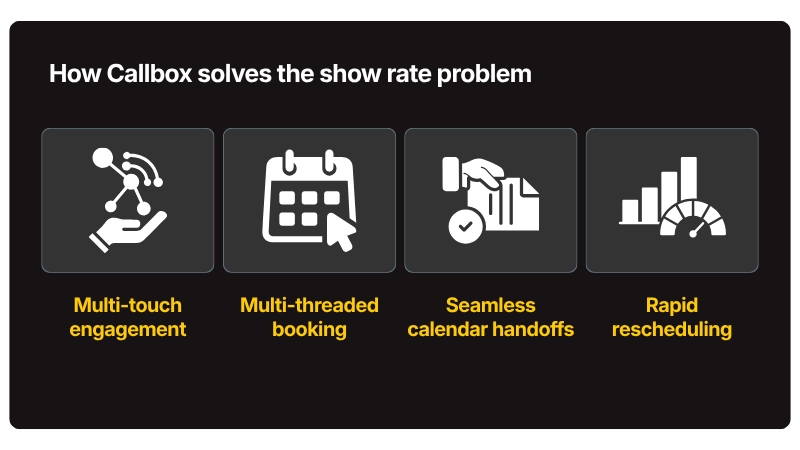
- Multi-Touch Pre-Call Engagement: Callbox SDRs manage the entire pre-call lifecycle, executing synchronized email, phone, and SMS reminders to confirm attendance 24 hours prior.
- Multi-Threaded Committee Booking: To mitigate single-contact ghosting risks, Callbox identifies and includes secondary decision-makers on meeting invites.
- Seamless Calendar Handoffs: Callbox integrates directly into client CRM platforms (such as Salesforce and HubSpot) to route vetted prospects directly to Account Executive calendars with full discovery notes.
- Rapid Rescheduling Workflows: If a prospect needs to move a meeting, Callbox SDRs re-engage immediately to secure a new time slot before the lead goes cold.
Ready to see what an outsourced SDR team could do for your pipeline?
Key Performance Indicators to Track for Show Rate Optimization
To ensure continuous improvement, monitor these core operational metrics weekly:
- Overall Show Rate: (Attended Meetings÷Total Scheduled Meetings)×100. Target: 80%–85%+.
- Reschedule Conversion Rate: Percentage of canceled/ghosted meetings successfully re-booked within 14 days. Target: > 30%.
- Time-to-Meeting Gap: Average days between initial booking and call delivery. Target: Less than 5 business days.
Industry Insight
"Track reschedule conversion separately from show rate. A 70% show rate with strong re-booking is a healthier pipeline than 80% with none."
Eliminate Ghosting and Scale Your Sales Pipeline
Learning how to improve B2B appointment show rates requires shifting from passive scheduling to active, value-driven pre-call engagement. By diagnosing qualification gaps, deploying a 72-hour nurture cadence, and leveraging managed SDR execution to handle handoffs, revenue teams can eliminate calendar ghosting and increase sales appointment conversions.
Evaluating your internal SDR bandwidth against meeting delivery goals clarifies whether automated workflows or dedicated execution partners offer the fastest path to growth. Speaking with a sales pipeline specialist at Callbox can clarify how a managed appointment setting program can optimize your meeting show rates and drive predictable revenue.