Foot in the Door: Why Email-First Multichannel Lead Gen Wins in AU
Why do Australian B2B buyers prefer email first? See how the foot-in-the-door effect shapes multichannel lead generation that books meetings.
 Frean Nismal
 is an SEO/AEO Specialist at Callbox with 7 years of industry experience driving business growth through strategic SEO, content execution, and AI visibility.
View full bio of Frean Nismal
Australian B2B buyers are far more likely to say yes to a small request before a big one. That is the foot-in-the-door effect, and it explains why email-first multichannel lead generation works so well in this market. A short, low-pressure email earns the first “yes”. LinkedIn, content, and phone calls then build on it, step by step, until a meeting feels like the natural next move.
Many outbound programs do the opposite. They open with the biggest ask of all: a cold call asking for 30 minutes. Then they wonder why buyers hang up. In this guide, we look at the psychology behind small first steps and why email is the right opening move for Australian buyers. We also show how to build a full client acquisition sequence around it.
 Quick answer: Australian B2B buyers respond best to email-first multichannel lead generation. Start with a short, low-pressure email that asks for almost nothing. Then build familiarity through LinkedIn, useful content, and events. Call only once the buyer recognises your name, and ask for a meeting last. Each small yes makes the next, bigger one easier.
What Is the Foot-in-the-Door Effect?
The foot-in-the-door effect is the tendency for people who agree to a small request to agree later to a larger one. Once someone says yes, they start to see themselves as the kind of person who says yes to you.
Psychologists Jonathan Freedman and Scott Fraser demonstrated it in a well-known 1966 study. Researchers asked homeowners to display a large, unattractive “Drive Carefully” sign in their front yards. Most refused. However, some homeowners had first agreed to a tiny related request, such as displaying a small window sticker. Weeks later, they were far more likely to accept the big sign.
The lesson for sales is simple. The size of your first ask shapes every answer that follows. A small, easy yes opens the door. A large, sudden request closes it.
Why Email is the Right First Step for Australian Buyers
Every channel carries a different level of commitment for the buyer. A phone call demands attention right now. An email, by contrast, waits until the buyer is ready. That makes email the smallest possible first request, which is exactly what the foot-in-the-door effect calls for.
Academic research supports this. Abram Anders and Joshua Coleman studied this in the International Journal of Business Communication (2017). They found that B2B buyers preferred to receive first messages from new salespeople by email. Phone calls and voicemails, meanwhile, were preferred later in established relationships, for tasks such as negotiation and relationship building.
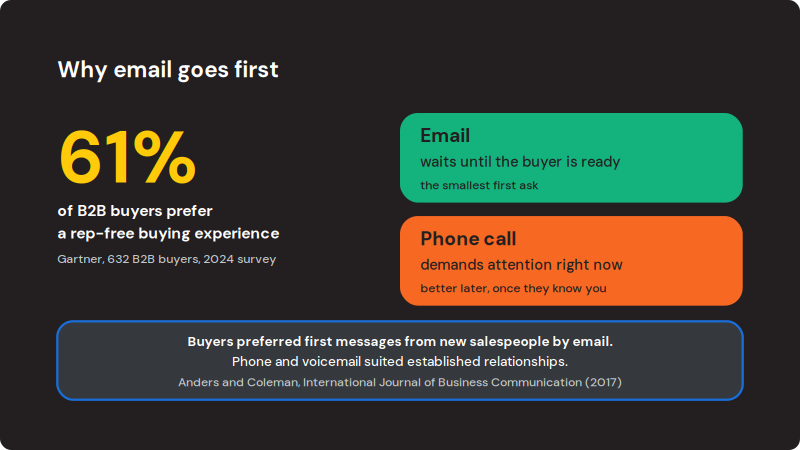
Broader buyer behaviour points the same way. A Gartner survey of 632 B2B buyers found that 61% prefer a rep-free buying experience overall. Most choose to research independently through digital channels. Email fits that preference. Buyers can read it, check your website, and reply on their own terms.
In Callbox’s Australian campaigns, this pattern is consistent. Email-led outreach earns more responses than cold calling alone, especially in the first weeks of a campaign. Australian decision-makers tend to value their time and privacy. An unexpected call can feel like an intrusion. A well-written email, on the other hand, feels like an invitation.
Building the Ladder: An Email-First Multichannel Sequence
Email opens the door, but it rarely closes a deal by itself. The real power of multichannel lead generation comes from stacking small yeses across channels. Each step asks for slightly more than the one before.
Here is how a typical email-first sequence climbs.
Step | Channel | What you ask for | Size of the ask |
1 | Read a short, relevant message | Very small | |
2 | Email follow-up | Reply, click, or download a useful resource | Small |
3 | Accept a connection or view a post | Small | |
4 | Landing page or event | Register for a webinar, briefing, or event | Medium |
5 | Phone | Take a short call from someone they now recognise | Medium |
6 | Meeting | Book time with your sales team | Large |
Start With a Request That Is Easy to Accept
Your first email should ask for almost nothing. Instead of “Can we book 30 minutes?”, try “Is this a priority for your team this quarter?” A one-line reply is an easy yes, and it starts the ladder. Just as importantly, every email must meet the consent and unsubscribe rules of Australia’s Spam Act.
Give Before You Ask
The second and third steps work best when they offer value first. A short guide, a local benchmark, or an invitation to an industry briefing gives the buyer a reason to engage. It also gives them a low-risk way to say yes again.
Let Recognition Build Across Channels
By the time a buyer sees your name on LinkedIn after two relevant emails, you are no longer a stranger. Consequently, each new touchpoint feels like a continuation, not an interruption.
When Should You Call Australian B2B Buyers Instead of Emailing
Email leads, but the phone remains essential. It simply works best later in the sequence, once the buyer has already said yes to something smaller.
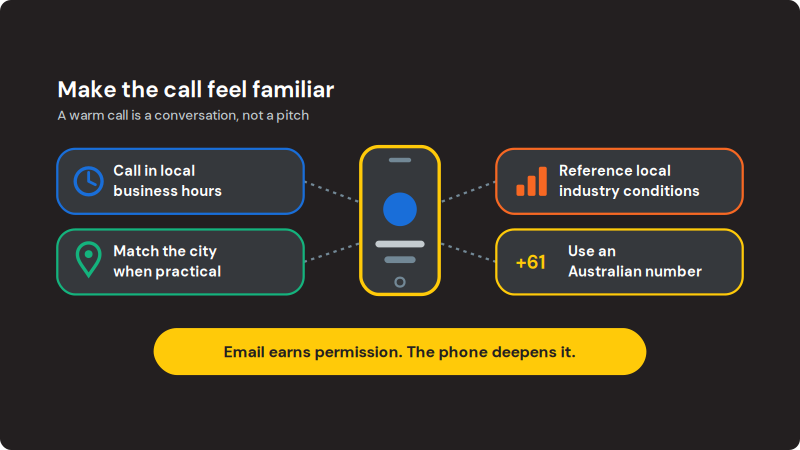
A warm call has a very different feel from a cold one. The buyer recognises the name, has seen the emails, and may have already downloaded a resource. As a result, the call becomes a conversation rather than a pitch. This matches the Anders and Coleman finding that buyers prefer voice for relationship building, the stage a warm call is designed for.
The phone also carries a local advantage. Many Australian buyers prefer to speak with someone who knows their market, and some favour callers from their own city: Sydney to Sydney, or Brisbane to Brisbane. Full city matching is not always practical for every campaign. Even so, small local cues help a call feel familiar. Call within local business hours, reference local industry conditions, and use an Australian number.
In short, use email to earn permission and use the phone to deepen it.
Want an email-first sequence built around your buyers?
Callbox plans the data, emails, LinkedIn touches, and warm calls for your target market.
Who Runs Each Step: Roles in a Multichannel Lead Generation Program
Callbox structures every program around its Smart Engage approach. Three core stages sit at the centre, with outbound and inbound channels working around them, so every buyer is reached in the way they prefer.
Three Stages Behind Every Sequence
Every campaign moves through the same three stages:
- Data enrichment. The team builds and verifies contact data so every message reaches the right person, with accurate role and company details.
- Smart engagement. Outreach runs across coordinated channels, with email leading and the other channels building on each reply, click, and connection.
- Lead handoff. Once a buyer is ready, the team passes the qualified lead to your sales team with full context, not just a name and a time slot.
Data enrichment does not stop after launch. Each interaction adds new details, so the data keeps improving as the campaign runs.
Outbound and Inbound Channels Working Together
Outbound channels start the climb. Inbound channels, meanwhile, catch buyers who start climbing on their own, such as those who click through to your website after an email.
Channel | Type | Role in the sequence |
Outbound | Opens the conversation with personalised campaigns, the smallest first ask | |
Social | Outbound | Builds recognition between emails through targeted LinkedIn outreach |
Instant messaging | Outbound | Sends short reminders that extend reach and lift meeting show rates |
Voice | Outbound | Delivers AI-optimised warm calls once the buyer recognises your namea |
Website and landing pages | Inbound | Converts campaign visitors and form fills into sales-ready leads |
Chat | Inbound | Answers buyer questions in real time through chatbot and live chat |
Inbound | Invites buyers to webinars or in-person events, a medium-sized yes |
Together, these channels mean a buyer is never asked to jump. Instead, each touchpoint makes the next one feel familiar.
Who Manages Each Channel
A strong multichannel lead generation program is never run by one person. Each seat on the campaign is backed by a group of specialists, and each specialist owns a different part of the sequence.
Core roles
Role | Responsibility in the sequence |
Data and Research | Builds, verifies, and enriches contact lists that match your ideal customer profile |
Sales Development Representative | Runs email, instant messaging, and warm call outreach, then qualifies interest and sets appointments |
Digital Manager | Manages landing pages, chat, event promotion, and the personalised content behind each touchpoint |
AI Specialist | Uses AI tools to sharpen targeting, personalisation, send times, and call preparation |
Production Manager | Oversees daily campaign operations, workload, and delivery across every channel |
Client Success | Aligns the campaign with your goals, reports on results, and keeps your sales team informed |
Supporting roles
Role | Responsibility in the sequence |
Copywriter | Writes and tests email sequences, social messages, and call scripts in a local, natural tone |
Social Engagement Specialist | Grows targeted LinkedIn connections and runs social outreach between emails |
Email Deliverability Specialist | Protects sender reputation, manages domain health, and keeps messages out of spam folders |
Inbound Lead Qualifier | Responds quickly to website, form, and chat enquiries before interest cools |
Appointment Coordinator | Confirms meetings, sends reminders, manages calendars, and tracks show rates |
Quality Assurance Analyst | Reviews calls and leads before handoff so only sales-ready buyers reach your team |
Compliance Specialist | Keeps outreach aligned with Australian rules, including consent, sender identification, and unsubscribe options under the Spam Act 2003 |
Together, these roles give you the depth of a full sales development department without hiring each specialist in-house. Every rung of the ladder has an owner, so no step in the sequence is left to chance.
There are two main ways to put this team in place.
A Fully Managed Lead Generation Program
With a managed program, Callbox runs the entire sequence for you. The team builds the data, writes the emails, and runs LinkedIn and calling. It then books qualified meetings directly into your sales team’s calendar. You stay in control of targeting and messaging approval, while Callbox handles the day-to-day execution.
A Co-Managed GTM Team
Some companies prefer to keep outreach inside their own systems. In that case, a co-managed GTM team works within your tech stack, uses your company email, and follows your managers’ direction. You choose the specialists you need, such as a Digital Engagement SDR and a Calling SDR, and scale from there.
Both models follow the same email-first, multichannel approach. The difference is simply who manages the team day-to-day.
Apply the Foot-in-the-Door Effect to Your Own Decision
The same psychology applies when you choose a lead generation partner. Handing over your entire pipeline on day one is the business equivalent of agreeing to the big sign first. A smaller, focused start is easier to say yes to, and easier to judge.
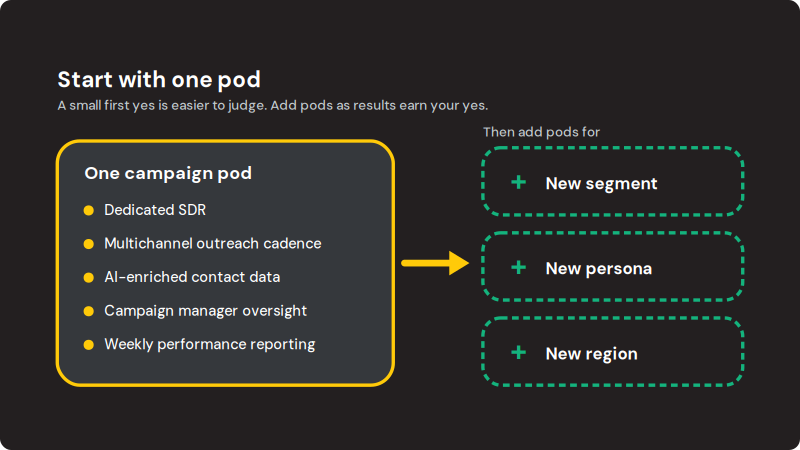
That is why Callbox builds programs one campaign pod at a time. Each pod is a dedicated outreach unit focused on a single market segment or buyer persona. It includes a dedicated SDR, a multichannel outreach cadence, AI-enriched contact data, campaign manager oversight, and weekly performance reporting.
You can start with one pod aimed at your most important segment. Then, once the results earn your yes, you add pods to reach new segments, personas, or regions. The ladder works the same way for you as it does for your buyers.
A typical engagement starts with a short onboarding period. During this time, the team learns your offer and builds the target list. It also writes and tests email copy and call scripts before launch.
Proof From Multichannel Campaigns in Australia
Three programs aimed at Australian buyers show multichannel lead generation at work.
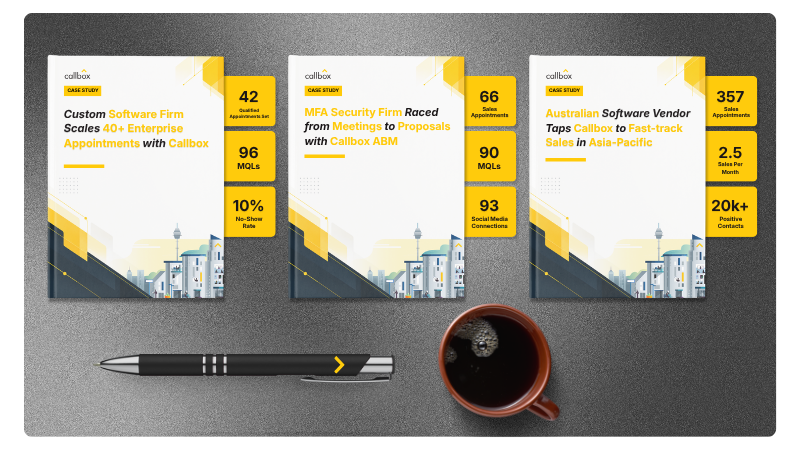
An Australian custom software firm relied mostly on referrals and repeat business. However, its in-house team lacked the time and structure to open new enterprise accounts. Through a multichannel ABM program aimed at CIOs, CTOs, and IT directors in New South Wales and Victoria, it set 42 qualified appointments and generated 96 marketing qualified leads. The no-show rate stayed at just 10%, and the program built a $3.2M pipeline.
A US-based multi-factor authentication provider wanted more end users in Australia and New Zealand. Its in-house marketing team, though, had limited access to channels like voice, email, chat, and social media. After it partnered with Callbox on an account-based marketing campaign, the program delivered 66 sales appointments, 90 marketing qualified leads, and 93 new social media connections.
Meanwhile, an Australian practice management software vendor had relied on word of mouth for new clients. It then used a fully managed lead generation and appointment setting campaign to reach IT directors and CIOs in Sydney, Melbourne, Queensland, New Zealand, Brunei, and India. As a result, the campaign produced 357 sales appointments, more than 20,000 positive contacts, and an average of 2.5 sales per month.
In each program, structured and repeated outreach replaced a single cold ask. That is the ladder in action: each touchpoint made the next one easier to accept.
Ready to take the first step yourself?
Start with one campaign pod focused on your most important segment, then scale once you see results.
What Mistakes Stop Buyers From Saying Yes
Even a well-designed sequence can fail if it skips steps. Watch out for these common errors:
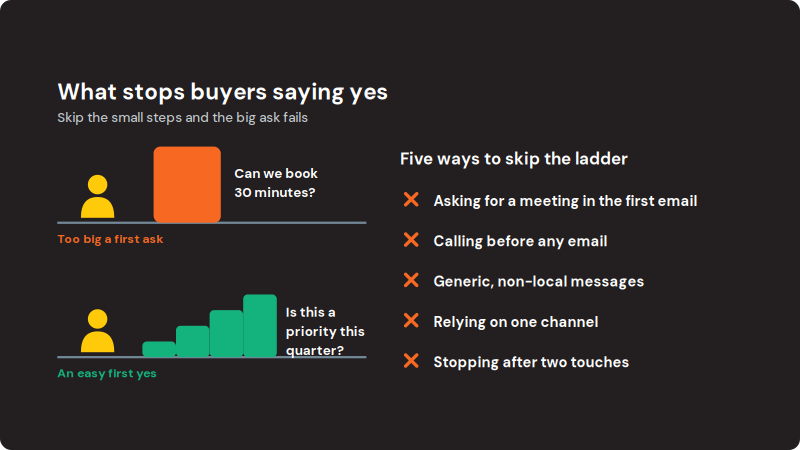
- Asking for a meeting in the first email. This jumps straight to the largest request and removes the chance of an easy first yes. It fails fastest with guarded C-suite buyers.
- Calling before any email. A cold call with no prior contact turns the phone into the first, and biggest, ask.
- Sending generic, non-local messages. Buyers who sense a template from overseas are unlikely to say yes to anything.
- Relying on one channel. Email alone stalls. Phone alone feels pushy. Multichannel lead generation works because each channel supports the others.
- Stopping after two touches. Small yeses take time to stack. Most buyers need several touchpoints before they are ready to meet.
Conclusion
Buyers rarely jump straight to yes. They climb towards it, one small decision at a time. The foot-in-the-door effect shows why the first step matters so much. For an Australian buyer, email is the smallest and most respectful first step you can offer.
From there, LinkedIn, content, events, and warm phone calls each add another yes. Build the ladder carefully, keep every message local and relevant, and the meeting becomes the obvious next step.
Frequently Asked Questions
What is the foot-in-the-door effect in sales?
The foot-in-the-door effect is when a buyer who agrees to a small request becomes more likely to agree to a bigger one later. In sales, it means starting with an easy first step, such as replying to an email, before asking for a meeting.
Do Australian B2B buyers prefer email or phone?
Most Australian B2B buyers respond better to email as a first contact because it lets them engage on their own terms. Phone works best later in the sequence, once the buyer recognises your name and has already engaged.
What is multichannel lead generation?
Multichannel lead generation reaches buyers through several coordinated channels, such as email, LinkedIn, events, and phone. Each channel supports the others, so buyers build familiarity with your brand before they are asked to meet.
How can I start multichannel lead generation without overcommitting?
Start with one focused campaign aimed at your most important segment or buyer persona. With Callbox, that means a single campaign pod with a dedicated SDR and multichannel outreach. Once it delivers results, you can add pods to scale.