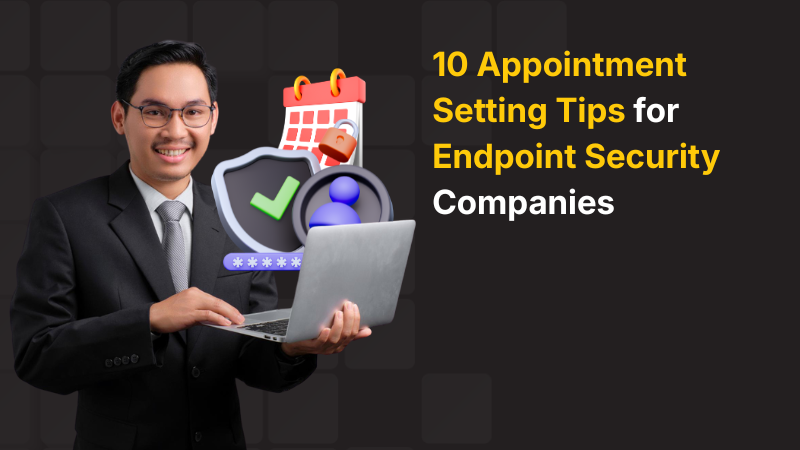
10 Appointment Setting Tips for Endpoint Security Companies
Struggling to book meetings with CISOs for your endpoint security product? Discover 10 proven appointment setting tips — compliance triggers, peer references, multi-threading, and qualification checklists.

Booking a meeting with a CISO for your endpoint security product isn’t just hard. It’s a different category of hard.
Your SDR sends a well-crafted email. It lands in an inbox alongside 99 other vendor pitches. The CISO — who just finished a board risk briefing, has a ransomware alert on her second monitor, and is two weeks out from a SOC 2 audit — either ignores it, flags it for later, or routes it to someone who routes it to someone else.
That’s not a messaging problem. That’s an endpoint security sales problem — and it requires endpoint security appointment setting strategies, not generic outreach playbooks.
This post gives you the 10 appointment setting tips that actually move the needle for endpoint security vendors: from the opening line that earns attention to the qualification checklist that protects your AE’s calendar — and everything in between.
Why Appointment Setting for Endpoint Security Is Harder Than Any Other Cybersecurity Category
Before the tips, let’s be clear about what you’re up against. Because if your SDR team is running the same outreach playbook they use for SaaS or managed services, that’s exactly why the calendar is empty.
Entrenched Competition: CrowdStrike, SentinelOne, and Microsoft Defender Dominate More Than 80% of Enterprise Seats
Most of the accounts your team is targeting already have an endpoint security solution. Often a multi-year contract. Often deeply integrated with their SIEM, identity stack, and SOC workflow. “We’d love to show you our platform” is not a compelling reason for a CISO to displace something that’s working. Your outreach needs to address the incumbent directly — identifying replacement signals rather than treating every target as a greenfield opportunity.
Saturated CISO Inboxes, Multi-Persona Buying Committees, and Long Replacement Cycles
CISOs are the most saturated executives in B2B. They receive more vendor outreach than any other C-suite persona — and they’ve developed excellent filters for discarding it. On top of that, endpoint security decisions don’t happen at one level. The CISO approves the strategy. The IT Director validates the technical fit. The SecOps Manager lives with the tool every day. If your outreach targets only one of these personas, you’ll either lose the deal during the technical evaluation or never get the budget sign-off. Multi-persona, multi-thread outreach isn’t a nice-to-have for endpoint security. It’s the minimum viable approach.
The Endpoint Security Buying Committee: Who You Need to Reach (and in What Order)
One of the most expensive mistakes in endpoint security appointment setting is reaching the right company but the wrong person. Here’s a clean breakdown of every key persona, what drives them, and how to approach them.
| Persona | What They Care About | Best Outreach Angle |
| CISO / CSO | Threat exposure, compliance mandates (SOC 2, ISO 27001, NIST, GDPR), board-level risk reporting | Threat intelligence, incident data, regulatory deadlines |
| IT Director / CTO | SIEM/SOAR integration, deployment complexity, agent performance impact, API compatibility | Technical credibility, stack compatibility, migration path |
| Security Operations Manager | Alert fatigue, MTTD/MTTR, SOC analyst workflow | Peer proof, trial data, operational outcomes |
| VP of IT / Head of Infrastructure | Endpoint count, device diversity (BYOD, OT/IoT), scalability, licensing model | TCO, consolidation narrative, fleet management |
| Procurement / Finance | Vendor risk, pricing model, SLA terms, competitive benchmarking | ROI data, reference customers, flexible commercials |
| CEO / COO (SMB/mid-market) | Business continuity, cyber insurance, ransomware exposure, regulatory penalties | Business-risk framing, not technical specs |
Multi-persona threading is not optional. A lead generation team that only reaches the CISO loses deals at the IT Director’s technical evaluation. A team that only reaches IT loses strategic budget authority. Both conversations need to happen — in parallel, with messaging tailored to each role.
Still reaching personas one at a time?
Callbox runs parallel outreach to CISOs, IT Directors, and SecOps Managers — so no deal falls through the cracks.
How to Book CISO Meetings for Endpoint Security – 10 Tips
These are not universal outreach principles presented in cybersecurity terminology. Each tip listed below is specific to the endpoint security buying environment, based on what actually earns responses from CISOs, IT Directors, and SecOps Managers in 2026.
Tip 1: Lead With the Threat, Not the Product
CISOs are urgency-driven. They respond to threat intelligence, not capability lists.
“Your sector saw a 68% increase in endpoint ransomware in Q1 2026” earns attention.
“We offer advanced EPP with AI-native detection” does not.
Reference specific CVEs, named ransomware groups (LockBit, BlackCat, Scattered Spider), or sector-specific incidents that are relevant to the prospect’s industry before you ever mention your product. The message signals that you understand their threat environment, which is the first credibility checkpoint a CISO will run your outreach through.
Opening formula: [Threat/incident relevant to their industry] + [Implication for their security posture] + [One-line bridge to your product]
Tip 2: Qualify Hard on Tech Stack Before Booking
This tip alone will save your AEs more wasted time than any other change you make.
Before booking a meeting, your SDR team needs to know: who is the incumbent?
CrowdStrike, SentinelOne, and Microsoft Defender collectively hold the majority of enterprise endpoint seats. A prospect locked into a three-year CrowdStrike Falcon contract with no renewal signal is not a qualified endpoint security appointment — it’s a no-show waiting to happen.
Know which solution is deployed. Know approximately when that contract was signed or renewed. Know whether there are signs of active evaluation: a recent hire in a security leadership role, a compliance certification push, a publicized breach or incident in their sector, a LinkedIn post from their CISO about “re-evaluating their security stack.”
A meeting booked without tech stack qualification is a meeting that wastes your AE’s time and your prospect’s. Qualify first.
Not sure whether to build this qualification process in-house or outsource it? See how the top cybersecurity sales leads firms compare — and what to look for before you choose one.
Tip 3: Multi-Thread the CISO and IT Lead Simultaneously
This is the structural change that has the highest impact on endpoint security pipeline quality.
Most SDR teams prospect sequentially: reach the CISO, get blocked or ignored, then try the IT Director. That approach is slower, loses context across personas, and creates a disconnected experience for the prospect.
Run parallel sequences to the CISO (strategic messaging), IT Director (technical messaging), and SecOps Manager (operational messaging) simultaneously. Use persona-appropriate language for each. Reference the others in your message: “We’re also connecting with your IT Director about the integration piece — but I wanted to start with you on the broader risk posture.”
This signals account-level intent, not just individual prospecting. It earns more responses, faster, and it protects your deal from falling apart at the technical evaluation stage because the IT Director wasn’t engaged from the start.
Tip 4: Use Compliance and Cyber-Insurance Triggers as Conversation Openers
The most powerful appointment triggers in enterprise endpoint security are not product features or ROI statistics. They are compliance deadlines and cyber-insurance requirements.
SOC 2 renewal windows, ISO 27001 audits, NIST CSF mandates, and — increasingly — cyber-insurance premium requirements are creating predictable, time-bound decision windows that most outbound teams are completely ignoring.
“Your cyber insurance renewal is Q3 — peers in your sector have reduced premiums by consolidating endpoint detection under a unified EDR platform. Worth 20 minutes?”
That message works because it’s specific, timely, and framed in the language of financial risk — not vendor sales. The prospect doesn’t have to care about your product to care about their insurance renewal.
Trigger identification checklist:
- Has the company recently completed or announced a SOC 2, ISO 27001, or FedRAMP certification push?
- Are they in a sector with recent NIST CSF or CMMC compliance mandates?
- Have cyber-insurance premium increases been publicly reported in their industry?
- Has their sector had a high-profile breach in the last 90 days?
Any yes on that list is a warm outreach trigger.
Tip 5: Use Conference Intelligence to Warm Cold Outreach (RSA, Black Hat, SecureWorld)
Conference-seeded meetings convert 5–10× better than cold email alone for cybersecurity outreach (LeadHaste 2026).
RSA Conference, Black Hat, SecureWorld, and Gartner Security Summit are not just networking events — they’re outreach intelligence goldmines. Every CISO who presents a session, joins a panel, or exhibits at a booth is signalling active engagement in their security strategy. That signal is your warm opener.
“I noticed you presented on zero-trust architecture at RSA last month — our endpoint detection approach was built with exactly that model in mind. Would a conversation make sense?”
This works for two reasons: it demonstrates that you’ve done actual research on the prospect (not just personalized their first name), and it references a context where they were publicly sharing their security priorities. You’re not cold-calling a CISO. You’re following up on a conversation they started publicly.
Timing matters too. Outreach timed to the weeks before and after RSA (April/May) and Black Hat (July/August) catches security leaders when they’re most actively thinking about their stack.
Want to go beyond using conferences as an outreach signal? Here’s what high-ROI cybersecurity event marketing looks like when you build it into your full pipeline strategy.
Tip 6: Peer Reference Outreach Converts 3× Better Than Feature Claims
CISOs are among the most sceptical buyers in B2B. They’ve sat through hundreds of vendor demos. They’ve heard every “AI-native,” “best-in-class,” “zero-day protection” claim. They don’t respond to those claims — but they do respond to hearing what their peers decided and why.
“Stripe and Snowflake trust our EDR,” with a genuine offer to introduce the prospect directly to a peer CISO at a comparable company converts significantly better than ROI statistics or product differentiation messaging.
Build a peer reference programme with three to five reference customers who are willing to take a 20-minute call with a qualified prospect. Make the offer specific and low-commitment: “I can connect you directly with the CISO at [Company X] — they went through the same evaluation 12 months ago.”
The peer reference converts. The feature list does not.
Tip 7: Time Your Sequence to Q3/Q4 Security Budget Planning Cycles
Enterprise security budgets are set in Q3 and Q4. Which means if your SDR team starts prospecting in Q3 for Q3 pipeline, you’re already too late.
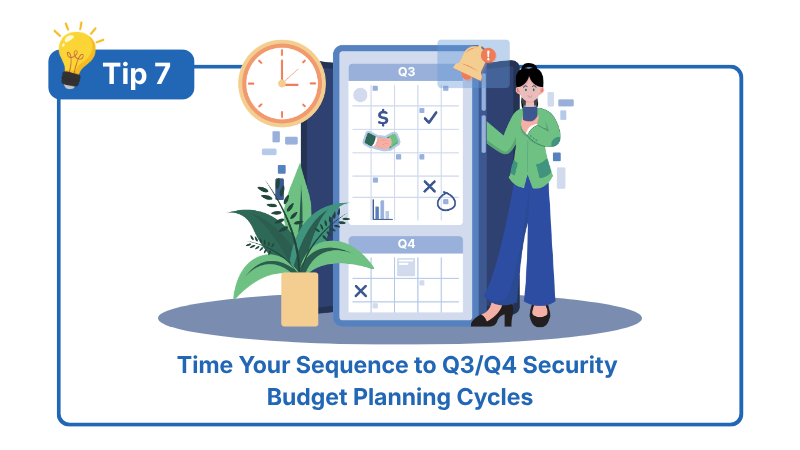
Outreach timed to Q1 and Q2 — when CISOs are building their budget requests, not executing against them — creates pipeline before your competitors even enter the conversation. The prospect is still in the evaluation phase, not the finalising vendors phase.
The practical implication: your Q2 outreach should be focused on Q3/Q4 budget planning conversations. Your message isn’t “we’d love to show you our product.” It’s “most of your peers are finalising their security stack for next year’s budget — worth 20 minutes to make sure you have the full picture before those conversations happen?”
SDRs who prospect in Q1/Q2 for Q3/Q4 pipeline wins consistently outperform those who prospect reactively. Build the sequence calendar around the enterprise security budget cycle, not around your own quota deadlines.
Tip 8: Personalize With Incident Intelligence — Not First-Name Tokens
Endpoint security buyers receive 100+ vendor emails weekly. A subject line with their first name is not personalisation. It’s a mail merge.
Real personalisation in endpoint security means referencing a specific incident affecting their sector, a recent regulatory change, or a named threat actor that is actively targeting companies like theirs.
“First-name personalisation” gets a 3.43% reply rate (platform average, Instantly 2026). Outreach that demonstrates genuine account intelligence — the right incident, the right sector, the right compliance moment — gets 6.4% C-level reply rates (Belkins 2025).
That’s nearly double the response at the hardest-to-reach persona level. The investment in incident-level personalisation pays back immediately in reply rates.
What counts as incident intelligence:
- A named ransomware group that recently targeted their specific sector
- A CVE actively being exploited in software that they’re known to run
- A regulatory change that directly affects their compliance posture
- A named breach at a direct competitor in the last 90 days
Tip 9: Define Qualified Before You Book — The Endpoint Security Checklist
This is the tip that protects your AEs’ calendar more than any other.
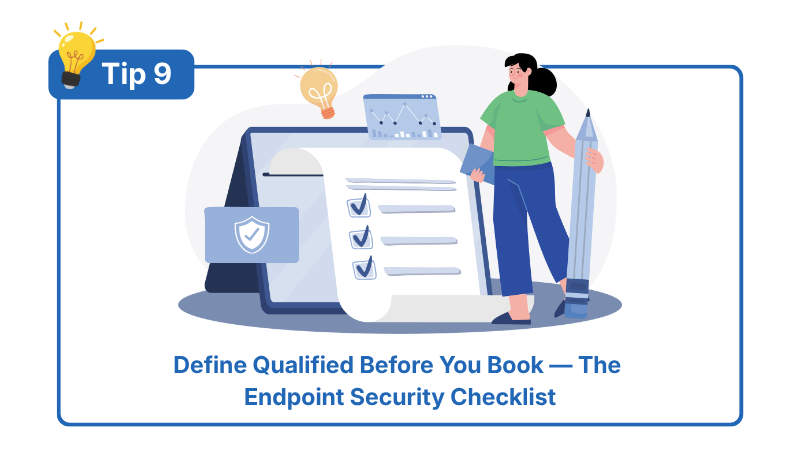
Before booking an endpoint security meeting, your SDR team should confirm all four of the following:
- Active evaluation or renewal signal — Is there evidence that the prospect is evaluating endpoint security solutions, or that their current contract is approaching renewal? Without this, you’re booking a courtesy call, not a sales meeting.
- Confirmed endpoint count (sizing) — Do you know approximately how many endpoints the company manages? This determines whether they’re a genuine fit for your product tier and pricing model. A 50-seat company and a 50,000-seat enterprise are not the same meeting.
- Identified incumbent solution — Which endpoint security product do they currently run? If it’s CrowdStrike on a three-year contract signed 18 months ago with no renewal signals, that’s a nurture contact, not a calendar booking.
- Stakeholder authority — Does the person you’re booking with have the authority to approve or meaningfully influence an endpoint security decision? If you’re booking with a mid-level IT admin who can’t move budget, you’re building a pipeline that stalls at the wrong stage.
A meeting that passes all four criteria is a qualified endpoint security appointment. A meeting that doesn’t is a no-show risk and a waste of AE capacity. The checklist is not a barrier to booking — it’s the thing that makes your booked meetings worth something.
Tip 10: Protect Your Show Rate With a Pre-Meeting Threat Intelligence Brief
Endpoint security buyers cancel or no-show at higher rates than commercial buyers — and not because they’re disinterested. It’s because their calendar fills with incident response obligations that were not scheduled 48 hours ago.
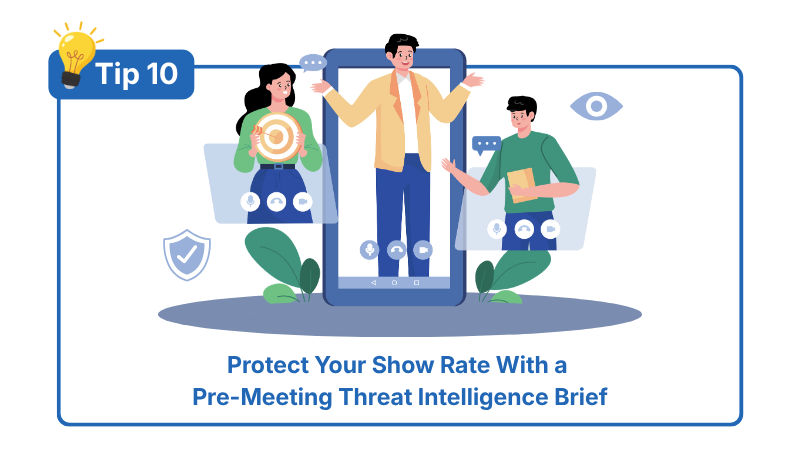
A CISO who was genuinely looking forward to your demo will deprioritize it the moment an active threat alert comes in. That’s not a reflection of your meeting quality. It’s a structural reality of the role.
The tactic that counters this: send a one-page pre-meeting brief 48 hours before the call, containing:
- The confirmed agenda (exactly what you’ll cover and in what order)
- Three specific questions you’ll be addressing in the meeting
- One piece of relevant, timely threat intelligence connected to their sector
This brief does several things at once. It re-confirms the meeting without awkwardly asking them to confirm. It demonstrates preparation and seriousness — signalling that the meeting is worth their time. And it anchors their attention on a threat that makes your product feel immediately relevant.
Teams who implement this pre-meeting brief report 30–40% reductions in endpoint security appointment no-shows. It’s low effort, high impact, and no competitor is doing it.
How Callbox Books Qualified Appointments for Endpoint Security Vendors
Everything in this guide reflects what it actually takes to build a pipeline in endpoint security. It requires multi-persona outreach, compliance-triggered timing, peer-referenced credibility, and a qualification standard that protects your sales team’s time.
Callbox has been running appointment setting programmes for cybersecurity vendors — from EDR and XDR platforms to managed detection and response providers. When a global endpoint security and cybersecurity platform vendor needed to break into Southeast Asia and broader APAC, Callbox built and ran a six-month, three-pillar programme covering lead generation, appointment setting, and webinar marketing across seven markets simultaneously. Outreach was compliance-aware and threat-led — engaging CISOs, IT Directors, SOC Managers, and IT procurement leaders with messaging anchored to each prospect’s specific regulatory obligations and security gaps, not product features.
Endpoint Security Firm Scales APAC Appointments with Callbox
A global endpoint security and cybersecurity platform vendor looking to deepen its pipeline across the Asia Pacific partnered with Callbox to reach CISOs, IT Directors, and Security Operations leaders across the region.
READ CASE STUDYMulti-persona outreach: CISO, IT Director, and SecOps Manager simultaneously
Callbox’s parallel outreach model runs persona-appropriate sequences to all key endpoint security stakeholders at the same time. The CISO receives threat-led, compliance-framed messaging. The IT Director receives integration and stack-compatibility messaging. The SecOps Manager receives MTTD/MTTR benchmarks and peer workflow proof. All three conversations are in flight from day one — which is why Callbox appointments convert at the strategic level, not just the technical evaluation.
Compliance-triggered campaigns: SOC 2 renewals, NIST mandates, cyber insurance cycles
Callbox’s campaign timing is built around the compliance and insurance triggers that open genuine buying windows. Rather than blasting outreach at volume and hoping for timing luck, Callbox identifies the accounts whose renewal windows, compliance deadlines, or insurance review cycles are approaching — and activates outreach exactly when the conversation is most likely to convert.
If you’re an endpoint security vendor — EDR, XDR, EPP, or MDR — and your pipeline isn’t where it needs to be heading into the next budget cycle, talk to a Callbox specialist about what a qualified appointment setting programme looks like for your product and target market.
If Singapore is a priority market for your endpoint security expansion, see our full cybersecurity vendor’s guide to B2B lead generation in Singapore.
FAQ: Appointment Setting for Endpoint Security Products
What are the best triggers to use when booking endpoint security appointments?
The highest-converting appointment triggers in endpoint security are: (1) Compliance deadlines — SOC 2 renewal windows, ISO 27001 audits, NIST CSF mandates, and FedRAMP requirements that create time-bound decision urgency. (2) Cyber-insurance requirements — Premium increases or coverage requirements that mandate specific EDR capabilities. (3) Threat intelligence — Sector-specific ransomware activity, named threat actors, or actively exploited CVEs relevant to the prospect’s environment. (4) Conference attendance — RSA, Black Hat, SecureWorld presentations and booth visits as warm outreach signals. (5) Leadership changes — New CISO or IT Director hires who are typically in re-evaluation mode in their first 90 days. (6) Competitor breach events — A high-profile incident at a company in the prospect’s sector that elevates urgency around endpoint posture review.
How do you qualify an endpoint security appointment before booking it?
A qualified endpoint security appointment requires confirmation of all four of the following: (1) Active evaluation or renewal signal — evidence the prospect is currently evaluating solutions or approaching a contract renewal window. (2) Confirmed endpoint count — sizing information that confirms the prospect is within your product’s viable target range. (3) Identified incumbent solution — knowledge of which solution is currently deployed and approximately how long that contract has been active. (4) Stakeholder authority — confirmation that the person being booked has the authority to approve or meaningfully influence the purchase decision. Meetings booked without this checklist produce high no-show rates and AE time waste. The checklist is not a barrier — it is the quality standard that makes booked meetings worth attending.
How do you prevent no-shows on endpoint security sales appointments?
The most effective show-rate protection tactic for endpoint security appointments is the pre-meeting threat intelligence brief: a one-page document sent 48 hours before the meeting containing the confirmed agenda, three specific questions to be covered, and one piece of timely threat intelligence relevant to the prospect’s sector. This re-confirms the meeting without awkwardly requesting confirmation, signals preparation and seriousness, and re-anchors the prospect’s attention on a threat that makes your product feel immediately relevant. Teams using this tactic report 30–40% reductions in endpoint security appointment no-show rates. For additional protection, run a multi-touch confirmation sequence — email at 48 hours, LinkedIn message at 24 hours, and a brief phone confirmation the morning of the call.
What is the role of peer references in endpoint security appointment setting?
Peer references convert 3× better than feature claims in endpoint security outreach, primarily because CISOs are deeply sceptical of vendor-sourced ROI data and marketing claims after years of oversaturated outreach. A genuine offer to connect the prospect with a peer CISO at a comparable company who has already gone through the evaluation and implementation process carries a level of credibility that no case study or ROI calculator can replicate. To operationalize this, build a peer reference programme with three to five reference customers in relevant sectors who are willing to take a 20-minute call with a qualified prospect. Make the offer specific and low-commitment in your outreach: “I can connect you directly with the CISO at [Company X] — they went through the same evaluation 12 months ago and are happy to share their experience.”
How does Callbox book qualified appointments for endpoint security vendors?
Callbox books qualified appointments for endpoint security vendors through a multi-persona, compliance-triggered ABM programme that runs parallel outreach sequences to the CISO, IT Director, and SecOps Manager simultaneously, each with persona-appropriate messaging. Callbox’s campaign timing is built around compliance renewal windows, cyber-insurance cycles, and sector-specific threat intelligence — ensuring outreach reaches prospects when genuine buying intent is highest. Every appointment delivered by Callbox passes a four-criteria qualification checklist (active signal, endpoint count, incumbent identification, stakeholder authority) before it reaches the client’s AE calendar. Callbox operates across North America, APAC (including Singapore, Australia, and Hong Kong), EMEA, and LATAM, giving endpoint security vendors global coverage with localized execution. To learn more, speak with a Callbox specialist.