Lead Generation for Enterprise Sales: A Buyer’s Framework
Use this enterprise sales lead generation framework to assess providers, improve pipeline quality, and support revenue growth.
 Rebecca Matias
Rebecca Matias is Callbox's COO with 18 years of experience scaling B2B pipeline through data-driven outbound marketing, lead generation, and sales development.
View full bio of Rebecca Matias
Here’s a number that should change how you think about lead generation for enterprise sales: the average enterprise deal above $50,000 ACV now involves 13 stakeholders, according to Forrester’s State of Business Buying research. Not two. Not five. Thirteen people across procurement, IT, finance, legal, and the C-suite — all of whom need to agree before your contract gets signed.
Most sales lead generation companies aren’t built for that. They’re built to find one contact, send a sequence, and book a meeting.
For enterprise sales teams, that single-threaded approach closes at roughly 5%. Multi-threaded outreach reaching five or more stakeholders closes at 30% — a 6x difference. The real question isn’t how you generate enterprise leads. It’s who your lead gen services expert can actually reach inside a target account.
What follows is a five-stage framework you can run against any vendor today, plus ten services that pass it. Each was chosen for qualification depth, compliance, buying committee reach, and how quickly they can ramp on a complex deal.
We built this guide for VP Sales leaders, CROs, and heads of enterprise sales evaluating outsourced lead generation options. We cover what makes enterprise deals different, walk through the five evaluation criteria, profile ten services, and close with a simple ROI model you can use in your next vendor conversation.
Are long enterprise sales cycles making it harder to hit your revenue targets?
Key Benchmarks for 2026
- 13 — Average stakeholders in an enterprise buying decision (Forrester, State of Business Buying 2024)
- $618 — Avg. cost per lead for enterprise SaaS with ACV above $50K (Gainsight & Pavilion, 2026)
- 6x — Higher close rate for multi-threaded vs. single-threaded outreach (Instantly.ai, 2026)
- 51% — Of B2B buyers now start vendor research in an AI chatbot (G2, 2026)
Callbox Revives Dormant Pipeline for Enterprise Tech
Callbox helped an enterprise software company capture high-intent prospects during an exhibition, generating 56 SQLs and 73 MQLs.
View Case StudyWhat Is Enterprise Sales — And Why Standard Lead Gen Breaks Down
Enterprise sales means selling complex, high-value deals — typically above $50,000 ACV — into organizations with procurement teams, legal reviews, IT sign-offs, and multiple layers of budget authority.
Your champion can love your product. That doesn’t mean you have a deal. You have a deal when procurement, finance, and the CISO all say yes at roughly the same time.
That reality breaks standard lead generation in three ways:
- Volume metrics mislead you. A vendor boasting 19% reply rates sounds impressive until those replies turn out to be mid-level managers with no budget authority. The number that matters is qualified meetings with people who can actually buy — not inbox opens or reply counts.
- Targeting has to be precise. Getting the right persona at the right company at the right moment is hard enough for one decision-maker. Threading five or more stakeholders — across different titles, departments, and seniority levels — requires a level of contact intelligence that most databases simply don’t provide.
- Compliance risk grows with volume. Enterprise programs dial more numbers against bigger lists. Under 2026 TCPA rules, every number needs to be verified against the reassignment database before you call it. Violations run $500 to $1,500 per call. At scale, that’s not an ops problem, — it’s a legal one.
Industry Insight: B2B buyers spend only 17% of their total buying time with all potential suppliers combined, according to Forrester. If a prospect is talking to three vendors, your team gets about 5 to 6% of their research window. The quality of your first conversation with the right person matters far more than how many times you’ve tried to reach someone.
Related: How Lead Generation Works for B2B Enterprise
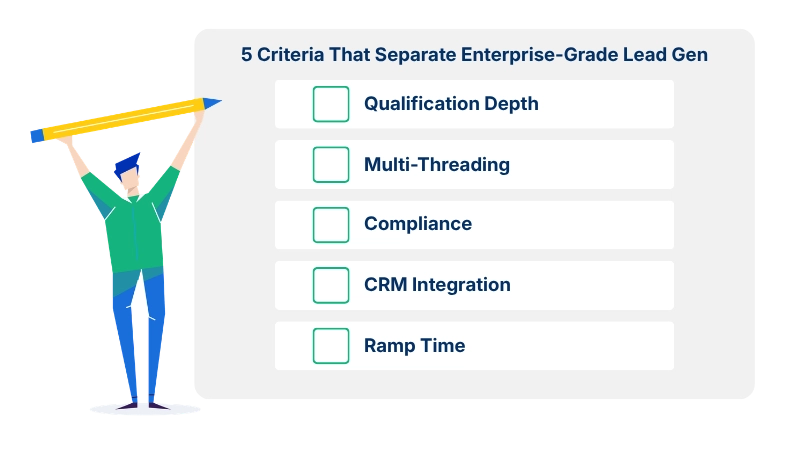
5 Criteria That Separate Enterprise-Grade Lead Gen
These five criteria are what separate vendors built for enterprise deals from those that just say they are.
1. Qualification Depth: Do they confirm the buying stage, not just fit?
Most vendors confirm that a prospect matches your ICP. Enterprise-grade vendors go further, — they confirm where that prospect is in their buying process, whether procurement or IT is already involved, and whether there’s real budget authority in play.
Ask any vendor for their disqualification rate. If they don’t have one, they’re passing everything through and letting your sales team do the filtering.
2. Multi-Threading: Can they reach more than one person per account?
A vendor that finds one contact and hands it over is giving you a name, not a pipeline opportunity. For enterprise deals, you need outreach running across multiple stakeholders in the same account at the same time.
Most vendors don’t do this well. It’s operationally harder than single-contact outreach, and many skip it entirely.
3. Compliance: Are they TCPA-ready for 2026?
For any program with real call volume, the vendor needs to verify phone numbers against the TCPA reassignment database before dialing. They also need a process for honoring opt-out requests within the FCC’s required 10-business-day window.
This isn’t a nice-to-have. It’s the legal baseline for running outbound in 2026.
4. CRM Integration: Does data land in your system or a portal?
Enterprise programs produce a lot of activity data. If your vendor delivers contacts in a spreadsheet or their own dashboard, your RevOps team will spend hours manually syncing information that should flow automatically.
Confirm native integration with your CRM and ask exactly which fields they populate.
5. Ramp Time: How long until you get a real meeting?
Enterprise programs take time to warm up. List verification, ICP refinement, and sequence calibration typically fill the first few weeks before outreach reaches full volume.
Ask vendors for the average time from program launch to a confirmed meeting with an economic buyer, broken out by your industry and deal size. If they can’t answer that specifically, that tells you something.
Expert Tip Ask this in every vendor discovery call: “Can you show me your TCPA verification process document right now?” A vendor with a real compliance program will produce it without hesitation. One that doesn’t have it will change the subject. That reaction alone tells you a lot about how they operate.
See the side-by-side comparison of enterprise sales and SMB sales
How Do You Generate Enterprise Leads? What Actually Works
Which channels work best for enterprise sales teams?
Multi-channel outbound with human qualification is still the most reliable engine for enterprise pipeline. Phone, email, and LinkedIn running together with a human confirming the buying stage before passing an appointment consistently outperform fully automated outreach on complex deals.
Callbox’s 2026 B2B pipeline benchmarks show that human-reviewed programs deliver higher qualified meeting rates than automated equivalents across every enterprise deal-size segment they track.
ABM gives outbound a sharper focus. Rather than prospecting broadly, Account-Based Marketing targets a defined list of accounts with coordinated messaging by persona and channel. For teams with a tight ICP and named account lists, it reduces wasted outreach and improves multi-thread coverage inside key accounts.
Intent data helps you reach the right accounts at the right time. Platforms that flag companies actively researching solutions like yours give outbound teams a real head start. Reaching an in-market account compresses ramp time and improves conversion at every stage.
Related: Best Enterprise Lead Generation Companies
What role should AI play?
AI has made real improvements in data sourcing, contact enrichment, and sequence personalization. Those are genuine wins.
Where it falls short is in qualification. Knowing whether a VP of Revenue Operations is actively evaluating vendors right now — versus just having started a new job — requires context that AI systems consistently miss.
The model that works for enterprise deals uses AI for efficiency in the data layer and humans for judgment at the qualification stage. That’s not a workaround. It’s the right split for complex sales cycles.
Callbox accelerates revenue by engaging prospects after brand awareness and converting them into qualified meetings, closed deals, and loyal customers. Once customers are acquired, Callbox then nurtures them into repeat business, advocacy, referrals, and expansion opportunities, feeding revenue back into the top of the funnel. This creates a self-reinforcing growth engine that continuously scales pipeline, accelerates sales, and maximizes customer lifetime value.
Which Lead Generation Services Are Built for Enterprise Sales Teams in 2026?
The ten services below were evaluated against the five criteria above. Each entry covers what they do well and where to look carefully before signing.
1. Callbox — Full-Service Enterprise Outbound
Callbox is a B2B lead generation and appointment-setting agency operating across North America, APAC, EMEA, and LATAM. They run a human-plus-AI model — AI handles data sourcing and enrichment, human SDRs handle outreach, qualification conversations, and appointment setting.
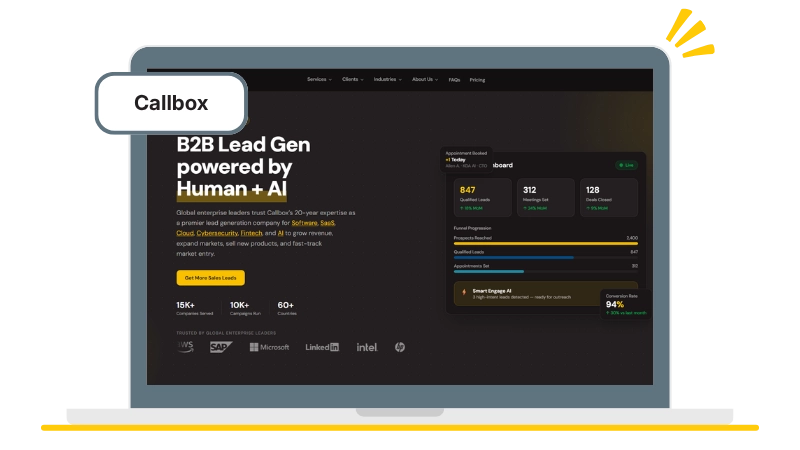
Their qualification process focuses on confirming decision-making authority, stakeholder involvement, and buying-stage readiness. They hold Platinum HubSpot Partner status, a 4.6-star Clutch rating, and 39 verified industry rankings.
CRM integration is HubSpot-native, with Salesforce also supported.
HQ: Los Angeles, CA (Global) | Model: Human + AI Hybrid | Clutch: 4.6★
2. SalesRoads — Human-First ABM for C-Suite Access
SalesRoads acquired VSA Prospecting in 2024 and now runs a human-first prospecting model focused on C-suite meeting generation. Their approach is ABM-oriented, which suits enterprise teams with defined account lists and a need for executive-level access.
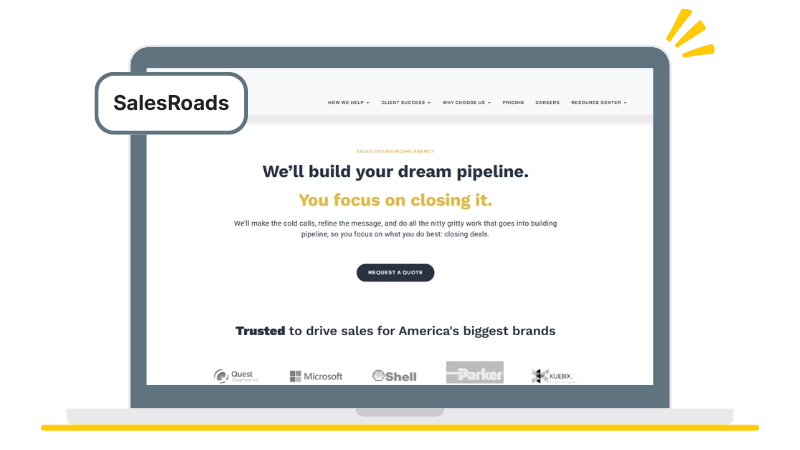
They’re less suited to high-volume multi-vertical programs.
HQ: Wilkes-Barre, PA | Model: Human-First ABM
3. Cognism — EMEA Enterprise Prospecting
Cognism is the default choice for enterprise teams prospecting into Europe. Their phone-verified data and GDPR-compliant database cover the UK, DACH, and broader EMEA markets more accurately than most North American platforms.
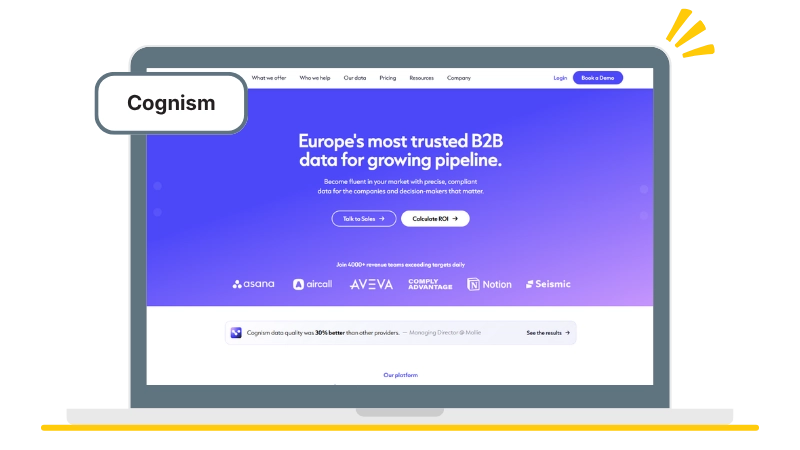
If your ICP lives in Europe, this is where the data quality difference shows up most clearly.
HQ: London, UK | Best Region: EMEA
4. Leadium — Custom ICP Research
Leadium builds hand-curated contact lists for enterprise teams with ICPs that standard databases don’t serve well. If your target persona involves unusual title combinations, niche verticals, or firmographic filters that automated tools mis-map, Leadium’s research-first approach closes that gap.
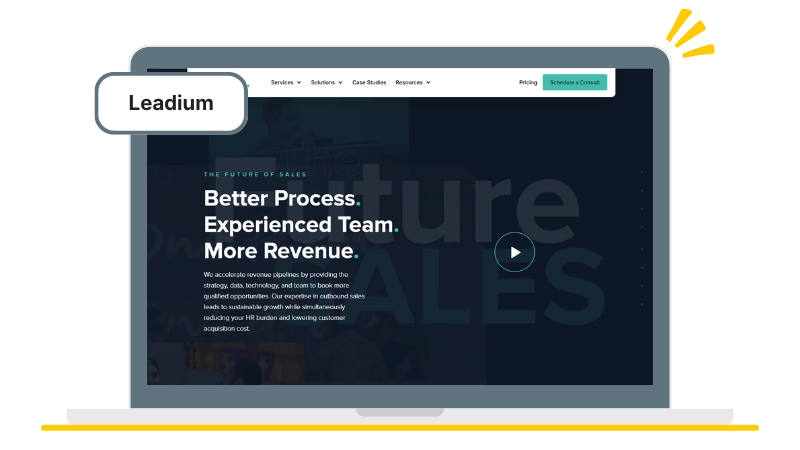
HQ: Las Vegas, NV | Strength: ICP precision for niche accounts
5. Abstrakt Marketing Group — U.S. Full-Service Pipeline
Abstrakt runs outbound appointment setting, digital marketing, creative production, and CRM integration under one roof. For U.S.-based enterprise teams that want one agency managing the full top-of-funnel workflow, Abstrakt covers the whole stack.
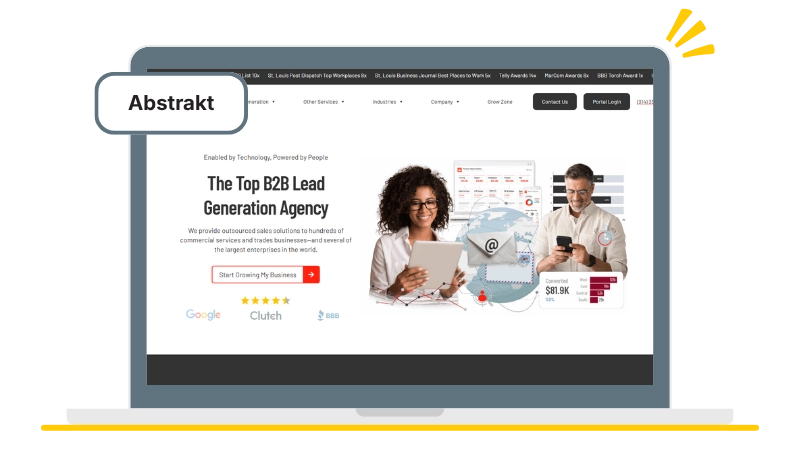
HQ: St. Louis, MO | Coverage: USA
Need a scalable way to engage enterprise decision-makers across complex buying groups?
Enterprise Lead Generation Services: At-a-Glance Comparison
| Company | HQ | Best For | Core Strength | Global Reach |
| Callbox | Los Angeles, CA | Full-service enterprise outbound | Human+AI hybrid; Platinum HubSpot Partner | Americas, APAC, EMEA, LATAM |
| Belkins | Delaware, USA | Email-led enterprise outreach | 98–100% inbox placement via Folderly | North America, Europe |
| SalesRoads | Wilkes-Barre, PA | C-suite enterprise meeting generation | Human-first ABM for executive access | North America |
| ZoomInfo | Vancouver, WA | In-house enterprise data infrastructure | Verified data + AI intent signals | Strong NA; global data coverage |
| Cognism | London, UK | EMEA enterprise outbound teams | Phone-verified EMEA mobile data; GDPR compliant | EMEA-first; expanding globally |
| CIENCE Technologies | Colorado Springs, CO | High-volume prospecting at scale | Proprietary AI platform (graph8) | Global |
| Leadium | Las Vegas, NV | Custom ICP list building | Research-grade hand-curated contacts | North America, Europe |
| LinkedIn Sales Navigator | Sunnyvale, CA | Buying committee mapping | Relationship intelligence for enterprise accounts | Global |
| Abstrakt Marketing Group | St. Louis, MO | U.S. full-service pipeline programs | End-to-end outbound and digital under one roof | USA |
Related: Callbox as one of he Best Global Lead Generation Companies
How Do You Measure ROI on Enterprise Lead Generation?
A 5-step framework for evaluating whether your program is actually working.
Step 1: Work out what a qualified meeting is worth
Multiply your average deal size by your close rate. At $120,000 ACV and a 15% close rate, each qualified meeting with the right buyer is worth $18,000 in pipeline.
Step 2: Track cost per qualified meeting, not cost per lead
Divide total monthly spend by meetings that reached a real economic buyer. A program delivering four genuine enterprise meetings for $5,000 a month beats one delivering 40 contacts for $3,000 if none of those contacts ever enter a real sales cycle.
Step 3: Watch how fast deals move, not just how many start
Track days from first contact to discovery call, and from discovery call to proposal. Programs that speed up early stages let your AEs carry more deals at once. That’s a return that raw meeting counts don’t capture.
Step 4: Factor in compliance cost avoidance
If your program includes TCPA verification, calculate what you’re avoiding: estimated violation rate on an unverified list multiplied by $500 to $1,500 per call. On programs running thousands of dials a month, that avoided cost often exceeds the total program fee.
Step 5: Give the program a real runway
Most enterprise programs hit steady-state meeting volume between weeks 6 and 10. Cutting a program at day 30 because the pipeline isn’t full yet is one of the most common and costly mistakes enterprise sales leaders make. Set your measurement window before the program starts.
Related: Understanding B2B Lead Generation Pricing
Selection Methodology
The ten services in this article were evaluated against five criteria: qualification depth, multi-threading capability, TCPA and FCC compliance posture, native CRM integration, and track record with deals above $50,000 ACV.
Rankings reflect editorial judgment of enterprise suitability. They are not paid placements. Data is sourced from HubSpot State of Marketing, Gainsight and Pavilion SaaS GTM Benchmarks, Forrester State of Business Buying, and G2 Market Reports.
What Does Winning Enterprise Lead Generation Look Like in 2026?
Two things are true about enterprise buying right now. Committees are getting bigger, not smaller. And the cost of a wasted meeting in AE time, account credibility, and lost opportunity is higher than most sales leaders account for.
The vendors that work in this environment aren’t optimized for volume. They’re built for complexity. They confirm buying stage before passing a meeting. They run outreach across multiple stakeholders at once. They manage compliance so you don’t have to. And their data lands in your CRM, not a portal you have to check separately.
The five-stage framework in this guide gives you what you need to run that evaluation yourself. Take it into your next vendor call. The answers you get back will tell you whether you’re talking to a vendor built for enterprise sales or one that’s just priced like it.
Frequently Asked Questions
Does more lead volume always mean a better enterprise program?
No. This is the most expensive assumption in enterprise lead gen. Volume only helps if qualification keeps pace with it. A program delivering 80 contacts a month, four of whom have real budget authority, will outperform one delivering 200 contacts that your AEs spend weeks disqualifying.
Measure qualified meetings with economic buyers. That’s the number that connects to revenue.
How long does it take to see results from an enterprise lead gen program?
Most programs need 6 to 10 weeks to reach steady-state. The first few weeks go into list verification, ICP refinement, and sequence setup. Outreach ramps in weeks four through six. Qualified meeting rates stabilize around weeks seven through ten.
Any vendor promising consistent enterprise meetings in week one is either defining “qualified” loosely or working with deal sizes that don’t match yours.
What’s the difference between lead generation and appointment setting for enterprise teams?
Lead generation finds the right prospects and confirms they’re worth pursuing. Appointment setting gets the right person on a call with your team.
For enterprise sales, both need to clear a higher bar than mid-market equivalents. Lead gen has to confirm stakeholder map and buying stage, not just company fit. Appointment setting has to deliver a meeting with someone who can actually move a deal forward — not just anyone who agreed to a call.
How do we evaluate a vendor when we can’t speak to their enterprise clients directly?
Ask for outcome data in ranges. Specifically: average time from program launch to first qualified meeting with an economic buyer, by vertical; disqualification rate by program type; and qualified meeting rate per 1,000 outbound touches, broken out by deal size.
A vendor with real enterprise experience has these numbers. One without it will send you a logo slide and a testimonial.