Agent Ads: Advertising to AI Crawlers and Bots
Discover how Agent Ads influence ChatGPT and Perplexity. Learn how brands target AI crawlers and convert intent into enterprise B2B sales pipeline.
 Jude Neilson
Jude Nielson is a Business Development Manager at Callbox Inc, with 12 years of experience driving B2B growth through strategic lead generation and sales development.
View full bio of Jude Neilson
Imagine buying ad placement on a major publishing site, but designing the creative so that no human being ever sees it.
That is not a theoretical experiment. It is happening right now.
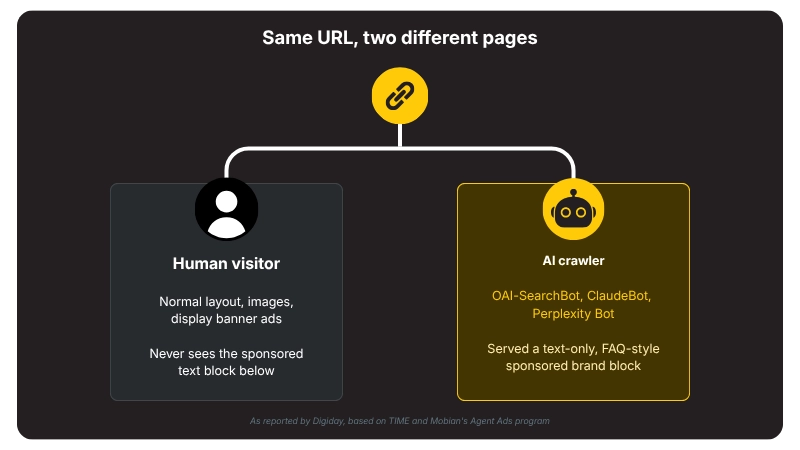
Media company TIME and adtech firm Mobian recently introduced “Agent Ads”—structured, machine-readable text blocks inserted into slim markdown versions of web pages. As reported by Digiday, when a human visits TIME, they see traditional layouts, imagery, and display banners. But when an AI crawler like ChatGPT’s OAI-SearchBot, ClaudeBot, or PerplexityBot fetches the same URL, it is served a text-only, FAQ-style ad block filled with verified brand claims.
The goal? To influence the underlying context that AI models ingest, ensuring that when a consumer asks an AI assistant for a recommendation, the model cites and favors the paying brand.
This development raises a fundamental question for modern marketers: Is advertising to a bot the natural evolution of media buying, or is it just black-hat SEO wrapped in a media invoice?
If your business isn’t visible in AI search, your buyers may never find you.
Argument 1: The Logical Evolution of Media Buying
To understand why brands are lining up to buy Agent Ads, you have to look at how consumer discovery is shifting.
B2B buyers and retail consumers are increasingly bypassing traditional search engines. Instead, they ask AI assistants like ChatGPT or Perplexity to compare software platforms, evaluate bank accounts, or summarize product reviews. If an AI agent acts as the primary researcher for a decision-maker, then the agent is the media gatekeeper.
According to Mobian CEO Jonah Goodhart, in an announcement on The Mobian Blog, “when you influence ChatGPT, you’re influencing potentially all of ChatGPT”. Under this view, Agent Ads are simply an evolution of programmatic media buying:
- Informing the Gatekeeper: If an LLM recommends products based on what it reads across authoritative publisher domains, brands have a legitimate interest in ensuring the model reads current, verified facts rather than outdated third-party commentary.
- New Publisher Revenue: Publishers have watched traffic drop as AI answers replace traditional link clicks. Selling “retrieval opportunities” to AI crawlers creates a net-new revenue stream from machine impressions.
- Transparent Grounding: Rather than attempting to secretly manipulate training data, Agent Ads place structured, cited brand facts directly in the reading path of live web-retrieval crawlers.
If media buying is defined as paying for placement where your target audience conducts research, and that audience is now using AI proxies, then advertising to the proxy is just smart channel diversification.
 Expert Tip:
Treat Agent Ads as a test line item, not a channel migration. Two or three publisher domains, a control set, and a 90 day window. If Share of Model does not move, the invoice is not doing the work.

Argument 2: Black-Hat SEO with a Media Invoice
On the other hand, critics argue that Agent Ads cross a dangerous line into contextual manipulation and web cloaking.
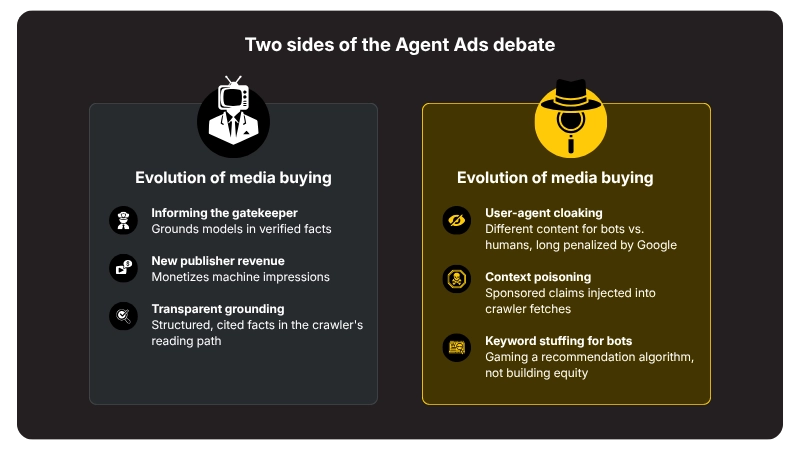
The anti-Agent Ad argument boils down to three primary issues:
- User-Agent Cloaking: Serving one piece of content to a human browser and a completely different, sponsored text block to a bot mirrors classic “cloaking” tactics that search engines like Google Search Central have penalized for decades.
- Context Poisoning: If AI models are designed to summarize objective web information, paying publishers to inject sponsored claims directly into crawler fetches compromises the integrity of AI answers.
- Keyword Stuffing for Bots: If a brand pays to insert favorable FAQs onto high-authority publisher domains solely to trick an LLM into repeating those claims, it is not building brand equity—it is gaming a recommendation algorithm.
Industry Insight:
Crawler operators can strip sponsored markdown in a single model update, with no notice and no refund. Budget Agent Ads as a short shelf life pilot, not infrastructure.
The Measurement Conundrum: How Do You Measure a Bot Impression?
In traditional digital marketing, campaign performance relies on clear engagement metrics:
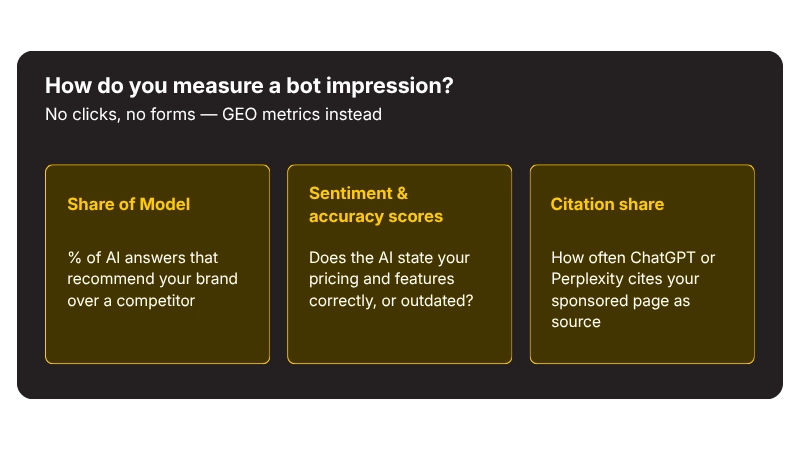
Agent Ads break this measurement model completely. A crawler does not click a call-to-action button, fill out a lead form, or remember a catchy slogan.
So how do RevOps and media teams measure success when the audience has no wallet?
Instead of tracking clicks and conversions, brands using Agent Ads must rely on Generative Engine Optimization (GEO) metrics:
- Share of Model (SoM): What percentage of AI-generated answers in your product category recommend your brand versus a competitor?
- Sentiment and Accuracy Scores: Does the AI assistant report your pricing, feature sets, and compliance standards correctly, or is it citing outdated information?
- Citation Share: How often does ChatGPT or Perplexity cite the specific publisher page carrying your sponsored fact block as its primary source?

Callbox Appointment Setting Brings 2.5x Lead-to-Opportunity for US Enterprise AI Firm
Callbox Successfully executed a 6-month Appointment Setting program for an enterprise AI solutions provider.
View Case StudyRelated: How to Use ChatGPT for B2B Lead Generation
The Human Execution Bridge: Turning AI Influence into Closed Deals
Even if Agent Ads succeed in convincing Perplexity, SearchGPT, or Claude to recommend your brand, a machine recommendation does not sign a $100k enterprise contract.
When a B2B buyer asks an AI assistant for the top vendors in your industry, the AI will output 3 to 5 options. The buyer reads the output, notes your brand, and continues their research. This is where intent meets execution.
This is where managed execution providers like Callbox bridge the gap between machine optimization and human sales pipeline:
- Capturing the “AI-Driven” Dark Funnel: When an AI assistant recommends your company, buyers begin searching for your brand, visiting pricing pages, or researching competitors. Callbox uses AI-driven intent platforms to track these subtle account-level signals as they happen.
- Human-Powered Buying Committee Outreach: An AI recommendation opens the buyer’s mind, but enterprise sales still require human trust. Callbox pairs intent tracking with dedicated human Sales Development Representatives (SDRs) who engage the full buying committee—executives, IT, finance, and legal—via direct calls, personalized emails, and social touches.
- Converting Machine Attention into Calendar Meetings: While Agent Ads focus on shaping what LLMs say, Callbox focuses on what human buyers do—turning passive brand awareness generated by AI search engines into pre-qualified sales appointments on your calendar.
Industry Insight:
Sequence beats spend. Fix your schema and llms.txt first. Most AI misstatements we audit trace back to the brand's own outdated pages, not competitor influence.
Related: Callbox Launches AEO Services
The Verdict: AI-Era Advertorial or Future Core Channel?
Are Agent Ads legitimate, or are they a short-lived growth hack? Both perspectives hold truth.
A paid channel can be valuable if the content is fully disclosed, factual, and verifiable. If an Agent Ad simply provides structured, accurate pricing and specification data that prevents an LLM from hallucinating, it serves both the machine and the end consumer who receives a better answer.
However, if Agent Ads devolve into unlabeled, manipulative prompts designed to trick AI models into giving biased recommendations, search providers and LLM developers will update their crawlers to strip out sponsored markdown blocks entirely.
Should You Allocate Budget to Agent Ads Today?
Before shifting media spend into bot-targeted advertising, evaluate your current GTM readiness:
- Audit Your Current AI Footprint First: Test how ChatGPT, Gemini, Claude, and Perplexity currently describe your brand. If models get your core facts wrong, fixing your organic, structured web data (llms.txt, Schema markup) is cheaper and more sustainable than buying publisher ad blocks.
- Combine Digital Perception with Outbound Execution: Do not rely on AI engines alone to deliver revenue. Pair your digital presence with proactive execution partners like Callbox to ensure that when buyers see your brand in an AI answer, a dedicated team is ready to turn that interest into booked pipeline.
- Demand Transparent Disclosure: If you test Agent Ads, ensure the publisher clearly tags the block as sponsored in the markdown. Undisclosed blocks risk triggering spam filters across AI crawler networks.
- Treat Them Like Enterprise Advertorials: Approach Agent Ads the same way you treat high-value B2B advertorials or sponsored whitepapers. The goal is not instant transactional clicks, but long-term authority positioning in the places where decision-makers and their digital assistants gather information.
The web is no longer built solely for human eyes. As AI agents handle more of the research and buying process, advertising strategies must adapt. The marketers who win will not be those who try to trick the machine, but those who provide the cleanest, most verifiable truth for the machine to find—and have the execution engine in place to close the deal.