Leading Lead Generation Companies for Telecom Companies
Discover the top lead generation companies for telecom and learn how they help B2B telecom businesses reach qualified buyers and grow pipeline.
 Callbox Admin
Callbox Admin is a content manager for Callbox Inc., a lead generation and appointment setting company.
View full bio of Callbox Admin
What Is Lead Generation for Telecom Companies?
Lead generation for telecom companies means identifying, engaging, and qualifying enterprise prospects, IT directors, network engineers, procurement, and finance stakeholders who are a fit for connectivity, UCaaS, SD-WAN, or managed network services, and getting a qualified meeting on an account executive’s calendar.
Lead generation companies help enterprise telecom teams by taking over the slowest, most resource-draining parts of the sales cycle, prospecting, qualifying, and getting a meeting on the calendar with a real decision maker, so internal sales leaders can spend their time closing instead of cold-calling.
For a telecom provider selling multi-site connectivity, UCaaS, SD-WAN, or managed network services, that matters more than it does in most B2B categories. Enterprise buying committees for telecom typically run six to ten people deep, per Gartner’s research on B2B buying behavior, and most of that group does its own research before a rep is ever looped in. A specialized lead generation partner that already knows how to multithread an IT director, a VP of network operations, and a CFO at the same account is worth more than a generalist SDR team learning telecom vocabulary on your dime.
That’s the short answer. The longer one is that “help” looks different depending on where your pipeline is actually stuck. Some telecom teams need raw volume, more qualified conversations with mid-market IT buyers who’ve never heard of them. Others have plenty of inbound interest but a terrible no-show rate on discovery calls, which points to a qualification problem rather than a prospecting one. A good lead generation partner diagnoses which bottleneck you actually have before proposing a solution, and the rest of this guide walks through how to evaluate whether a prospective partner can do that for your business specifically.
Wondering how to reach the right telecom decision-makers in international markets?
What Makes Telecom Lead Gen Different From Other B2B?
Telecom sales leads aren’t the same animal as SaaS leads or professional-services leads, and a lead generation partner that treats them the same way will fall flat with telecom buyers. Three things set enterprise telecom apart.

First, the sale usually touches an existing vendor relationship. Most enterprise prospects already have a carrier, an MSP, or an internal IT team managing some version of what you’re selling. That means your outbound messaging has to open with displacement or augmentation, not pure education, and a rep who doesn’t understand circuit types, SLAs, or the pain of a multi-year contract with an incumbent carrier will get filtered out in the first thirty seconds of a call.
Second, the buying committee is technical and financial at once. A network engineer cares about uptime guarantees and failover architecture. A CFO cares about total cost of ownership and contract term flexibility. Telecom sales leads convert fastest when a lead generation team can speak to both audiences without sounding like it memorized a script, which is why industry-specific SDR training, not a generic cold-calling playbook, is one of the first things to ask a provider about.
Third, compliance and reliability claims carry real weight. A telecom buyer evaluating enterprise telecom leads will ask about SOC 2 status, redundancy, and service-level commitments earlier than a typical B2B buyer would, because an outage has a measurable revenue cost on their end. A lead generation company that can’t help your reps arrive prepared for that conversation is setting up meetings that stall at the second call.
Telecom Firm Expands US Market Reach with Callbox
Callbox completed a 12-month Lead Generation and Appointment Setting program for a leading telecommunications firm and generated 142 sales qualified leads and 97 marketing qualified leads
View Case StudyWhy Hire a Lead Generation Company for Telecom?
Telecom and enterprise connectivity deals are decided by committees, not individuals, and that complexity is exactly where a lead generation company earns its keep. Gartner’s research on B2B buying behavior found that a complex B2B purchase now runs through six distinct “buying jobs”, problem identification, exploration, requirements building, supplier selection, validation, and consensus creation, each revisited more than once by a buying group that typically runs six to ten people deep. Gartner separately found that B2B buyers now spend roughly two-thirds of the entire purchase journey gathering and reconciling information on their own, largely before a sales rep ever gets a call. For a telecom seller running outbound with a generalist team, that’s a lot of ground to cover alone.
Gartner studies this pattern specifically for the communications industry: its Communications Industry Buying Behavior research tracks how network operators, carriers, and managed-service providers navigate exactly this kind of multi-stakeholder purchase. A lead generation partner who already understands that pattern, who knows to open a conversation with a network engineer differently than with a CFO, and who can keep several threads moving inside the same account, closes a gap most internal teams can’t shortcut on their own.
The case for outside help gets stronger as buyer research habits shift further from sales-led to self-directed. McKinsey’s B2B Pulse research found that ecommerce and self-serve channels have overtaken in-person interaction as the top revenue-generating channel for B2B sellers, with buyers increasingly researching and shortlisting vendors before ever picking up the phone. A lead generation company built around multi-channel outbound, not just cold calls, meets telecom buyers where they already are: researching quietly, comparing options, and engaging a rep only once they’re most of the way to a decision.
 Industry Insight: In our experience running outbound campaigns for telecom and managed services clients, the single biggest predictor of a slow enterprise telecom sales cycle isn't lead volume, it's how many of the "right" stakeholders get engaged before the first proposal goes out. Teams that multithread three or more buying-committee roles in the first 30 days close meaningfully faster than teams chasing a single champion.
How Do You Evaluate a Telecom Lead Gen Partner?
Most evaluation checklists are generic. Here’s a methodology built specifically for vetting a lead generation company for telecom, in the order you should actually work through it.

- Confirm telecom-specific experience, not just B2B experience. Ask for two or three reference clients in telecom, managed services, or adjacent infrastructure categories, and ask those references directly how long ramp-up took before campaigns produced qualified enterprise telecom leads.
- Audit their qualification criteria before their call volume. A partner should be able to show you their BANT or MEDDIC-style qualification framework and explain how it’s adapted for a technical, multi-stakeholder telecom sale, not just recite a generic SDR script.
- Test their multithreading approach. Ask how the team identifies and engages multiple buying-committee roles (IT, procurement, finance) on the same account, since single-threaded outreach is the most common reason telecom pipeline stalls after the first meeting.
- Check data and compliance practices. Confirm how prospect data is sourced and whether the vendor can operate within your compliance requirements (TCPA for outbound calling, GDPR for international accounts), since a data misstep here becomes your liability, not theirs.
- Review reporting cadence and ownership of the handoff. Ask exactly what happens between a booked meeting and your AE’s calendar: who confirms the meeting, what briefing material your rep receives beforehand, and how a no-show gets rebooked.
- Pressure-test the contract structure. Favor terms that let you exit a partnership that isn’t working without a long-term penalty, and be cautious of any lead generation company unwilling to build in an early off-ramp before you’ve seen a single qualified meeting.
Run every finalist through all six steps side by side rather than evaluating one at a time. A provider that looks strong on volume but weak on qualification criteria will show up clearly once you compare it against one that’s slower to ramp but produces cleaner meetings.
Learn effective ways on how to generate more telecom leads.
Which Companies Serve Enterprise Telecom Teams?
The table below profiles five providers whose service model fits enterprise telecom and adjacent B2B infrastructure sales. Treat it as a starting shortlist, not a ranking, since the right fit depends on whether you need US-only delivery, EU compliance coverage, or multilingual APAC reach.
Company | HQ | Best For | Core Strength | Global Reach |
Callbox | Encino, CA, USA | Enterprise and mid-market telecom accounts needing multilingual, multi-country outbound | Multi-channel outbound (phone, email, LinkedIn, direct mail) plus appointment setting delivered through native-language teams | US, APAC (Philippines, Singapore), and EMEA delivery |
Cognism | London, UK | Teams prioritizing compliant, verified contact data for outbound into UK and EU telecom accounts | Phone-verified intent data paired with compliance-first prospecting | UK, US, and broader EU coverage via offices in London, Boston, Cologne, and Paris |
SalesHive | Denver, CO, USA | Mid-market to enterprise B2B teams wanting a fully US-based, in-house SDR bench | Multi-channel outbound (cold call, email, LinkedIn, paid) built on a proprietary reporting platform | Primarily US-based delivery |
Leadium | Las Vegas, NV, USA | Companies wanting a 100% US-based SDR team for outbound appointment setting | Multi-channel prospecting with rapid-response lead management | US-focused delivery |
EBQ | Austin, TX, USA | Technology, hardware, and cloud companies needing a full outsourced sales-and-marketing bench beyond lead gen alone | End-to-end coverage spanning data management, appointment setting, and CRM consulting | US-based delivery |
Notice that none of these five compete on the same axis. If multilingual, multi-country delivery is the deciding factor for your rollout, that narrows the list fast; if UK/EU compliance coverage is non-negotiable, it narrows differently. Run the shortlist through the six-step methodology above before signing anything.
Here’s how each of the five fits into a telecom lead generation program specifically:
Callbox
HQ: Encino, California, USA
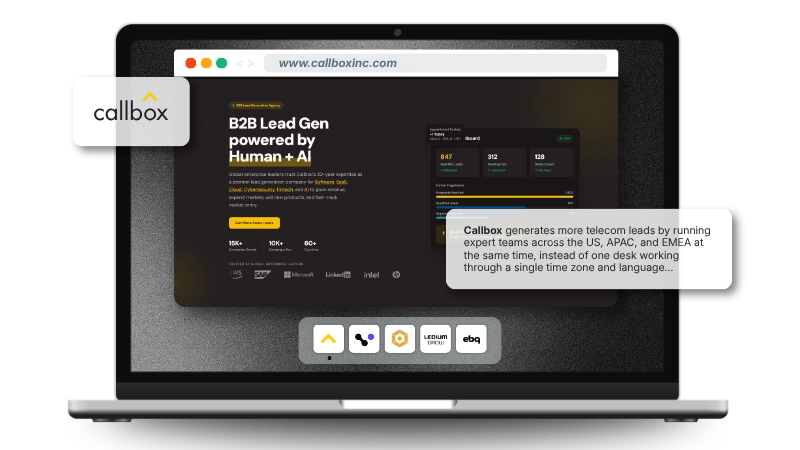
Callbox generates more telecom leads by running expert teams across the US, APAC, and EMEA at the same time, instead of one desk working through a single time zone and language. Outbound to a network director in Germany, an IT lead in Singapore, and a CTO in the US can run in parallel rather than sequentially, multiplying the number of qualified conversations a seller can realistically have in a quarter. Its multi-channel sequencing (phone, email, LinkedIn, and direct mail layered together) also raises the odds of reaching a given stakeholder at all, since enterprise telecom buyers rarely respond to a single touch.
See how Callbox ABM lead generation elevates telecom outreach and generates 124 SQL and 237 MQLs
Cognism
HQ: London, United Kingdom
Cognism increases telecom lead volume by widening the pool of reachable, accurate contacts in the first place. Its phone-verified data means reps spend outbound hours actually talking to network engineers and IT directors instead of burning calls on disconnected numbers or outdated titles, which directly raises connect rates and the number of qualified meetings a fixed amount of outbound effort produces. Because that data is also compliance-checked for GDPR, telecom sellers can expand outbound into UK and EU accounts at scale without campaigns stalling over consent issues.
SalesHive
HQ: Denver, Colorado, USA
SalesHive drives more telecom leads through a dedicated, always-on US-based SDR bench running multiple channels (cold calling, email, LinkedIn, and paid) off one reporting platform. Because the team and the data sit in a system the client can see into, targeting gets refined in near real time instead of waiting for a monthly report, so an underperforming telecom sub-vertical gets redirected toward better-converting segments within days rather than months.
Leadium
HQ: Las Vegas, Nevada, USA
Ledium generates more telecom leads by closing the gap between a prospect showing interest and a rep actually reaching them. Its rapid-response, same-day follow-up model matters most for the leads telecom sellers tend to waste: names captured at a trade show, webinar attendees, or referrals from a channel partner who are warm for days, not weeks. Reaching those contacts quickly converts a meaningfully higher share of that pool into booked meetings.
EBQ
HQ: Austin, Texas, USA
EBQ adds telecom lead volume less through raw outbound speed and more through cleaning up the pipeline underneath it. Combining CRM consulting and data management with appointment setting fixes the data problems, duplicate records, stale firmographic fields, missing technographic signals, that quietly suppress lead volume by causing good-fit accounts to be mistargeted or missed entirely.
What to Expect in the First 90 Days
The first 90 days tell you more about a partnership’s long-term fit than any sales deck. Weeks one through two should be messaging and ICP calibration, your partner confirming firmographic and technographic targeting criteria against accounts you’ve already closed or lost, not generic telecom filters pulled from a database. Weeks three through six are when outbound volume ramps and the first qualified meetings should start landing on your AEs’ calendars; if nothing is booked by week six, that’s a legitimate point to ask hard questions, not wait quietly. By week twelve, you should have enough data, meetings held, show rate, and early-stage opportunity creation, to judge whether the qualification criteria from the methodology above are actually being applied, or whether volume is being prioritized over fit.
Expert Tip: Ask for a joint weekly call during the first 90 days, not a monthly report. Enterprise telecom sales leads surface disqualifying information fast, and a weekly cadence lets your team redirect targeting before a month of wasted outreach compounds.
Choosing the Right Partner Comes Down to Fit
The right lead generation partner for telecom isn’t necessarily the one with the flashiest case studies, it’s the one that understands your buying committee and can prove it with real client examples. Work through the six-step evaluation methodology, hold any finalist to the 90-day benchmarks above, and confirm they can speak to both the technical and financial sides of an enterprise telecom sale before you commit.
FAQ: Lead Generation Companies for Telecom
Why Outsource Telecom Lead Generation?
Enterprise telecom deals move through multi-stakeholder buying committees that Gartner puts at six to ten people on average, each researching independently before engaging a rep. A specialized outside team that already knows how to multithread those roles can get a telecom seller in front of the right people faster than a generalist in-house team building that playbook from scratch.
How Long Until You See Results?
Most lead generation programs for telecom need a 90-day ramp: two weeks to calibrate targeting, several more weeks for outbound volume to produce qualified meetings, and the remainder to confirm qualification criteria are being applied consistently. See the first-90-days section above for the specific milestones to check.
How Many Stakeholders Are in a Telecom Deal?
Gartner’s B2B buying research puts the typical committee for a complex purchase at six to ten decision-makers, and enterprise telecom deals, which touch IT, network operations, procurement, and finance, tend to sit at the higher end of that range.