What Is an Unqualified Lead? (And What to Do With One)
Understand what an unqualified lead is in B2B sales, the signs to look for, and best practices for identifying sales-ready prospects.
 Jude Neilson
Jude Nielson is a Business Development Manager at Callbox Inc, with 12 years of experience driving B2B growth through strategic lead generation and sales development.
View full bio of Jude Neilson
The 2-minute answer, the 5 warning signs, and a simple playbook for turning wasted pipeline into real revenue.
 Quick Answer
An unqualified lead is a potential buyer who doesn't meet your criteria for a sales conversation, usually because they lack the budget, authority, need, or timing to buy. They're not a lost cause, they're just not sales-ready, so they should be nurtured, recycled, or removed instead of handed to your sales team.
Unqualified leads are the silent budget killers of B2B sales. They fill your CRM, eat your SDRs’ time, and inflate your pipeline reports, all without ever turning into revenue. Every hour spent chasing the wrong contact is an hour your team isn’t spending on appointment setting with buyers who are ready to talk.
The fix isn’t more lead generation. It’s better lead qualification.
Here’s everything you need to know, in plain English.
Are low-quality leads slowing down your sales pipeline and hurting growth?
Why Unqualified Leads Are a Bigger Problem Than You Think
Most teams treat unqualified leads as background noise. It’s one of the more expensive B2B lead generation lessons a team learns the hard way. The data says they’re a revenue leak.
| Stat | What It Means |
| 67% | of lost sales are attributed to poor lead qualification (SURFE, via Landbase) |
| ~25% | of leads are actually legitimate and ready to advance to sales (Gleanster Research) |
| 79% | of marketing leads never convert to sales, often due to no nurturing (MarketingSherpa) |
| 6.3x | more likely to close: well-qualified deals vs. poorly qualified ones (Ebsta, 2025) |
Read those together and the picture is clear: roughly 3 out of 4 leads entering your funnel aren’t sales-ready, and the way you handle them decides whether they become future revenue or dead weight.
How Do You Spot an Unqualified Lead?
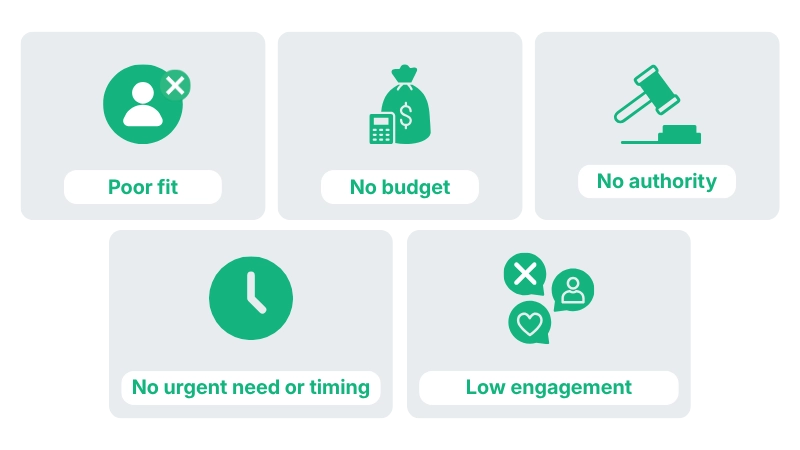
An unqualified lead usually fails on one or more of these five signals, and a consistent set of qualifying questions upfront will surface most of them fast:
- Poor fit. They don’t match your ideal customer profile (ICP). Wrong industry, wrong company size, wrong geography. No amount of nurturing fixes a fundamental mismatch.
- No budget. They can’t afford your solution, or they don’t control the money. Interest without budget is a conversation, not a deal.
- No authority. They’re researching, but they’re not the decision-maker and can’t get you to one. Useful contact, not a sales-ready lead.
- No urgent need or timing. The problem you solve isn’t a priority right now. “Maybe next year” is a nurture track, not a pipeline entry.
- Low engagement. One whitepaper download or a single site visit isn’t buying intent. It’s curiosity. Treat it that way.
Expert Tip
Never rely on a single "Unqualified" bucket in your CRM. Create specific disposition reasons like No Budget, Wrong Industry, or Timing 12+ Months. Reviewing those reasons monthly tells you exactly where your targeting is leaking, so fewer unqualified leads enter the funnel in the first place.

Driving Qualified Leads for a US 3PL Logistics Company
Callbox helped a 3PL company to generate 245 qualified appointments in six months.
View Case StudyQualified Leads vs. Unqualified Leads: The Side-by-Side
The difference isn’t interest. It’s fit plus readiness.
| Signal | Qualified Lead | Unqualified Lead | What to Do | Who Owns It |
| ICP Fit | Matches industry, size, and geography | Outside your target profile | Disqualify or deprioritize | Sales + Marketing |
| Budget | Confirmed or realistic budget range | No budget, or no control over it | Nurture until budget cycle opens | Marketing |
| Authority | Decision-maker or clear path to one | Influencer with no buying power | Map the account, find the buyer | SDR |
| Need & Timing | Active problem, buying window open | Problem is vague or not urgent | Recycle with a revisit date | SDR + Marketing |
| Engagement | Repeated, two-way intent signals | One-off click or form fill | Score, watch, and nurture | Marketing |
Industry Insight
Frameworks like BANT (Budget, Authority, Need, Timeline) and CHAMP exist to make this table operational. But frameworks only work when a human actually applies them. AI-only qualification tools score behavior well, yet they routinely miss context, like a "decision-maker" title that carries no real authority, or an informal opt-out buried in a reply. That`s why hybrid human + AI qualification consistently produces cleaner pipelines than automation alone.
Drowning in leads that go nowhere? This is exactly the problem Callbox solves: human-verified lead qualification layered on top of AI-powered targeting, so your sales team only ever talks to sales-ready buyers.
What Should You Do With Unqualified Leads?
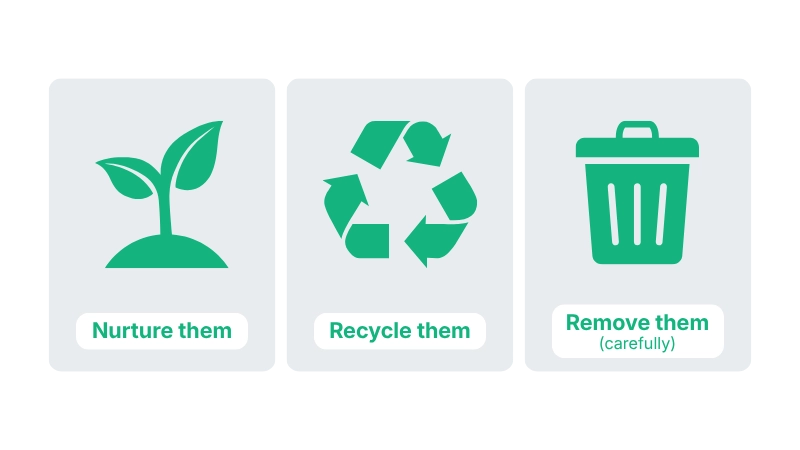
You have three options. Choosing the right one per lead is where the money is.
1. Nurture them
Good fit, bad timing? Keep them warm with helpful content until their situation changes. It pays off: companies that excel at lead nurturing generate 50% more sales-ready leads at 33% lower cost (Forrester).
2. Recycle them
Send them back to marketing with a specific revisit trigger: a renewal date, a budget cycle, a funding event. A “Recycle” status with a follow-up task beats a black hole every time.
3. Remove them (carefully)
Explicit “no”? Permanently wrong fit? Remove them from active outreach. This isn’t losing a lead. It’s protecting your team’s time, your sender reputation, and increasingly, your legal exposure. Under 2026 TCPA rules, continuing to dial contacts who opted out or whose numbers were reassigned carries penalties of $500 to $1,500 per call.
Expert Tip
Speed matters even for disqualification. Since 35 to 50% of sales go to the vendor that responds first, qualifying (or disqualifying) new inbound leads within minutes lets you capture serious buyers fast and flag unqualified contacts before anyone wastes a follow-up sequence on them.
How to Measure the ROI of Better Lead Qualification
Want to prove that fixing your unqualified lead problem is worth it? Track these five steps:
1. Baseline your unqualified rate. What percentage of leads entering the funnel get marked unqualified? Break it down by source, campaign, and list.
2. Calculate wasted effort. Multiply unqualified leads worked by average SDR minutes per lead. That’s your monthly cost of chasing the wrong people.
3. Tighten qualification criteria. Document your ICP, adopt a framework like BANT, script the right sales questions to qualify tech leads and other segments, and require a disposition reason for every disqualified lead.
4. Track conversion lift. Watch lead-to-meeting and meeting-to-opportunity rates. Cleaner qualification should push both up within one quarter.
5. Compare pipeline value per lead. Divide total pipeline created by leads worked, before and after. This single number captures the full ROI of qualification discipline.
Conclusion
Unqualified leads aren’t a failure. They’re a normal part of every funnel. The teams that win aren’t the ones with zero unqualified leads, they’re the ones with a clear system for sorting them.
Get three things right and the leak closes on its own: define who a qualified buyer actually is, route every unqualified lead deliberately into nurture, recycle, or remove, and measure pipeline value per lead so everyone can see what tighter qualification is worth. Do that and your reps spend more hours in front of real buyers while your cost per opportunity drops.
If your CRM is full of contacts that look busy but never convert, that’s a qualification problem, not a volume problem. Callbox pairs human-verified qualification with AI-powered targeting so your reps only ever talk to sales-ready buyers. Talk to a Callbox strategist about auditing your funnel and benchmarking your qualification rates against industry data.
Frequently Asked Questions
What is an unqualified lead in simple terms?
It’s someone who showed interest but isn’t ready or able to buy from you right now. They lack budget, authority, a real need, or the right timing, so they need nurturing instead of a sales call.
Is an unqualified lead the same as a bad lead?
No. A bad lead is a permanent mismatch (wrong industry, fake contact info). An unqualified lead may become a qualified lead later, once budget, timing, or authority changes. Treating the two the same throws away future revenue.
What’s the difference between an unqualified lead and an MQL?
A marketing qualified lead (MQL) has crossed an engagement threshold that suggests interest. But an MQL can still be unqualified for sales if it fails on fit, budget, or authority. That’s why a second, human-led qualification step before the sales handoff matters.
Should you ever delete unqualified leads?
Only when they explicitly opt out or are a permanent poor fit. Under current TCPA and FCC rules, opt-outs must be honored within 10 business days through any reasonable means. Everyone else goes into a nurture or recycle track.
How do you reduce unqualified leads in the first place?
Fix the top of the funnel: tighter ICP definitions, verified contact data, intent signals, and human review of every list before a campaign launches. Better inputs mean fewer unqualified leads for your team to sort through later.