Leading Cybersecurity Companies to Watch in 2026
Find out which leading cybersecurity companies are redefining digital defense in 2025. Gain insights to grow your cybersecurity leads.

Cyber threats in 2026 are no longer random or opportunistic. They are targeted, coordinated, and relentless. Ransomware-as-a-service, AI-assisted phishing, and state-sponsored intrusions have raised the stakes for every organization — regardless of size or industry. For modern businesses, staying secure means partnering with providers that anticipate and neutralize risks before they strike.
This guide profiles the 10 most trusted cybersecurity companies operating today, explains exactly how to evaluate them for your organization, and includes a full comparison table so you can build your shortlist with confidence. Whether you’re a startup handling sensitive customer data or a global enterprise managing thousands of endpoints, choosing the right cybersecurity partner can define your resilience against a rapidly evolving threat landscape.
This guide is written for: IT managers, CISOs, procurement leads, and B2B technology buyers evaluating enterprise cybersecurity vendors.
Accelerate sales cycles with verified, intent-driven cyber leads.
What Are the Top Cybersecurity Companies in 2026?
The companies below were selected based on a structured evaluation framework combining technology leadership, market adoption, breadth of protection, compliance posture, and verified customer outcomes. Below is an at-a-glance comparison of all ten providers.
| Company | Specialization | Best For | Key Differentiator | Ideal Customer |
| Palo Alto Networks | Network + Cloud Security | Enterprise & MSSP | Cortex XDR + Prisma Cloud platform | Large enterprise, hybrid cloud |
| CrowdStrike | Endpoint (EDR/XDR) | Mid-market to enterprise | Falcon AI-powered threat intelligence | IT/security-mature orgs |
| Fortinet | Network firewall + SD-WAN | SMB to large enterprise | Unified SASE & Security Fabric | Distributed/remote workforces |
| Cisco Security | Network + Identity + Cloud | Enterprise hybrid IT | SecureX cross-domain integration | Cisco-native IT environments |
| Check Point | Network threat prevention | Compliance-driven enterprises | Infinity Architecture prevention-first | Regulated industries |
| IBM Security | SIEM + Threat Intelligence | Enterprise SOC teams | QRadar + X-Force consulting | Orgs needing managed services |
| Microsoft Security | Identity + Cloud Security | Microsoft-stack orgs | Defender + Sentinel AI integration | M365/Azure enterprises |
| Trellix | XDR + Incident Response | Mid to large enterprise | Cross-environment threat visibility | Complex multi-vendor stacks |
| Sophos | Endpoint + Ransomware | SMBs | Intercept X deep-learning engine | Budget-conscious SMBs |
| SentinelOne | Autonomous AI EDR | DevSecOps + enterprise | Singularity real-time rollback | Speed-focused security teams |
How Did We Select These Best Cybersecurity Companies?
Every company in this list was evaluated against seven measurable criteria. Here is exactly what we assessed:
| Evaluation Criterion | What We Measured |
| Technology Leadership | AI/automation, threat detection & response capabilities |
| Market Presence | Multi-industry adoption, enterprise-scale client base |
| Breadth of Solutions | Endpoint, network, cloud, and identity coverage |
| Compliance & Certification | ISO 27001, NIST CSF, GDPR, SOC 2, CCPA alignment |
| Customer Confidence | Documented case studies, retention rates, client reviews |
| Innovation & R&D | Ongoing investment in threat intelligence and security research |
| Scalability & Support | 24/7 SOC support, global reach, multi-size org capability |
Companies that appeared on multiple Gartner and Forrester recognized lists, maintained active CVE disclosure practices, and demonstrated measurable customer retention were weighted higher in our final ranking.
Targeted ABM Helps Cyber Firm Boost Engagement
The 12-month Lead Generation and Appointment Setting Program generated 158 Sales Appointments, 272 Marketing Qualified Leads, and 491 Social Media Connections.
View Case StudyWhich Cybersecurity Companies Are Most Trusted by Enterprise Buyers?
The following profiles cover each provider’s core strength, flagship product, ideal use case, and the type of buyer it serves best.
1. Palo Alto Networks — Best Overall Enterprise Cybersecurity Platform
Palo Alto Networks is the most trusted cybersecurity company for large enterprises and MSSPs, consistently leading Gartner’s Magic Quadrant for Network Firewalls. Their AI-driven security platform unifies protection across networks, clouds, and endpoints through real-time analytics and automation.
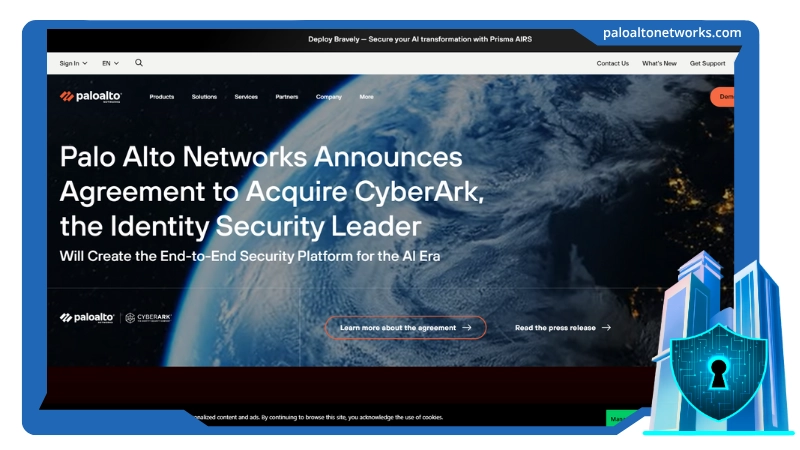
- Flagship products: Cortex XDR (threat detection), Prisma Cloud (cloud security), Cortex XSOAR (SOAR automation)
- Security model: Zero-trust network access (ZTNA) + AI-powered threat prevention
- Compliance support: NIST CSF, SOC 2, ISO 27001, HIPAA, PCI DSS
- Ideal for: Large enterprises, hybrid cloud environments, MSSPs requiring consolidated platforms
Key Strength: Unified security across hybrid environments with the deepest AI integration of any single vendor.
2. CrowdStrike — The Benchmark for Endpoint Detection and Response (EDR)
CrowdStrike has become synonymous with endpoint detection and response (EDR). Its Falcon platform combines AI-powered threat intelligence with behavioral analytics to stop attacks before they spread. CrowdStrike is a consistent leader in Forrester’s Wave for Endpoint Security.
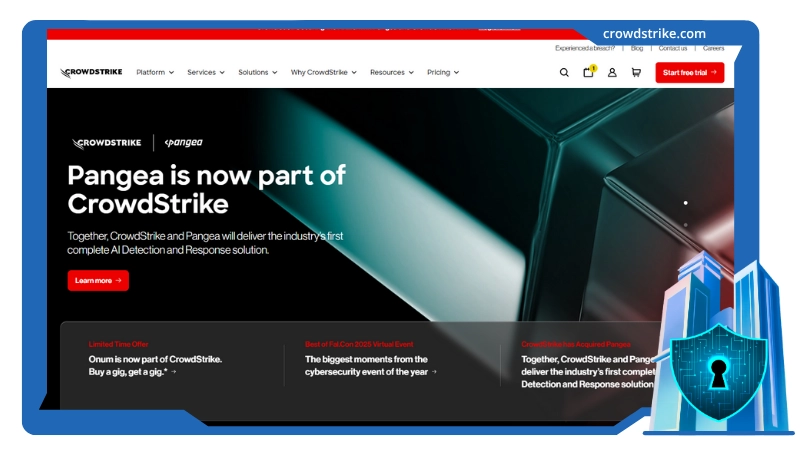
- Flagship product: CrowdStrike Falcon (EDR/XDR, identity protection, threat intelligence)
- Security model: Cloud-native EDR with behavioral AI — no on-premises footprint required
- Response capability: Threat hunting + Falcon OverWatch 24/7 managed detection
- Ideal for: Security-mature mid-market and enterprise organizations prioritizing endpoint and identity
Key Strength: Fastest mean-time-to-detect (MTTD) of any EDR platform, with unmatched threat intelligence breadth.
3. Fortinet — Best Cybersecurity Services for Unified Network Protection
Fortinet delivers end-to-end cybersecurity through its FortiGate next-generation firewalls and Security Fabric platform. Known for high-performance network security, Fortinet integrates AI-based threat analysis and secure SD-WAN — making it a top choice for distributed and remote teams requiring a unified SASE architecture.
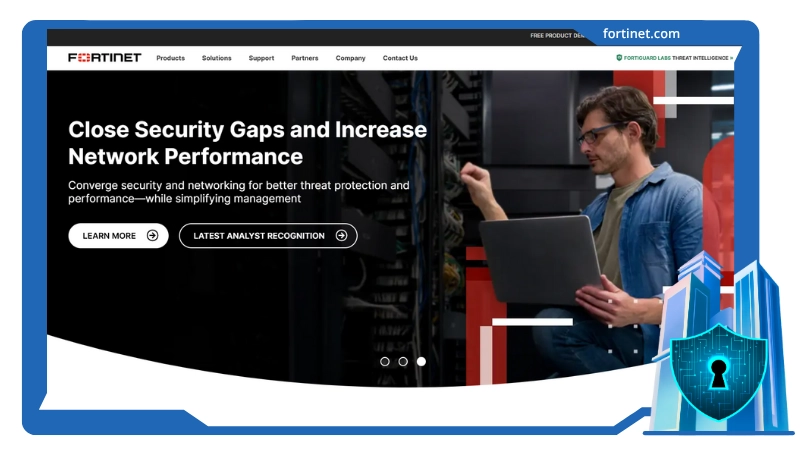
- Flagship products: FortiGate NGFW, FortiSIEM, FortiEDR, FortiNAC
- Security model: Unified SASE + SD-WAN + zero-trust network segmentation
- Compliance support: GDPR, PCI DSS, HIPAA, SOC 2
- Ideal for: Distributed enterprises, retail chains, healthcare networks, and remote-workforce-heavy orgs
Key Strength: Best price-to-performance ratio for network security at scale — especially for non-US enterprise markets.
4. Cisco Systems — Enterprise-Grade Protection for Hybrid IT Environments
Cisco leverages its global networking dominance to deliver integrated cybersecurity. Its SecureX platform connects email, cloud, endpoint, and network security with automation and cross-domain threat visibility — reducing mean time to respond (MTTR) significantly.
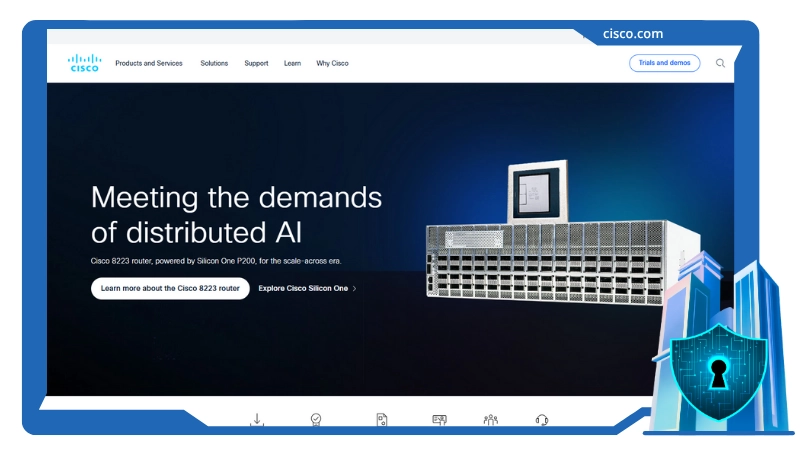
- Flagship products: Cisco SecureX, Duo (identity/MFA), Umbrella (DNS security), Talos Threat Intel
- Security model: Zero-trust + integrated SecOps across Cisco and third-party tools
- Compliance support: FedRAMP, HIPAA, ISO 27001, SOC 2
- Ideal for: Cisco-native IT environments and enterprises requiring tight networking + security integration
Key Strength: Talos threat intelligence — one of the largest commercial threat research teams in the world.
5. Check Point Software Technologies — Prevention-First Cybersecurity at Enterprise Scale
Check Point continues to lead in prevention-focused security. Its Infinity Architecture provides consolidated threat prevention across network, cloud, and mobile environments, while Quantum Security Gateways deliver high-throughput protection with minimal latency.
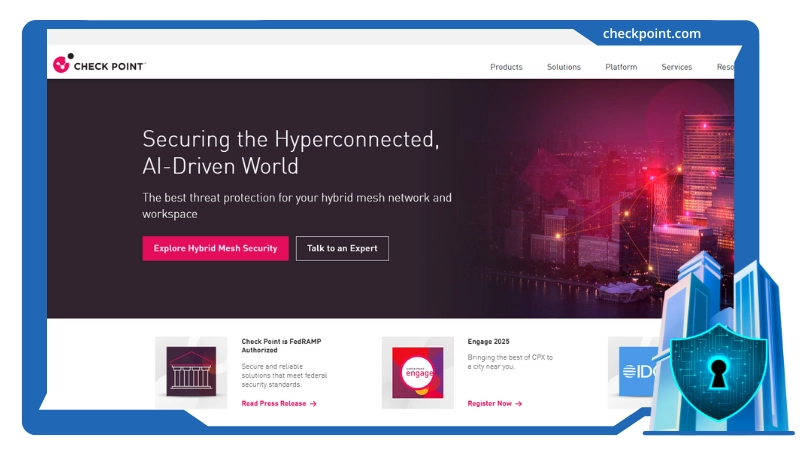
- Flagship products: Harmony (endpoint + email), CloudGuard (cloud), Quantum (network)
- Security model: Prevention-first — block threats before they reach systems (vs. detect-and-respond)
- Compliance support: ISO 27001, PCI DSS, GDPR, SOC 2, NIST
- Ideal for: Compliance-heavy industries (finance, healthcare, government) requiring low false-positive rates
Key Strength: Industry-leading threat catch rate with a consolidated platform that reduces vendor sprawl.
6. IBM Security — Best for Enterprise SIEM and Managed Security Services
IBM Security provides broad protection through its QRadar SIEM and X-Force Threat Intelligence services. Known for strong consulting and managed security services, IBM helps enterprises build robust cyber resilience strategies.
Key Strength: Integrated threat management and consulting expertise.
7. Microsoft Security — AI-Enhanced Protection for Microsoft-Native Stacks
Microsoft Security protects billions of endpoints globally through Defender for Cloud, Microsoft Sentinel (cloud-native SIEM), and Entra ID. Its large telemetry base — processing 65 trillion signals per day — makes it one of the most data-informed cybersecurity ecosystems available at any price point.
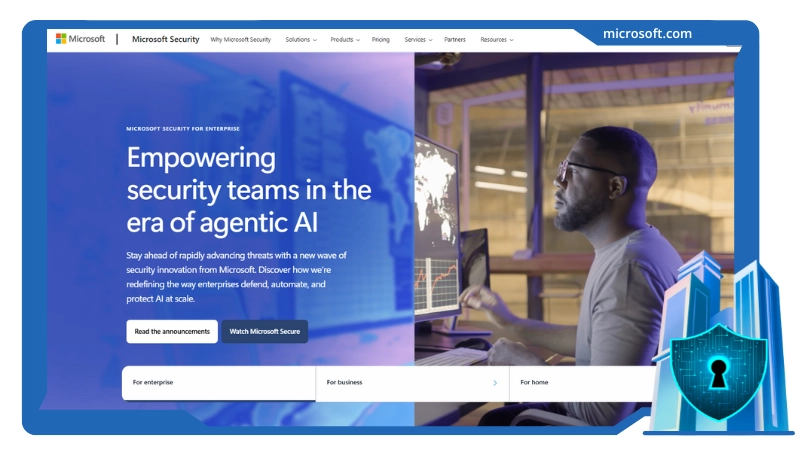
- Flagship products: Microsoft Defender (endpoint/cloud), Sentinel (SIEM/SOAR), Entra ID (identity)
- Security model: Integrated identity + cloud + endpoint with AI Copilot for Security
- Compliance support: ISO 27001, SOC 2, FedRAMP, GDPR, HIPAA, NIST
- Ideal for: Organizations already on Microsoft 365 or Azure — dramatically reduces integration complexity
Key Strength: Unmatched value-for-money for M365/Azure shops — security already embedded in the licenses you own.
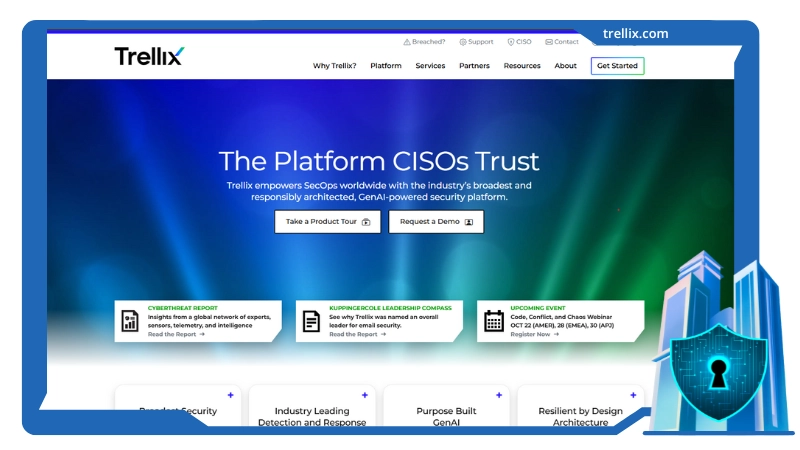
8. Trellix — Advanced XDR and Incident Response for Complex Environments
Formed from the merger of McAfee Enterprise and FireEye, Trellix brings together two legacy cybersecurity powerhouses. Its XDR (Extended Detection and Response) platform delivers cross-environment threat visibility with strong incident forensics — a natural fit for organizations managing multi-vendor stacks.
- Flagship products: Trellix XDR, Trellix EDR, Trellix Email Security
- Security model: Extended detection and response (XDR) across endpoints, network, email, and cloud
- Compliance support: ISO 27001, NIST CSF, GDPR, SOC 2
- Ideal for: Mid to large enterprises with heterogeneous IT environments requiring unified detection
Key Strength: FireEye-heritage incident response expertise — battle-tested in nation-state and APT investigations.
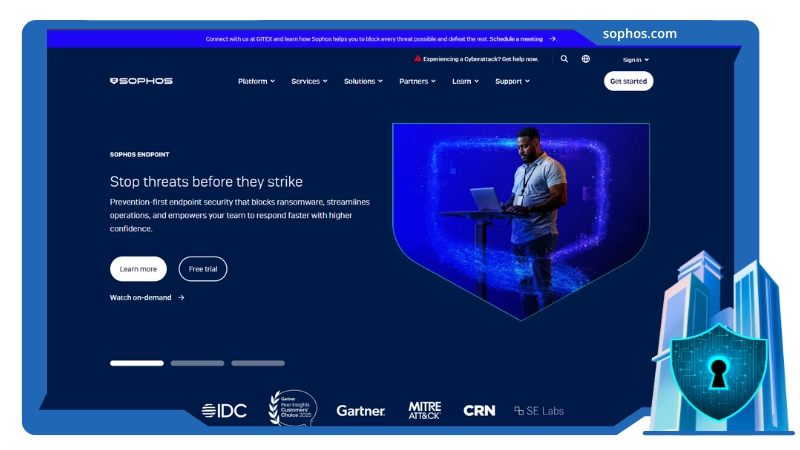
9. Sophos — Best Cybersecurity Company for Small and Midsize Businesses
Sophos specializes in simplifying cybersecurity for SMBs without compromising protection depth. Its Intercept X platform uses deep-learning AI to stop ransomware and zero-day exploits before they execute — all manageable through a single cloud-based console.
- Flagship products: Intercept X (endpoint), Sophos Firewall, Sophos MDR
- Security model: Deep-learning AI for endpoint + managed detection and response (MDR) option
- Compliance support: ISO 27001, GDPR, HIPAA (via partner integrations)
- Ideal for: SMBs, MSPs managing multiple clients, and organizations without dedicated security staff
Key Strength: Best SMB-to-enterprise handoff path — Sophos MDR provides 24/7 threat monitoring without in-house SOC investment.
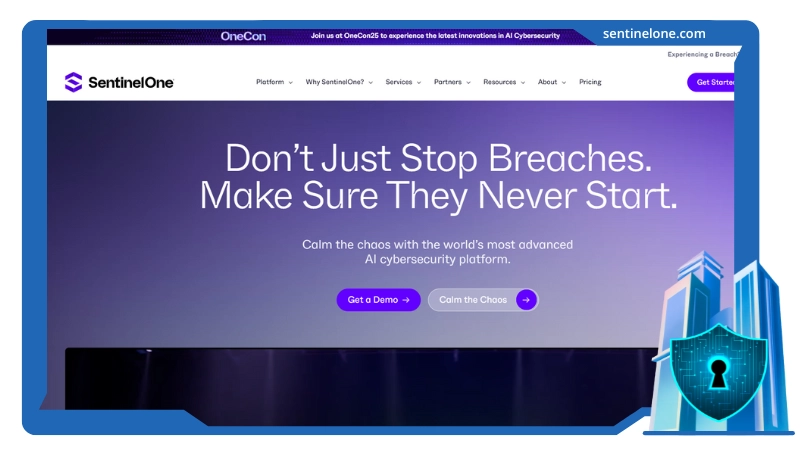
10. SentinelOne — Autonomous AI Endpoint Protection for Speed-First Teams
SentinelOne‘s Singularity Platform uses autonomous AI to identify, contain, and remediate threats in real-time — including a patented ‘rollback’ capability that reverses damage from ransomware attacks automatically. It is the fastest-growing EDR vendor by revenue among enterprise buyers.
- Flagship product: SentinelOne Singularity (EDR/XDR, cloud workload protection)
- Security model: Autonomous AI — no manual analyst input required for initial threat containment
- Compliance support: ISO 27001, SOC 2, FedRAMP, NIST, HIPAA
- Ideal for: DevSecOps teams, cloud-native organizations, and security teams prioritizing response speed
Key Strength: Industry-only automatic ransomware rollback — SentinelOne can restore encrypted files without backup restoration.
Generate quality cybersecurity leads with lead generation today!
What Should You Look for in the Best Cybersecurity Service Providers?
Selecting the right cybersecurity partner depends on your organization’s size, risk exposure, existing tech stack, and compliance obligations. Use this framework to build a shortlist that matches your operational reality.
Step 1: Define your threat model and risk profile
Before evaluating vendors, classify what you are protecting. Regulated data (PII, PHI, financial records) demands different controls than IP or operational systems. Identify your highest-risk attack vectors — endpoint, identity, cloud, or supply chain — before shortlisting.
Step 2: Match the security model to your architecture
Choose between prevention-first (Check Point), detect-and-respond (CrowdStrike, SentinelOne), or managed service (IBM, Sophos MDR) models. If you run primarily on Microsoft Azure or M365, Microsoft Security’s native integration will outperform standalone tools.
Step 3: Evaluate EDR vs. XDR coverage
EDR (Endpoint Detection and Response) focuses on device-level protection. XDR (Extended Detection and Response) extends visibility across endpoints, networks, email, identity, and cloud in a single platform. For organizations with complex multi-vector environments, XDR from CrowdStrike, Trellix, or SentinelOne will reduce analyst alert fatigue significantly.
Step 4: Confirm zero-trust and compliance readiness
Verify that the vendor supports zero-trust network access (ZTNA) as a core architectural principle — not just a marketing term. Check specific compliance certifications relevant to your industry: NIST CSF for federal/regulated sectors, ISO 27001 for global operations, HIPAA for healthcare, PCI DSS for payments.
Step 5: Assess managed services and SOC availability
If your organization lacks in-house security analysts, prioritize vendors offering managed detection and response (MDR) or MSSP services. Sophos MDR, CrowdStrike Falcon Complete, and IBM Managed Security Services all provide 24/7 coverage without requiring internal SOC headcount.
Step 6: Request proof-of-concept (POC) data
Ask each vendor shortlisted for their mean-time-to-detect (MTTD), mean-time-to-respond (MTTR), and false-positive rate benchmarks from independent tests (MITRE ATT&CK evaluations are the industry standard). Vendors that cannot provide these metrics should be deprioritized.
Related: Where and How to Get New Cybersecurity Leads
How Do the Best Cybersecurity Companies Differ by Industry?
Not all cybersecurity platforms serve every sector equally. The table below maps the top cybersecurity providers to their strongest industry fit.
| Industry | Recommended Providers | Primary Reason |
| Financial Services & Fintech | Check Point, Palo Alto, IBM Security | PCI DSS compliance depth, fraud detection, SOC 2 alignment |
| Healthcare & Life Sciences | Microsoft Security, Cisco, Fortinet | HIPAA compliance, EHR protection, device security at scale |
| Government & Defense | Palo Alto, Cisco (FedRAMP), SentinelOne | FedRAMP authorization, zero-trust mandates, classified environments |
| Technology & SaaS | CrowdStrike, SentinelOne, Trellix | DevSecOps integration, cloud workload protection, rapid deployment |
| Retail & E-Commerce | Fortinet, Sophos, Check Point | PCI DSS, distributed store networks, ransomware resilience |
| SMB / Mid-Market | Sophos, Microsoft Defender, CrowdStrike Falcon Go | Cost-effective MDR, managed console, minimal IT overhead |
Are You a Cybersecurity Vendor? How to Build Pipeline in 2026
For cybersecurity companies, maintaining visibility and trust in the market depends on more than product quality. Reaching IT decision-makers who are actively evaluating solutions requires a strategic, multi-channel approach. Callbox specializes in cybersecurity lead generation — helping vendors connect with CISOs, IT directors, and procurement leaders through targeted outreach, appointment setting, and account-based marketing.
If you are scaling pipeline for a cybersecurity product or MSSP offering, explore how our B2B appointment setting for technology companies can accelerate your sales cycle. We have helped over 1,000 technology vendors — including cybersecurity, SaaS, cloud, and managed services providers — build qualified, sales-ready pipelines across North America, APAC, and Europe.
The Bottom Line: Choosing the Right Cybersecurity Partner in 2026
Cybersecurity is no longer an IT expense — it is a business continuity investment. The leading cybersecurity companies of 2026 combine autonomous AI, zero-trust architecture, and human-led threat intelligence to keep organizations resilient against an ever-expanding attack surface that now includes cloud infrastructure, identity systems, supply chains, and AI-generated phishing.
When shortlisting providers, prioritize alignment between their security model (EDR, XDR, MDR, or SASE) and your actual attack surface. Use the MITRE ATT&CK evaluation benchmarks to validate real-world detection performance — not vendor marketing materials alone.
Frequently Asked Questions
What should I look for in the best cybersecurity service providers?
Evaluate EDR/XDR endpoint coverage, zero-trust network access (ZTNA), 24/7 SOC or MSSP availability, compliance with NIST CSF/ISO 27001/SOC 2, threat intelligence quality, and integration compatibility with your existing stack.
How much do enterprise cybersecurity services typically cost?
Enterprise cybersecurity services range from $50,000 to $500,000+ annually, depending on scope and company size. Mid-market MSSP contracts average $8,000–$25,000/month. EDR platform licenses typically run $15–$65 per endpoint per year.
What is zero-trust architecture in cybersecurity?
Zero-trust is a security model that requires continuous verification of every user, device, and connection — even inside the network perimeter. It assumes no implicit trust and is considered a foundational framework for modern enterprise cybersecurity by NIST and CISA.


