How to Increase Medical Device Sales in 2026
Explore proven medical device sales strategies for reaching healthcare buyers, generating qualified leads, and creating a more predictable sales pipeline.
 Jude Neilson
Jude Nielson is a Business Development Manager at Callbox Inc, with 12 years of experience driving B2B growth through strategic lead generation and sales development.
View full bio of Jude Neilson
If you’re a VP of Sales or CRO staring at a flat medical device pipeline, the instinct is usually to add headcount. Hire two more reps, split the territory, hope the numbers move. In 2026, that instinct is usually wrong. AI lead generation services can help medical device companies use AI-assisted targeting and engagement to identify higher-value accounts without simply adding more salespeople.
Medical device sales increase fastest when a clearly defined ideal customer profile drives multi-channel outbound, voice, email, LinkedIn, and event follow-up, against named accounts, with every touch tracked in one system through the entire committee-based buying cycle. Companies that need to turn those targeted prospects into qualified sales conversations can also use B2B appointment setting services to move qualified opportunities further through the pipeline.
None of that requires more reps. It requires a defined pipeline system, whether you build it internally or work with Callbox to run it. This guide covers why the old approach to medical device sales is breaking down, what a modern multi-channel pipeline looks like, how to run the ROI math, and how to vet a lead generation partner if you decide to outsource.
Why Are Medical Device Sales Cycles Taking Longer to Close?
Selling a new implant system or a capital equipment line has never resembled a straightforward transaction, and it’s gotten more complex, not less. A Value Analysis Committee, not a single physician, usually makes the final call, and that committee can pull in clinical staff, procurement, risk management, biomedical engineering, and finance before a purchase order gets signed. Layer on data handling questions tied to HIPAA, FDA classification questions buyers will ask about upfront, and budget cycles tied to a hospital’s fiscal year, and a deal that looked close in January can still be open in September.

The practical effect is a sales cycle that regularly runs 6 to 18 months, depending on whether you’re selling disposables or capital equipment. Reps who are also responsible for filling their own pipeline end up splitting time between chasing net new accounts and nursing existing opportunities through six or more internal sign offs. Something has to give, and in most organizations it’s prospecting. The accounts already in motion get the attention, and top of funnel activity quietly stalls until someone notices the pipeline looks thin three months later.
What Channels Actually Move Medical Device Sales Forward?
No single channel carries a medical device pipeline on its own anymore, and treating outbound as one email sequence or one trade show booth is the fastest way to plateau. The channel mix that’s actually producing qualified conversations in 2026 looks like this.
- Multi-channel outbound: coordinated voice, one-to-one email, and LinkedIn outreach aimed at named accounts, not a purchased list, is what gets in front of the procurement and clinical stakeholders who actually influence a VAC decision. For companies evaluating AI-assisted approaches, this also makes it useful to compare AI lead generation agencies in the US based on their targeting capabilities, channel coverage, and ability to connect AI workflows with human sales execution.
- Event and trade show follow-up: conferences like AAOS, HIMSS, and RSNA still generate a meaningful share of medtech pipeline, but only for the companies that own structured follow-up in the weeks after the booth comes down.
- This account-level approach becomes even more important when evaluating leading generative AI companies for enterprise, where buying decisions can involve multiple technical, operational, financial, and executive stakeholders.
 Industry Insight: Physical events and trade shows are used by roughly a third of B2B marketers, nearly matching digital-first tactics like SEO for adoption, according to HubSpot`s State of Marketing research. For a category like medical devices, where clinicians want hands-on time with a product before they`ll advocate for it internally, that channel isn`t optional. It only pays off with a real follow-up process behind it.
The common failure point isn’t any single channel underperforming. It’s that most in-house teams run these channels separately, in separate spreadsheets and separate inboxes, with no shared view of which touch actually moved an account forward. This is where AI SDR tools for lead generation can complement human sales development by automating repetitive prospecting and engagement tasks while keeping account-level activity visible across the pipeline.
Curious what this looks like against a real device manufacturer’s numbers? Callbox recently helped a global medical technology company fix a leaking funnel and rebuild a steadier flow of qualified US accounts. Read the full breakdown of that engagement.
How Do You Calculate ROI Before Hiring a Partner?
This is the section your CFO will actually read, so keep the math honest and simple. Before you evaluate a single vendor, pull three numbers you already have sitting in your own CRM.

- Average deal value for a new device account. First-year contract value works fine as a proxy.
- Your current close rate from qualified appointment to signed contract.
- The fully loaded cost of the program you’re evaluating, including any internal hours spent managing it.
From there, the framework is simple. Projected pipeline value equals qualified appointments generated, multiplied by your historical close rate, multiplied by average deal value. ROI equals projected pipeline value minus program cost, divided by program cost. Run this before you sign anything, and run it again with conservative assumptions to see if the math still holds.
Worked example: say a program is projected to deliver 40 qualified appointments over six months. Your historical close rate on qualified appointments is 20 percent, and your average first year contract value is 35,000 dollars. That’s a projected pipeline value of 40 times 0.20 times 35,000, or 280,000 dollars, against a program cost of, say, 60,000 dollars for the same period. That works out to roughly a 3.7x return before a single deal has actually closed. The number that matters more than total ROI, though, is payback period: how many months until the pipeline value generated covers the program cost, since medical device deal cycles mean that answer usually lands later than in faster moving B2B categories.
Expert Tip for C-Suite Leaders: Don`t evaluate a lead generation partner on cost per lead alone. Ask them to walk you through cost per qualified appointment, and eventually cost per closed deal once you have a few months of data. In medical device sales, a slightly more expensive appointment that`s already qualified against your ICP is almost always cheaper than a high volume of raw leads your reps have to filter themselves.
How Do You Evaluate a Medical Device Agency?
Once the ROI math pencils out, run any partner you’re considering through these checks before you sign a contract.
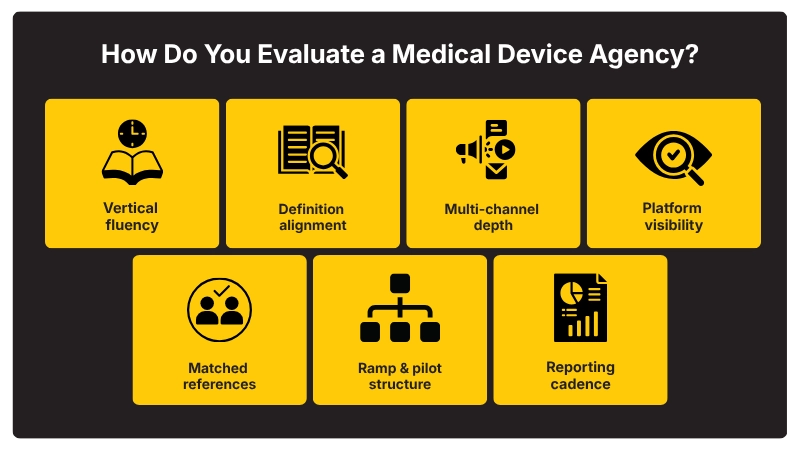
- Vertical fluency. Ask for evidence they’ve sold into hospitals, IDNs, or ambulatory surgery centers specifically, not “healthcare” in general. A medical device buying committee behaves differently than a hospital software buying committee. Geographic specialization can matter as well, particularly for companies targeting concentrated markets. For example, teams evaluating AI lead generation in New York should assess whether a provider understands the region’s target accounts, buyer landscape, and competitive environment.
- Definition alignment. Get their exact definition of a Sales Qualified Lead in writing, and compare it against your own CRM stages before the contract starts, not after your first monthly report.
- Multi-channel depth. Confirm voice, email, LinkedIn, and event follow-up run as one coordinated sequence against the same accounts, not siloed hand-offs between separate teams.
- Platform visibility. Ask what system tracks every touch, ideally a real platform like Callbox Pipeline, not a monthly PDF recap after the fact.
- Category-matched references. A reference client selling capital equipment won’t tell you much if you sell disposables, and vice versa. Ask specifically for references in your device category.
- Ramp and pilot structure. Ask how long ramp-up actually takes, and whether a shorter pilot is available before a full annual commitment.
- Reporting cadence. Confirm how often you’ll see qualified appointment counts and pipeline value, not just activity metrics like calls dialed or emails sent.
If you want a side-by-side look at how several outsourced options stack up against these criteria, Callbox has already broken down the leading medical device lead generation companies worth putting on your shortlist.
What Results Should You Expect From a Sales Pipeline?
The same principle applies as AI becomes more embedded in B2B prospecting. AI-powered B2B lead generation advantage comes from using technology to improve targeting, personalization, and sales efficiency rather than treating automation as a replacement for the human conversations required in complex medical-device sales.
In the first 60 to 90 days, expect qualified conversations to build steadily rather than spike. Named account outreach aimed at VAC level stakeholders takes longer to warm up than a broad prospect list, and that’s expected, not a red flag. What you should see by month three or four is a consistent, predictable number of qualified appointments landing on your reps’ calendars every month. That predictability, more than any single big number, is the metric that correlates with pipeline value six to twelve months later, once those early conversations have had time to move through a full VAC cycle.
Frequently Asked Questions
How Long Until You See Medical Device Sales Results?
Most programs need 60 to 90 days to ramp fully. Building and validating a named account list, then running a complete voice, email, and LinkedIn sequence against it, takes longer in medtech than in faster cycle B2B categories. Expect qualified appointment volume to become predictable by month three or four rather than in the first few weeks.
What Close Rate Is Realistic for Medical Device Sales?
Close rates vary widely by product category, but a well qualified appointment run against a validated ideal customer profile typically closes at a meaningfully higher rate than an unqualified cold lead. Track this by comparing close rate on outsourced appointments against your existing pipeline over a full quarter, since a single month of data will be misleading given how long device deals take to close.
Should You Outsource Medical Device Sales Outreach?
It depends on internal capacity. Companies with an established SDR function often keep outreach in house and outsource only overflow work or new market expansion. Companies without dedicated SDR headcount usually reach a full pipeline faster by outsourcing the prospecting motion and keeping reps focused on selling.