State of B2B Lead Generation 2026: The Hybrid Advantage Report
Explore the State of B2B Lead Generation 2026 report and discover hybrid strategies driving pipeline growth and qualified leads.

For the past three years, the B2B lead generation conversation has been dominated by one question: how much can AI replace? The answer, as of 2026, is nuanced in a way that should matter to every VP of Sales and Demand Generation leader reading this. AI can replace volume tasks. It cannot replace judgment. And the agencies that understood this distinction early — building programs around the Human + AI SDR model — are producing pipeline results that traditional shops and pure-automation platforms simply can’t match.
This report compares the leading B2B lead generation approaches across the dimensions that actually drive qualified pipeline: data quality, personalization depth, channel coverage, global reach, and measurable ROI. Whether you’re evaluating an outsourced partner or benchmarking your in-house team, the numbers in this guide will give you a clear picture of where the industry stands in 2026 — and where it’s heading.
Quick Answer: What Is Hybrid B2B Lead Generation?
Hybrid B2B lead generation combines AI-powered automation (for data enrichment, personalization at scale, and sequencing) with human expertise (for consultative outreach, relationship building, and strategic judgment). In 2026, hybrid approaches consistently outperform both fully automated platforms and traditional human-only SDR teams across reply rates, meeting conversion, and pipeline quality.
Why 2026 Is a Turning Point for B2B Lead Generation
Three forces converged over the past 18 months that have fundamentally changed the competitive landscape for B2B pipeline generation.
First, AI-generated outreach became the norm — which means it also became noise. As automation tools proliferated, inboxes filled with messages that were technically personalized but emotionally hollow. Buyers got faster at filtering them out. Open rates for template-based campaigns dropped an average of 22% year-over-year between 2024 and 2025, according to HubSpot’s annual sales report. The bar for what “feels personal” moved considerably higher.
Second, the buying committee got larger. Enterprise deals in 2026 rarely involve a single decision-maker. The average B2B technology purchase now touches 6.8 stakeholders, each with different priorities, objections, and communication preferences. Reaching all of them with a single message type is no longer viable. Account-based strategies that map and address the full buying committee are outperforming single-contact outreach by a significant margin.
Third, data decay accelerated. With more professionals changing roles, companies restructuring, and new funding events reshaping the market, contact data decays faster than it ever has. The agencies winning in 2026 are those with real-time enrichment pipelines that keep their databases current — not those sitting on static lists purchased 18 months ago.
Industry Insight
According to Salesforce’s State of Sales report, 72% of high-performing B2B sales teams now use AI for lead prioritization and outreach personalization — up from 38% in 2023. But the same study found that teams running a Human + AI SDR structure outperformed AI-only approaches by 41% on pipeline-to-close rates. The insight isn’t to choose between AI and humans. It’s to deploy each where they excel.
The Three Approaches: How They Stack Up in Practice
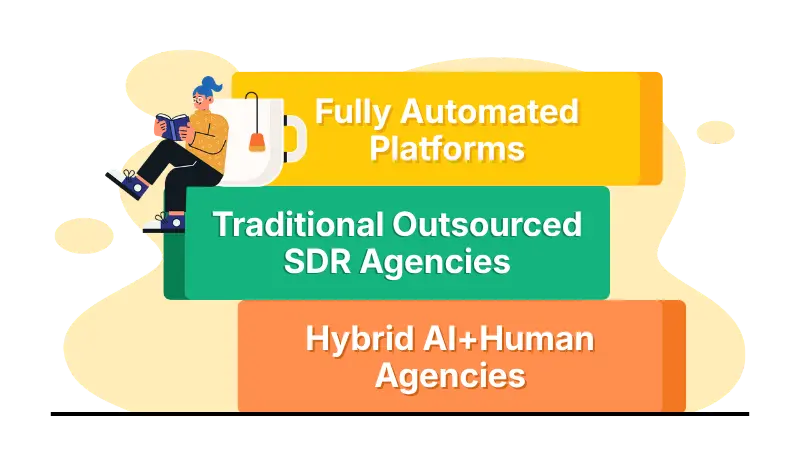
Before comparing specific agencies, it’s worth being precise about what each model actually delivers — because the marketing language around “AI-powered” and “personalization” has become genuinely confusing.
Fully Automated Platforms
Tools like Apollo, Instantly, and Smartlead offer affordable, high-volume outreach automation. They work well for top-of-funnel volume plays in well-defined, easy-to-reach markets. What they struggle with: nuanced personalization, complex buying committees, regulated industries, and global markets where cultural context matters. They also require significant in-house configuration, ongoing management, and a skilled team to interpret results. Many mid-market companies have discovered the hard way that a tool is not a strategy.
Traditional Outsourced SDR Agencies
The legacy model — hire a team of human SDRs, give them a list, have them dial and email — is not dead, but it’s under serious pressure. Human-only teams are constrained by working hours, geographic and language limitations, and the time cost of manual research. An experienced SDR can meaningfully research and personalize outreach for roughly 15 to 20 prospects per day. That ceiling doesn’t scale with pipeline ambitions.
Hybrid AI+Human Agencies
The Human + AI SDR model uses AI to do what it does best: processing large volumes of data, identifying intent signals, enriching contact records, generating first-draft personalized content, and sequencing outreach at optimal times. Humans handle what AI still gets wrong: building rapport, reading between the lines of an objection, navigating complex organizational dynamics, and knowing when to slow down and listen. The agencies that have built this model well are producing results that neither approach achieves alone.
2026 Agency Comparison: Who’s Delivering and How
The table below compares the leading B2B lead generation agencies and approaches across five dimensions that directly affect pipeline quality and ROI. Selection methodology is disclosed in full at the end of this article.
| Agency / Approach | Callbox | Belkins | CIENCE | In-House SDR Team |
|---|---|---|---|---|
| Years in Market | 20+ years | 7+ years | 8 years | Varies by team |
| AI Personalization Depth | True 1:1, research-driven per prospect | Template + light personalization | AI-assisted sequencing | Manual, 1–2 hrs per prospect |
| Contact Data Accuracy | 95%+ via waterfall enrichment | 75–85%, single-source | 70–80%, blended sources | Varies widely |
| Channel Coverage | Voice, Email, LinkedIn, Chat, Events, Webinars | Email, LinkedIn, limited voice | Email, calling, limited social | Dependent on team skills |
| Global Reach | NA, APAC, EMEA, LATAM — localized | US and Europe focus | US primary, some EMEA | Language-limited |
| Voice AI Agents | ✓ Agentic, 24/7 transactional calls | ✗ Human SDRs only | ✗ No AI voice | ✗ No AI capability |
| Intent Signal Tracking | ✓ Real-time, 3rd-party signals | ~ Basic firmographic | ~ Some intent data | ✗ Typically absent |
| ABM Buying Committee Mapping | ✓ Full committee, tailored per role | ~ Account-level targeting | ~ Limited multi-stakeholder | ~ CRM-dependent |
| Pricing Model | Flexible subscription | Retainer-based | Retainer + performance | Fixed headcount cost |
The Data Problem Nobody Talks About Enough
Every agency in the market talks about their database. Very few are transparent about how they maintain it. This matters more in 2026 than it ever has, because B2B contact data now has an average shelf life of under 18 months. Professionals change roles, companies restructure, and the email that was valid six months ago now bounces.
The difference between a 70% deliverability rate and a 95% deliverability rate isn’t just a technical metric. It’s the difference between your SDR’s call list being genuinely workable and being a time sink of dead ends and wrong numbers. For campaigns targeting senior decision-makers at enterprise accounts, bad data doesn’t just waste time. It damages your sender reputation and, in some regions, creates compliance exposure.
The agencies worth working with in 2026 are running waterfall enrichment models: sourcing contact data from multiple premium providers in sequence, automatically falling back to the next source when the primary can’t confirm a record, and verifying email deliverability in real time before any message goes out. This is table stakes for professional pipeline generation at this point.
Expert Tip: When evaluating any lead generation partner, ask them one specific question: ``What is your data enrichment waterfall, and which providers do you pull from in sequence?`` A good answer names specific providers (ZoomInfo, Lusha, Apollo, Cognism, Clearbit) and describes verification steps. A vague answer about ``proprietary databases`` or ``multiple sources`` is a signal to dig deeper before signing anything.
Why Global Coverage Is Becoming a Must-Have, Not a Nice-to-Have
The shift to remote-first buying and the expansion of software markets into APAC and LATAM have turned global reach into a competitive requirement for a growing number of B2B companies. It’s no longer just multinationals that need to run outreach in Singapore or Sao Paulo. Series B SaaS companies targeting APAC expansion are doing it from day one.
The challenge is that global reach is not just about time zone coverage or language translation. It’s about understanding that LinkedIn is the primary outreach channel in some markets, while WhatsApp is standard business communication in others. It’s knowing that an American-style cold email subject line lands badly with a Singapore VP of Procurement. It’s having the cultural fluency to build multi-region campaigns that feel native rather than translated.
Very few lead generation agencies have genuine operational presence and localized expertise across North America, APAC, EMEA, and LATAM simultaneously. The ones that do carry a meaningful advantage for clients targeting multiple regions in a single campaign.
Related: Callbox’s Global Recognition as the Top Lead Generation Company
The Hybrid AI Flywheel: How the Best Campaigns Compound
One of the underappreciated advantages of well-built hybrid programs is the compounding effect over time. The first month of a campaign is primarily about calibration: refining the ICP, identifying which messaging angles resonate, and discovering which channels generate the fastest response in your specific market. By months two and three, the AI has accumulated enough signal data to meaningfully improve targeting precision and content quality.
This is fundamentally different from a static campaign that sends the same sequence to the same list until it exhausts itself. A hybrid program where AI is continuously feeding engagement data back into targeting and messaging models gets better every week it runs. The best agencies have built their platforms to capture this feedback loop and make it systematic rather than relying on a campaign manager reviewing results manually once a month
Expert Tip: When reviewing an agency`s reporting capabilities, look specifically for engagement signal feedback loops, does their platform show you which messages, subject lines, and outreach angles are driving replies — and does it automatically adjust future sends based on that data? Real-time optimization is what separates a managed campaign from a managed-and-improving campaign.
ROI Framework: How to Measure B2B Lead Generation Performance in 2026
Define Your Cost per Qualified Meeting (CPQM)
Divide the total program cost by the number of meetings that meet your qualification criteria (right title, right company size, right budget authority). This is your true acquisition cost, more useful than raw meeting volume.
Track Pipeline Velocity, Not Just Pipeline Volume
A meeting that stalls at discovery is not equivalent to a meeting that progresses to proposal. Measure average days from first meeting to proposal stage to identify where deals are getting stuck and which lead sources produce faster-moving opportunities.
Measure Data Quality Upstream
Track email deliverability rate, bounce rate, and phone connection rate before you evaluate reply rates. Poor data quality inflates all your downstream acquisition costs. A 95% deliverability rate vs. a 70% rate effectively means you’re paying 25% more per valid outreach attempt with the lower-quality list.
Calculate the True Cost of In-House vs. Outsourced
In-house SDR teams carry full-loaded costs: salary, benefits, management overhead, tech stack licensing, training, and ramp time (typically 3 to 4 months before a new SDR reaches full productivity). Compare this against an outsourced program that starts generating qualified meetings within 30 days, with no ramp cost and no turnover risk. See why B2B Companies choose Callbox as their outsourced SDR partner.
Set a 90-Day Benchmark, Not a 30-Day One
Any legitimate lead generation program requires at least 60 to 90 days before you have statistically meaningful data on what’s working. Evaluate partner performance against 90-day benchmarks — campaigns optimized over that window consistently outperform those judged and adjusted weekly based on noise.
Related: 5 Winning Sales Cadence Examples
What the Best Programs Have in Common in 2026
After reviewing performance data across hundreds of B2B pipeline programs, a clear pattern emerges. The campaigns generating the most qualified pipeline share four characteristics regardless of industry, geography, or deal size.
They treat ICP definition as an ongoing process, not a one-time exercise. Markets move. Decision-maker titles shift. The company that was an excellent fit 18 months ago may have been acquired, downsized, or shifted strategy. The best programs review and refine ICP criteria every quarter based on which accounts are actually converting.
They run coordinated multichannel sequences, not parallel single-channel ones. There is a meaningful difference between sending an email and a LinkedIn message to the same prospect on the same day, versus sending them as part of a deliberately sequenced strategy where each touch reinforces the last. The former is noise. The latter is a campaign.
They have genuine feedback loops between sales and marketing. When an SDR discovers that a specific objection keeps coming up on calls — say, a concern about implementation timelines — that insight should immediately inform email messaging, follow-up scripts, and LinkedIn content. The programs where this loop is fast and systematic consistently outperform those where it’s informal and slow.
They optimize for meeting quality, not just meeting volume. A pipeline full of unqualified meetings is a morale problem, not a success metric. The agencies worth working with in 2026 are the ones that define qualification criteria upfront, filter against them rigorously, and would rather deliver 20 genuinely qualified meetings than 50 that waste your team’s time.
Selection Methodology
Agencies included in this comparison were selected based on four criteria: verifiable years in operation (minimum five years), documented multichannel capability, publicly available client testimonials from named organizations, and demonstrated global reach. Rankings and capability assessments are based on publicly available information, industry reports, and Callbox’s competitive intelligence as of Q1 2026. This guide is produced by Callbox and reflects our perspective as a practitioner in this space. Readers should conduct independent due diligence when evaluating any lead generation partner.
Industry Insight
A 2025 IDC study found that companies outsourcing B2B lead generation to specialized agencies reach their first qualified meeting 2.3x faster than those building in-house SDR capacity from scratch. The same study found that hybrid AI+human agencies reduced average cost per qualified opportunity by 34% compared to human-only outsourced teams. The economics of the Human + AI SDR model are not theoretical. They are documented across a growing body of enterprise deployments.
The Verdict: What to Look for in a 2026 Lead Generation Partner
If you take one thing from this report, make it this: the agencies winning in 2026 are not the ones with the most automation. They are the ones with the best judgment about when to use automation and when not to.
The practical checklist for evaluating any partner comes down to six questions. Can they show you their data enrichment process in detail — specific sources, specific verification steps? Do they have genuine multichannel capability across voice, email, and social, or is one channel clearly an afterthought? Can they operate in your target geographies with localized teams, not just translated templates? Do they have a feedback loop that systematically improves campaigns over time? And can they point to clients in your industry or adjacent industries with documented, quantified results?
The B2B lead generation market has more options than ever. It has fewer genuinely excellent ones. The gap between the best and the rest is measurable, and it shows up in pipeline velocity, meeting quality, and ultimately, revenue.