Callbox Unveils Next-Generation AI Stack for B2B Growth
Discover how Callbox uses AI across email, voice, and social to build B2B pipelines faster than traditional agencies.

The old playbook — templated emails, manual research, human-only calling — is producing diminishing returns. Here is how Callbox uses AI across every outreach channel to deliver pipeline results that traditional agencies simply cannot match.
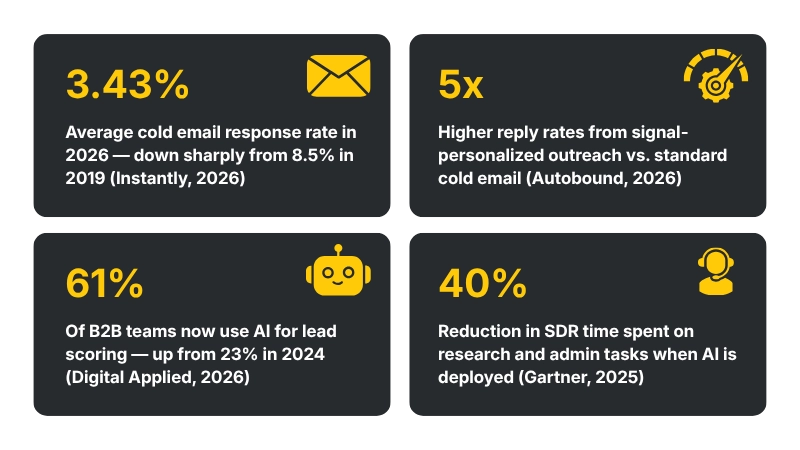
The average cold email response rate has dropped to 3.43% in 2026 — down from 8.5% just seven years ago. Inboxes are saturated. Buyers are savvier. And the spray-and-pray outreach model that powered a generation of B2B lead generation agencies is running out of road. The teams still winning pipeline in this environment share one thing: they are using AI not as a productivity add-on, but as the core engine of every outreach channel.
Callbox has spent 20 years building B2B pipeline for some of the world’s most recognized technology companies. What that track record makes clear is that AI-powered lead generation is not a feature upgrade — it is a fundamentally different approach to prospect identification, research, contact, and conversion. This article breaks down exactly how Callbox’s AI stack works across email, voice, social, and data, and why it produces results that traditional outreach cannot replicate.
What is AI-powered B2B lead generation?
AI-powered B2B lead generation uses machine learning, generative AI, and agentic automation to identify, research, and engage target prospects at a level of personalization and scale that humans cannot achieve manually. Rather than applying templates to contact lists, AI researches each prospect individually, generates unique outreach for every person, scores engagement signals in real time, and continuously optimizes targeting and messaging based on campaign outcomes.
The Problem With Traditional Lead Generation
Most B2B lead generation still operates on a model built for a different era. A contact list is sourced from a single data provider, loaded into a sequencing tool, and blasted with a template that swaps in a first name and company. The response rates are predictable — and predictably poor.
The issue is not effort. It is structure. Template-based outreach treats every prospect identically, which means it is relevant to almost none of them. Signal-personalized outreach achieves 15 to 25% reply rates, compared to the 3 to 5% industry average for cold email — a difference that compounds across every downstream metric, from meetings booked to pipeline generated to closed revenue.
Data quality compounds the problem further. Single-source contact lists deliver 60 to 75% accuracy at best, which means roughly one in three contacts is wrong before a campaign even launches. Stale emails bounce. Wrong phone numbers waste calling capacity. And because the data was never enriched with intent signals or trigger events, even the correct contacts are reached at random times with generic messages.
This is the gap Callbox’s AI stack is built to close — not incrementally, but structurally.
Email AI: From Mail Merge to True 1:1 at Scale
The most visible expression of Callbox’s AI advantage is in email personalization — and the gap between what most agencies do and what Callbox does is not a matter of degree. It is a matter of kind.
Template-based personalization inserts variable fields into a pre-written message. Every recipient gets the same email with minor surface-level substitutions. The prospect knows it. Their inbox filter knows it. And the response rate reflects it.
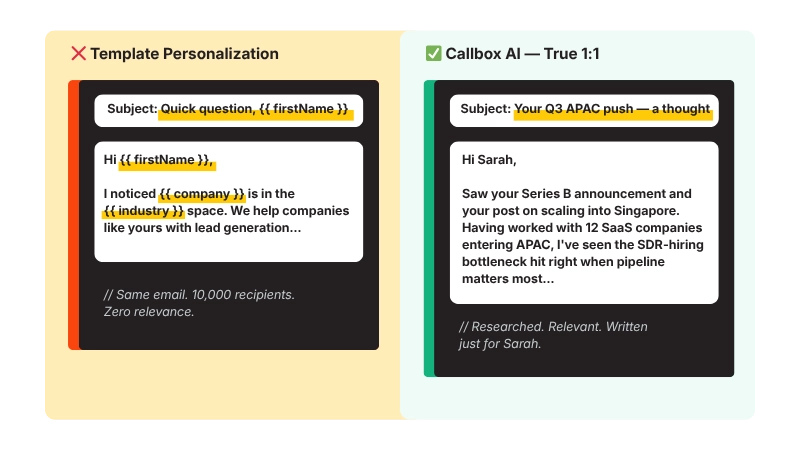
Callbox’s email AI works differently from the ground up. Before a single word is written, AI agents research each prospect individually — scanning their LinkedIn activity, recent company news, funding rounds, job postings, and professional context. That research is then synthesized into a unique email: a distinct subject line, a relevant opening, a tailored angle, and a CTA matched to where that person is likely to be in their decision process.
The result is not personalization as a feature — it is personalization as the output of genuine prospect intelligence. Highly personalized campaigns using multiple data signals boost reply rates by 142% compared to non-personalized outreach (Martal, 2025). Callbox’s campaigns consistently deliver 3 to 5x the reply rates of template-based alternatives, while producing 100% unique emails with zero duplicates across a campaign.
Expert Tip
The Follow-Up Is Where Most Teams Lose the Thread
Generic follow-up emails — “Just bumping this to the top of your inbox” — signal that the sender has nothing new to say. Callbox’s AI follow-up sequences layer in fresh value at every touch: a new trigger event, a relevant case study, a data point specific to the prospect’s industry. Each message builds on the last rather than repeating it, which is why Callbox’s follow-up sequences drive disproportionate response compared to single-touch campaigns.
Voice AI: Agentic SDRs That Never Clock Out
Cold calling at scale has always been a headcount problem. Every call a human SDR makes to confirm a meeting, follow up on a no-show, or remind a webinar registrant is a call they are not spending on consultative discovery. The math has never worked in favor of high-volume transactional calling — until agentic AI voice agents changed the equation entirely.
Callbox deploys conversational AI voice agents that handle the full range of outbound transactional call workflows, around the clock, without downtime. These are not robocalls or IVR trees. They are AI agents capable of natural conversation, dynamic responses to prospect replies, and seamless escalation to a human SDR when a call reaches the depth that requires genuine relationship-building.
What Callbox’s Voice AI Agents Handle
- Appointment confirmation calls: Proactively contacts confirmed leads 24 to 48 hours before a scheduled meeting, confirms attendance, offers to reschedule if needed, and delivers a warm context brief on what to expect. AI-confirmed meetings show a 40% higher show rate than unconfirmed bookings.
- Webinar and event activation: Reaches registered attendees with personalized calls that build anticipation, gather pre-event interest signals, and qualify leads before the event begins — so your team enters the room knowing who is worth the conversation.
- No-show recovery: When a prospect misses a meeting, an AI agent calls within minutes. Not hours. The window of opportunity is still warm, the agent is empathetic and professional, and the reschedule rate reflects the difference in timing.
- Post-demo follow-up: Calls prospects 24 hours after a demo to capture objections, answer FAQs, and surface next-step intent — gathering intelligence that your CRM would otherwise miss entirely.
- Trial and renewal nudges: For SaaS clients, AI agents proactively engage trial users approaching expiration, highlighting value moments and routing upgrade signals to Account Executives before the window closes.
- Warm human handoff: When a call reaches discovery depth, the AI agent transfers seamlessly to a human SDR with a live context brief — so the rep enters the conversation informed, not cold.
Industry Insight
The AI SDR Market Is Growing at 29.5% CAGR
The AI SDR market is projected to reach $15.01 billion by 2030, with 22% of teams already having replaced high-volume transactional calling with AI agents (MarketsandMarkets, 2025). The shift is not about replacing human sales skills — it is about deploying human SDRs where their skills actually matter, while AI handles the volume-intensive workflows that drain capacity without requiring genuine relationship intelligence.
Social AI: LinkedIn Outreach That Did Its Homework
LinkedIn has become the default channel for B2B social selling — and the default approach has followed the same path as email. Generic connection requests. Boilerplate pitches sent the moment a connection is accepted. Messages that reference nothing specific to the person receiving them.
Callbox’s social AI operates on the same research-first principle as its email approach. Before sending a connection request or InMail, AI agents analyze the prospect’s full LinkedIn profile, recent posts, shared content, career transitions, and engagement patterns. That intelligence shapes a connection note that references something real — a post they wrote, a challenge relevant to their current role, a transition they recently made.
Beyond individual outreach, Callbox’s social AI performs account-level mapping for ABM campaigns — identifying the full buying committee within a target account, distinguishing champions from blockers, and tailoring messaging for each stakeholder’s perspective and priorities. It also monitors for buying signals in real time: job changes, leadership hires, funding announcements, tech stack shifts, and content engagement patterns that indicate active research. Organizations using intent signal data report 47% better conversion rates compared to traditional lead scoring (Landbase, 2025).
Social touches are not managed in isolation. They are timed and sequenced in coordination with email and voice — so a prospect sees Callbox’s client on LinkedIn the same day a highly relevant email arrives in their inbox, creating the compound effect of multiple channels reinforcing the same message without feeling coordinated or pushy.
Data AI: Waterfall Enrichment That Closes the Quality Gap
Every outreach campaign is only as good as the data powering it. Callbox’s AI-driven data infrastructure addresses the quality gap at the source — before a single message is written or a single call is placed.
The process begins with AI-built Ideal Customer Profile modeling. Rather than applying a manually defined ICP to a static list, Callbox’s AI analyzes your best-fit existing customers to identify the firmographic, technographic, and behavioral patterns that predict conversion, then scores every target account against that model in real time.
Contact acquisition then runs through a waterfall enrichment engine that cycles through multiple premium data sources in sequence: ZoomInfo, Lusha, and Apollo at Tier 1, then Clearbit, Cognism, and Hunter.io at Tier 2 to fill gaps. Every email is validated before sending. Every phone number is confirmed as live. Every record is flagged for role changes, company exits, or stale data before it reaches a campaign. The result is 95%+ email deliverability — compared to 60 to 75% from single-source contact lists.
Beyond verification, each account record is enriched with firmographic depth (revenue band, headcount growth, funding stage, tech stack, subsidiary structure) and behavioral intelligence (G2 category research, Bombora intent signals, competitor evaluation activity, and web visit patterns). These signals tell Callbox’s AI not just who fits the ICP, but who is actively in-market right now — and why reaching them today is better than reaching them next month.
Expert Tip
Trigger Events Are the Most Underused Personalization Signal in B2B
A funding round, a new VP of Sales hire, a product launch, or a competitive displacement event are not just interesting data points — they are reasons to reach out that make outreach feel perfectly timed rather than cold. Callbox’s data AI surfaces trigger events per account and feeds them directly into messaging AI, so every outreach leverages a specific, timely hook that generic campaigns will never have.
Smart Engage: The Platform That Ties It All Together
Each of Callbox’s AI capabilities runs on Smart Engage — a proprietary platform built specifically for B2B pipeline generation. It is not a repurposed CRM or a generic marketing automation tool adapted for outbound. It is purpose-built for the coordinated, multichannel, AI-driven approach that defines the Callbox model.
Smart Engage provides native bi-directional sync with Salesforce, HubSpot, Pipedrive, and 20+ other CRMs, so leads, notes, call outcomes, and engagement signals flow automatically without manual data entry. Its real-time analytics dashboards surface open rates, reply rates, meeting conversion, pipeline velocity, and ROI by channel, campaign, persona, and geography. And its generative AI core produces emails, call scripts, LinkedIn messages, and follow-up sequences in the client’s brand voice — uniquely written per prospect, at any volume.
For global campaigns, Smart Engage also handles multi-region localization at the AI level — adapting tone, cultural references, regulatory compliance requirements, and channel preferences for North America, APAC, EMEA, and Latin America from a single unified campaign setup. No separate agency for each region. No inconsistent messaging across markets.
How Callbox Compares to Traditional Agencies
| Capability | ✦ Callbox AI | Typical Agency | In-House SDR Team |
|---|---|---|---|
| Email Personalization | True 1:1 AI-crafted per prospect | Template with merge tags | Manual, 1-2 hrs per prospect |
| Contact Data Accuracy | 95%+ waterfall enrichment | Single-source, 60-75% | Varies widely |
| Voice AI Agents | ✓ Agentic, 24/7 transactional calls | ✗ Human callers only | ✗ No AI capability |
| LinkedIn AI Outreach | ✓ Research-driven 1:1 messaging | ~ Templated sequences | ~ Manual, inconsistent |
| Intent Signal Tracking | ✓ Real-time, 3rd-party signals | ~ Firmographic only | ✗ Typically absent |
| Optimal Send-Time AI | ✓ Per-individual timing model | ✗ Fixed blast windows | ✗ Manual scheduling |
| Global Localization | ✓ NA, APAC, EMEA, LATAM | ~ US/EU focus | ✗ Language-limited |
| ABM Orchestration | ✓ Full buying committee mapping | ~ Basic list targeting | ~ CRM-dependent |
| Years in B2B Lead Gen | 20+ years | 3-7 years typical | Varies by team |
ROI Framework: Measuring AI-Powered Pipeline Performance
Adopting AI-powered lead generation requires clarity on what to measure and when to expect results. Here is the framework Callbox uses with clients to track the impact of AI across the full campaign cycle.
- Baseline Contact Data Quality (Week 1-2)
Before any outreach launches, measure email deliverability and bounce rate on your existing contact list against Callbox’s waterfall-enriched list. The gap — typically 20 to 35 percentage points — is the first measurable AI advantage and sets the quality floor for every campaign that follows. - Reply Rate Lift from AI Personalization (Week 2-4)
Compare reply rates on AI-crafted outreach against prior template-based campaigns. Callbox clients typically see 3 to 5x improvement within the first campaign cycle. Track this metric by persona and industry segment to identify where personalization creates the most leverage. - Meeting Show Rate After Voice AI Activation (Month 1-2)
Measure show rate before and after deploying AI confirmation and no-show recovery agents. A 40% improvement in show rate directly reduces cost per held meeting and increases pipeline efficiency without adding headcount or stretching SDR capacity. - Pipeline Velocity by Channel (Month 2-3)
Track time from first contact to qualified meeting, broken down by channel. AI-coordinated multichannel sequences — where email, LinkedIn, and voice are timed together — typically close the gap to first meeting 30 to 40% faster than single-channel outreach. - Cost Per Qualified Meeting vs. Prior Benchmark (Month 3-6)
The ultimate efficiency metric. As AI optimizes targeting, messaging, and timing across campaign cycles, cost per qualified meeting should decrease quarter over quarter. Callbox’s continuous learning model means the AI gets better with every send, every call, and every engagement signal captured.