Logistics Marketing Strategies to Win More Shippers in 2026
Discover logistics marketing strategies designed to generate qualified opportunities, shorten sales cycles, and increase customer acquisition.
 Rebecca Matias
Rebecca Matias is Callbox's COO with 18 years of experience scaling B2B pipeline through data-driven outbound marketing, lead generation, and sales development.
View full bio of Rebecca Matias
 QUICK ANSWER
Logistics marketing is the set of strategies logistics, freight, and supply chain companies use to attract, engage, and convert B2B clients such as shippers, manufacturers, and retailers. It combines digital channels like SEO, content, LinkedIn, and email with targeted outbound outreach to build a predictable sales pipeline instead of relying on referrals alone.
Logistics marketing has quietly become the difference between logistics companies that grow and those that stall. For decades, freight forwarders, 3PLs, and carriers built their books on referrals, trade shows, and long-standing relationships. That playbook is breaking down. Shippers now research providers online, compare credentials digitally, and increasingly ask AI tools to shortlist vendors before a salesperson ever hears their name.
Companies that invest in targeted digital outreach and specialized logistics lead generation programs are often better positioned to capture demand and engage qualified buyers earlier in the purchasing journey. This guide covers what logistics marketing is, which logistics marketing strategies actually generate pipeline, how to build a plan, and when it makes sense to bring in outside help.
Struggling to attract shippers and decision-makers in a crowded logistics market?
Why does logistics marketing matter right now?
The market opportunity is enormous, and so is the competition for it. The global logistics market is projected to reach roughly $4.3 trillion in 2026, according to Grand View Research, while The Business Research Company estimates the 3PL segment alone will hit $1.46 trillion this year, growing at over 10% annually. Growth of that scale attracts new entrants, and most of them are competing on the same three claims: price, routes, and reliability.
Meanwhile, the buyer has changed. Gartner research shows B2B buyers complete about 80% of their purchase research before ever speaking with a sales rep. Gartner puts the typical buying group for a complex B2B purchase at 6 to 10 decision-makers, and logistics contracts routinely take anywhere from 3 to 18 months to close, depending on size. If your company isn’t visible, credible, and findable during that long, silent research phase, you’re eliminated before the shortlist exists.
Related: Best Lead Generation for 3PL for 2026
Stat Cards
| $4.3T | 80% | 6-10 | 80% |
| Projected global logistics market in 2026 (Grand View Research) | Of B2B purchase research happens before sales contact (Gartner) | Decision-makers in a typical complex B2B buying group (Gartner) | Of B2B social media leads originate on LinkedIn (LinkedIn) |
There’s one more shift worth naming: AI answer engines. A growing share of procurement teams now ask ChatGPT, Perplexity, or Gemini questions like “best 3PL for cold chain in Southeast Asia” instead of scrolling Google results. Content structured to be quoted by these engines, with clear answers, original data, and verifiable proof, is the newest front in logistics visibility.
Callbox Boosts U.S. Market Expansion for Logistics Leader
Callbox achieved key objectives by connecting with high-potential prospects, generating qualified leads, and strengthening the Client’s market presence across diverse industries..
View Case StudyHow is marketing a logistics company different from other B2B marketing?
Generic B2B playbooks underperform in this industry for three structural reasons:
- Switching costs are high, so risk reduction beats promotion. A shipper changing 3PLs risks missed deliveries, angry customers, and career damage for whoever signed the contract. Effective logistics marketing reduces perceived risk with proof: case studies, verifiable performance data, and third-party validation. Asset counts (“three sites, 67 vehicles”) don’t differentiate; outcomes do.
- Buyers demand demonstrated operational fluency. Content that can’t speak credibly about Incoterms, demurrage, detention, customs clearance, or reassignment risk reads as generic and gets ignored. Sector-specific case studies (logistics for FMCG, for automotive, for e-commerce) consistently outperform broad “future of supply chain” think pieces.
- The sales cycle is long and committee-driven. With buying groups of 6 to 10 stakeholders and multi-month cycles, a single touchpoint converts nobody. Your strategy needs sustained, multi-channel presence that nurtures an account from first awareness through procurement review.
INDUSTRY INSIGHT
Maersk's award-winning `From Chaos to Hero` campaign didn't market shipping routes at all. It positioned the logistics professional as the hero, and delivered a 4% lift in brand favorability plus a 46% month-over-month increase in share of voice, according to The Drum. The lesson for any budget: buyers respond to marketing that understands their identity and pressure, not another capabilities list.
Related: How to Get More 3PL Leads
6 logistics marketing strategies that actually generate pipeline
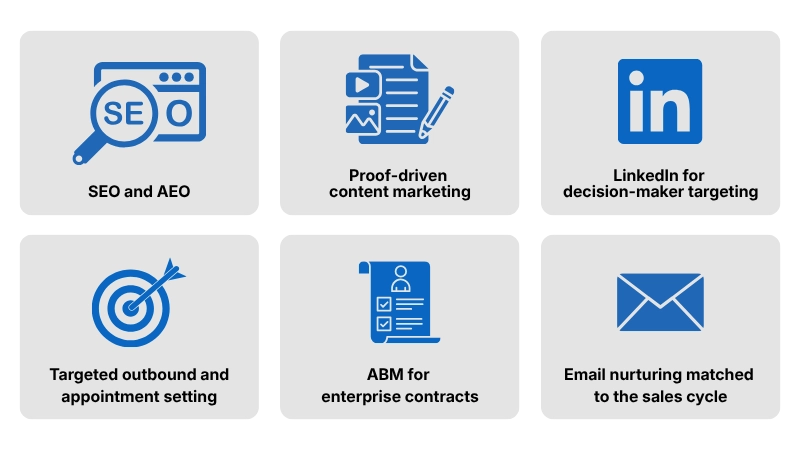
1. SEO and answer engine optimization (AEO)
Shippers search by mode, lane, and specialization: “bonded warehouse Rotterdam,” “FTL carrier Texas to Midwest,” “3PL for medical devices.” Building service pages and content around these commercial-intent queries makes you findable during active vendor evaluation. In 2026, extend this to AEO: structure content in question-and-answer format, publish original data AI engines can cite, and keep your best insights ungated so crawlers can actually see them.

2. Proof-driven content marketing
Trust is the currency of logistics deals, and content is how you build it before the first call. Prioritize sector-specific case studies with hard numbers, buyer’s guides for long procurement cycles, and operational explainers that show real expertise. One rule keeps quality honest: if a piece wouldn’t impress a supply chain director, it won’t generate a lead either.
3. LinkedIn for decision-maker targeting
Around 80% of B2B leads from social media originate on LinkedIn, and no other platform lets you target procurement managers, supply chain directors, and operations heads by role, industry, and company size with the same precision. Combine organic thought leadership from your operators (not just your marketing team) with paid campaigns aimed at your ideal customer profile.
4. Targeted outbound and appointment setting
Inbound builds the foundation, but outbound accelerates it. Multi-channel outreach that combines calling, email, and LinkedIn puts your team in front of shippers who match your ICP but haven’t found you yet.
The catch is qualification: a “hot lead” is worthless if the prospect’s freight volume, lanes, or requirements don’t fit what you can profitably serve. This is where logistics lead generation programs that qualify on shipping volume, regions served, and decision-maker authority outperform volume-based prospecting.
5. Account-based marketing (ABM) for enterprise contracts
When one contract can be worth millions, it pays to market to specific named accounts rather than broad segments. ABM coordinates content, ads, and outreach around a defined target list of shippers. In one documented Callbox campaign, a twelve-month ABM program for a B2B logistics brand produced 168 sales-qualified leads and a $6M closed deal from just three of them.
6. Email nurturing matched to the sales cycle
With decisions taking 3 to 18 months, most of your pipeline is “not yet” rather than “no.” Intent-triggered email sequences (for example, following up when a prospect revisits your pricing page) keep your firm present through the long middle of the journey, so you’re the first call when the current provider slips.
EXPERT TIP
Never advertise what operations can't execute. If your campaigns promise DDP shipping but your team hasn't aligned on tariff classification and customs clearance for those lanes, leads will come in and quotes will collapse. Marketing and ops alignment isn't a nice-to-have in logistics; it's what protects margin.
Related: How to Drive Logistics Sales
How do you build a logistics marketing plan?
A workable logistics marketing plan doesn’t need 40 pages. It needs five decisions, made in order:

- Define your ideal customer profile. Industry, shipping volume, lanes, freight type, and the pain that triggers a provider switch (cost creep, poor tracking, unresponsive account management). Everything downstream depends on this.
- Position on outcomes, not assets. Translate square footage and fleet size into what buyers actually purchase: reliability, transit-time consistency, visibility, and lower total cost.
- Pick 2 to 3 channels and go deep. For most logistics firms that’s SEO/content, LinkedIn, and outbound. Spreading a limited budget across six channels produces six mediocre results.
- Map content to the buying journey. Educational content for early research, comparison and proof content for evaluation, and ROI or risk-mitigation content for the procurement stage.
- Set revenue-based targets before launch. Qualified opportunities per quarter, pipeline value, and cost per opportunity, not impressions or follower counts.
Not sure what a realistic pipeline target looks like for your service type? See how multi-channel campaigns are structured for freight and carrier companies, from ICP mapping to booked discovery calls.
Should you hire a logistics marketing agency?
The honest answer: it depends on whether the agency knows the industry. A pattern repeats across the sector: a logistics company hires a generalist digital agency, receives twelve months of content about “why technology matters in logistics,” generates zero qualified leads, and concludes marketing doesn’t work for freight. Marketing works. Generic execution doesn’t. The best logistics marketing agencies can write about detention charges with authority, understand why an automotive shipper buys differently from a retailer, and tie every campaign to pipeline rather than traffic.
Here’s how some of the notable players compare:
| Company | HQ | Best For | Core Strength | Global Reach |
| Callbox | Encino, CA, USA | Freight, 3PL, and logistics tech firms needing qualified appointments at scale | Human + AI multi-channel outreach (phone, email, LinkedIn) with lead qualification on volume, lanes, and authority | North America, LATAM, EMEA, APAC; campaigns in 15+ languages |
| Martal Group | Oakville, Canada | Tech-enabled logistics and SaaS firms wanting fractional SDR teams | Outsourced sales teams layered on inbound content programs | Primarily North America and Europe |
| Full Mix Marketing | United Kingdom | UK warehousing, transport, and logistics companies | Full-service B2B marketing with deep UK logistics sector specialization | UK-focused |
| Virago Marketing | Ohio, USA | Freight and logistics brands aligning marketing with sales pipeline | Demand generation strategy and revenue attribution | Primarily North America |
| Wildnet Technologies | Noida, India | Logistics firms seeking cost-efficient SEO and paid media execution | SEO, PPC, and LinkedIn outreach delivery at offshore rates | India-based, serving global clients |
The right question when evaluating any logistics marketing agency isn’t “what do you charge?” It’s “show me a logistics client you’ve generated pipeline for, and walk me through how you qualified those leads.” A firm that can’t answer with specifics will learn the industry on your budget.
HOW WE SELECTED THESE COMPANIES
This comparison was built from publicly available information: each provider's published logistics or transport sector focus, documented case studies and client outcomes, stated service models, and geographic coverage as of mid-2026. It is not exhaustive, and inclusion reflects relevance to logistics marketing rather than paid placement. We recommend verifying current capabilities and references directly with any provider you evaluate.
Related: Top Lead Generation Companies for Logistics
How do you measure logistics marketing ROI?
Vanity metrics kill logistics marketing budgets. Sessions and impressions don’t survive a CFO review; pipeline does. Use this framework:
- Track cost per qualified opportunity, not cost per lead. A logistics company doesn’t need 10,000 leads. It needs a steady flow of qualified opportunities from shippers whose volumes and lanes it can serve profitably. Divide total marketing spend by opportunities that pass your qualification bar.
- Attribute pipeline value by channel. Connect your CRM to every campaign so you know whether that $8,000/month ad budget produces contracts or clicks. If you can’t trace a channel to pipeline dollars, pause it until you can.
- Measure velocity: days from first touch to discovery call. In an industry with 3-to-18-month cycles, shortening the front of the funnel is real money. Compare velocity across channels; outbound appointments typically compress this stage the most.
- Calculate closed-won revenue against contract lifetime value. Logistics contracts renew. A campaign that costs $60K and lands one $500K multi-year shipper is a very different investment than one producing fifty unqualified form fills. Judge ROI on contract value, including renewals.
- Review quarterly and reallocate ruthlessly. Feed win-loss insights back into targeting. If closed deals cluster in a vertical or lane, shift budget there. Exception data from operations (customs holds, claims, detention) can also sharpen which cargo profiles marketing should attract.