B2B Appointment Setting: Why Booked Isn’t Confirmed
Most B2B appointment setting stops at “booked,” then meetings no-show. See why confirmed, tracked meetings are what actually turns into pipeline.
 Rebecca Matias
Rebecca Matias is Callbox's COO with 18 years of experience scaling B2B pipeline through data-driven outbound marketing, lead generation, and sales development.
View full bio of Rebecca Matias
If you run sales, you have seen the report that looks great until it doesn’t. Meetings booked: up and to the right. Pipeline created: flat. That gap is the quiet failure mode of B2B appointment setting, and it almost always traces back to one bad assumption: that a booked meeting and a confirmed meeting are the same thing.
They are not. For a leader measured on revenue, the difference between the two is the difference between a busy calendar and a growing pipeline. A meeting that gets booked and then no-shows does not just fail to help you. It costs you more than the meeting you never booked, because it burned rep time, skewed your forecast, and told your marketing team a campaign worked when it didn’t.
 Quick Answer: B2B appointment setting is the process of finding qualified buyers, reaching them across channels, and booking sales meetings for your closers. The metric that matters is not how many meetings get booked, but how many are confirmed, attended, and progress into real pipeline.
Sales appointments slowing down and revenue starting to decline?
The Metric That’s Quietly Lying to You
Booked-meeting count is the most-reported and least-trustworthy number in sales development. It goes up when activity goes up, which feels like progress, but it says nothing about whether those meetings happen or matter.
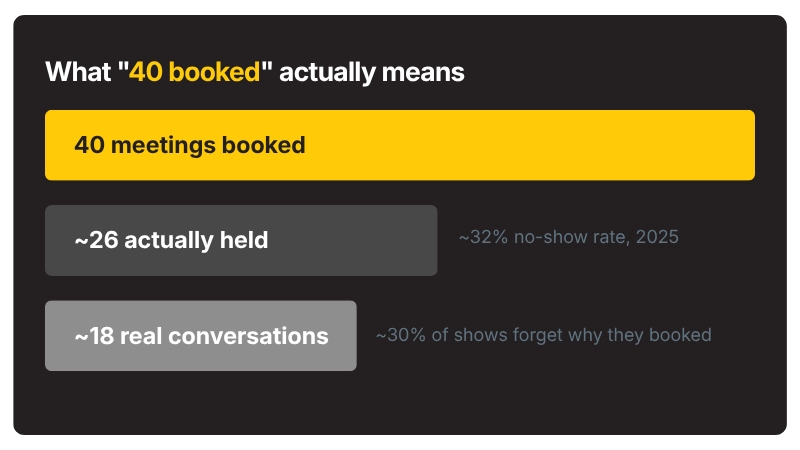
The no-show data explains why. On cold-booked outbound meetings, average no-show rates climbed to roughly 32% in 2025, up from about 18% in 2020, according to Calendly’s 2025 State of Scheduling. Across B2B more broadly, no-show rates of 20% to 40% are common. So a report showing 40 meetings booked may really mean 26 held, and the 14 that vanished still consumed your team’s prep, calendar space, and attention.
It gets worse for the meetings that do happen. Roughly 30% of prospects who show up arrive with no memory of why they booked, per Demodesk’s 2026 analysis, which turns the call into a cold re-pitch instead of a real conversation. When you strip out the no-shows and the re-pitches, your true meeting-to-opportunity conversion is far lower than the booked count suggests.
Worth a quick gut check: pull your last quarter`s booked-meeting number, then your held number, then how many advanced past the first call. The drop between those three is the real health of your appointment setting.
What a Confirmed Appointment Actually Means
A confirmed appointment is not a calendar invite that a prospect clicked once. It is a meeting that has been re-verified close to the slot, where the prospect still remembers the context, knows the agenda, and has agreed to a next step if the fit is there. That is the version worth handing to a closer.
The gap between the two is huge and measurable. Industry meeting-held rates typically fall between 60% and 80%, while the best-run teams push no-shows below 6%. The teams at the top of that range are not lucky. They confirm agendas, send reminders that carry value, and set clear expectations before the meeting, so the prospect shows up ready rather than surprised.
Expert Tip:
Move your dashboard and your SDR comp off meetings booked and onto meetings held. Held rate is unusual among sales metrics because it responds fast: teams often see it move within about three weeks of making it the number that gets reviewed.
Related: How Appointment Setting Can Help You Find The Right Clients
The Handoff Is Where Good Meetings Die
Even a genuinely confirmed meeting can leak value in the ten seconds it takes to move from the SDR who booked it to the AE who runs it. If the rep walks in without context, the confirmed meeting quietly becomes another re-pitch.
Follow-through is the weak point across the industry. Most B2B deals need five to eight follow-up touches to close, yet 48% of salespeople never make a single follow-up attempt after first contact, per Invesp. And speed compounds the effect: research on speed to lead shows prospects contacted within five minutes are far likelier to qualify, and the first vendor to respond wins a disproportionate share of deals.
So the handoff is not administrative. It is where confirmed meetings either become pipeline or become wasted calendar time. A clean handoff carries the full context of the conversation, the prospect’s stated pain, and the agreed next step, so the closer never starts cold.
Industry Insight:
Buying groups now include four or more stakeholders in 87% of B2B deals. A confirmed meeting with a single contact is a start, not a finish: without mapping the rest of the committee, even a great first call stalls when it hits people who were never in the room.
Related: The Ins and Outs of Appointment Setting
From Booked to Closed: Track the Whole Progression
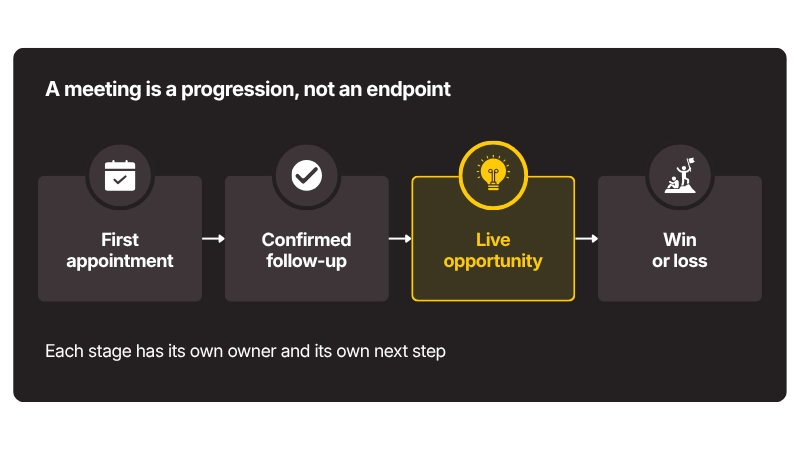
The fix for all of this is a mindset shift. Stop treating a meeting as an endpoint you count once, and start treating it as an opportunity you track across its whole life. A meeting is only the first stage of a progression that runs from first appointment, to confirmed follow-up, to a live opportunity, to a clear win or loss. Each stage has its own owner and its own next step.
That framing matters because B2B timelines are long. The average buying cycle now runs about 10 months, per 6Sense’s 2025 Buyer Experience Report, and enterprise deals stretch past a year. A prospect who says “not now” in January can be a real opportunity by Q3, but only if someone stays in their orbit instead of marking the meeting done and moving on. A follow-up inside that window is a second appointment; the same conversation after a long silence is a reactivation. Both belong in your tracking, and both get lost when you only count bookings.
It also matters because closing is harder than it used to be. Average win rates fell to 19% in 2025, down from 29% in 2024, according to Ebsta and Pavilion’s 2025 benchmarks. In that environment, the teams that win are the ones watching quality metrics, meeting-to-opportunity conversion and close rate on sourced pipeline, not vanity volume.
This is the difference a partner like Callbox is built around: meetings are confirmed before they reach your team, and each one is tracked from that first conversation through to a closed deal, so you always know what is actually progressing rather than just what got booked. See the leading B2B appointment setting companies.
Choosing a B2B Appointment Setting Partner
If you are weighing providers, look past the booked-meeting promise on the homepage and compare how each one qualifies, confirms, and hands off. Here is a high-level view of common options in the market.
One question to ask every vendor: “What happens to a meeting between the moment it is booked and the moment my rep joins the call?” The answer tells you whether you are buying confirmed pipeline or just a booked number.
Related: Appointment Setting Companies in the USA
How to Measure the ROI of Appointment Setting
Whether you build in-house or outsource, judge the program on economics you can defend to a CFO. Work through these five steps.
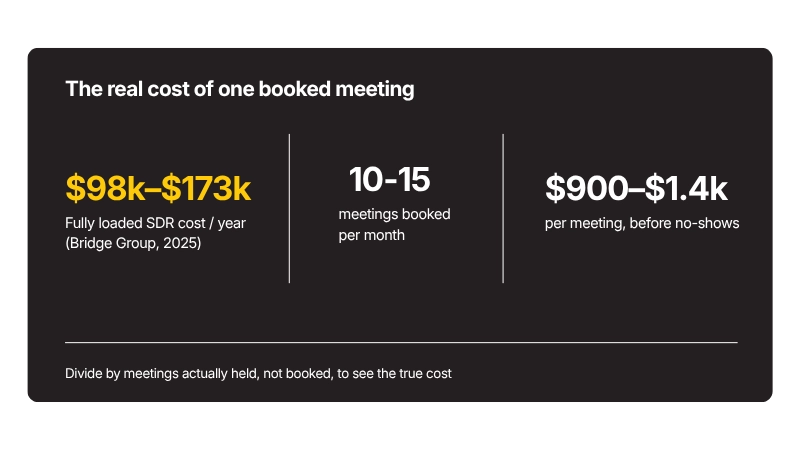
- Cost per confirmed meeting, not booked – Divide fully loaded cost by meetings actually held. A fully loaded in-house SDR runs about $98,000 to $173,000 a year (Bridge Group, 2025) and books 10 to 15 meetings a month, putting cold outbound meetings near $900 to $1,400 each before you subtract no-shows.
- Meeting-to-opportunity conversion – Track what share of held meetings become real opportunities. This is where quality shows up or falls apart, and it is invisible if you only measure bookings.
- Pipeline created against coverage – Most teams need three to five times pipeline coverage to hit quota reliably. Measure the dollar pipeline your appointment setting sources, not just the count of meetings.
- Win rate on sourced pipeline – Compare the close rate on appointment-set pipeline to your other sources. If sourced pipeline wins below your average, you have a quality problem upstream, usually ICP drift.
- Time to value and payback – An in-house SDR takes three to six months to ramp. A capable partner starts delivering meetings in two to four weeks, and outsourcing often cuts total sales development cost by 30% to 60%. Factor speed into the return, not just the rate.
How these comparisons were made: Statistics are drawn from published 2025 and 2026 industry sources, including Calendly, Demodesk, 6Sense, Bridge Group, Ebsta and Pavilion, and Invesp, and are cited inline. Provider positioning reflects publicly available company information at the time of writing and is meant as a starting point, not a ranking. Ranges are used where the underlying data varies by ICP, deal size, and region. Always validate figures against your own funnel before making a decision.
Related: Sales Development vs Appointment Setting
See What “Confirmed” Does to Your Pipeline
Book a short strategy session with a Callbox specialist. We will look at your booked-to-held gap, your ICP, and your sales cycle, and show you how confirmed, tracked meetings would map to your growth goals.
Frequently Asked Questions
How long until an appointment setting program delivers?
An in-house SDR typically takes three to six months to ramp, while an experienced partner usually starts delivering confirmed meetings in two to four weeks.
Should we outsource or build an in-house SDR team?
Build in-house when volume is high and steady, your product demands deep technical fluency, and you can absorb three to six months of ramp. Outsource when you need coverage across regions, faster time to value, or a confirmation and handoff process you do not want to build yourself. Many teams run both.
How do you track appointments through to closed deals?
Treat a meeting as a progression rather than an endpoint: first appointment, confirmed follow-up, live opportunity, then a clear win or loss, with a named owner at each stage. Callbox runs this inside Callbox Pipeline, its campaign and CRM platform, so every confirmed meeting stays visible from first conversation to closed deal.