APAC Manufacturing: Smart Ways to Generate Leads
Learn marketing strategies for manufacturers. Learn how to generate leads, attract industrial buyers, and grow your manufacturing business.
 Mitos Aguadera
Mitos Aguadera is VP of Sales and Marketing at Callbox, leading go-to-market strategy and demand generation for B2B clients across tech and SaaS.
View full bio of Mitos Aguadera
For manufacturers, the ability to connect with industrial companies looking for suppliers is key to driving growth.
But generating quality leads in this space isn’t always easy. Long sales cycles, technical products, and multiple decision-makers make the process more complex than in other industries. And with many businesses offering similar solutions, standing out is an added challenge.
In this blog, we’ll explore why lead generation differs for manufacturers and provide practical strategies to attract the right prospects and convert them into long-term customers.
Why Lead Generation Is Different for Manufacturers
Generating leads in manufacturing is more challenging than in most other industries. The sales process is longer, the products are more complex, and the buying journey involves more people.
Here are three main reasons why:
1. Products are expensive
Manufacturing products often costs a lot. Buyers don’t make decisions quickly; they need time, information, and clear value before moving forward.
2. The sales cycle takes longer
Because of the price and complexity, buyers do their homework. They ask questions, compare options, and expect helpful content to guide them. This makes buyer education essential.
3. Many people are involved in the decision
Manufacturing deals often go through multiple levels of approval. That means more time, more back-and-forth, and more effort to convince all stakeholders.
These challenges aren’t unique to your business. According to research, 61% of marketers say that lead generation is their These challenges aren’t unique to your business. 91% of marketers say lead generation is their most important goal, and the pressure to perform is intensifying as digital channels grow more competitive.
According to the latest HubSpot State of Marketing reports and market analytics, the core issue has evolved. Marketers are no longer struggling with lead volume due to the explosion of AI-generated content and automation. Instead, they face a steep hurdle with lead quality and sales readiness.
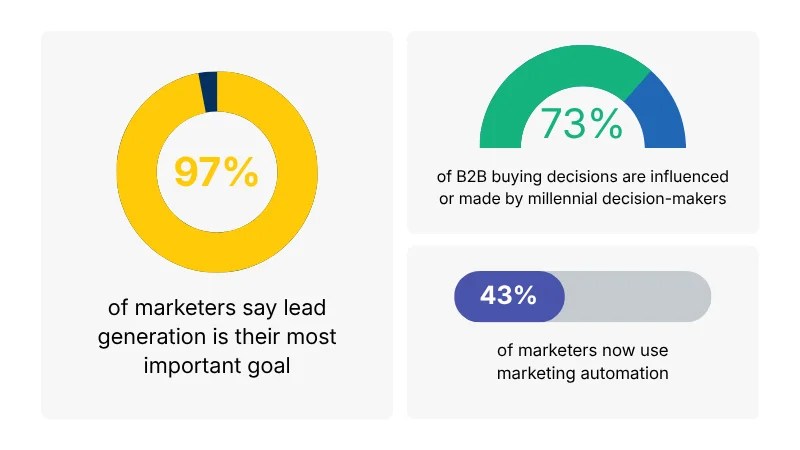
On top of this, digital disruption is changing how manufacturers attract leads. While relationships and loyalty still matter, today’s buyers, especially millennials, use digital channels to research and choose suppliers. In fact, 73% of B2B buying decisions are made by millennials, and 43% of marketers now use marketing automation to generate leads.
As companies expand their online presence, the competition for attention also grows. That’s why digital marketing for manufacturing companies is essential. Platforms like LinkedIn, Facebook, and even Instagram give manufacturers a way to connect with the right audience and stay top of mind.
To succeed in this fast-changing environment, manufacturers need more than instinct. They need a clear strategy, the right tools, and a strong digital presence.
Looking to generate more manufacturing leads? We got you.
Callbox helps APAC manufacturers reach industrial decision-makers through multi-touch, multi-channel outreach built for complex B2B sales.
Let’s look at why so many manufacturers are choosing APAC as a base for their services.
Why Manufacturers Are Turning to the Asia-Pacific Region
With digital transformation changing how manufacturers grow, many are looking at the Asia-Pacific (APAC) as a key region for expansion.
APAC is one of the largest and most active hubs for B2B manufacturing. It’s home to a broad network of manufacturers and distributors that serve international clients from well-located, cost-effective facilities.
Two significant changes are reshaping the region:
- Rising incomes are turning Asia into a major market, not just a place to produce, but a place to sell.
- Digital growth is shifting momentum from traditional manufacturing to tech-enabled services and digital-first solutions.
These trends, combined with the region’s size, diversity, and fast-moving digital economy, are creating new opportunities for manufacturers to grow their customer base and build lasting partnerships.
What makes APAC so promising?
- Digitally: It has a large and growing base of digital-first buyers and decision-makers.
- Dynamically: The region’s population, workforce, and demand for B2B solutions continue to rise.
- Demographically: More internet access, better education, and higher incomes have created a new wave of digital entrepreneurs and tech-savvy buyers.
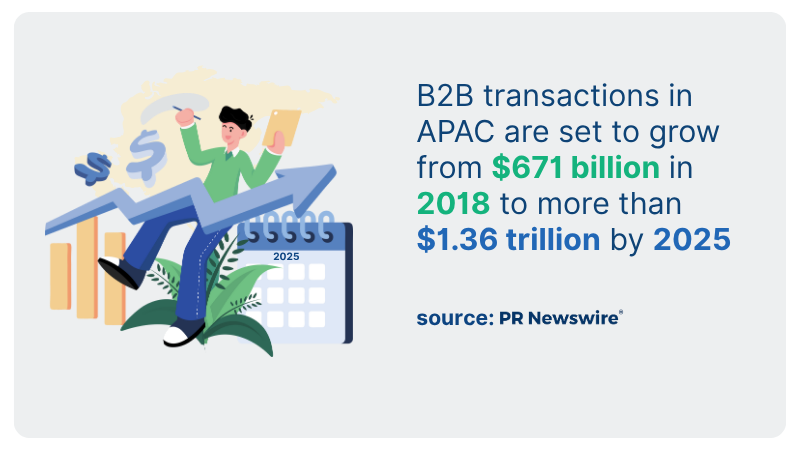
The numbers speak for themselves. B2B transactions in APAC are set to grow from $671 billion in 2018 to more than $1.36 trillion by 2025, with an annual growth rate of 10.5%.
Still, launching a successful lead generation strategy in APAC isn’t easy. From language and culture to platform preferences and buyer behaviour, there’s a lot to consider.
Explore Marketing Tips for Companies Expanding Into APAC
How APAC Manufacturing Lead Generation Channels Compare
| Channel | Best For | Avg. Cost per Lead | APAC Effectiveness | 2025–2026 Trend |
| SEO / Organic Search | Long-term inbound pipeline from industrial buyers researching suppliers | ~$31 | High — 42% of B2B marketers rank organic as the top lead source | Growing, as AI Overview adoption shifts buyers to later-stage site visits |
| Email Marketing | Nurturing long sales cycles, re-engaging dormant leads | ~$53 | High — 93.2% of marketers say personalised email drives more leads (HubSpot 2026) | Stable — strongest channel for pipeline warming in complex B2B |
| Webinars / Virtual Events | Educating multi-stakeholder buying groups, building authority | ~$72 | Very High — 98% of B2B marketers say virtual events produce quality leads | Rising — 38% of manufacturers plan to increase webinar budgets in 2026 |
| LinkedIn / Social Media | Reaching procurement managers, engineers, and supply chain leads | Variable | High — LinkedIn drives ~80% of all B2B social media leads | Growing fast — LinkedIn converts visitors at 2.74% vs 0.77% on Facebook |
| Cold Calling / Telemarketing | Direct engagement with hard-to-reach industrial decision-makers | $300–$500 fully loaded | High for enterprise — 49% of B2B buyers prefer phone as first point of contact (VoiceSpin, 2025) | Evolving — human-led calls supported by AI prep and sentiment tools |
How Manufacturers Can Get More Clients in APAC: 13 Proven Strategies
Once you understand the challenges of manufacturing lead generation and the unique opportunities in APAC, the next step is building a strategy that works. Below are the most effective lead generation tactics manufacturers can use to attract, engage, and convert the right prospects.
1. Participate in Industry Events and Trade Shows
Attending in-person events, trade shows, and conferences is one of the most effective ways to connect with prospects in the manufacturing industry. These settings offer a chance to showcase your products, build real connections, and share your company’s values.
When done right, event marketing creates strong impressions, drives brand awareness, and helps generate high-quality leads. Many companies also use these events to engage existing clients and partners, making them valuable not only for lead generation but also for fostering long-term relationships.
Need help filling your booth or virtual event with qualified leads?
We specialise in event marketing and attendee acquisition for manufacturers.
2. Personalise Your Outreach at Every Touchpoint
Personalisation plays a key role in improving lead quality. By tailoring your messages based on the prospect’s job role, industry, or place in the buying journey, you can make your outreach more relevant and engaging.
Personalised communication helps show that you understand the prospect’s needs and challenges, increasing the chances of conversion. It also allows you to deliver the right message at the right time through the right channel, whether that’s email, social media, or a phone call. Businesses that personalise their outreach build stronger relationships and move prospects through the sales funnel more effectively.
3. Use a Multi-Touch, Multi-Channel Strategy
A multi-touch, multi-channel approach allows you to connect with leads through different platforms and at multiple points in their buying journey. This means combining tools like email, phone calls, social media, content marketing, and even direct mail to stay top of mind.
Since today’s buyers use multiple channels to research and interact with vendors, reaching them through various touchpoints improves engagement and helps build trust. This method ensures that your messaging is consistent and visible, no matter where your prospects are in the decision-making process.
4. Leverage Email Marketing
Email remains one of the most powerful tools for B2B lead generation, particularly when paired with automation. B2B email marketing achieves an average conversion rate of 2.4%, making it the fourth-highest converting B2B channel.
You can use email to share product updates, nurture leads, and promote offers. Automation helps by sending the right messages based on user behaviour, saving time while keeping your outreach relevant. To get even better results, integrate your email programs with other strategies like social media, content marketing, and audience segmentation.
Learn why email marketing in APAC continues to drive results.
5. Modernise Telemarketing With Human-Led, AI-Supported Outreach
While traditional telemarketing has lost some popularity, it remains a useful lead generation method when done correctly. Today’s telemarketing is less about cold calls and more about having meaningful conversations.
With the addition of video conferencing and scheduled calls, you can build stronger rapport and add a human touch to your outreach. This approach works especially well for complex or high-value products that require discussion. Combining phone outreach with digital tools helps strengthen connections and support other marketing channels.
6. Host or Join Webinars and Virtual Industry Events
Event marketing continues to be a top strategy for generating leads. Whether it’s a webinar, product demo, virtual conference, or live Q&A session, events give you a platform to educate prospects and position your business as an industry leader.
According to industry reports, in-person and virtual events are among the most effective formats for reaching top-of-funnel leads. Hosting your own event or participating in one is a great way to introduce your brand, answer common questions, and engage decision-makers in a structured, high-value format.
7. Optimise Your Website for Industrial Buyers and Search Intent
Your website is one of your most essential marketing tools for generating manufacturing leads. A well-optimised website makes it easy for visitors to find information, understand your products, and take action. Website and SEO are the most important channels for 83% of B2B marketers in their current strategies.
Currently, optimising for search goes beyond traditional SEO. Answer Engine Optimisation (AEO) is now equally critical. As more B2B buyers use AI-powered tools like Google’s AI Overviews, ChatGPT, and Perplexity to research suppliers, your content needs to be structured so these engines can surface it as a direct answer. That means writing clear definitions, using FAQ sections, and organising content with concise H2s and H3s that mirror the questions your buyers are actually asking. Manufacturers who optimise for AEO position themselves to appear not just in traditional search results, but in the AI-generated answers that now sit above them.
SEO gets your site found. AEO gets your content cited. Together, they ensure your business is visible at every stage of the modern industrial buyer’s research journey, whether they’re searching on Google or asking an AI assistant which suppliers to shortlist. Since your website is available 24/7, it’s a valuable channel for attracting leads even outside business hours.
8. Add Live Chat Support to Capture High-Intent Visitors

Live chat is an effective way to interact with visitors in real time. Many buyers have questions before making a decision, and offering instant support can help move them closer to a purchase.
Live chat tools appear as pop-ups or icons on your website, allowing visitors to chat directly with a sales representative or support agent. Some platforms even offer automated responses and co-browsing features. This type of communication feels personal and responsive, making it easier to turn visitors into qualified leads.
9. Engage Decision-Makers Through LinkedIn and Social Media
Social media offers a direct and interactive way to reach potential customers. Platforms like LinkedIn, Facebook, Twitter, and Instagram allow you to share content, run ads, and connect with audiences who are already interested in your industry. LinkedIn is ideal for B2B lead generation, while Facebook and Instagram help showcase visual content and ads to targeted users.
Twitter is useful for real-time updates and engagement. Using the right platform for your audience allows you to increase visibility, build relationships, and drive traffic to your website or landing pages.
10. Use Instant Messaging to Stay Connected With Warm Leads
Instant messaging tools such as WhatsApp and SMS are becoming popular for direct communication with leads. These platforms are useful for sending reminders, checking in with prospects, or following up after a call or meeting.
Messaging offers a fast, informal way to stay in touch and keep leads engaged. It also helps personalise communication and provide quick answers to questions. In Southeast Asian markets especially, many prospects prefer text-based follow-up as part of a broader outreach sequence.
11. Automate Your Marketing Workflows With AI-Assisted Tools
Marketing automation tools help streamline tasks like email programs, social posts, and lead nurturing. Automation saves time by handling repetitive work, allowing your team to focus on content creation and strategy.
You can set up automated workflows that send targeted messages based on lead behaviour or segment. Pairing automation with a customer relationship management (CRM) system helps track interactions and manage your database more effectively. Together, these tools improve lead quality, reduce delays, and move prospects through your sales funnel more efficiently.
12. Reconnect with Past Clients

One often-overlooked strategy is reaching out to former customers or leads that didn’t convert. These contacts already know your business and may be ready to re-engage under better circumstances.
Past clients are easier to approach because there’s already a history, you understand their needs, and they recognise your value. Reach out with updates, new offerings, or simply a check-in to see how their needs have changed. Reconnecting with these prospects can lead to quick wins and stronger long-term relationships.
13. Try Account-Based Marketing (ABM)
Account-based marketing is a focused strategy that targets high-value companies instead of individual leads. Instead of casting a wide net, ABM lets you personalize your marketing to a small group of ideal accounts.
This approach works well in B2B industries where buying decisions are made by groups, not individuals. ABM requires close alignment between sales and marketing teams to deliver the right message, at the right time, to the right people within each company. This method helps improve lead quality and drive better ROI by focusing efforts where they matter most.
Find out how a 12-month ABM program powered enterprise manufacturing
Frequently Asked Questions: Manufacturing Lead Generation in APAC
What is B2B lead generation for manufacturing companies?
B2B lead generation for manufacturing companies is the process of identifying, attracting, and qualifying potential industrial buyers, procurement managers, and supply chain decision-makers who have a genuine need for your products or services. It involves a combination of digital marketing, direct outreach, content, and events to build a pipeline of qualified prospects. In manufacturing specifically, lead generation must account for long sales cycles, high deal values, and the involvement of multiple stakeholders across technical, commercial, and executive functions.
Why is lead generation harder for manufacturers than other B2B companies?
Manufacturing lead generation is harder because of three structural factors: products are high-value and require significant buyer education before a decision is made, sales cycles are longer and involve multiple layers of approval, and many manufacturers offer technically similar solutions, making differentiation difficult. These factors mean that generic outreach strategies used in simpler B2B sectors rarely perform well. Manufacturers need targeted, personalised, multi-touch approaches that address the specific role and concerns of each stakeholder in the buying group.
What are the most effective lead generation strategies for manufacturers in APAC in 2025–2026?
The most effective strategies for manufacturing lead generation in APAC include: account-based marketing (ABM) targeting high-value industrial accounts, multi-touch multi-channel outreach combining email, phone, and LinkedIn, SEO-optimised website content that captures buyers during their self-directed research phase, webinars and virtual events for educating multi-stakeholder buying groups, and AI-supported telemarketing for direct engagement with decision-makers. The highest-performing teams combine several of these approaches in coordinated sequences rather than relying on any single channel.
How does ABM work for manufacturing companies in Asia-Pacific?
Account-based marketing for manufacturers in APAC involves identifying a defined list of high-value target companies, building detailed profiles of the key decision-makers within each account, and running personalised outreach campaigns that address the specific priorities of each stakeholder. Rather than casting a wide net, ABM focuses resources on the accounts most likely to convert and deliver strong lifetime value. In APAC, this approach is especially effective because buying decisions in manufacturing tend to involve multiple functions — procurement, engineering, finance, and operations — each of which needs to be engaged with tailored messaging.
What role does digital marketing play in manufacturing lead generation today?
Digital marketing now plays a central role in manufacturing lead generation. Today’s industrial buyers, increasingly millennials and Gen Z procurement professionals, conduct the majority of their supplier research online before engaging with a sales rep. SEO ensures your business is visible when they search for solutions. Content marketing educates them during that research phase. LinkedIn builds brand familiarity with decision-makers. Email nurtures long buying cycles. And marketing automation keeps prospects moving through the funnel without requiring manual follow-up at every stage. Manufacturers who underinvest in digital are increasingly invisible to the buyers they most want to reach.
How long does it take to generate leads in manufacturing?
Lead generation timelines in manufacturing vary depending on the channel and strategy. On average, it takes a B2B lead 64.5 days to convert into a customer from the point of first contact, though this can extend significantly for complex, high-value manufacturing products. Outbound strategies like telemarketing and direct outreach tend to generate qualified meetings faster, within weeks, while inbound channels like SEO and content marketing take several months to build momentum but deliver compounding returns over time. Most high-performing manufacturing teams run a combination of both to maintain a healthy short-term and long-term pipeline.
Should manufacturing companies outsource lead generation or keep it in-house?
The right choice depends on your scale, market complexity, and internal capacity. In-house lead generation makes sense if you have an experienced SDR team, strong market knowledge, and the tools and time to build and manage campaigns consistently. Outsourcing is often more effective for manufacturers expanding into new APAC markets where local buyer behaviour, cultural nuances, and platform preferences differ significantly from home markets. An experienced B2B lead generation partner brings verified data, localised outreach expertise, and proven processes that can compress the time to first qualified meeting compared to building from scratch.
Why is APAC a priority region for manufacturing lead generation?
APAC has become a priority region for manufacturing lead generation because of its scale, growth trajectory, and digital transformation pace. The region is home to a large and growing base of industrial buyers, a rapidly digitising procurement ecosystem, and rising incomes that are shifting APAC from a production hub to an active consumption market. The global B2B lead generation services market is projected to nearly triple by 2035, with Asia-Pacific identified as the fastest-growing region. For manufacturers looking to grow their customer base, establish regional partnerships, or enter new markets, APAC offers both the opportunity and the complexity that rewards well-prepared, strategically run outreach programs.
Building a Manufacturing Lead Generation Engine That Lasts
Generating quality leads in the manufacturing space requires more than just visibility. It demands strategy, precision, and a clear understanding of your buyer. The challenges are unique: high-value products, long decision cycles, and multiple stakeholders involved in every deal.
Combined with digital disruption and shifting buyer behaviour, it becomes clear that a one-size-fits-all approach is no longer practical. Manufacturers need a more intelligent and more focused way to reach and convert potential customers.
The Asia-Pacific region presents a major opportunity for growth. With a large and growing population of digitally savvy buyers, rising economic activity, and strong B2B transaction growth, APAC is becoming a key base for manufacturers.
To succeed in this region, companies must adapt to local buyer expectations, cultural differences, and digital behaviour. This includes building trust across various platforms, delivering relevant content, and using a consistent mix of digital and personal outreach.
By applying the right lead generation strategies, such as personalisation, multi-channel engagement, marketing automation, and event participation, manufacturers can stand out in a crowded market and build stronger relationships with potential clients.
The goal is to reach prospects where they are, provide real value throughout the process, and guide them toward becoming long-term customers. With a thoughtful, well-planned approach, lead generation becomes a reliable engine for sustainable business growth.