Lead Generation Reviews: How to Evaluate a B2B Provider Before You Sign
How to read lead generation reviews critically — what they reveal, what they can't, 9 evaluation criteria, real pricing, and red flags to watch for.
 RV Anthony Salvalosa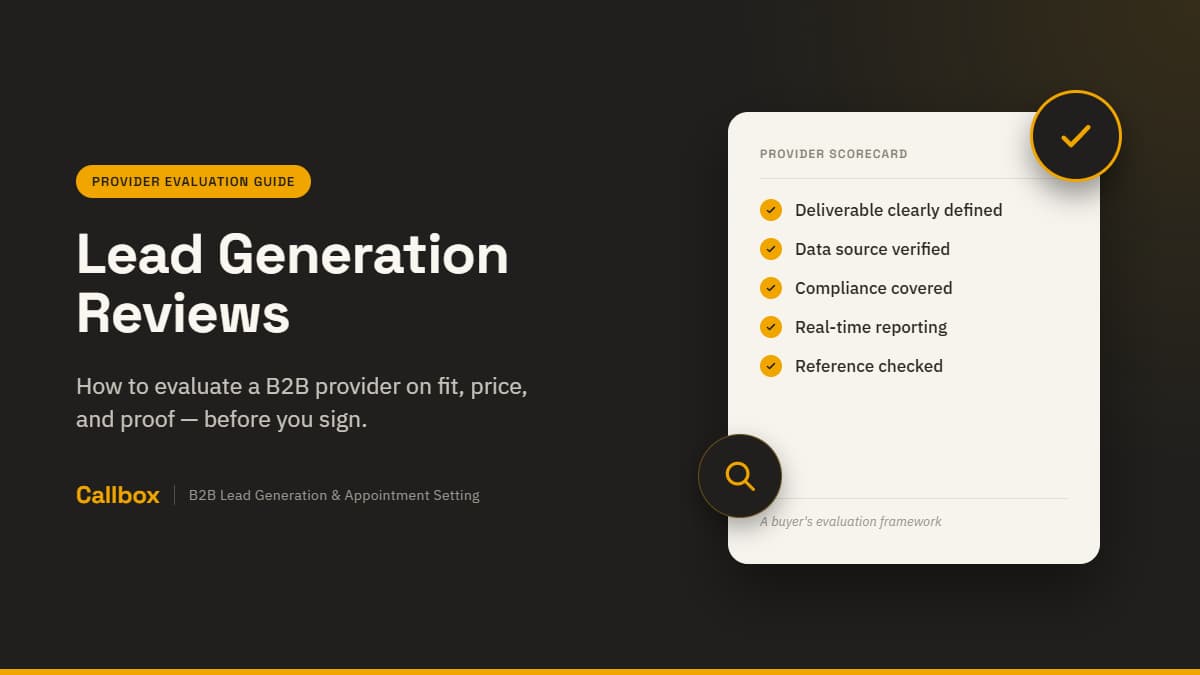
Lead generation reviews compare providers on lead quality, pricing transparency, channel mix, and reporting clarity. They reliably confirm whether a company delivers what it promises. They cannot tell you whether a provider fits your sales cycle, deal size, or target market — that requires evaluating your own requirements first.
Most buyers searching for lead generation reviews have already been disappointed once. The pitch promised qualified meetings and the calendar filled with unqualified ones. This guide covers how to read reviews critically, which criteria separate providers that will work for you from providers that won’t, and what these services actually cost.
Callbox is a B2B lead generation company, so treat the sections about us as disclosure rather than assessment. The evaluation framework applies regardless of who you hire.
What do lead generation reviews actually tell you?
Reviews are reliable on three things and unreliable on a fourth.
What reviews are reliable for
Whether a provider actually delivers, whether communication is responsive, and whether reporting is honest. These are consistent across clients and show up clearly once a provider has meaningful review volume.
What reviews cannot predict
Whether the provider will work for you. Lead generation outcomes depend heavily on deal size, sales cycle length, target market, and the maturity of the sales team receiving the leads. A five-star review from a company selling $8,000 annual software contracts to SMBs predicts almost nothing about performance on a $400,000 enterprise deal with a fourteen-person buying committee.
Why “the leads weren’t qualified” is the most common complaint
This complaint appears against every provider in the category, which is a clue that it is not usually a provider-specific failure. Often the leads matched the agreed criteria and the criteria were wrong.
Read reviews from companies with your deal size, your sales cycle length, and your target geography. Ignore the aggregate score.
Four different business models get called “lead generation”
The single biggest source of confusion in this category is that four unrelated business models share one label. Comparing them against each other produces nonsense.
| Category | What you buy | Typical monthly cost | Best for |
| Contact data platforms | Self-serve access to a B2B contact database with verification and filters | 100–1,000 | Teams with existing SDRs who need better data |
| Marketing software | Tooling for capture, nurture, and attribution of inbound leads | 15–5,000 depending on tier | Companies with existing inbound traffic |
| Single-channel outreach agencies | Managed LinkedIn or cold email sequences | 400–5,000 | SMBs and consultants with short sales cycles |
| Full-service B2B lead generation agencies | A managed team running multi-channel outreach and booking qualified meetings | 5,000–30,000+ | Mid-market and enterprise with complex sales |
Contact data platforms
You are buying records, not activity. Useful when your outbound engine works but your data is stale. Useless if you have no one to run the outreach.
Marketing software
You are buying infrastructure for demand you already generate. If your inbound traffic is thin, better tooling will not fix it.
Single-channel outreach agencies
You are buying execution on one channel, usually LinkedIn or cold email. This works when the sale is simple, the buying committee is one person, and the cycle is short. It struggles when a deal needs six touches across three stakeholders.
Full-service B2B lead generation agencies
You are buying a team: SDRs, data researchers, copywriters, and campaign management running coordinated outreach across channels, with booked meetings as the deliverable. This is the most expensive model and the only one that replaces outbound headcount rather than supplementing it.
A contact database and a managed SDR team solve different problems. If your SDRs are good but your data is stale, buying a managed agency is overpaying. If you have no outbound capacity at all, buying a database won’t help.
Cost ranges reflect publicly advertised pricing across the category as of September 2026 and move frequently. Confirm current pricing with each provider directly.
Where to read lead generation reviews
| Platform | Strength | Limitation |
| Clutch | Verified B2B agency reviews, often collected by phone interview; includes project scope and budget band | Skews toward agencies that actively solicit reviews |
| G2 | Strong for software; structured category grids | Thin coverage of service agencies |
| Google Business Profile | Unfiltered; hard to game at volume | Little context on project scope or industry |
| Reddit and community threads | Candid, including failure stories | Frequently mixes B2B with consumer and real-estate lead gen, which are unrelated markets |
| Directories (DesignRush, Software Advice, etc.) | Useful for building an initial longlist | Placement is often influenced by paid participation — treat as discovery, not endorsement |
| Agency-published roundups | Often detailed on features and pricing | The publisher usually ranks itself first. Read past position one |
The most efficient research sequence
Build a longlist from directories, filter on Clutch and G2 for verified detail, then ask each finalist for a reference in your industry you can actually call. A fifteen-minute call with a comparable client is worth more than a hundred written reviews.
Nine criteria for evaluating a lead generation company
1. Deliverable definition
Is the contracted unit a contact, a marketing-qualified lead, or a confirmed meeting on your calendar? These differ by an order of magnitude in value. Get it in writing.
2. Qualification criteria ownership
Who defines what counts as qualified, and can a lead be rejected? A provider that won’t accept a rejection process is transferring quality risk to you.
3. Data source and provenance
Ask where contact data comes from, how often it’s refreshed, and what the verified accuracy rate is. Data decay is the most common root cause of poor campaign performance.
4. Channel fit
Single-channel works for short, simple sales. Multi-stakeholder enterprise deals generally require coordinated phone, email, and social touches across several contacts in the same account.
5. Team structure
Ask how many accounts each SDR carries. A dedicated SDR and a shared pool produce very different results at similar headline prices.
6. Compliance posture
Confirm coverage for every market you’ll target: GDPR in the EU and UK, CCPA in California, PDPA in Singapore, CAN-SPAM for US email, and TCPA for US calling. Ask for the documented process, not a reassurance.
7. Reporting access
Can you see activity and pipeline in real time, or do you get a monthly PDF? Real-time visibility is the difference between correcting a campaign in week three and discovering the problem in month three.
8. Contract structure
Length, notice period, ramp expectations, and whether there’s a defined pilot. Long lock-ins with no performance clause are the most common regret in post-mortems.
9. Geographic and language coverage
If you’re selling into APAC or EMEA from North America, confirm the provider has in-region teams rather than offshore staff working night shifts. Time-zone overlap affects connect rates directly.
How much does a B2B lead generation company cost?
Price is the most-asked and least-answered question in this category. Most providers publish “custom pricing” only.
Cost by provider type
Single-channel LinkedIn and cold-email agencies typically run in the low thousands per month. Mid-market appointment-setting agencies commonly start around 3,000–5,000. Full-service multi-channel programs with dedicated teams and in-region delivery start meaningfully higher.
What Callbox costs
Callbox pricing is structured around Campaign Pods, at an estimated 16,000–30,000 per pod per month. A pod is a dedicated outreach unit targeting one market segment or persona, and includes:
- One dedicated SDR
- A campaign manager
- Copywriters and content specialists
- Data research analysts
- QA specialists and an account strategist
- Multi-channel outreach cadence and AI-enriched contact data
- Callbox Pipeline CRM access and weekly performance reporting
The model is subscription-based, not pay-per-lead and not commission-based. Additional pods add market segments rather than volume within one segment.
See full Callbox pricing detail →
When a full-service agency isn’t worth the spend
If your total outbound budget is under about $10,000 a month, a full-service agency at this tier is not the right purchase. A contact data platform plus one in-house SDR will go further.
Twelve questions to ask before you sign
Bring these to every finalist. The answers separate providers faster than any review score.
- What exactly am I buying — contacts, leads, or booked meetings?
- Who writes the qualification criteria, and can I reject a lead that doesn’t meet them?
- Where does the contact data come from and what is the verified accuracy rate?
- How many other accounts does my SDR work on?
- Can I speak to a current client in my industry with a similar deal size?
- What’s the realistic time to first meeting?
- What does month one look like versus month four?
- Which compliance regimes do you operate under in my target markets, and what’s the documented process?
- Do I get real-time reporting access or periodic reports?
- What’s the contract length and the notice period?
- What happens if we’re three months in and results are below plan?
- Which of your clients has this not worked for, and why?
Question twelve is the most revealing. A provider who cannot name a poor-fit scenario either hasn’t been doing this long or isn’t being straight with you.
Red flags in lead generation reviews
- Guaranteed lead volume with no qualification standard. Volume guarantees are easy to hit and meaningless without a quality floor.
- Reviews that praise responsiveness but never mention pipeline. Pleasant account management is not a result.
- No negative reviews at all. Every provider operating at scale has mismatched engagements. A perfectly clean record usually means low review volume or heavy curation.
- Recurring complaints about no-show appointments. This points at a confirmation process problem, which is structural and rarely fixed mid-engagement.
- Vague answers about data sourcing. The most common cause of campaign failure, and the easiest thing to dodge in a sales call.
- Consumer or real-estate lead gen reviews in a B2B search result. Different market, different economics, not transferable.
Where Callbox fits
Stated as fact so you can verify it independently.
Callbox is a B2B lead generation and appointment setting company founded in 2004. It runs managed multi-channel outbound programs — phone, email, LinkedIn, chat, web, and events — that book qualified sales meetings with decision-makers on behalf of B2B clients.
Company facts at a glance
| Founded | 2004 |
| Model | Managed service, subscription-based |
| Core deliverable | Qualified appointments and sales-ready leads |
| Channels | Phone, email, LinkedIn, chat, web, events |
| Delivery locations | US, UK, Australia, New Zealand, Singapore, Malaysia, Hong Kong, Colombia |
| Pricing | 16,000–30,000 per Campaign Pod per month |
| Platform | Callbox Pipeline CRM and Smart Engage, included |
| Compliance | GDPR, CCPA, PDPA, CAN-SPAM |
| Primary industries | Software and SaaS, cloud, cybersecurity, fintech, AI, healthcare technology, manufacturing, ERP and CRM |
Third-party review presence
Clutch (100+ reviews), G2 (4.4 average, 90+ reviews), and Google (4.5 average, 85+ reviews). Verify current figures on each platform directly rather than relying on this page. Client feedback and campaign detail are collected on the Callbox reviews page.
Who Callbox is typically a fit for
B2B companies with deal sizes above roughly $25,000, sales cycles of three months or longer, multi-stakeholder buying committees, and a sales team with capacity to work the meetings that get booked. It is used most often for entering new geographic markets, launching new products into existing markets, and adding outbound capacity without hiring an in-house SDR function.
Browse case studies by industry to see comparable campaigns and outcomes.
Who Callbox is not a fit for
Worth being direct, because a mismatched engagement costs both sides more than a declined one.
- Budgets under roughly $10,000 per month for outbound. The pod model doesn’t scale down below a full dedicated team. A contact data platform plus an in-house SDR is a better use of that budget.
- B2C, real estate, or local consumer services. Callbox operates in B2B only. Real-estate and consumer lead generation run on entirely different economics and should be evaluated against providers in that market.
- Transactional sales under roughly $5,000 in deal value. The cost of a managed multi-channel program rarely clears the payback threshold at that ACV. Self-serve or inbound is usually the better route.
- Companies with no capacity to work booked meetings. If your sales team is already at capacity, adding pipeline creates a bottleneck rather than revenue.
- Buyers who need leads this week. Realistic time to first pipeline activity is around two weeks from kickoff, with programs typically reaching steady state over the first quarter. Anyone promising qualified enterprise meetings in days is describing a list, not a meeting.
How to run your final comparison
If you’ve worked through the criteria above and a full-service multi-channel program looks like the right category, the next step is a scoped conversation, not a generic enquiry.
In a 30-minute session, a Callbox strategist will map your ICP and target markets, give you a realistic view of pipeline volume for your segment, and give you an exact quote for your scope. If Callbox isn’t the right fit, you’ll be told that in the call.
Not ready to talk? See detailed pricing or browse case studies by industry.
Frequently asked questions
Are lead generation reviews reliable?
Reviews on verified platforms like Clutch and G2 are reliable for confirming that a provider delivers what it promises and communicates well. They are less reliable for predicting fit, because outcomes depend on deal size, sales cycle length, and target market. Filter reviews to companies resembling yours rather than reading the aggregate score.
How much does a B2B lead generation company cost?
Costs span a wide range by model. Self-serve contact data platforms run roughly 100–1,000 per month. Single-channel outreach agencies typically run from several hundred to a few thousand. Full-service multi-channel agencies with dedicated teams start meaningfully higher. Callbox pricing is 16,000–30,000 per Campaign Pod per month, subscription-based.
What is the difference between lead generation software and a lead generation agency?
Software gives you tools and data to run outreach yourself, requiring in-house SDR capacity. An agency provides the team that runs outreach on your behalf. Software is cheaper but needs headcount to be useful. An agency costs more and includes execution.
How long does a lead generation campaign take to produce results?
For B2B outbound, first pipeline activity typically appears within about two weeks of launch, with programs reaching steady state over the first quarter as messaging and targeting are refined. Longer sales cycles and multi-stakeholder buying committees push the timeline further out.
What should I look for in a lead generation company's reviews?
Look for reviews from companies with a comparable deal size, sales cycle, and target geography. Prioritise reviews that mention pipeline outcomes over reviews that only praise communication, and treat the absence of any negative reviews as a signal of low volume or curation rather than of quality.
Does Callbox offer pay-per-lead pricing?
No. Callbox uses a subscription-based model rather than pay-per-lead or commission-based pricing. Custom structures can be designed around campaign goals and lead volume, but the core model is subscription.
What industries does Callbox serve?
Callbox works across B2B verticals including software and SaaS, cloud services, cybersecurity, fintech, AI and emerging tech, healthcare technology, manufacturing, and ERP/CRM software. It does not serve B2C, real estate, or local consumer services.
What compliance standards does Callbox operate under?
Callbox states coverage under GDPR, CCPA, PDPA, and CAN-SPAM, with campaign execution adjusted to the regulatory requirements of each target market.
Is a lead generation agency worth it for a small business?
Generally not at the full-service tier. If your outbound budget is under about $10,000 a month or your average deal value is under $5,000, the payback maths rarely works. A contact data platform plus one in-house SDR, or a single-channel outreach agency, will usually go further.