Top Logistics Tech Companies Reshaping Supply Chains
Explore top logistics tech companies of 2026. Learn logistics tech meaning, best solutions, and how smart lead gen fills your pipeline with quality leads.

If you work in freight, 3PL, warehousing, or supply chain management, you already know that logistics tech companies are no longer just a nice-to-have. They are the backbone of modern operations. From real-time shipment tracking to AI-powered route optimization, logistics tech has completely changed how goods move around the world and how businesses compete for the contracts that keep those goods moving.
But here is the thing: knowing who the major players are is only half the battle. The other half is figuring out how to actually reach the right decision-makers and convert interest into revenue. Let’s dig into both.
What Is Logistics Tech?
Logistics tech refers to the application of digital tools, software platforms, and automated systems to optimize the planning, execution, and tracking of supply chain and transportation operations. Simply put, it is the intersection of information technology and physical logistics designed to move goods faster, cheaper, and with greater visibility
Looking how double your logistics tech sales growth?
The Top Logistics Tech Companies to Know in 2026
The logistics tech space is crowded, but a handful of companies consistently rise to the top. Whether you are looking for a tech logistic partner to modernize your operations, or you are selling into this space and need to understand the landscape, here is who matters right now.
Enterprise and Platform Leaders
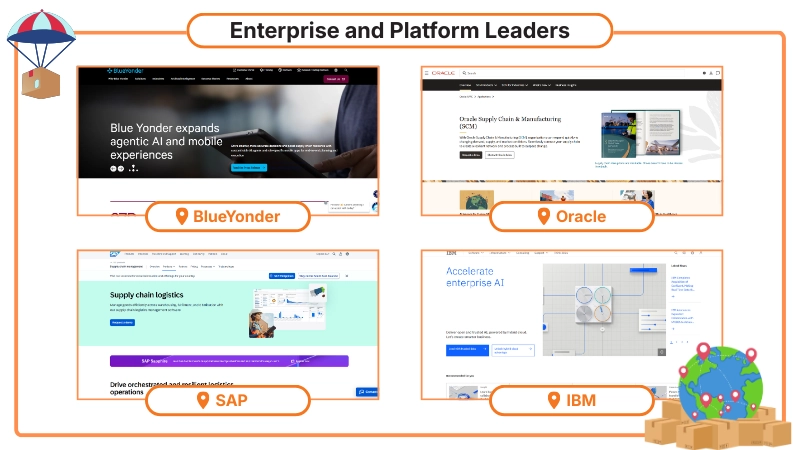
- Blue Yonder (JDA Software): AI-powered demand forecasting, autonomous planning, and cloud logistics. Its suite saw 12% year-on-year adoption growth in 2026, particularly among retail and manufacturing clients.
- Oracle (Fusion Cloud SCM): A global heavyweight offering end-to-end supply chain automation, blockchain-enabled traceability, and freight integrations across North America and Europe.
- SAP: Deep ERP integration with robust logistics planning, inventory, and order management capabilities for large enterprises.
- IBM: Focuses on AI, hybrid cloud, and blockchain to bring resilience and transparency to complex global supply chains.
Fleet, Visibility, and IoT Specialists
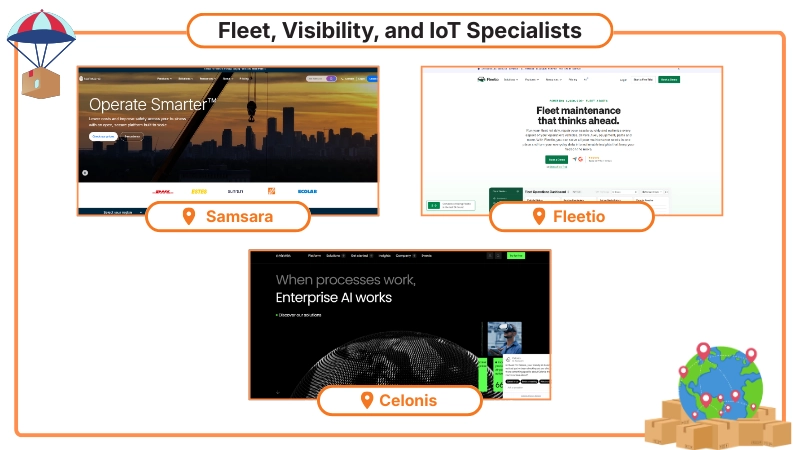
- Samsara: Founded in 2015, Samsara specializes in IoT solutions for fleet operations, including AI-powered dash cams, GPS tracking, ELD compliance, and driver safety monitoring. Its stock value climbed 26, reflecting strong investor confidence.
- Fleetio: Named one of Fast Company’s Most Innovative Companies in logistics, Fleetio streamlines fleet maintenance and operations management for mid-market and enterprise fleets.
- Celonis: A process intelligence platform that identifies operational bottlenecks across supply chain workflows, helping logistics companies remove friction at scale.
Are you ready to bring your supply chain management software sales?
Digital Freight and Forwarding Innovators
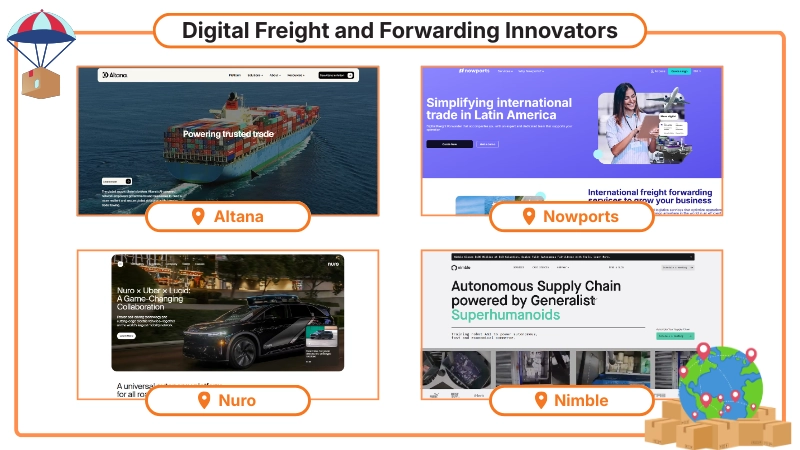
- Altana: An AI platform that analyzes over 2.8 billion shipments and 500 million companies to give businesses deep supply chain visibility, including forced labor risk detection.
- Nowports: A digital freight forwarder built for Latin American SMBs, offering real-time tracking, automated documentation, and data-driven insights.
- Nuro: An autonomous delivery company co-founded by former Google engineers, designed specifically for last-mile package and grocery delivery with zero-emission vehicles.
- Nimble: Specializes in robotic third-party logistics, building fully autonomous warehouses to help brands scale fulfillment at lower cost.
Rising Startups Worth Watching
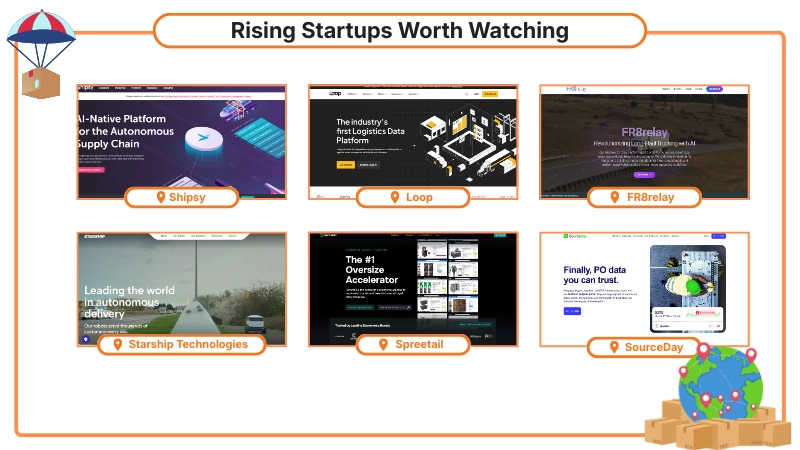
- Shipsy: AI-powered logistics management platform automating and optimizing supply chain operations end-to-end.
- Loop: Centralizes freight, parcel, and financial data to automate decision-making and surface cost-saving insights.
- FR8relay: Optimizes long-haul trucking through a relay model, coordinating freight handoffs between regional drivers.
- Starship Technologies: Autonomous sidewalk delivery robots built for neighborhood-level, last-mile logistics.
- Spreetail: A consultancy handling fulfillment and marketplace logistics for oversized and complex product categories.
- SourceDay: Focused on supplier communication and purchase order management, helping companies like Dell reduce part delays and price disputes.
💡Industry Insight
According to market analysts, the global digital logistics market is projected to reach USD 154.92 billion by 2034, expanding at a CAGR of 12% to 15%. AI adoption, ecommerce growth, and warehouse automation are the primary drivers. If you are selling into this space, the opportunity is enormous but so is the competition.
How Tech Integration Benefits Logistics Companies
Understanding how tech integration benefits logistics companies is critical for both operators and sales teams targeting this vertical. The payoffs are real and quantifiable:
- Faster decision-making: Real-time dashboards replace spreadsheets, letting operations teams react to disruptions in minutes, not days.
- Lower operational costs: Route optimization and load consolidation tools consistently reduce fuel and carrier costs by 10% to 20%.
- Improved compliance: Electronic logging devices (ELDs) and automated documentation reduce violations and manual processing overhead.
- Stronger customer experience: Shipment tracking portals and proactive exception alerts keep customers informed and reduce inbound service calls.
- Scalability: Cloud-based platforms allow logistics providers to onboard new clients, lanes, and service lines without proportional headcount increases.
The bottom line is that technology does not replace good logistics. It amplifies it.
Is your logistics tech failing to generate real sales opportunities?
Winning Logistics Tech Sales Leads in a Competitive Market
Here is where things get real. Whether you are a logistics tech vendor trying to land new enterprise clients, or a logistics provider looking to grow your book of business, logistics sales leads are the lifeblood of your pipeline.
The challenge? Decision-makers in logistics are notoriously difficult to reach. Supply chain directors, operations VPs, and procurement heads are busy people. They are not browsing cold emails between meetings. You need a smart, multi-touch strategy to get on their radar.
What works for generating quality logistics leads:
- Account-Based Marketing (ABM): Target specific companies that fit your ideal customer profile rather than spraying and praying.
- Multi-channel outreach: Combining phone, email, LinkedIn, and digital retargeting keeps your brand visible across multiple touchpoints.
- Content that solves real problems: Whitepapers on cost reduction, case studies on efficiency gains, and ROI calculators resonate strongly with logistics buyers.
- Referral and partnership programs: Strong referral networks in logistics move fast because trust matters enormously in the industry.
Thinking about refining your lead generation strategy? Mapping your ICP (Ideal Customer Profile) before launching any outreach is step one. Get that wrong and every dollar spent on logistics tech sales leads is wasted.
Why Logistics Tech Lead Generation Needs a Dedicated Partner
Most logistics tech companies and logistics providers hit the same ceiling: their internal sales team is great at closing, but early-stage pipeline development is inconsistent. The lead flow is either feast or famine. That is where logistics tech lead generation partners come in.
Callbox, founded in 2004, is one of the most established B2B lead generation companies operating in the logistics and supply chain space. Their approach is built on a human-plus-AI model, combining AI-assisted prospecting with experienced SDR teams who execute personalized, multi-channel outreach campaigns on your behalf.
Here is what sets that kind of partnership apart:
- Verified, ICP-matched contact data: No more wasting calls on gatekeepers. Callbox builds and maintains verified B2B databases across industries, segmented by role, region, and service need.
- Multi-channel execution: Outreach runs across phone, email, LinkedIn, and digital channels, meaning your brand is visible wherever your buyer is.
- Speed to pipeline: Clients typically see early results, including booked discovery calls, within the first 30 to 45 days of a campaign.
- Proven results in logistics: Callbox helped one B2B logistics provider close a $6 million deal from a targeted 12-month appointment-setting campaign. Another logistics firm generated 200-plus qualified leads through a Callbox-managed pipeline growth program.
💡Expert Tip: The best logistics lead generation campaigns are built around roles, not just companies. Titles like Logistics Manager, Supply Chain Director, Operations VP, and Procurement Head are the real buying committee in enterprise logistics deals. Targeting by title and intent signal, not just firmographic data, is what separates a 2% response rate from a 12% one.
For logistics tech companies trying to scale into new verticals or geographies, outsourcing early-stage pipeline development is one of the highest-leverage moves available. It lets your closers close while the pipeline stays full.
Talking about how to increase your sales and discover new opportunities? Discover how Callbox sealed a $6-Million sales deal for a B2B logistics firm.
The Bottom Line: Tech Moves Fast, Pipelines Need to Keep Up
The rise of logistics tech has created massive commercial opportunity, but it has also raised the bar for everyone competing in this space. Buyers are more informed, the sales cycle is longer, and standing out requires more than a good product or service. It requires a consistent, intelligent approach to generating and converting logistics leads. The companies winning in 2026 are those that have aligned their logistics tech stack with a disciplined go-to-market motion. They are investing in the right tools, reaching the right decision-makers, and showing up with a message that speaks directly to operational ROI.