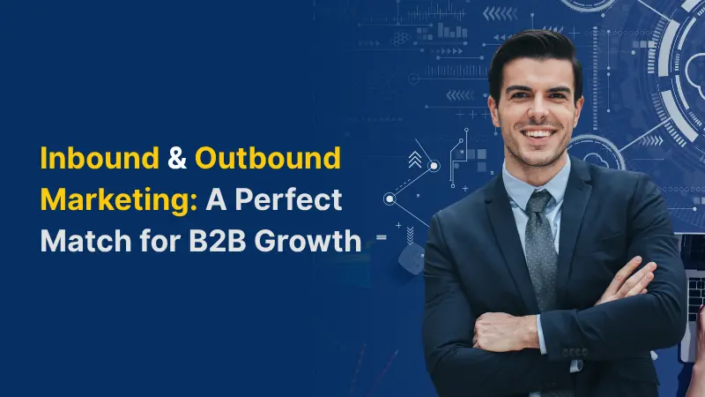






Many marketers try to oversimplify the difference between inbound and outbound marketing, sometimes stating, “Outbound is for those with money, inbound is for those with brains.” Others frame it as permission-based (inbound) vs. interruption-based (outbound).
While there’s some truth in these ideas, this black-and-white thinking overlooks a critical reality for enterprise organizations: both inbound and outbound marketing are essential pillars of a scalable, revenue-driven strategy.
In enterprise B2B, growth doesn’t come from choosing one tactic over another. It comes from integrating both approaches into a unified, account-focused framework.
Wondering how inbound and outbound can work together?
Enterprise Inbound vs. Outbound Marketing: Understanding the Enterprise Context
Let’s define both approaches based on widely accepted industry perspectives.
Inbound Marketing for Enterprises
Inbound marketing for enterprises focuses on attracting high-value accounts by delivering authoritative, problem-solving content across digital channels. Instead of pushing messages, inbound draws decision-makers in through:
- SEO for Enterprise: Optimizing high-value assets (thought leadership, product pages, customer stories) to rank for intent-driven keywords, especially those searched by C-level executives, IT leaders, procurement teams, and evaluators.
- Enterprise Content Marketing: Creating premium resources such as industry reports, ROI calculators, comparison guides, and case studies that educate and influence large buying committees.
- Landing Pages & Enterprise Lead Magnets: High-value gated assets like transformation playbooks, compliance frameworks, or technology benchmarks that capture enterprise-level interest.
Inbound builds brand authority, domain expertise, and long-term demand. It ensures that when target accounts begin researching, your brand is already part of their consideration set.
Inbound not bringing results? Learn how to fix your inbound engine.
Outbound Marketing for Enterprises
Outbound marketing for enterprises involves strategically initiating conversations with stakeholders across target accounts to establish a strong presence. It’s not about random outreach—it’s structured, personalized, and aligned with account-based marketing (ABM).
Enterprise outbound channels include:
- Multithreaded Cold Calls & Email Campaigns: Personalized sequences that target multiple roles (CIOs, CISOs, VPs, Directors, Managers) within a single organization.
- Targeted Paid Ads: Account-targeted display ads and retargeting to influence enterprise buying committees throughout the evaluation process.
- Trade Shows and Events: High-value enterprise engagements that accelerate pipeline, deepen relationships, and push deals toward closure.
Outbound allows enterprise teams to proactively engage accounts that fit their ICP, even if they aren’t actively searching yet.
While outbound marketing often delivers quicker results, inbound marketing focuses on building long-term brand authority. The most effective strategy combines both approaches to create a comprehensive marketing framework.
Discover how to build an outbound lead generation strategy.
Inbound vs. Outbound: Pros and Cons for Enterprise B2B
Understanding the strengths and challenges of each method helps develop a strategy that aligns with business goals.
Inbound Marketing: The Enterprise Advantage
Advantages:
- Attracts highly qualified leads from large organizations already in active problem-solving mode.
- Builds industry authority and positions the brand as a trusted advisor.
- Supports complex internal research stages within buying committees.
Disadvantages:
- It can take longer to generate a pipeline, especially for niche or emerging enterprise solutions.
- Requires high-quality content production and technical SEO to maintain competitiveness.
Related: Benefits of Inbound Lead Generation
Outbound Marketing: Enterprise-Level Impact
Advantages:
- Generating leads quickly makes it ideal for businesses looking for faster sales cycles.
- Drives pipeline velocity by engaging ICP accounts directly.
- Enables personalized outreach at scale using multi-channel enterprise sequences.
- Reaches senior executives who rely less on organic searches and more on curated vendor conversations.
Disadvantages:
- It can be perceived as intrusive if messaging is not tailored to each account.
- Higher costs are associated with paid channels and enterprise-grade prospecting tools.
Rather than treating these approaches as opposing forces, enterprise companies achieve the strongest results by integrating both to build a predictable, scalable revenue engine.
Check out the best outbound marketing agencies for enterprise companies.
How to Combine Enterprise Inbound and Outbound Marketing Strategies
Enterprise buyers expect consistency across every touchpoint. Integrating inbound and outbound marketing strategies can create an all-inclusive approach that leverages the strengths of both methods. Here’s how modern organizations blend inbound and outbound for maximum impact:
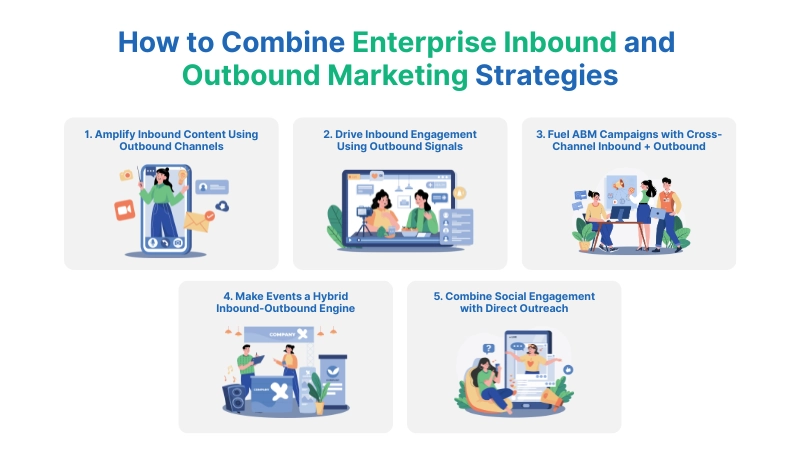
1. Amplify Inbound Content Using Outbound Channels
Share high-value assets such as reports, case studies, frameworks, and benchmarks through outbound emails, LinkedIn outreach, and targeted ads. This accelerates visibility within large accounts that may not naturally discover your content.
Related: 10 Effective Outbound Lead Generation Strategies
2. Drive Inbound Engagement Using Outbound Signals
Use outbound data to shape inbound content strategy:
- What recurring pain points emerge in enterprise conversations?
- Which industries respond best?
- Which decision-makers engage most?
This ensures inbound content aligns with real buying behavior.
3. Fuel ABM Campaigns with Cross-Channel Inbound + Outbound
Leverage ABM programs to:
- Serve personalized content via inbound channels
- Back it with targeted outbound sequences to key stakeholders
- Track engagement signals for prioritization
This aligns with Callbox’s own Smart Engage + ABM execution model, which integrates inbound channels (website, chat, events) and outbound channels (email, voice, social messaging) across full account penetration. Learn more about multichannel marketing.
4. Make Events a Hybrid Inbound-Outbound Engine
Enterprise events, such as virtual or in-person, work best when:
- Inbound warms up interest through content
- Outbound secures registrations and high-value attendance
- Post-event inbound nurturing and outbound follow-up convert interest into SQLs
5. Combine Social Engagement with Direct Outreach
Enterprise marketers strengthen reach by:
- Engaging target accounts publicly on LinkedIn
- Following up with direct outbound messaging
- Supporting both with branded, content-rich assets produced by marketing teams
By blending inbound and outbound marketing strategies, businesses can craft a stronger and more effective marketing framework that maximizes reach and engagement.
Sample Case Studies: Showing the Strategy in Action
Let’s look at some real-world examples of how this combined approach can drive serious growth:
Inbound & Outbound Case Study #1: Business Travel Platform’s Lead Surge
A business travel platform struggling to generate leads combined inbound content marketing with targeted outbound outreach. They reached 386 target contacts, resulting in 180 Marketing Qualified Leads and 189 ebook downloads.
By integrating SEO-driven content with outbound lead nurturing, they doubled whitepaper downloads and significantly increased MQLs. This combined approach accelerated engagement and improved conversion rates, demonstrating the power of synergistic marketing.
Read the full success story about Outbound Campaign Fast-tracks Inbound Results for Business Travel Platform
Inbound & Outbound Case Study #2: IT Leader’s Lead & Deal Breakthrough
A global IT services provider struggling with lead generation and sales processes integrated their inbound marketing with a top lead gen company’s outbound expertise. Within six months, they achieved a significant breakthrough, dramatically improving lead quality and closing more deals.
This strategic alignment, targeting ideal customers with relevant content and personalized outreach, streamlined the sales pipeline and accelerated deal closures, resulting in 214 marketing qualified leads and 156 social media connections.
Learn how Callbox Enhance IT Firm’s Marketing with Lead Gen Integration
Inbound & Outbound Case Study #3: Utility Company’s Customer Service Transformation
A utility company overwhelmed by customer complaints partnered with a lead gen company to revolutionize its support processes. By integrating inbound inquiries with proactive outbound support, they achieved remarkable results.
Representative occupancy soared to 85%, daily case resolution jumped 32%, and average handling time plummeted 27%. This full-service solution enhanced workflows and dramatically improved customer satisfaction.
See how the results happened about Utility Gains Omni-channel Inbound with Callbox
Aligning Inbound and Outbound for Enterprise B2B Growth
At Callbox, we specialize in enterprise outbound lead generation supported by an integrated inbound engine. Our multi-channel Smart Engage platform unifies inbound channels (website, chat, events) with outbound channels (email, calls, social messaging) to align with buying committees and long, complex enterprise sales cycles.
By pairing targeted outbound campaigns with deep content-driven inbound engagement, we help enterprise organizations:
- penetrate high-value accounts
- multithread across buying committees
- nurture long-term relationships
- accelerate pipeline velocity
Success in enterprise markets isn’t about choosing inbound or outbound—it’s about orchestrating both under a unified ABM strategy.