How to Find More IT Consulting Leads
Learn how to find more IT consulting leads by defining your ideal client, reaching decision-makers, nurturing prospects, and building a steadier pipeline.
 Lene Tabucanon
I'm a journalism graduate and content writer at Callbox. My work covers topics related to B2B marketing, lead generation, and sales, with a focus on creating content that's informative, practical, and easy to understand.
View full bio of Lene Tabucanon
To find more IT consulting leads, define your ideal clients, publish useful technical content, connect with decision-makers on LinkedIn, nurture prospects by email, and build referral or outreach partnerships. If delivery work limits prospecting time, a lead generation partner can help keep conversations moving.
Thinking where can you find IT consulting buyers?
Why IT Consulting Lead Generation Is Harder Than It Looks
IT consulting firms often struggle to find time for business development while current projects need attention. Founders and technical leaders may handle sales themselves, making prospecting inconsistent when delivery work increases.
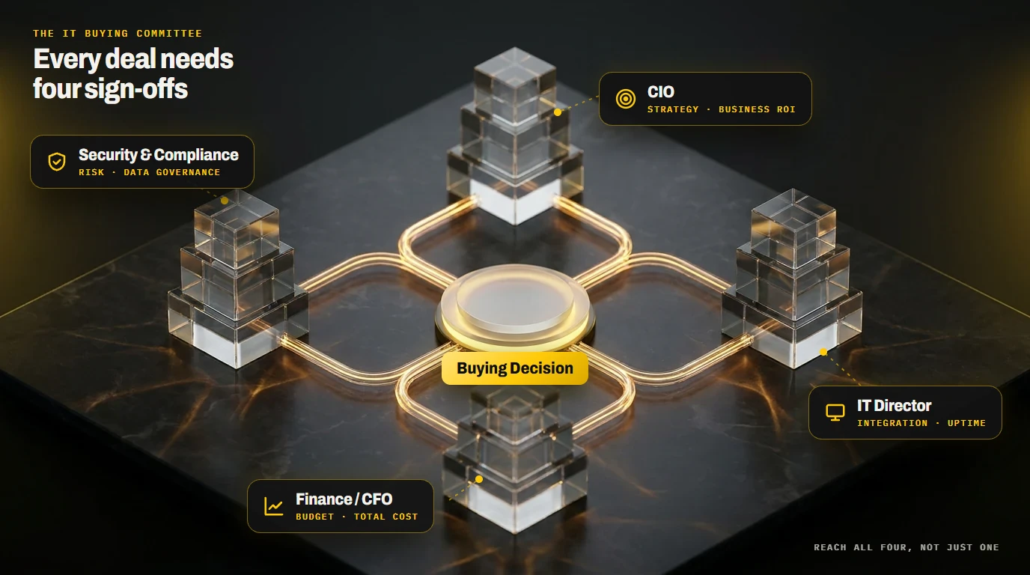
IT purchases involve several stakeholders, technical evaluation, budget approval, security reviews, and competing priorities. CIOs may focus on business risk, IT directors on operations, and finance teams on investment.
Being visible before prospects reach out matters. In its 2026 B2B Buyer Experience Report, 6sense found that North American buyers first engaged sellers about 63% of the way through a 10.6-month buying cycle. About 93% had ordered their shortlist before first contact, and the pre-contact favorite won 84% of the time. These are cross-industry B2B findings, not IT consulting benchmarks.

Outsourced Appointment Setting Fuels IT Consulting Firm’s Expansion
In six months, Callbox helped the Client secure 174 sales appointments and 122 marketing-qualified leads, accelerating market expansion and boosting visibility in the IT consulting space.
View Case StudyDefine Your Ideal IT Consulting Client
Identify the organizations most likely to need your expertise. A clear ideal client profile (ICP) focuses limited sales time on prospects with a relevant need, realistic project, and path to a decision. IT consulting services are easier to position when firms clearly define the industries, company sizes, and technical problems they are equipped to address.
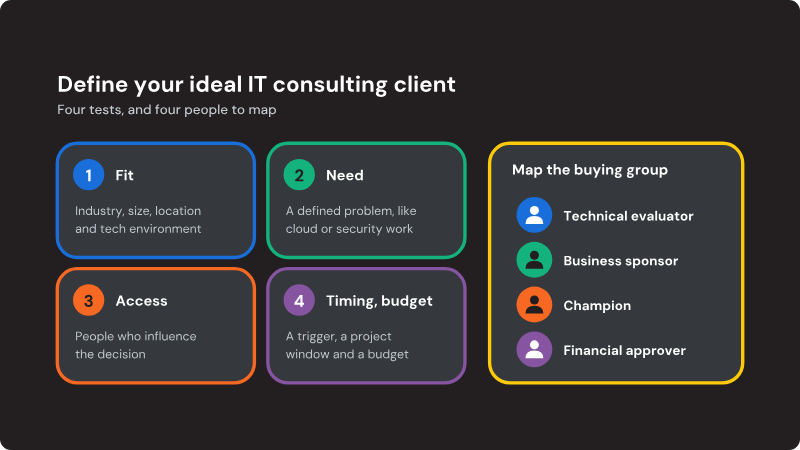
Start with four criteria:
- Fit. Identify the industries, company sizes, locations, and technology environments your team can support. A cloud migration specialist for mid-market manufacturers needs a different prospect list from a healthcare cybersecurity consultant.
- Need. Look for a defined business or technical problem, such as a cloud migration, infrastructure refresh, security assessment, system integration, or modernization project.
- Access. Map the people who influence the decision. Depending on the project, that may include a CIO, CTO, IT director, IT manager, CISO, operations leader, or finance stakeholder.
- Timing and budget. Determine whether there is a buying trigger, a project window, and a budget owner or credible path to funding.
Prioritize observable buying triggers rather than assuming every company needs the same services. New technology leadership, acquisitions, expansion, cloud or security hiring, modernization initiatives, compliance deadlines, and platform end-of-support dates can signal a relevant conversation. Confirm each signal before treating it as buying intent.
Enterprise IT decisions rarely belong to one person. Map the technical evaluator, business sponsor, champion, and financial approver, then tailor messages to each stakeholder’s priorities. A structured appointment setting strategy can help IT consulting firms engage the right decision-makers, qualify buying opportunities, and secure relevant sales conversations.
Five Strategies to Find IT Consulting Leads
Combine inbound, outbound, and relationship-based activities.
1. Use content marketing to prove your expertise early
Useful content helps your firm become familiar as buyers research problems and compare providers. Consistently sharing practical insights also helps position your firm as a knowledgeable tech consulting partner for businesses evaluating technology solutions. It demonstrates that your team understands the technical and operational issues behind a project.
Create resources around services you deliver, such as cloud migration assessments, cybersecurity checklists, infrastructure modernization guides, or cloud cost reviews. Publish project summaries that explain the challenge, scope, approach, and outcomes.
Technical webinars and expert-led sessions extend that content. A session on preparing legacy infrastructure for modernization can attract IT leaders exploring a project but not ready to speak with a provider. Discover webinar and event marketing services show how event promotion and post-event follow-up can be coordinated.
Keep educational content accessible. Across all regions, 6sense found that 35.2% of buyers used their own contact information on forms. Gate substantial resources, such as customized assessments, when their value justifies it.
2. Connect with decision-makers on LinkedIn
LinkedIn helps consultants identify relevant companies, understand buying roles, and build familiarity. Make company and personal profiles clear about the clients you help and the problems you solve.
Use LinkedIn Sales Navigator to build account and lead lists by industry, company size, geography, and job title. Monitor changes, such as a new technology leader joining a target company, to make outreach timely.
Engage before pitching. Comment on CIO and IT director posts with useful insight, share project lessons, and explain relevant technical issues. Personalize connection requests around a business trigger, then follow up with a useful resource or question.
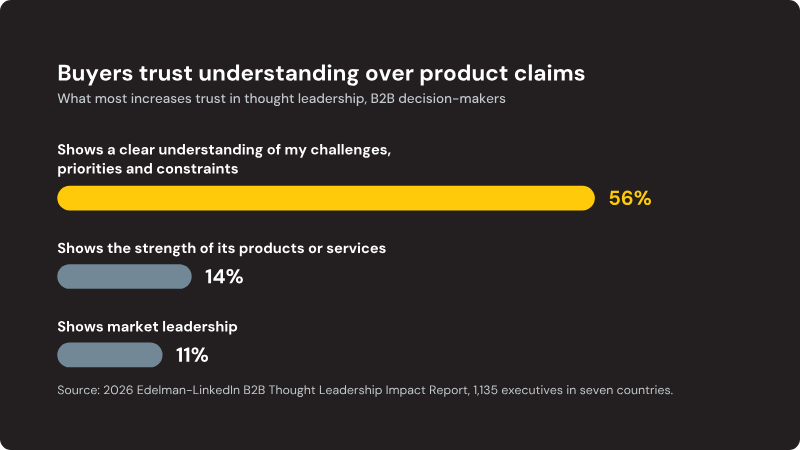
Research can also inform how firms communicate expertise. In the 2026 Edelman-LinkedIn B2B Thought Leadership Impact Report, 56% of surveyed B2B decision-makers said the aspect of thought leadership that most increases their trust in a company is a clear understanding of their challenges, priorities, and constraints. Only 14% chose the strength of its products or services. The study surveyed more than 1,100 executives across seven countries, so treat it as broad B2B evidence rather than a US IT consulting benchmark. For outreach, demonstrate an understanding of the buyer’s problem before pitching a solution.
Related: 5 Intent Signals for Better LinkedIn Cold Outreach Strategies
3. Nurture prospects through targeted email
Not every qualified prospect has an active project or approved budget when you first connect. Email nurturing keeps your firm relevant while prospects evaluate options or wait for the right time.
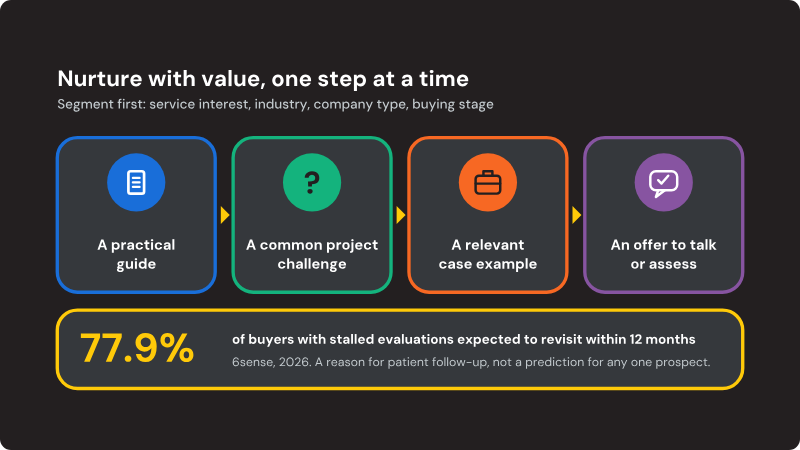
Segment contacts by service interest, industry, company type, and buying stage. A cloud migration prospect needs different information from a company exploring cybersecurity or infrastructure modernization.
Build a sequence that adds value: share a practical guide, explain a common project challenge, provide a relevant case example, then offer a discussion or assessment. Avoid sending every contact the same pitch.
Record why opportunities stall, such as budget timing, missing stakeholder approval, or changing requirements. In its 2026 research, 6sense found that 77.9% of surveyed buyers with stalled evaluations expected to revisit them within 12 months. Treat that as a reason for patient follow-up, not a prediction for any one prospect.
CAN-SPAM applies to B2B commercial email in the US. Use accurate sender information and honest subject lines, identify the message as an advertisement where required, include a valid postal address, and provide a clear opt-out that you honor within 10 business days. If a partner sends email for you, your firm is still responsible for compliance.
4. Outsource lead generation and appointment setting when needed
Outsourcing may help when technical specialists are fully booked, no one owns prospecting, or the firm is entering a new market without the capacity to reach unfamiliar accounts.
A partner may handle account research, contact verification, multichannel outreach, qualification, and appointment setting. Agree on the ICP, target roles, qualification criteria, reporting, and what counts as a completed appointment.
ABM can support this work when you have a defined list of high-value companies. Map each buying group, identify business triggers, and coordinate relevant touches across email, phone, LinkedIn, and useful content.
IT lead generation services combine account targeting, multichannel outreach, lead nurturing, and appointment setting to help technology companies connect with qualified prospects. Evaluate potential partners based on industry fit, transparency, qualification standards, and the quality of sales conversations delivered. Outsourcing requires an investment, but the right partner can extend your sales capacity without compromising your offer or existing sales process.
5. Build referrals and strategic partnerships
Ask satisfied clients for introductions at appropriate milestones, such as after a successful deployment or assessment. Describe the type of organization and project that make a strong fit so clients know whom to introduce.
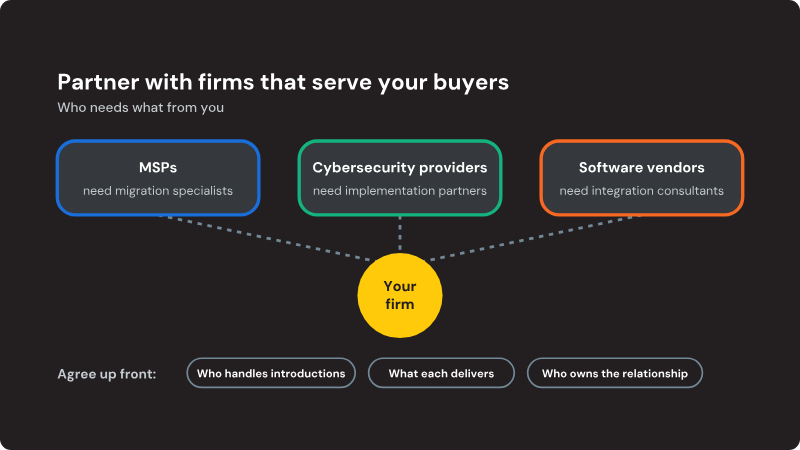
Partner with businesses serving the same customers. MSPs may need migration specialists, cybersecurity providers may need implementation partners, and software vendors may need consultants for integration.
Agree on how introductions will be handled, what each partner can deliver, and who manages the client relationship.
Tools That Support the Process
Choose tools based on firm size, sales complexity, and management needs.
- CRM: HubSpot, Salesforce, or Microsoft Dynamics 365 can help organize company records, contacts, opportunities, follow-up tasks, and reasons deals have stalled.
- Prospecting: LinkedIn Sales Navigator can help identify relevant accounts and decision-makers, save lead lists, and monitor account or contact updates.
- Email marketing: HubSpot Marketing Hub, Salesforce Marketing Cloud Account Engagement, or Adobe Marketo Engage can support segmented campaigns and nurture workflows.
- Scheduling: Calendly, Chili Piper, or HubSpot Meetings can make it easier for qualified prospects to book a discovery call.
- Analytics: Google Analytics 4 and Google Search Console can help evaluate website engagement, organic search visibility, and the content that attracts relevant visitors.
- Content and webinars: WordPress and webinar platforms such as Zoom Webinars can support publishing, registration, and educational sessions.
A small consultancy may need a CRM, prospecting workflow, and scheduler before complex automation.
How to Measure Your Lead Generation Performance
Measure whether your activities create qualified conversations and sales opportunities. Review a small set of metrics by channel, service line, and target segment.
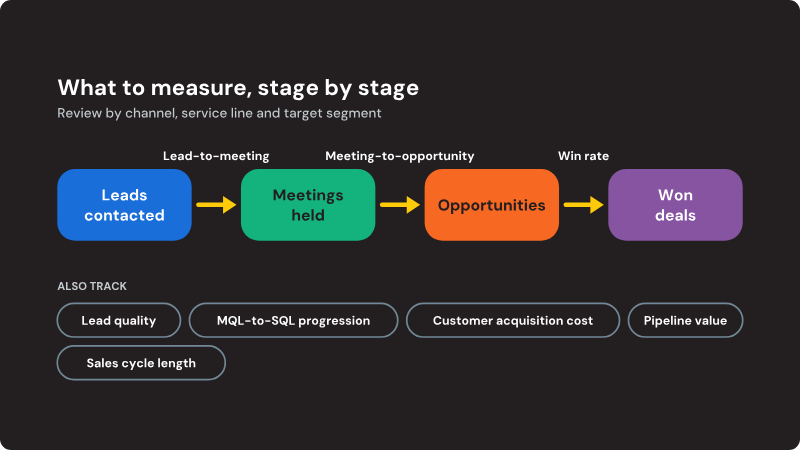
An MQL fits your target profile and shows meaningful engagement. An SQL has a confirmed need, access to a decision-maker or champion, and a plausible timeline. Budget, authority, need, and timing offer a useful qualification check.
- Lead quality: Track the share of new leads that match your ideal client profile and have a relevant business or technical need.
- Lead-to-meeting rate: Compare the number of meetings held with the number of leads contacted.
- MQL-to-SQL progression: Monitor how many marketing-qualified leads become sales-qualified leads.
- Meeting-to-opportunity rate: Measure how many completed discovery meetings turn into legitimate sales opportunities.
- Customer acquisition cost (CAC): Compare sales and marketing costs with the number of new clients acquired over the same period.
- Pipeline value and win rate: Track the value of open opportunities and the share of won deals among all closed opportunities.
- Sales cycle length: Measure the time from the first meaningful sales conversation to a signed agreement.
Smaller firms should watch meetings held, win rate, acquisition cost, and sales cycle length. Enterprise-focused firms should also monitor buying-group engagement, pipeline value, stage conversion, and stalled opportunities. Learn how B2B prospecting tools help generate qualified sales meetings and measure the effectiveness of your prospecting efforts.
Build a Consistent Pipeline for Your IT Consulting Firm
A consistent pipeline starts with a repeatable process, not occasional prospecting between projects. Define your client profile, share expertise that helps buyers evaluate technical challenges, build relationships with relevant decision-makers, and follow up as priorities develop.
Review the quality of conversations and adjust targeting when opportunities do not progress. If your team needs help with research, multichannel outreach, qualification, or appointment setting, explore Callbox’s IT lead generation services and discuss a program for your market.
Frequently Asked Questions
How do I generate leads for my IT consulting business?
Define the companies and technical problems that fit your expertise. Publish useful content, connect with decision-makers on LinkedIn, nurture prospects by email, and build referral partnerships. Outsource when your team cannot prospect consistently.
How long does it take to see results from IT consulting lead generation?
Results depend on the channel, project value, and buying process. Referrals and focused outreach may create conversations sooner, while content takes longer to compound. 6sense reported a 10.6-month average North American B2B buying cycle in its 2026 study of qualifying purchases. It is a cross-industry average, not an IT consulting timeline.
Should I handle lead generation myself or outsource it?
In-house lead generation works when someone owns research, outreach, and follow-up. Outsourcing may help when consultants are busy delivering projects or the firm is entering a new market. Compare costs, qualification standards, transparency, and appointment quality.
How do I know if a lead is qualified?
A qualified lead fits your target profile, has a specific business or technical need, and includes access to someone who can influence the decision. A realistic timeline and funded or fundable project strengthen qualification.
Are referrals enough to grow an IT consulting firm?
Referrals can be valuable but may be difficult to scale predictably. Ask satisfied clients for introductions and build partnerships with complementary providers. Support referrals with content that helps prospects evaluate your expertise.
What content attracts clients to IT consulting firms?
Create content that addresses a buyer’s problem, such as cloud migration assessments, cybersecurity checklists, infrastructure modernization guides, technical webinars, and project summaries. Focus on services your team can deliver.