How to Choose a B2B Lead Generation Agency: 15-Point Evaluation Guide
Discover 15 essential factors to consider when choosing a B2B lead generation agency, including experience, strategy, technology, pricing, and results.
 Judy Caroll
Marketing Executive at Callboxinc.com | Blogger | Online Marketer
View full bio of Judy Caroll
Outsourcing your pipeline growth is one of the highest-stakes decisions a marketing or sales leader can make. Partner with the right B2B lead generation agency, and you instantly unlock a predictable stream of qualified pipeline, scale your account reach, and reduce your overall customer acquisition cost (CAC).
Partner with the wrong one, however, and the consequences hit fast: wasted quarterly ad spend, damaged sender domain reputation, and a frustrated sales team overwhelmed by unqualified meeting no-shows.
The challenge isn’t a lack of options—it is a crowded marketplace where almost every agency promises the exact same outcome: “guaranteed sales-ready appointments.” Distinguishing high-performing sales development partners from transactional list-brokers requires looking beyond slick sales decks and scrutinizing their actual operational engine.
Whether you are looking to replace an underperforming incumbent agency or deciding whether to build an internal SDR team from scratch, this comprehensive 15-point evaluation framework will guide your decision. Below, we break down the fundamental trade-offs of in-house vs. agency teams, expose critical vendor red flags, detail standard pricing models, and provide the exact operational questions you must ask before signing a contract.
Looking for a reliable lead generation partner?
In-House vs. Agency Lead Generation: Decision Framework
Before selecting an external partner, revenue leaders must evaluate whether building an internal Sales Development Representative (SDR) team or outsourcing outreach aligns better with their budget, timeline, and long-term growth targets.
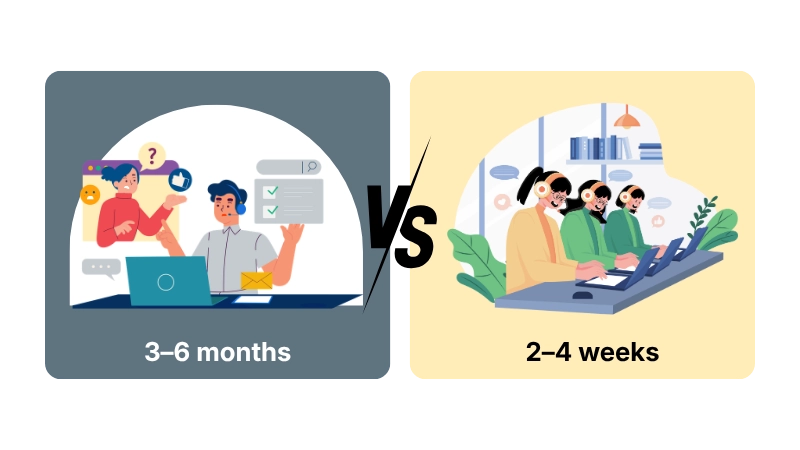
Building an internal team gives you total operational control, but it requires significant capital investment, extensive management overhead, and a 3- to 6-month hiring and ramp period. Partnering with an established agency provides immediate access to pre-built infrastructure, enterprise-grade technology, and trained SDRs capable of executing multi-channel outreach in weeks rather than months.
| Evaluation Metric | In-House Lead Generation | Agency Lead Generation |
| Time to Market | 3–6 Months (Hiring, onboarding, ramp time) | 2–4 Weeks (Pre-built infrastructure & trained teams) |
| Upfront Capital | High (Salaries, benefits, software licenses) | Predictable (Flat monthly retainers or hybrid performance models) |
| Tech Stack Costs | High ($1,500–$3,000+/mo per rep for data & outreach tools) | Included (Leverages existing enterprise-grade tools) |
| Scalability | Slow (Requires repeated hiring and onboarding cycles) | Flexible (Instantly scale rep capacity up or down) |
| Operational Overhead | High (Requires daily sales management & QA) | Managed (Dedicated account managers & team leads) |

Seattle Enterprise Cybersecurity Firm Secured 3 Closed Deals in 4 Months
Callbox helped close 3 deals and successfully executed a 4-month Lead Generation program for an enterprise cybersecurity solutions provider..
View Case Study15-Point Evaluation Framework for B2B Lead Generation Agencies
Use this structured 15-point checklist to evaluate potential lead generation partners across their strategic, operational, and technical capabilities before signing a contract.
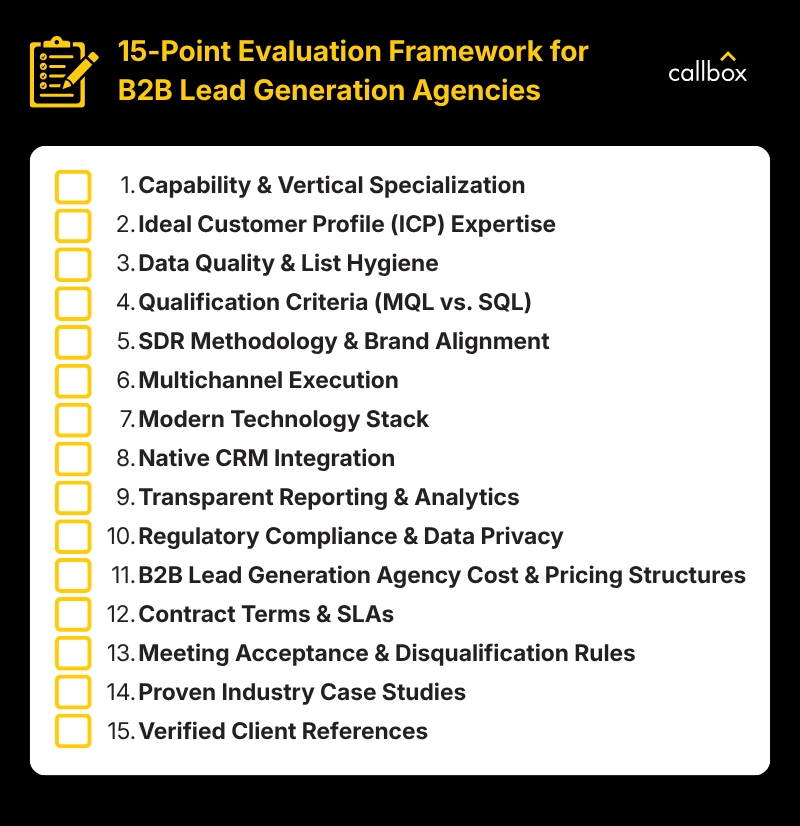
1. Capability & Vertical Specialization
An effective B2B lead generation agency must understand your specific industry nuances, buyer personas, and sales cycle complexity. Assess their market alignment by reviewing their core focus areas:
- Industry expertise: Evaluate their track record within your vertical (e.g., Enterprise SaaS, Healthcare, IT Services, Manufacturing).
- Core methodology: Confirm whether their playbooks lean toward outbound cold outreach, inbound strategy, or Account-Based Marketing (ABM).
- Questions to ask: Do you have dedicated playbooks and active campaigns running in our exact industry niche?
 Takeaway: Avoid agencies claiming equal expertise across every market—look for specialized vertical experience with proven playbooks.
Related: Why Callbox Is Chosen as a Top Lead Generation Company
2. Ideal Customer Profile (ICP) Expertise
A successful outbound campaign depends on precise targeting rather than high-volume spray-and-pray tactics. Ensure the vendor can translate your value proposition into clear targeting parameters:
- Firmographic filters: Company revenue thresholds, headcount, geographic footprint, and industry sub-sectors.
- Technographic matching: Specific hardware, software, or cloud infrastructure requirements used by target accounts.
- Intent data triggers: Signal-based targeting such as funding rounds, leadership hires, or active product research.
Takeaway: Choose a partner that builds dynamic, signal-driven lists tailored strictly to your specific ICP rather than selling static contact directories.
Check out how to turn your prospects into sales-qualified opportunities.
3. Data Quality & List Hygiene
Outbound campaign performance hinges on contact accuracy, as bad contact data damages sender reputation and wastes valuable rep time. Inspect the agency’s data management processes against these standards:
- Verification protocols: Multi-step email scrubbing and direct-dial phone verification before outreach begins.
- Database updates: Real-time list enrichment rather than relying on stale, static contact databases.
- Questions to ask: What is your guaranteed email deliverability rate, and how do you handle invalid contact data?
Takeaway: Prioritize partners that back their data with a clear deliverability guarantee (typically 95% or higher) and real-time verification.
Related: Best Outbound Lead Generation Companies
4. Qualification Criteria (MQL vs. SQL)
Unclear definitions of what constitutes a “qualified lead” cause friction between sales teams and external vendors. Ensure your agency uses recognized qualification frameworks to vet prospects:
- Framework alignment: Use established vetting criteria such as BANT (Budget, Authority, Need, Timeline) or MEDDPICC.
- Discovery parameters: Confirm whether meetings are set with actual decision-makers or lower-level influencers.
- Questions to ask: What specific qualifying questions will SDRs ask before handing off an appointment?
Takeaway: Establish strict, mutually agreed-upon lead acceptance criteria in writing before launching any campaign.
Related: Difference between MQL and SQL
5. SDR Methodology & Brand Alignment
The agency’s Sales Development Representatives (SDRs) act as the front line of your brand, making their communication style crucial. Review their daily operational methodology across all prospect touchpoints:
- Messaging style: Inspect cold calling scripts, email templates, and objection-handling guides for tone and brand alignment.
- Value-first approach: Ensure reps focus on solving prospect pain points rather than delivering aggressive sales pitches.
- Quality assurance: Confirm that managers regularly conduct call reviews and ongoing rep coaching.
Takeaway: Treat the agency’s SDR team as an extension of your company—ensure their communication style mirrors your internal standards.
Related: Best Outsourced SDR Companies
6. Multichannel Execution
Single-channel outreach is rarely sufficient to convert modern B2B buyers who interact across multiple platforms. Look for agencies capable of running coordinated, multi-touch cadences across multiple touchpoints:
- Outreach touchpoints: Integration of cold email, phone/telemarketing, LinkedIn social selling, and direct mail.
- Cadence timing: Strategic spacing of touchpoints to build familiarity without overwhelming prospects.
- Message adaptation: Tailoring messaging naturally to fit the format of each distinct channel.
Takeaway: Select a vendor that coordinates outreach across at least three distinct channels to maximize touchpoint frequency and response rates.
Related: Embracing B2B Multichannel Marketing
7. Modern Technology Stack
A modern agency relies on an enterprise technology stack to scale outreach, protect deliverability, and optimize performance. Verify that their technical infrastructure includes these core categories:
- Sales engagement tools: Platforms that automate personalized email sequencing and call task workflows.
- Deliverability protection: Automated domain warming, inbox rotation, and SPF/DKIM/DMARC management tools.
- Conversation intelligence: AI-driven call recording and speech analytics platforms to monitor call quality.
Takeaway: Ensure the agency's tech stack is included in their base fees rather than passed along as surprise software licensing surcharges.
8. Native CRM Integration
Seamless data sync between systems eliminates manual data entry, prevents lead leakage, and maintains clean reporting. Evaluate how easily their workflow integrates with your internal stack:
- Bi-directional syncing: Real-time updates for contact status, call notes, meeting dates, and activity logs.
- Supported platforms: Native integration capabilities with systems like Salesforce, HubSpot, Zoho, or Microsoft Dynamics.
- Questions to ask: How do you sync campaign data into our CRM, and how are duplicate contacts prevented?
Takeaway: Never settle for manual CSV file exports—require automated, bi-directional CRM integration to keep sales pipelines aligned.
9. Transparent Reporting & Analytics
You need consistent visibility into campaign performance metrics to evaluate ROI and optimize tactics. Demand direct access to comprehensive reporting assets:
- Key operational metrics: Real-time visibility into call attempts, email open rates, positive reply rates, and booked meetings.
- Pipeline tracking: Clear line-of-sight from initial outreach activities to held discovery calls and SQL conversions.
- Dashboard access: Live self-serve analytics dashboards alongside regular tactical review meetings.
Takeaway: Insist on live dashboard access rather than relying on periodic static reports to track performance in real time.

10. Regulatory Compliance & Data Privacy
Outbound marketing requires strict adherence to privacy legislation to protect your brand from legal liabilities and steep financial penalties. Ensure the agency enforces rigorous compliance standards:
- Global privacy laws: Full compliance with GDPR, CCPA, CAN-SPAM, and regional Do-Not-Call (DNC) registries.
- Opt-out handling: Automated suppression list management and instant unsubscribing across all communication channels.
- Questions to ask: Can you provide your formal compliance documentation and opt-out processing protocol?
Takeaway: Verify that the vendor carries full legal compliance documentation to protect your organization from regulatory fines and reputational risk.
11. B2B Lead Generation Agency Cost & Pricing Structures
Understanding how fees are structured helps you evaluate financial alignment and predictable budgeting. Agencies typically operate under three primary commercial models:
- Monthly Retainer: A fixed fee ($3,000–$10,000+/month) covering dedicated SDR labor, technology, and data access.
- Hybrid Model: A base management fee ($2,500–$5,000/mo) coupled with a smaller performance bonus per booked SQL.
Takeaway: Hybrid pricing models often offer the best balance of risk-sharing and aligned incentives between client and agency.
Related: Understanding B2B Lead Generation Pricing
12. Contract Terms & SLAs
Contract length and service terms should reflect a partnership focused on accountability and mutual growth. Review initial agreement terms using these guidelines:
- Pilot duration: Initial commitment terms of 3 to 6 months to allow adequate time for campaign ramp-up and testing.
- Service Level Agreements: Clear SLAs detailing expected deliverables, lead quality parameters, and replacement policies.
- Questions to ask: What are your contract cancellation terms if agreed performance metrics are consistently missed?
Takeaway: Avoid rigid 12-month initial commitments—start with a 3- to 6-month pilot agreement tied to clear SLAs.
13. Meeting Acceptance & Disqualification Rules
Even well-targeted campaigns encounter occasional unqualified prospects or missed calls. Guard your investment by establishing formal lead replacement guidelines:
- No-show policy: Automatic replacement or credit for prospects who fail to attend scheduled meetings.
- Out-of-scope criteria: Clear replacement protocols if a lead clearly fails to meet pre-agreed ICP parameters.
- Dispute window: A designated timeframe (e.g., 5 business days post-meeting) to request a lead replacement.
Takeaway: Require an explicit lead replacement policy in your contract to safeguard your budget against unqualified calls and no-shows.
Related: How to Improve B2B Appointment Show Rates
14. Proven Industry Case Studies
An experienced agency should provide clear evidence of their ability to generate pipeline for similar businesses. Analyze their historical performance data through these lenses:
- Relevant client benchmarks: Success metrics from campaigns executed within your industry or target buyer segment.
- Outcome-based metrics: Proven impact on pipeline volume, deal velocity, cost-per-acquisition (CPA), and overall ROI.
- Campaign scope: Evidence of managing campaigns of similar scale and complexity to yours.
Takeaway: Look for case studies that highlight revenue impact and pipeline growth rather than vanity metrics like open rates.
15. Verified Client References
Speaking directly with current or former clients provides candid insight into what working with the agency is actually like. Gather real feedback by focusing your conversations on key operational areas:
- Communication & agility: How responsive the account management team is when adjustments are needed.
- SDR stability: Rep retention rates on the account and overall quality of daily execution.
- Pipeline impact: How well converted meetings performed once handed off to internal account executives.
Takeaway: Always speak with at least two active references in your vertical to validate the agency's performance claims.
Lead Generation Agency Red Flags Checklist
Identifying operational warning signs early in the evaluation process prevents costly hiring mistakes. Walk away from vendors exhibiting these core red flags:
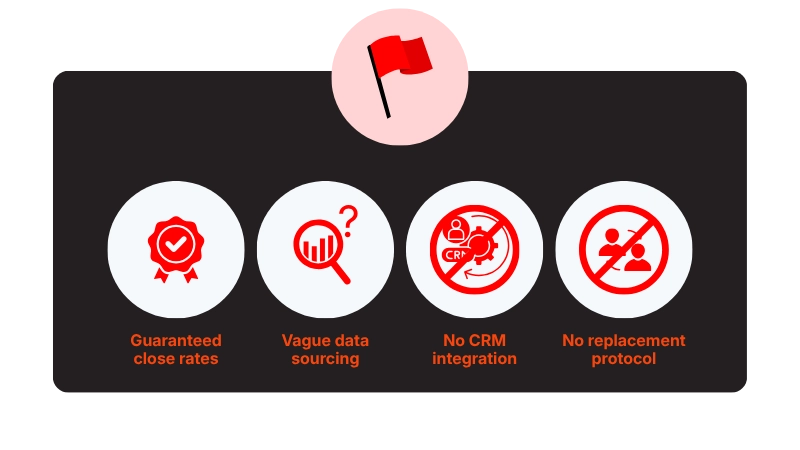
1. Guaranteed Conversion or Close Rates: Unrealistic revenue commitments.
Agencies control campaign inputs—such as data accuracy, touchpoint volume, and meeting setting quality. They cannot control your internal sales team’s closing ability. Any agency promising guaranteed closed-won revenue is using deceptive marketing.
2. Vague or Unverified Data Sourcing: Opaque data management.
Refusing to explain where contact data, direct dials, and work email addresses are sourced and verified. Operating with unverified lists leads to severe spam complaints and domain blacklisting.
3. No CRM Integration Options: Manual operational handoffs.
Relying exclusively on weekly spreadsheets or CSV email attachments rather than automated CRM syncing. This creates data silos, causes delayed follow-ups, and leads to unmapped pipeline tracking.
4. Absence of Lead Replacement Protocols: Lack of financial accountability.
Unwillingness to provide credits or replacement meetings for prospects who fail to attend scheduled calls or clearly fall outside agreed-upon ICP parameters.
Frequently Asked Questions (FAQ)
How long does it take for a lead generation agency to deliver results?
Most campaigns require 30 days for technical setup, domain warming, prospect list building, and messaging customization. Qualified appointments typically begin booking consistently during weeks 4 through 6.
What critical questions should I ask a lead generation agency on a discovery call?
Key questions include:
- How do you source, scrub, and verify your prospect data in real time?
- What is your formal policy for handling meeting no-shows or unqualified prospects?
- Do you offer native, bi-directional integration with our CRM platform?
- How do you ensure strict compliance with GDPR, CCPA, and regional telemarketing regulations?