How to Increase Lead Quality Effectively
Struggling with low-quality leads? Explore these 5 proven methods to attract, nurture, and convert the right prospects.
 Contributor
From time to time, we are glad to feature content contribution from sales and marketing experts around the world.
View full bio of Contributor
Let’s be real here. No matter what your industry is, you know that not all prospects are worth pursuing. Some are a perfect match, ready to dive into what you offer, while others? Well, they’re just tire-kickers.
The problem? 79% of marketing leads never convert to sales, and only 27% of B2B leads generated by marketing are ever contacted by sales; the rest are lost to follow-up failures or data quality issues. That’s a massive amount of wasted pipeline spend.
So, how do you cut through the noise and focus on leads that actually matter?
It’s time to stop chasing every prospect and start zeroing in on better leads—the ones that truly move the needle for your business. The big question is, how do you get more of them? Let’s break it down and explore how to improve lead quality in a way that works for you.
What is Lead Quality
Lead quality refers to how likely a lead is to convert into a paying customer or generate substantial revenue for your business. It’s a crucial metric for optimizing sales efforts and marketing ROI.
High-quality leads align with your target audience, show clear interest in your offerings, and have the potential for substantial revenue. By understanding what constitutes a quality lead, you can better allocate resources and improve your sales funnel’s efficiency.
How to Measure Lead Quality
Lead quality is typically assessed through criteria such as:
- Behavioral Indicators: Actions like downloading content, visiting pricing pages, or engaging with your emails.
- Demographics or Firmographics: Alignment with your ideal customer profile (ICP), such as job title, industry, or company size.
- Engagement Levels: Frequency of interactions with your website or sales team.
- Revenue Potential: The financial value a lead might bring if converted.
To make this process easier, businesses often use lead scoring methods, like the B.A.N.T. framework (Budget, Authority, Need, and Timeline) or advanced CRM integrations, to evaluate and rank leads systematically.
Key Lead Quality Benchmarks to Know in 2026
Before diving into strategy, it helps to know where the industry stands:
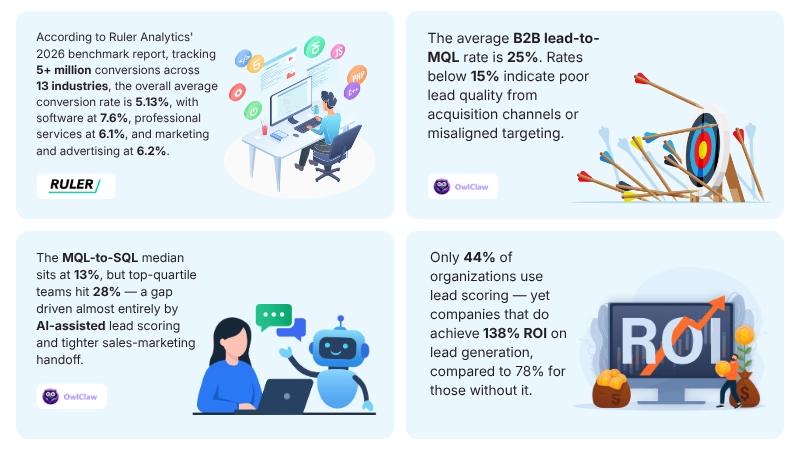
- According to Ruler Analytics’ 2026 benchmark report, tracking 5+ million conversions across 13 industries, the overall average conversion rate is 5.13%, with software at 7.6%, professional services at 6.1%, and marketing and advertising at 6.2%.
- The average B2B lead-to-MQL rate is 25%. Rates below 15% indicate poor lead quality from acquisition channels or misaligned targeting.
- The MQL-to-SQL median sits at 13%, but top-quartile teams hit 28% — a gap driven almost entirely by AI-assisted lead scoring and tighter sales-marketing handoff.
- Only 44% of organizations use lead scoring — yet companies that do achieve 138% ROI on lead generation, compared to 78% for those without it.
These numbers reveal one clear truth: improving lead quality, not lead volume, is where the biggest gains are hiding.
9 Strategies to Increase Lead Quality
- Clearly Define What a Quality Lead Is
- Identify and Optimize Lead Sources
- Revamp Your Lead Forms
- Use Data to Fine-Tune Your Targeting
- Align Your Sales and Marketing Teams
- Implement Lead Scoring
- Leverage Technology to Your Advantage
- Respond Fast
- Measure, Adjust, Repeat
1. Define Exactly What a Quality Lead Looks Like

Before you can start improving, you need to answer a crucial question: What is a quality lead for your business?
Start by aligning your sales and marketing teams around a shared definition. Look at demographics, firmographics, behavioral signals, and engagement metrics together. Ask: does a quality lead need a specific job title or budget range? Are they engaging with high-value content like product demos or pricing pages? Aligning on these criteria ensures everyone’s focused on converting the right people.
For example, does a quality lead need a specific job title or budget? Are they engaging with high-value content on your website, like product demos or pricing pages? Aligning on these criteria ensures everyone’s focused on converting the right people.
Not sure where to begin? Look at historical data. Analyze previous leads that successfully converted into paying customers and identify commonalities. This can include factors like company size, industry, or even their engagement with specific marketing campaigns. By establishing a clear definition, you set the foundation for improving lead quality across the board.
2. Focus on Where Your Best Leads Are Coming From
Not all lead sources deliver equal quality. Paid search leads all channels at a 5.4% average conversion rate, followed closely by organic search and email at 4.9% each, and referral at 4.8%.
Use tools like Google Analytics or your CRM to track lead quality by source, that way you’ll know how to measure lead quality. If LinkedIn ads bring in high-quality leads but generic web traffic doesn’t, you know where to focus your energy.
A common mistake? Casting too wide of a net. By narrowing your focus to channels that drive the best results, you can stop wasting time and money on leads that will never convert.
In addition, don’t overlook referrals either. Referrals bring in 20% of total B2B leads, and about 89% of buyers trust personal recommendations over ads. A structured referral program with your existing clients is one of the most cost-effective ways to generate a steady stream of high-intent prospects.
3. Revamp Your Lead Forms

Here’s a quick way to instantly weed out low-quality leads: add more fields to your forms. Yes, this might scare off tire-kickers—and that’s exactly the point. Ask questions that only serious buyers would take the time to answer, like their job title, company size, or project timeline.
 Pro Tip: “Use conditional logic to show follow-up questions based on initial responses. It’s an easy way to dig deeper without overwhelming potential leads.”
Remember, lead forms aren’t just about filtering; they’re also an opportunity to understand your audience better. Incorporate questions that reveal pain points or challenges they’re facing. This data can inform your sales pitch and marketing strategies, ensuring you’re speaking directly to their needs.
4. Use Data to Fine-Tune Your Targeting

When it comes to targeting, precision beats volume every time. Platforms like Google Ads or LinkedIn offer advanced options to focus on high-intent audiences. But don’t just rely on automated suggestions—manually refine your targeting based on historical performance.
For example:
- Use lookalike audiences to find prospects similar to your best-converting customers
- Apply negative keywords to exclude low-value search segments
- Layer behavioral intent data to prioritize accounts showing active buying signals
A notable 2026 development: AI search referral traffic from tools like ChatGPT, Perplexity, and Gemini now converts at roughly 3.49%, about 22% higher than traditional organic, because AI pre-qualifies users before surfacing the link. This is a small but fast-growing share of traffic worth optimizing for now.
The more precisely you can match your outreach to buyer intent, the higher your lead-to-opportunity rate climbs.
5. Align Your Sales and Marketing Teams

Misalignment between sales and marketing is one of the biggest barriers to improving lead quality. Companies with shared definitions of “qualified” close at 2–3x the rate of those without alignment.
If marketing is bringing in leads that sales don’t prioritize, you’ve got a disconnect.
Fix it with these steps:
- Hold regular marketing meetings where both teams review lead quality and conversion rates together
- Create a shared feedback loop so marketing can adjust campaigns based on real sales intelligence
- Develop a unified lead scoring system so every lead is evaluated consistently across both teams
When sales and marketing operate from the same playbook, you stop arguing about MQL counts and start optimizing for revenue.
Are you ready to outsource your lead generation?
6. Implement Lead Scoring and Make It Smarter
Lead scoring is no longer optional for B2B teams serious about quality. When leads are properly scored and qualified before reaching sales, your team stops wasting time on prospects that were never going to close — and starts focusing energy where it actually converts.
In 2026, AI-powered scoring has become the key differentiator between median and top-performing demand-gen teams. It’s the primary driver of the widening conversion gap between teams that treat all leads equally and those that don’t. The logic is simple: better scoring means better routing, faster follow-up on the right leads, and less pipeline noise for your sales team to wade through.
A practical scoring model to start with:
- Assign a firmographic letter grade (A–D) based on ICP fit: industry, company size, revenue, and tech stack
- Layer in a numeric intent score (0–300) based on engagement signals: page visits, content downloads, email interactions, pricing page views
- Route “A220” leads to same-day sales follow-up; send “C80” leads into automated nurture sequences
Clean data comes first, though. A sophisticated scoring model running on inaccurate contact data will consistently underperform a simple model running on verified, enriched data.
7. Leverage Technology to Your Advantage

In today’s digital age, technology can be your best ally in improving lead quality. Tools like AI-powered lead scoring and predictive analytics can help you identify high-potential leads faster. By automating these processes, you free up your team to focus on closing deals instead of chasing unqualified prospects.
But the most important, and most overlooked, foundation is data quality. Over 40% of B2B leads contain wrong or incomplete data, and 60–70% are never contacted by sales. No amount of technology fixes a fundamentally broken data pipeline.
The right order of operations:
- Verify and enrich your contact data before every campaign
- Integrate your CRM with your marketing automation platform to track behavior in real time
- Use AI lead scoring to prioritize high-potential accounts
- Automate follow-up sequences personalized to lead segment and buying stage
Discover Callbox Human + AI-Powered Lead Generation.
8. Respond Fast
This one is often overlooked but it’s backed by hard data. Responding within 60 seconds can boost conversions by 391%, while the odds of qualifying a lead drop by 80% after the first 5 minutes. Yet the average B2B response time is 42–47 hours, with 55% of companies taking 5+ days, or never responding at all.
You see, 78% of B2B buyers choose the first vendor to respond.
Speed doesn’t just affect whether you reach a lead, it signals to the prospect that your team is responsive and capable. Set up real-time lead alerts in your CRM, automate an immediate acknowledgment email, and establish a same-day follow-up SLA for high-scoring leads.
9. Measure, Adjust, Repeat
Improving lead quality isn’t a one-and-done task—it’s an ongoing process. That’s why it’s essential to learn how to measure lead quality effectively. Use KPIs like lead-to-customer conversion rates, ROI by source, and lead engagement metrics to see what’s working.
Not seeing the results you want? Tweak your strategies. Maybe your targeting needs refinement, or your lead scoring criteria are too broad. Continuous improvement is the secret sauce for better leads over time.
Dive deeper into your analytics to uncover trends. Are certain industries converting at higher rates? Do leads from specific campaigns tend to close faster? Use these insights to refine your approach and double down on what’s working.
Ready to Level Up Your Leads?
No matter your industry, focusing on how to improve lead quality will help you attract more of the right prospects and fewer of the time-wasters. By defining your ideal lead, refining your sources, and aligning your teams, you’ll see real results—both in conversions and revenue.
So, stop chasing leads that go nowhere. It’s time to build a lead generation strategy that delivers the high-quality leads your business deserves.