SaaS Marketing Trends You Need to Watch in 2026
Uncover 2025's top B2B SaaS marketing trends and learn how to future-proof your sales and growth strategy in a fast-evolving SaaS market.

The B2B SaaS landscape is evolving faster than ever. As businesses continue to digitize operations and adopt cloud-based solutions, competition is getting fiercer. To stay ahead in 2026, you’ll need to refine your B2B SaaS marketing strategy and align it with the emerging trends redefining how companies attract, convert, and retain customers.
This year’s SaaS marketing trends highlight the growing role of AI-powered personalization, data-driven storytelling, community-led growth, and outcome-based marketing models. Whether you’re a marketing leader, product manager, or startup founder, understanding these shifts will help you future-proof your growth strategy and gain a real competitive edge.
From predictive analytics to customer-centric ecosystems, here are the top B2B SaaS marketing trends for 2026, and how you can use them to scale sustainably.
Looking for the best SDR agency to consistently book qualified SaaS demos?
1. Predictive Personalization and the Next Phase of AI Marketing
AI is becoming the backbone of B2B SaaS marketing in 2026, with predictive intelligence taking personalization to a new level. Beyond simple segmentation, predictive AI analyzes behavior, purchase intent, and engagement patterns to anticipate what each account or user needs next.
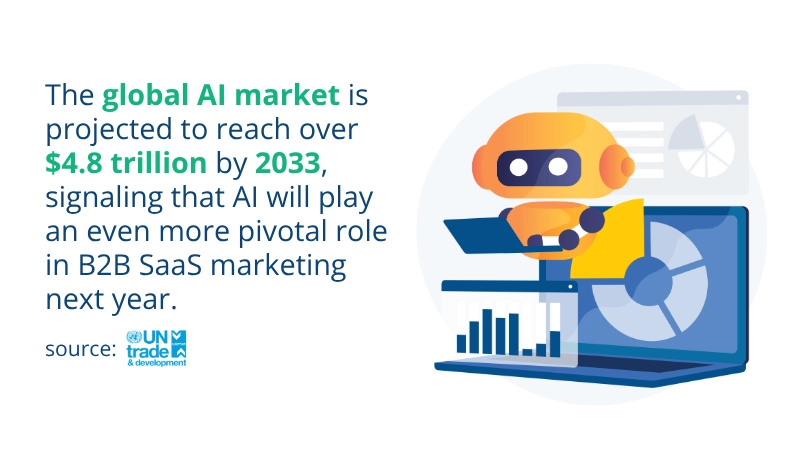
Source: UNCTAD
In 2026, the next phase of AI will center on predictive personalization using data and behavior insights to anticipate customer intent before it’s expressed. Marketers will move beyond static campaigns to AI-driven adaptive experiences. Expect marketing tools that deliver personalized experiences in real time across multiple touchpoints, from website interactions to email nurture sequences.
Pro Tip: Incorporate AI analytics into your CRM and marketing stack to predict churn, upsell opportunities, and content preferences before they occur.
Related: AI for Successful Marketing
2. From Product-Led to Experience-Led Growth
While Product-Led Growth (PLG) remains core, Experience-Led Growth (XLG) is emerging as the defining B2B SaaS marketing strategy for 2026. Buyers are seeking value beyond features. They want frictionless onboarding, proactive support, and intuitive interfaces that enhance productivity.
In 2025, an estimated 80% of B2B SaaS sales will take place online, making digital-first experience optimization essential. Project management tools are also predicted to be used by 50% of organizations by 2026 to centralize SaaS operations, further driving the need for integrated, user-friendly ecosystems.
Best Practice: Audit your user experience from the first website visit to renewal. Map pain points and use marketing automation to enhance satisfaction at every stage.
Fuel your B2B SaaS growth with proven lead generation.
3. Ecosystem Marketing: Winning Through Partnerships and Integrations
B2B SaaS brands are moving away from isolated product marketing and embracing ecosystem storytelling. Growth will increasingly depend on how well your software integrates with other tools, platforms, and partners.
Instead of competing, smart SaaS companies are co-marketing with complementary solutions. This amplifies reach while demonstrating interoperability. This ecosystem-based marketing enhances customer trust and reduces friction during the buying process.
Actionable Step: Build integration landing pages, joint webinars, and shared marketplace listings to position your product within a larger tech ecosystem.
Discover the Top SaaS Lead Generation Companies that will help you.
4. Video-Centric Marketing and the Rise of Short-Form Education
Visual storytelling remains one of the most powerful B2B SaaS marketing tools.
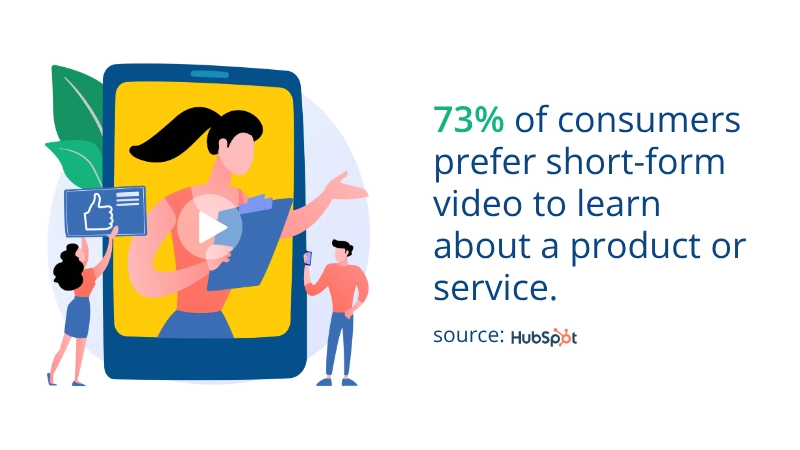
Source: HubSpot
73% of consumers prefer short-form videos to discover new products or services, making video a non-negotiable for SaaS brands targeting time-strapped buyers.
B2B SaaS video content will shift toward quick educational bursts, micro demos, AI tutorials, and customer stories under 60 seconds. These assets will dominate social channels like LinkedIn, YouTube Shorts, and even emerging B2B video communities.
Smart Move: Turn every product update or success story into a visual asset. Use short-form video to drive awareness, and long-form case studies to deepen engagement.
5. Value-as-a-Service (VaaS): Marketing Measurable Outcomes
SaaS buyers won’t settle for feature comparisons. They want evidence of ROI. Value-as-a-Service (VaaS) transforms marketing from promoting functionality to proving tangible business outcomes.
By positioning success metrics as part of your offering, such as revenue impact, time savings, or customer growth, you move from a software vendor to a strategic partner.
Growth Hack: Convert customer data into anonymized insights for marketing content. Case studies showing “3x faster deployment” or “40% cost savings” speak louder than any product sheet.
6. The Rise of Low-Code Marketing Automation
As no-code and low-code technologies mature, marketers are now empowered to build and automate without relying heavily on developers. By 2025, the use of low-code or no-code platforms will triple, enabling smaller SaaS marketing teams to execute sophisticated workflows quickly.
This democratization of MarTech will fuel agility in B2B SaaS campaigns, allowing faster testing, personalization, and optimization cycles.
Pro Tip: Adopt a hybrid automation model where technical and non-technical teams co-create workflows using low-code CRM, email, and analytics tools.
Related: Ways to Automate Your Sales Operation with AI
7. Community-Driven Trust and Peer-Led Advocacy
In an age of buyer skepticism, community is the new conversion engine. B2B SaaS companies are shifting from transactional marketing to relationship ecosystems—building digital spaces where users learn, share, and advocate.
Community engagement will influence 40%+ of SaaS buying decisions, as buyers increasingly rely on peers, forums, and micro-influencers over sales reps.
Smart Move: Foster user communities through Slack groups, LinkedIn communities, or branded events where users can exchange insights and experiences.
8. Full-Funnel ABM and Intent-Oriented Campaigns
Account-Based Marketing (ABM) continues to evolve, but 2026 will see the rise of full-funnel ABM, powered by buyer intent data and multichannel orchestration.
Marketers will use AI to map decision committees, trigger multi-channel campaigns, and align sales and customer success around a single account journey.
Winning Strategy: Use intent monitoring tools to detect buying signals early. Follow up with personalized outreach across email, social, and retargeting ads.
Related: Top Full-Funnel Marketing Agencies
9. Data Privacy, Transparency, and Trust Marketing.
With increased regulation and security concerns, trust-first messaging will become central to B2B SaaS marketing. Transparency around data usage, compliance, and ethical AI practices will be key differentiators in a crowded space.
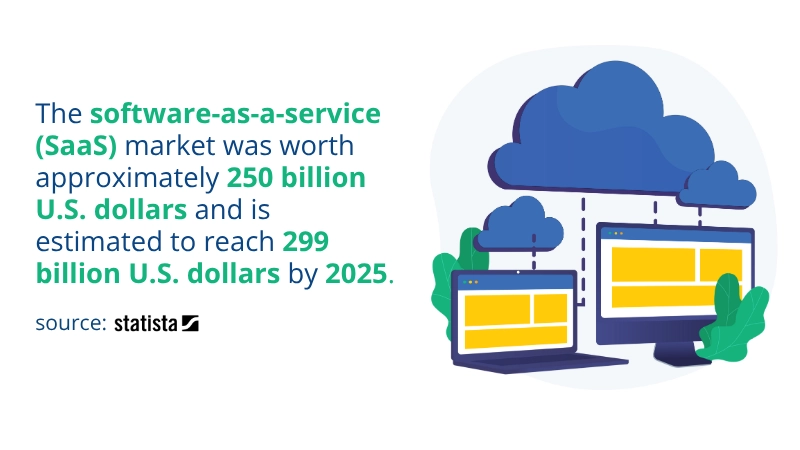
Source: Statista
By 2025, the US SaaS market is estimated to reach $299 billion, mainly driven by enterprise buyers who now prioritize vendors that demonstrate integrity and accountability.
Smart Move: Incorporate trust signals—certifications, compliance badges, and open-data policies—into your brand communications and website experience.
10. Humanized AI Content and Co-Created Storytelling
AI-generated content will remain central to SaaS marketing, but it will increasingly focus on humanizing it. B2B buyers crave authenticity and expertise, and brands that blend AI efficiency with human insight will lead the pack.
In B2B SaaS marketing, the winning formula is “AI + human voice.” Use AI for research, structure, and personalization, but let industry experts or customers bring credibility and empathy.
Content Tip: Co-create blogs, videos, or webinars with clients, partners, and influencers using an auto-caption generator to build authenticity and expand reach.
11. Lifecycle Revenue Optimization
In 2026, marketing won’t end at acquisition. B2B SaaS marketers will be equally accountable for customer success, renewals, and expansions.
This shift toward lifecycle revenue means marketing, sales, and customer success teams must work together to nurture accounts post-conversion.
Strategy: Deploy AI-driven lead nurturing and retention workflows that personalize upsell and cross-sell campaigns based on product usage data and renewal likelihood.
12. Outcome-Driven Metrics and ROI Accountability
As budgets tighten, B2B SaaS marketing in 2026 will prioritize measurable impact. Vanity metrics like clicks and impressions will take a backseat to outcome-driven KPIs such as customer lifetime value (CLV), pipeline velocity, and ROI per campaign.
Winning SaaS teams will use data dashboards to tie every campaign to revenue performance.
Pro Tip: Align marketing metrics with sales outcomes and report shared success indicators like deal influence, conversion acceleration, and retention uplift.
Related: 13 Marketing Challenges and Solutions
13. Sustainable and Ethical Growth Marketing
Sustainability is making its way into SaaS. B2B SaaS marketing will emphasize ethical growth, social responsibility, and sustainable business models.
Buyers—especially enterprise accounts—will favor brands that demonstrate responsible data use, eco-friendly operations, and inclusive policies.
Future-Ready Move: Highlight ESG initiatives in your brand narrative. Ethical marketing doesn’t just attract customers—it earns loyalty.
Final Thoughts
The SaaS industry is evolving rapidly, and keeping up with these trends is essential to staying competitive. Whether it’s refining your SaaS growth strategy, leveraging AI, or focusing on customer retention, small yet strategic adjustments can drive big results.